All posts by GretchenJoanna

Unknown's avatar

About GretchenJoanna

Orthodox Christian, widowed in 2015; mother, grandmother. Love to read, garden, cook, write letters and a hundred other home-making activities.

Monkeys in the Forest

Rudyard Kipling turned me against monkeys long ago, when I was reading The Jungle Book to the children. As I recall, all the other animals of the jungle despised the monkeys for being foolish and emptyheaded chatterboxes. Add to that the rumors (as I’ve never known a monkey firsthand) that they are in real life dirty and infested with vermin, and the result was my assignment of them somewhere around the level of cockroaches.

Perhaps 15 years ago I took one of the first of the quizzes that have since become ubiquitous on the Internet. This one had you rate animals according to how much you liked them, and at the end you were told in turn something about your character or personality. I think it was based on some Oriental tradition and valuation. My results came back with the assessment that I disliked children. Oh, I’m sure there were some other points to my identity, probably equally misread, but all I remember is my horror at being so unfairly pegged in regard to that one aspect, I who was joyfully homeschooling my several children and praying for more. I figured out eventually that it was the dismissive attitude toward monkeys that did me in.
You know how children behave like little monkeys much of the time? I guess I never thought of mine as resembling monkeys, but if I had, I’d still think that educating them, training them to be grown-ups with good manners and character, would transform them from monkeys into human beings.

In my last post I shared “A Psalm of the Forest” with you, with its descriptions of trees and monkeys honoring and delighting in the Lord with whatever gifts and personality they have. In the scene described, the monkeys can’t be considered foolish, as they are giving glory to their Lord. The fool says in his heart that there is no God, and lives as though he were the center of everything. But the monkeys of this forest are all consumed with excitement over God. They are more like innocent and lively children who have no fear of offending Him.

My heart is softened nowadays toward monkeys, not that I think of them very much. I think the change was happening even before I discovered these lines from Paton, but he in his forest psalm has helped by reminding me how much every creature plays a part in bringing praise to the Creator.

We have the redwoods that amazed Alan Paton growing in our backyard, and have often camped near where he wrote these lines. The same feeling of awe and reverence has come over us in these forests, but nothing so playful and raucous as in the scene he describes. I love the fig tree, the waterfalls, the leaves showering down on their Maker, and the monkeys standing in for all of us children of our Father.

A Psalm of the Forest


Alan Paton wrote Cry, The Beloved Country in about 1947. He hadn’t been planning to write a book when he went on a world tour visiting reformatories, but in Norway his heart was full and he started what became a whole novel before he returned to South Africa after his sabbatical.

A few years later he found himself again in California, where the last words of Cry had been set down, and this time he was supposed to be working on a second novel, staying in a cabin alone under and among the towering redwoods, when he wrote this modern psalm. I hope I can write more about it later, but I can’t wait to share the poem itself with you and tell you that it is one more thing that endears me to this man. I will let him introduce it as he does in Journey Continued, which is the second volume of his autobiography:

“…It is called ‘A Psalm of the Forest,’ the forest being that of Lane’s Flat, but the actual trees of the poem, and the monkeys that played in them, being imported from Africa.”

A Psalm of the Forest

By Alan Paton

I have seen my Lord in the forest, He goes from tree to tree laying His hands upon them.

The yellowwoods stand upright and proud that He comes amongst them, the chestnut throws down blooms at His feet.

The thorns withdraw their branches before Him, they will not again be used shamefully against Him.

The wild fig makes a shade for Him, and no more denies Him.

The monkeys chatter and skip about in the branches, they peer at Him from behind their fingers,

They shower Him with berries and fruits, they shade the owls from their hiding places,

They stir the whole forest, they screw up their faces,

They say to each other unceasingly, It is the Lord.

The mothers cuff their children, and elder brothers the younger,

But they jump from tree to tree before Him, they bring down the leaves like rain,

Nothing can bring them to order, they are excited to see the Lord.

And the winds move in the upper branches, they dash them like cymbals together,

They gather from all the four corners, and the waterfalls shout and thunder,

The whole forest is filled with roaring, with an acknowledgement, an exaltation.

New Words

During my convalescence after very minor surgery, I have been reading a lot, and using the dictionary, and reveling in words. I can’t take long to write about all my fun discoveries, but one new-to-me word came up in two very different books, within the week: faience.

Rosemary Sutcliff used it in Mark of the Horse Lord in describing a Pictish pendant hanging from a warrior’s neck. And M.F.K. Fisher used it in Long Ago in France to describe mustard pots she knew in Dijon in the 1930’s. I found a photo of a French mustard pot to show here, and one explanation more helpful than the basic dictionary one: “Majolica, delft, and faience are really names for similar ceramic products. An earthenware body is covered with an opaque enameled glaze, usually colorfully decorated.”

I wonder if this one I found online is anything like what Mary Frances saw.

Stay tuned for more word findings!

Lebanese Spice

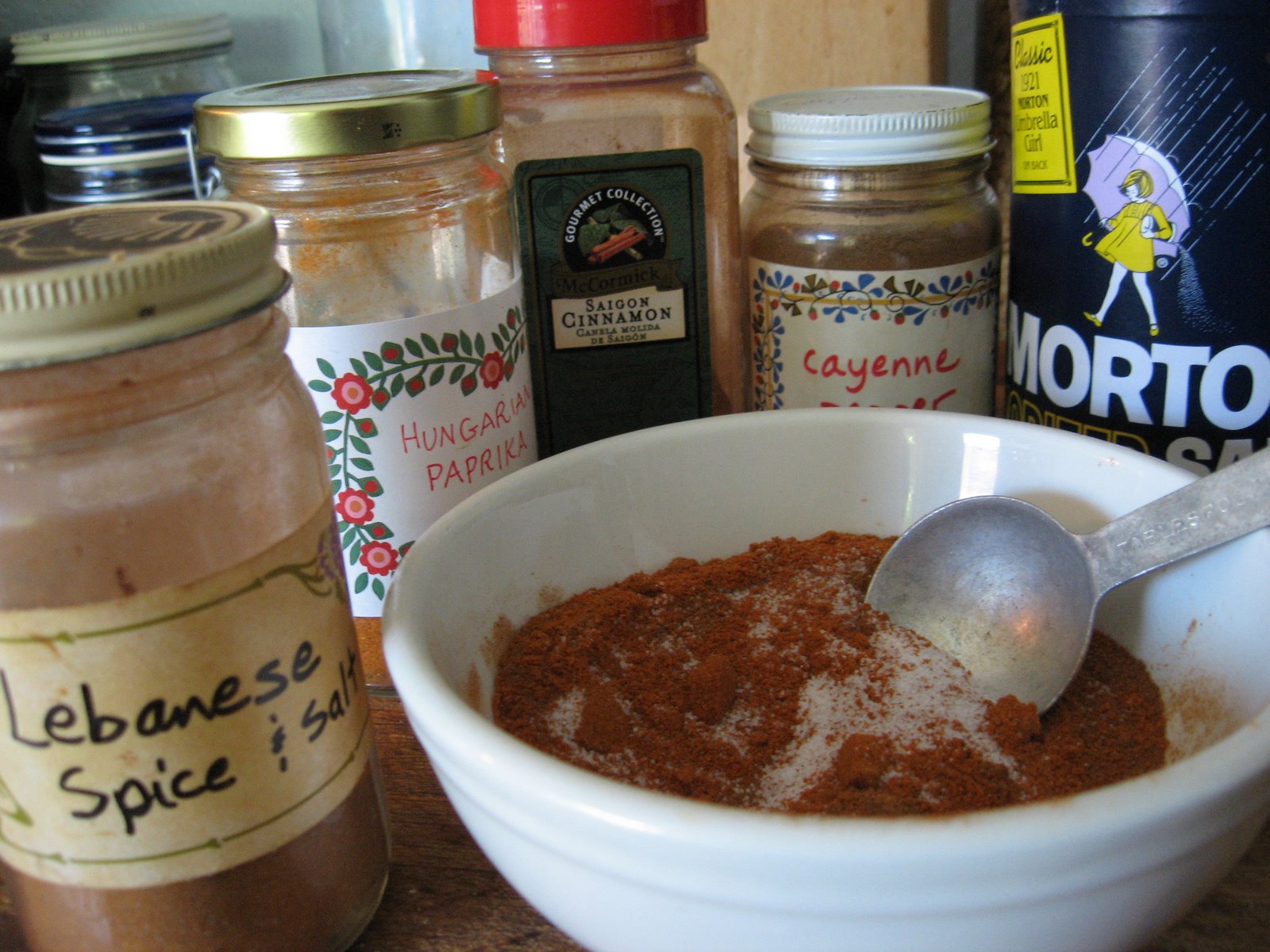
This week I’m not able to spend much time here at the computer, but I don’t want you to think I disappeared, so I’ll just share with you a favorite staple recipe I like to keep on hand.

I have been using this combination of spices and salt for decades. It did come from an authentic Lebanese cook, perhaps via Sunset Magazine. My adaptation is lower in salt and cayenne pepper than the original. You can tweak the proportions to suit your own taste.

Typically it is used to flavor ground beef or lamb; the suggestion was to add 2 teaspoons to one pound of meat. I’ve used it in stews as well. I love that little bit of cinnamon surprise.

Combine the following, mix well, and store at room temperature in your spice cupboard:
3 tsp each cinnamon and paprika
2 tsp salt
1/2 tsp cayenne pepper