This is my little town, My Bethlehem, And here, if anywhere, My Christ Child Will be born.
I must begin To go about my day– Sweep out the inn, Get fresh hay for the manger And be sure To leave my heart ajar In case there may be travelers From afar.
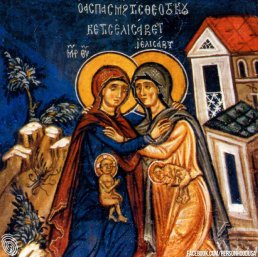
Today is the Sunday of the Forefathers of Christ, His ancestors according to the flesh. We remember these who lived “before the Law and under the Law,” especially the Patriarch Abraham, to whom God said, “In thy seed shall all of the nations of the earth be blessed” (Gen. 12:3, 22:18).
I brought an icon of the Prophet David to stand up on the table in my church school class, and we talked about David as a shepherd boy, his killing of a lion who was threatening the sheep, his composing songs, and his anointing by the Prophet Samuel. (But first, we must chat about St. Nicholas and Santa, because he was strongly on the minds of the four- and five-year-olds.)
When I took the icon out of my bag again at home, I set it up downstairs, and lit a candle to help me keep remembering for the remainder of today. Maybe I will leave it here through next Sunday, when we remember more of these saints; the next church school lesson will focus on the Hebrew Children in the Fiery Furnace.
One thing I didn’t discuss with the children, but would be fun to teach older students about, is the Tree of Jesse, a visual depiction of the genealogy of Jesus Christ. Jesse was the father of King David; his roots extend down and back to his own forefathers including Abraham, the Father of the Faithful; and Jesse was himself the root, or progenitor, of David’s line, which culminated in Christ the Messiah.
Jesse Tree icons must necessarily include so much information, they somewhat overwhelm me. When looking at them I tend to concentrate on Jesse himself, lying at the base of the tree, with its trunk growing out his very body.
Stained glass windows portraying the Jesse tree, which abound in Britain, are also a bit much for me to take in. Often they are in tall cathedrals and extend up a whole wall, the figures distant and their names unreadable. As I was looking at some online I was happy to find Val Stevens talking about the Jesse Window at Wells Cathedral, which I no doubt saw when I visited there with daughter Pippin, but I don’t remember.
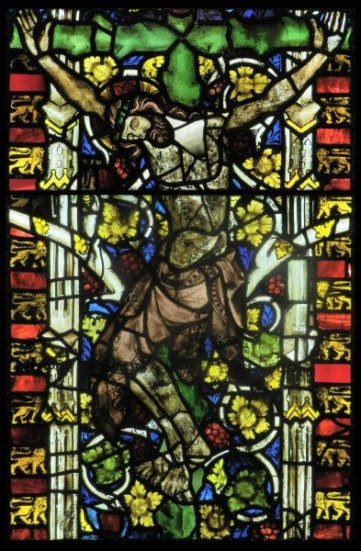
It’s a very short video (which ends with a request for contributions which are no longer needed, because the repairs have been completed), and she speaks for only two minutes, but she made me laugh with joy when she began to speak about the rare crucifixion scene that is in that window, which dates from the 14th century. The stem turns green, and takes the form of a cross, on which the Savior hangs. When she got to the part about the meaning of the green wood, or what it meant to the medieval mind, my heart leapt to hear it, and to see the change in her body language as she moved from purely artistic ideas, to the more compelling realities of the heart: Jesse Window of Wells Cathedral
Ansgar Holmberg
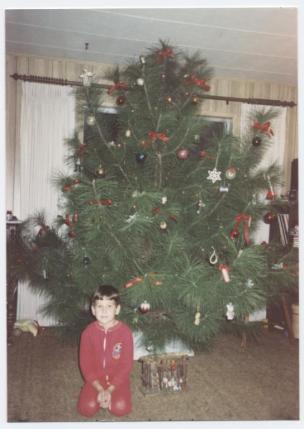
Also I want to share a quote I have posted before, more than once, because it pulls together several of these images, metaphors, and real people in our salvation history, in our cultural tradition. This is about a different sort of tree, the more familiar and ubiquitous Christmas tree! From Metropolitan Hierotheos Vlachos:
“I suspect that the custom of decorating a tree at Christmas time is not simply a custom which came to us from the West and which we should replace with other more Orthodox customs. To be sure, I have not gone into the history of the Christmas tree and where it originated, but I think that it is connected with the Christmas feast and its true meaning.
“First, it is not unrelated to the prophecy of the Prophet Isaiah: ‘There shall come forth a Rod from the stem of Jesse, and a Branch shall grow out of his roots’ (Is. 11:1). St. Cosmas the poet had this prophecy in mind when he wrote of Christ as the blossom which rose up out of the Virgin stem from the stump of Jesse. The root is Jesse, David’s father, the rod is King David, the flower which came from the root and the rod is Theotokos. And the fruit which came forth from the flower of the Panagia is Christ. Holy Scripture presents this wonderfully.
“Thus the Christmas tree can remind us of the genealogical tree of Christ as Man, the love of God, but also the successive purifications of the Forefathers of Christ. At the top is the star which is the God-Man (Theanthropos) Christ. Then, the Christmas tree reminds us of the tree of knowledge as well as the tree of life, but especially the latter. It underlines clearly the truth that Christ is the tree of life and that we cannot live or fulfill the purpose of our existence unless we taste of this tree, ‘the producer of life.’
“Christmas cannot be conceived without Holy Communion. And of course as for Holy Communion it is not possible to partake of deification in Christ without having conquered the devil, when we found ourselves faced with temptation relative to the tree of the knowledge of good and evil, where our freedom is tried. We rejoice and celebrate, because ‘the tree of life blossomed from the Virgin in the cave’.”
-Excerpt from: “The Feasts of the Lord: An Introduction to the 12 Feasts and Orthodox Christology” by Metropolitan of Nafpatkos Hierotheos Vlachos – November 1993.
I’ve known families who used a Jesse Tree along with their Advent wreath as helps in Advent. But oh, my, out of curiosity I just looked at some current Pinterest-era examples, and had to abort that browsing quick; it was plenty for a Sunday afternoon to look at stained glass windows.
My daughters and I have been sharing memories this month, from our homes scattered across the country; posting photos of past and current Christmas trees, reminiscing about Christmas caroling, and recalling their father’s voice and his Christmas joy. This year I will have neither a Jesse nor a Christmas tree, but I feel rich with history and symbols and family. There’s my earthly family, and there is the heavenly family into which I’ve been adopted by the Father. Today I’m especially grateful for all those patriarchs and prophets who have gone before and who encourage me by their lives of faith.
By faith You justified the Forefathers, when through them You betrothed Yourself beforehand to the Church of the Gentiles. The saints boast in glory, that from their seed there is a glorious fruit: she who bore You without seed. By their prayers, O Christ God, save our souls.
We Orthodox Christians begin our Advent, our Nativity Fast, in November, because our Advent is 40 days long. So whether we celebrate Christmas on December 25th or January 7th, we’re ahead of western Advent. My parish is of the December 25th, and today was our first day of the fast.
It was the coldest day yet in my garden, and my fountain had a layer of ice on it. The water level was also a bit low so I poured a few pitchers of tepid water in there, and pulled redwood needles out of the filter to get it going again. Then I spent the rest of the morning at church, baking Communion bread with other women. With three ovens going at once, we got the kitchen quite toasty!
I drove straight from there to pick up my friend Mother S. who is in town visiting family for Thanksgiving. She loves the beach, so we drove out to Jenner-by-the-Sea, where the Russian River flows into the Pacific. I took very few pictures this time, but it was a perfect day, not a cloud in the sky, 60 degrees and sunny! We parked in the lot down near the beach, after taking pictures from this spot on a hill, from which you can see where the river comes in. I squished my bare feet into the sand, but didn’t walk out into the surf.
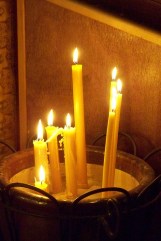
It was a lot of driving, but well worth it. By the time I got Mother S. home again, I barely had time to get to the service I was aiming for, back at church. It was a combination of a Paraklesis for Advent and the Blessing of Water. I had left my phone in the car so I didn’t take pictures of the small church lit only by candles.
I think it was good for me to not have that option of taking pictures, because when I eliminated the role of observer, I could be fully present and participating, not standing apart in my mind, so to speak, distracted by photographic possibilities. I was just being me, in church, praying.
It might have been for that reason that I was able to pay attention and be deeply affected by the prayers and hymns that were specific to this day and these services. They were metaphorically super-rich, and many of them were in the form of exhortations and expressions of wonder from us or from the Virgin, on the subject of the Incarnation. We were giving commands to rejoice, to get ready, to glorify God — to the universe, to the cave, to Zion, even to our mortal nature.
I’ve transcribed a few of the verses below:
O Bethlehem, receive Christ: for, made flesh, he comes to dwell in thee, opening Eden to me. Make ready, O Cave, to behold most strangely contained in thee, him who cannot be contained, who now is made poor in the wealth of his tender mercies.
Christ comes to be born, granting in his goodness a strange rebirth to those sprung from Adam. Be glad, the whole nature of mortal man, thou that art barren and bearest not: the master has come to make thee a mother of many children.
Rejoice exceedingly, O Zion: make ready, O Bethlehem. The Upholder of all things, sending a star before him, has made known his condescension without measure. He before whom the heavenly powers tremble, our only God, without change is born in very truth from the Virgin.
Today the Virgin cometh to the cave to give birth in an ineffable manner to the pre-eternal Word. Rejoice, therefore, O universe, when thou hearest, and glorify with the angels and shepherds him who shall appear by his own will as a new child, the pre-eternal God.
It was a glorious beginning to Advent. I feel that I’ve gotten a boost of expectation that will help keep my heart tuned to the upcoming joyous Feast of the Nativity of Christ.
It was a drippy and drizzly morning when I drove to the post office to ship Christmas presents to a few of my family. I thought there would be a long line, so I gave myself plenty of time, because I wanted to go directly from there to the cemetery in time to pray with a friend at her husband’s interment.
But few people were at the post office, and three workers, so I finished that business and was out the door with time to spare. Before I got my car door open a man with a long and full beard said, “Hi, Gretchen!” but I didn’t recognize him behind his face mask. Actually, I wouldn’t have known him without the face mask, because I hadn’t seen him in six years, and never with such facial hair. I had to ask, “Who are you?” and as soon as he told me his name I gave him a big hug and a kiss. Mike doesn’t live in my town, but the last time we’d met was in the same shopping center, the year in which we both lost our spouses. Back then we weren’t in the talking mood, but this time we stood in front of the post office and caught up for half an hour. He told me that recently he has fallen in love — with the Liturgy of St. John Chrysostom! What a joyous meeting we had.
I had another visit with friends yesterday, for which I made a big pot of chili beans; this afternoon a little tea time with a sister from church when I got back from the cemetery; and last week, a walk with two friends. It’s still fall here, but the colors are all turning to browns and grays, so I was surprised to see this mushroom, the brightest I’ve ever encountered. It was one of several of its kind popping up under bushes.
Some of my family are expected to arrive next week for a nice long Christmas visit. I need to hire a Christmas elf assistant, to help me accomplish all my projects — but that doesn’t sound likely, so I cheerily push one thing after another on to the list of what we can do together, after they arrive.
And for this month, our church women’s reading group has picked a great pair of books: A Christmas Carol by Charles Dickens, and On the Incarnation by St. Athanasius. I am just amazed at us! Last month when Pippin’s family was down for Thanksgiving, the Professor and I were sitting around chatting about church history and doctrine, and he shared with me a paragraph from the first chapter of On the Incarnation. My response was that it was crystalline. That’s probably the first time I ever used that word, which just popped into my mind — that’s what Athanasius will do! And I told the Professor that since I was soon to start reading the book again, I would be sure to post that passage on my blog.
Beginning to read St. Athanasius again has been soothing and encouraging. I got the idea of posting a series of excerpts this month of Advent, when we anticipate The Incarnation. But as I looked over my past blog posts to make sure I didn’t repeat myself too much, I discovered that I have already posted that very paragraph the Professor read to me, plus many more long and short quotes. Maybe I will find something different, but not likely a series.
Tomorrow is the Feast of the Conception of the Theotokos. I’m looking forward to attending Liturgy for the feast. I feel very happy at the moment, thinking about it. The world is full of trouble and strife and unknowns, questions about what governments will do, and what I should do. But for at least many hours of every day, I know what to do, and I do it — one thing after another. My mind gets distracted constantly, but often when I bring it back to here and now, a great gush of joy falls on me, knowing that I am alive.

 Today is the Sunday of the Forefathers of Christ, His ancestors according to the flesh. We remember these who lived “before the Law and under the Law,” especially the Patriarch Abraham, to whom God said, “In thy seed shall all of the nations of the earth be blessed” (Gen. 12:3, 22:18).


 “Christmas cannot be conceived without Holy Communion. And of course as for Holy Communion it is not possible to partake of deification in Christ without having conquered the devil, when we found ourselves faced with temptation relative to the tree of the knowledge of good and evil, where our freedom is tried. We rejoice and celebrate, because ‘the tree of life blossomed from the Virgin in the cave’.”
 We Orthodox Christians begin our Advent, our Nativity Fast, in November, because our Advent is 40 days long. So whether we celebrate Christmas on December 25th or January 7th, we’re ahead of western Advent. My parish is of the December 25th, and today was our first day of the fast.


 I think it was good for me to not have that option of taking pictures, because when I eliminated the role of observer, I could be fully present and participating, not standing apart in my mind, so to speak, distracted by photographic possibilities. I was just being me, in church, praying.
 It was a drippy and drizzly morning when I drove to the post office to ship Christmas presents to a few of my family. I thought there would be a long line, so I gave myself plenty of time, because I wanted to go directly from there to the cemetery in time to pray with a friend at her husband’s interment.
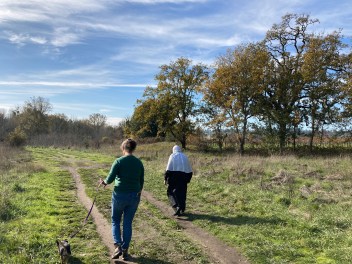
 I had another visit with friends yesterday, for which I made a big pot of chili beans; this afternoon a little tea time with a sister from church when I got back from the cemetery; and last week, a walk with two friends. It’s still fall here, but the colors are all turning to browns and grays, so I was surprised to see this mushroom, the brightest I’ve ever encountered. It was one of several of its kind popping up under bushes.
 Gladsome Lights