Category Archives: architecture

We step down and back.

You can’t walk very far in Thessaloniki without encountering antiquity as more than an idea; the present city layout incorporates reminders of previous communities and cultures, the oldest of which had been buried for thousands of years.
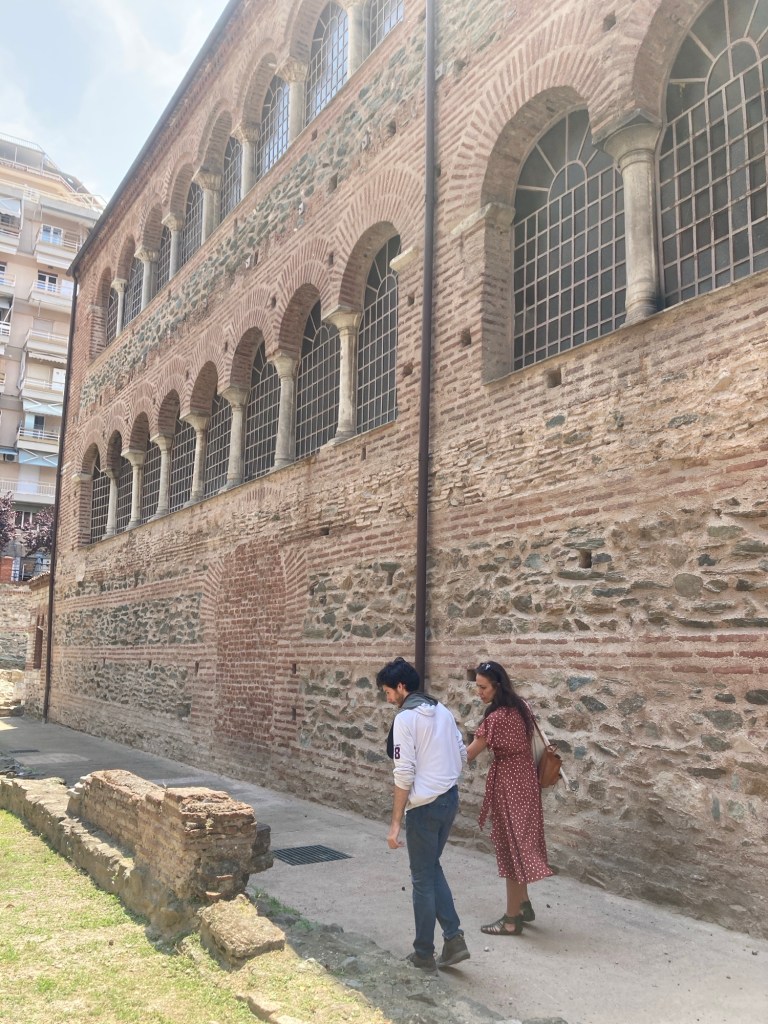
The Church of Panagia Archeiropoietos prompted me to think about this when I visited over the last week.
One has to descend a flight of steps in order to travel back in time to when Byzantine Christians first worshiped here.
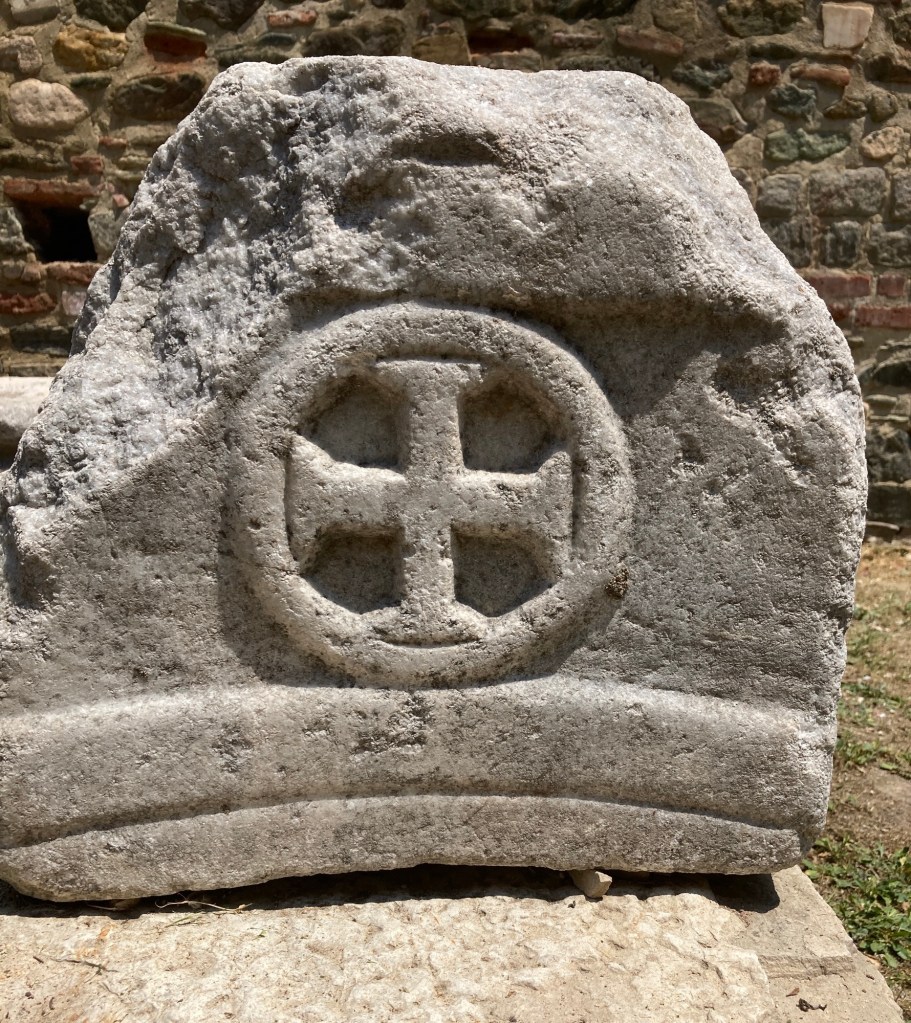
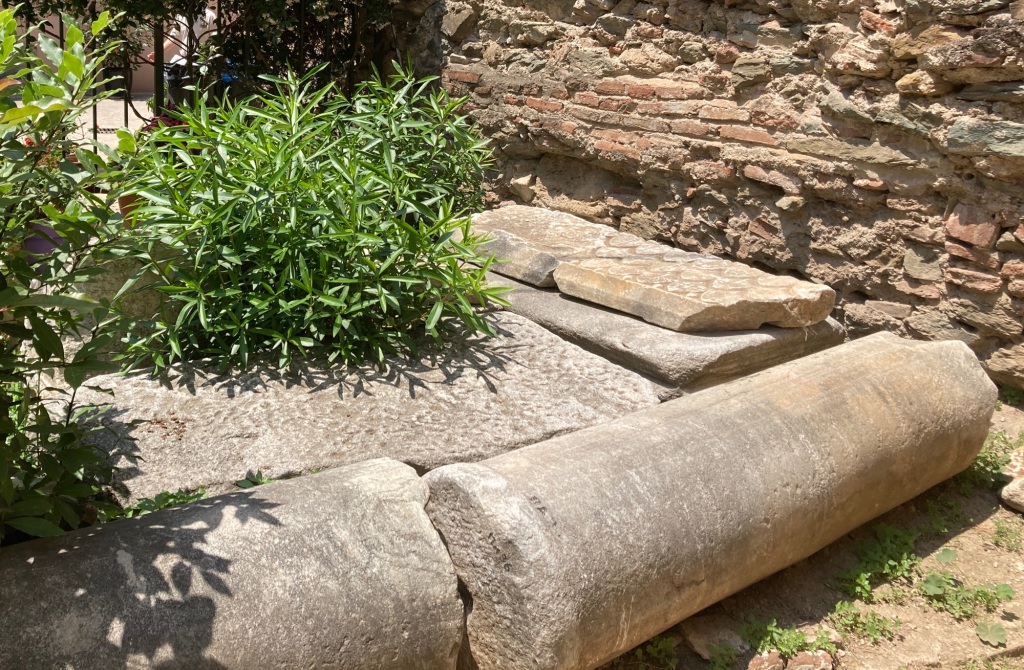
One afternoon my guide Maria and I found a university student at work behind the church, in a gated area where she had never been. The priest had given him two tasks: gardening, and also sorting and organizing stone and marble chunks of the church that had broken during earthquakes. He couldn’t have been more pleased.

“Would you like a piece of antiquity?” he asked me. “We have buckets of it!” And he handed me a few small souvenirs of my favorite type.

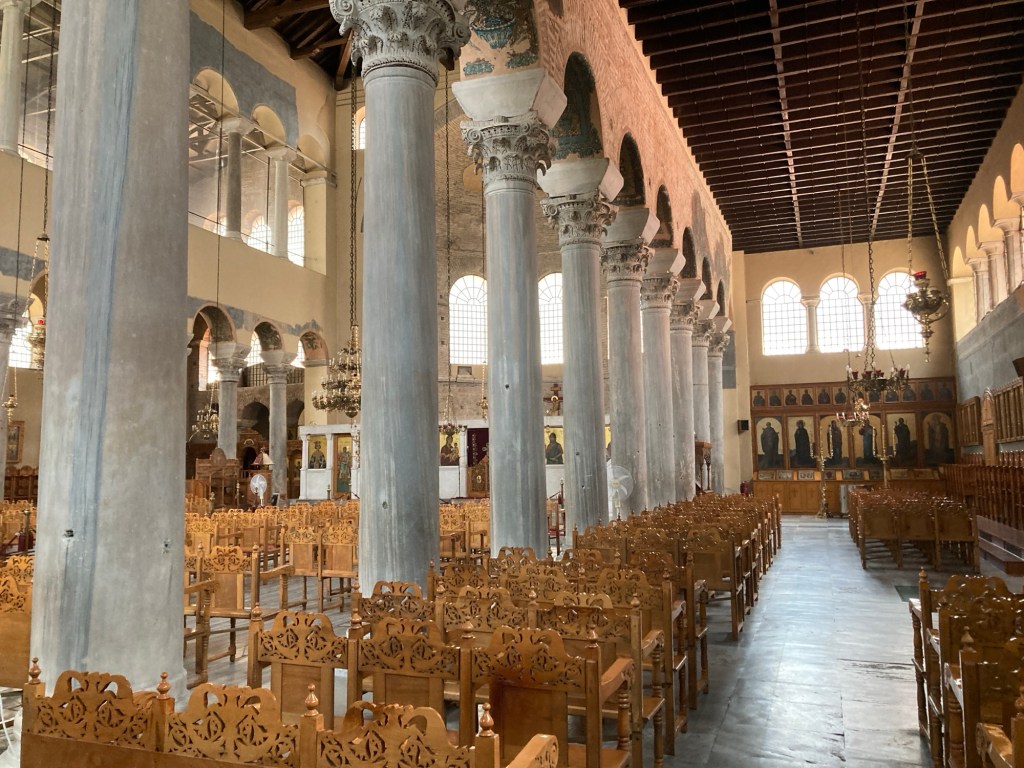
Inside the church, Maria pointed out to me distinctive features of this basilica style temple built in the 5th century.

It was the first church in Thessaloniki to be turned into a mosque when the Ottomans conquered the city in 1430, and Sultan Murad II inscribed his name and the date on a pillar.

Murad II’s insignia

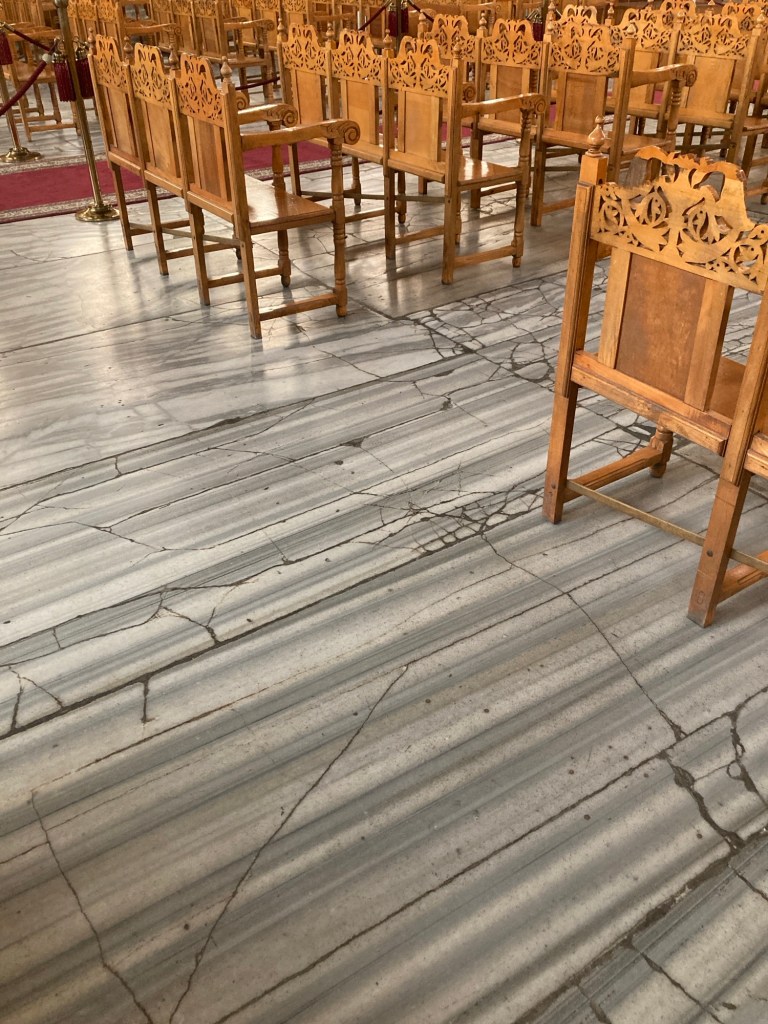
Historians say that the blue-veined marble in the floors and columns of this church was sourced from the island of Proconnesos in the Sea of Marmara. Before the custom of sitting on chairs in church was introduced in the last century, the pattern on the floor imitating rivers would have been more obvious. Near the altar the lines are wavier. The floor is still the most captivating feature of the space for me. How many people have stood, processed, knelt and prostrated on these smooth and cool floors over the centuries?
I joined the ranks of that company this morning, not just to stand but to kneel, because it is Pentecost Sunday, when Orthodox Christians around the world join in three long prayers, in the service of Kneeling Vespers.

The Byzantine Christians built this temple on top of a Roman bath complex. At places in the church see-through panels (easily ignored and walkable for regular parishioners) reveal below, farther down and further back, three previous layers of Roman floor mosaics from that earlier era.

Yesterday I walked a half hour to the northwest corner of what would have been the old walled city. That’s where the Church of the Twelve Apostles is, which I hadn’t seen yet. But I had forgotten some of the things Maria told me about the best time to go, in order to find it open during or just following a service, and it was closed.

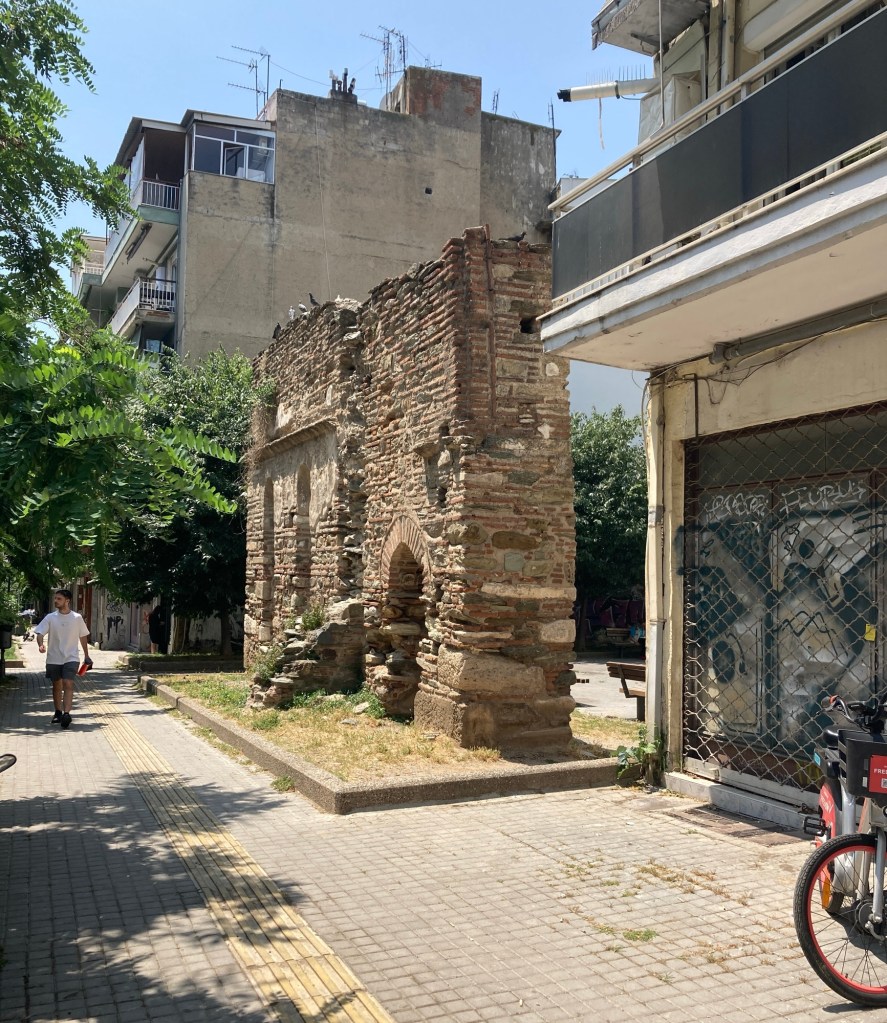
That was okay. I’m pretty much filled to the brim from all of the information and experiences of the last days, and was kind of happy just to have a walk in an area I hadn’t been yet. I came upon one wall portion…
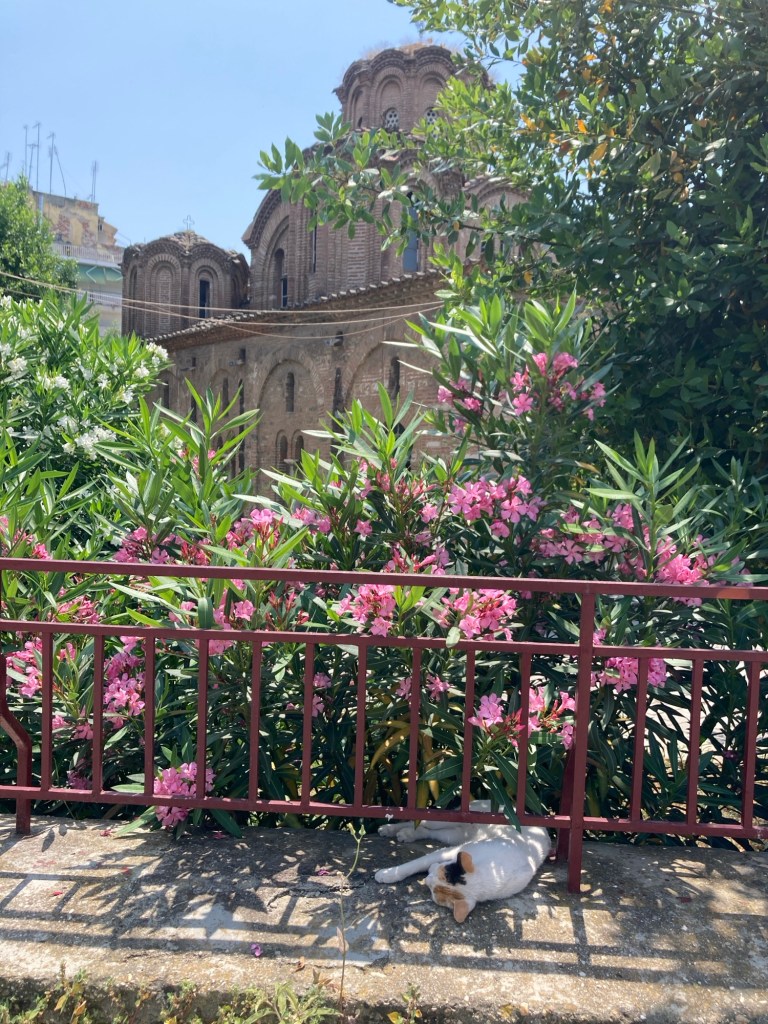
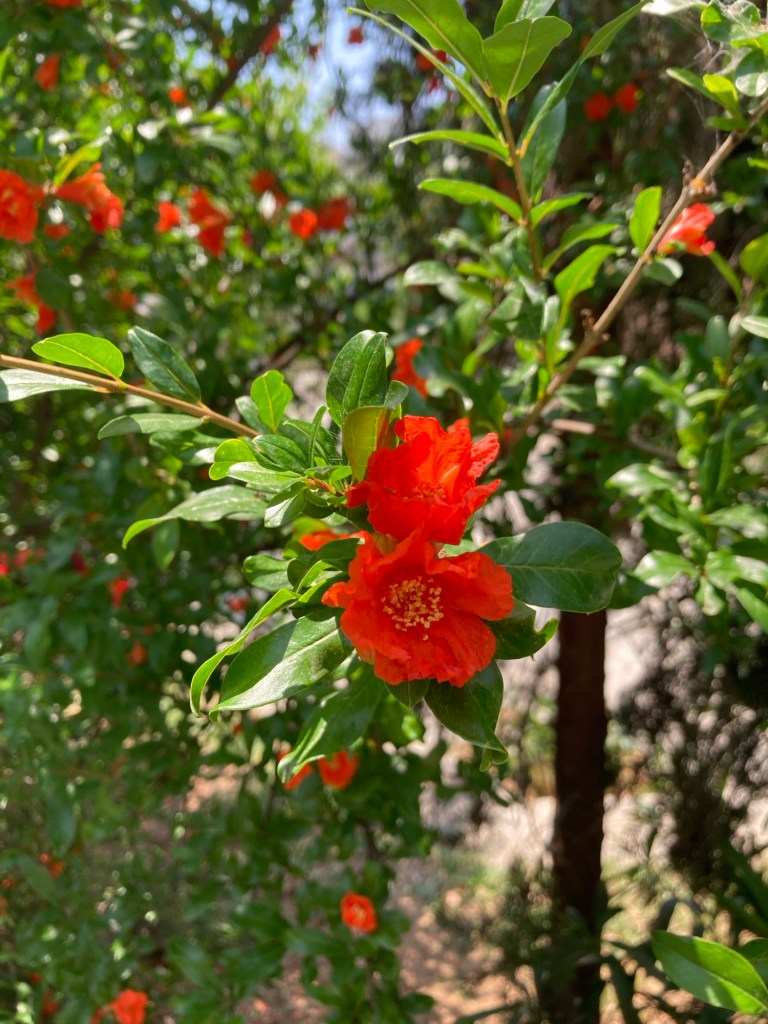
… and as I walked around the church, noting that every gate was locked, I saw a magpie in a tree, a cat trying to stay comfortable in the heat, and the most beautiful pomegranate tree.
The temperature has risen since my arrival in Thessaloniki, and the humidity increased, so that I have needed to walk less briskly, and to return to my hotel in the hottest part of the day to rest for a while before going out in the evening.
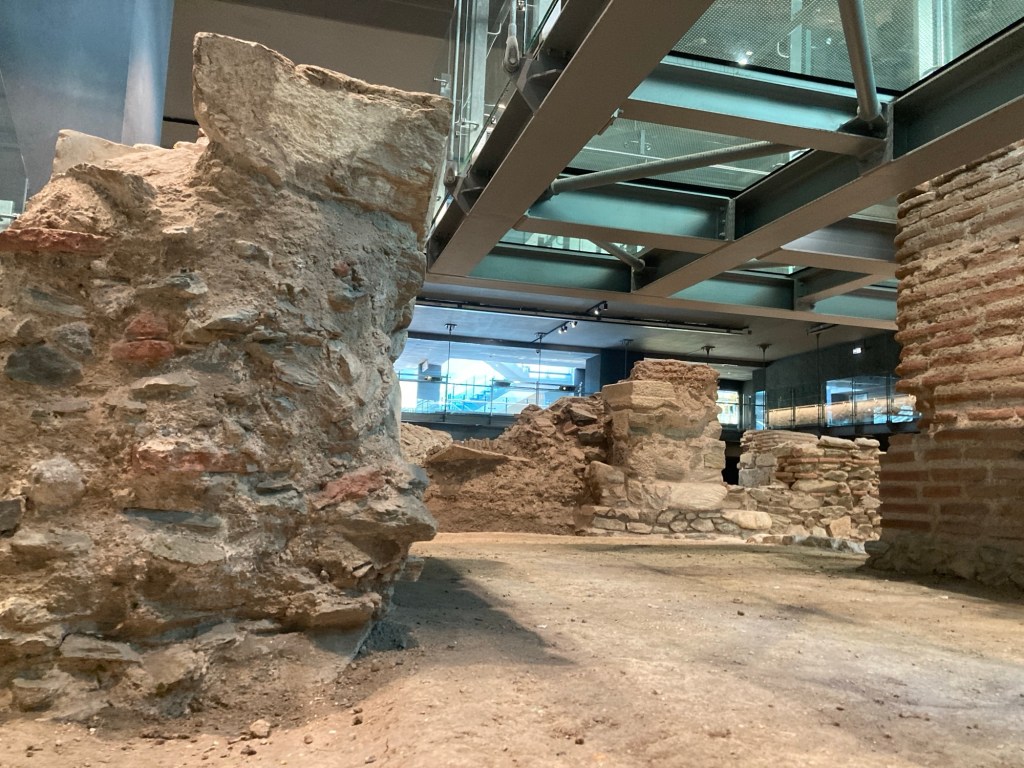
But I enjoyed strolling back through the center of the city, where the new Metro has also been built in such a way as to highlight the ancient civilizations that lie in its lower regions.

Maria gave me a tour of it also, and from all levels of that central station we got different views of the street scenes that have been preserved. It was the vastness of the archaeological discoveries, when excavation began for the project, that demanded a thorough and extended discussion about how to respect these artifacts.
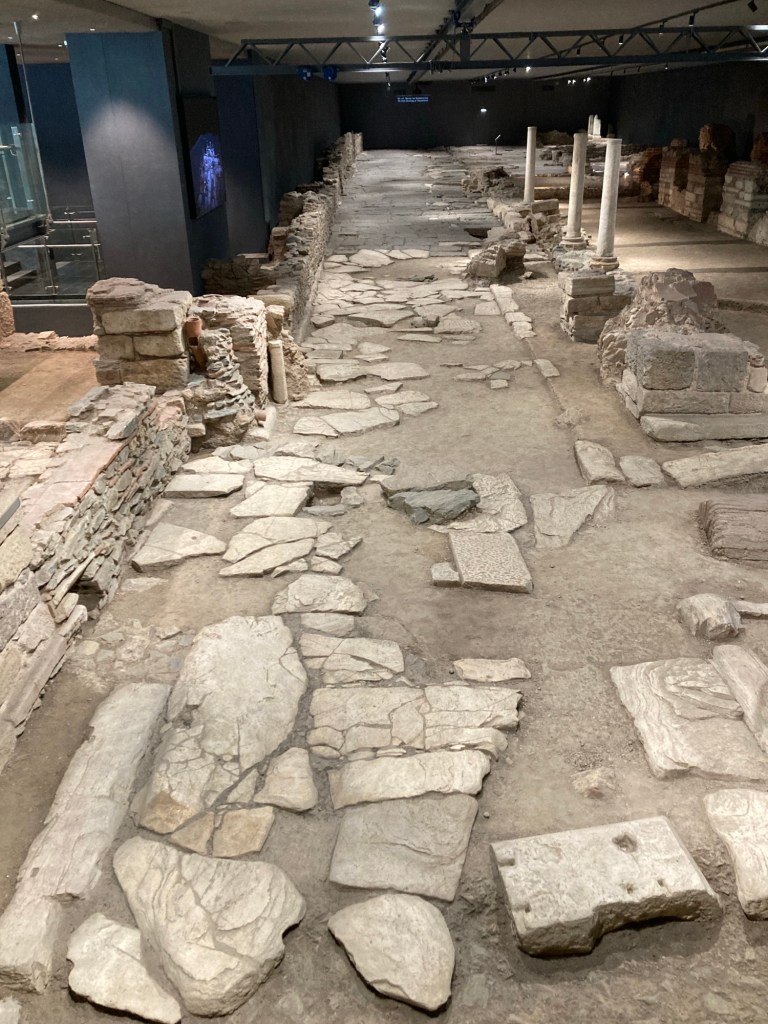
The main road of the Roman city.

Layers representing Hellenistic, Roman, Byzantine and Ottoman societies were found, and the decision was made to display the Roman city. All of the artifacts will eventually be exhibited in a museum, a foretaste of which makes a wall display in the lower levels of the Metro station.
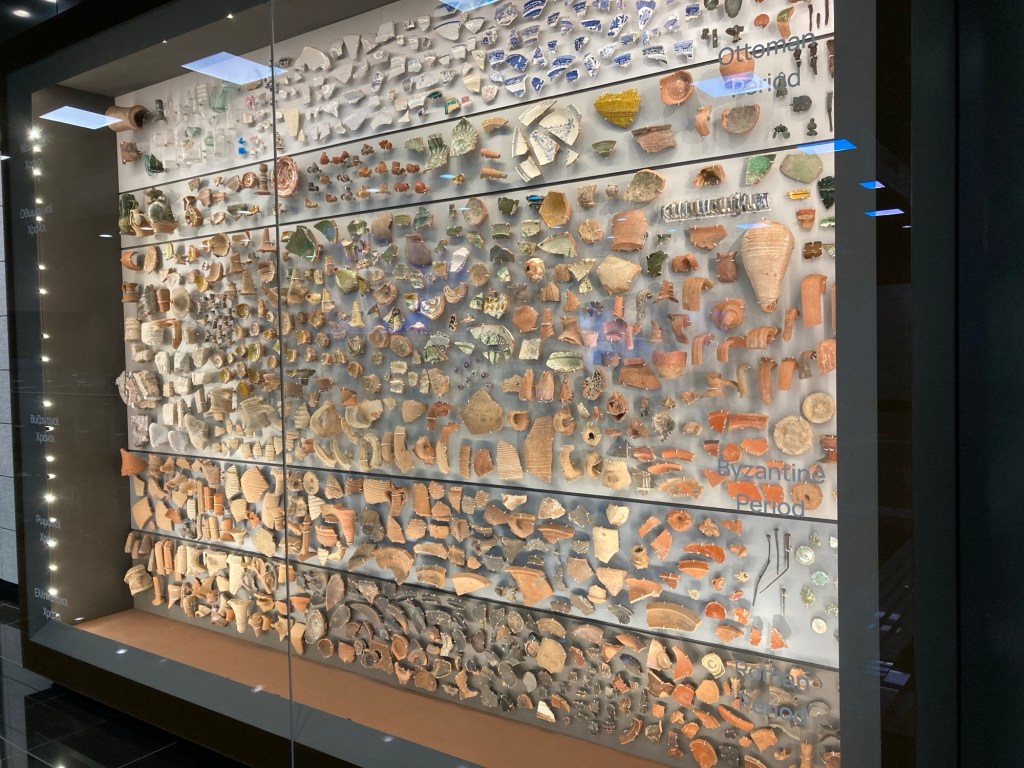
I am amazed at the vision and scope of this project. History is alive here.
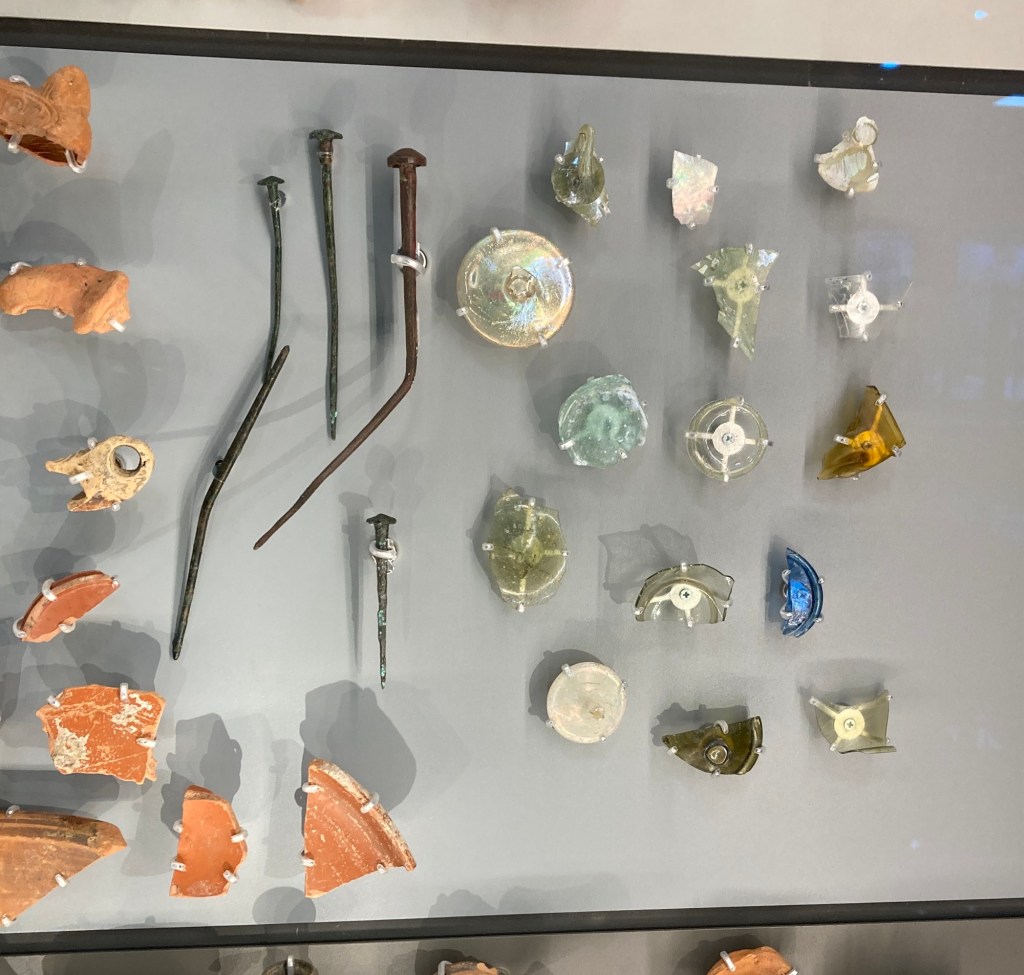
Roman artifacts

Because my time in Thessaloniki is running out, I need to tell you about the Rotonda now as well. It is the oldest of Thessaloniki’s churches.

This edifice that was built in the early 4th century by the Emperor Galerius, possibly completed by Constantine when he lived here, has walls six meters thick. As soon as I was inside, I felt the immense presence of the place. The only visitor at that time besides us was a woman sitting on a folding chair and reading, and I knew it would be a blessed place just to sit. But I didn’t want it enough to go back and pay another ten euros to enter.
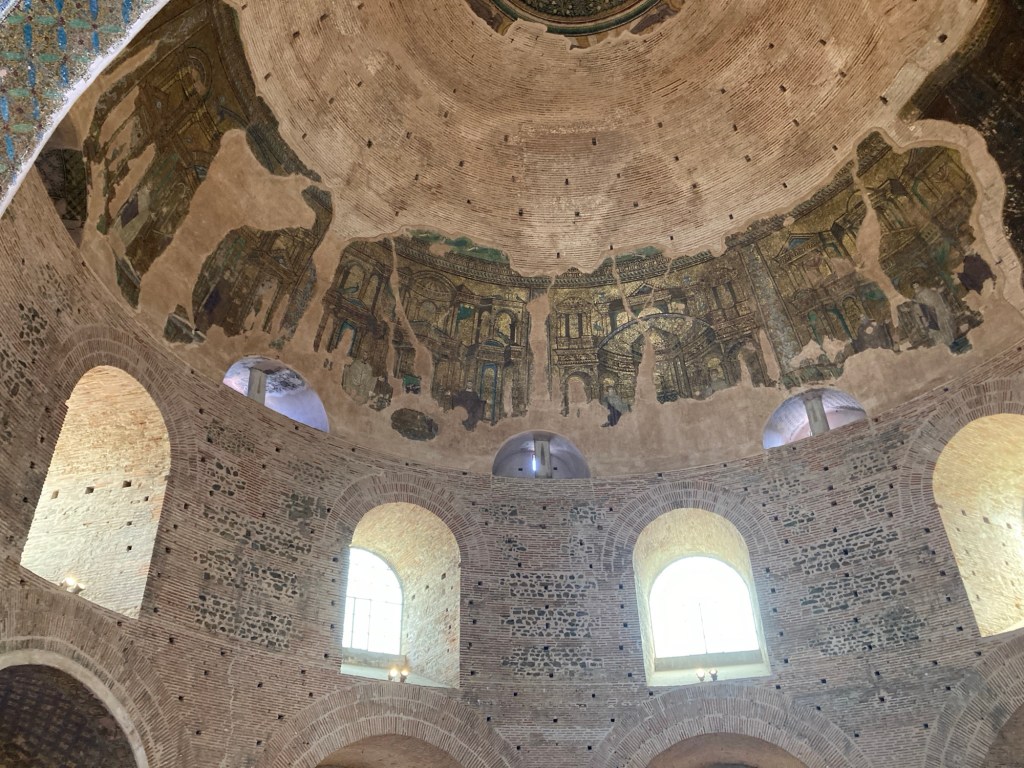
Some historians think that Galerius built it as a mausoleum, as part of the complex including the Arch of Galerius and the palace. But others think it was built as a temple to a god, possibly Zeus, who was Galerius’s patron god.

Galerius was buried in Serbia in any case, and a few decades later the Emperor Theodosius (probably) was the one who ordered the Rotonda to be made into a church dedicated to St. George.
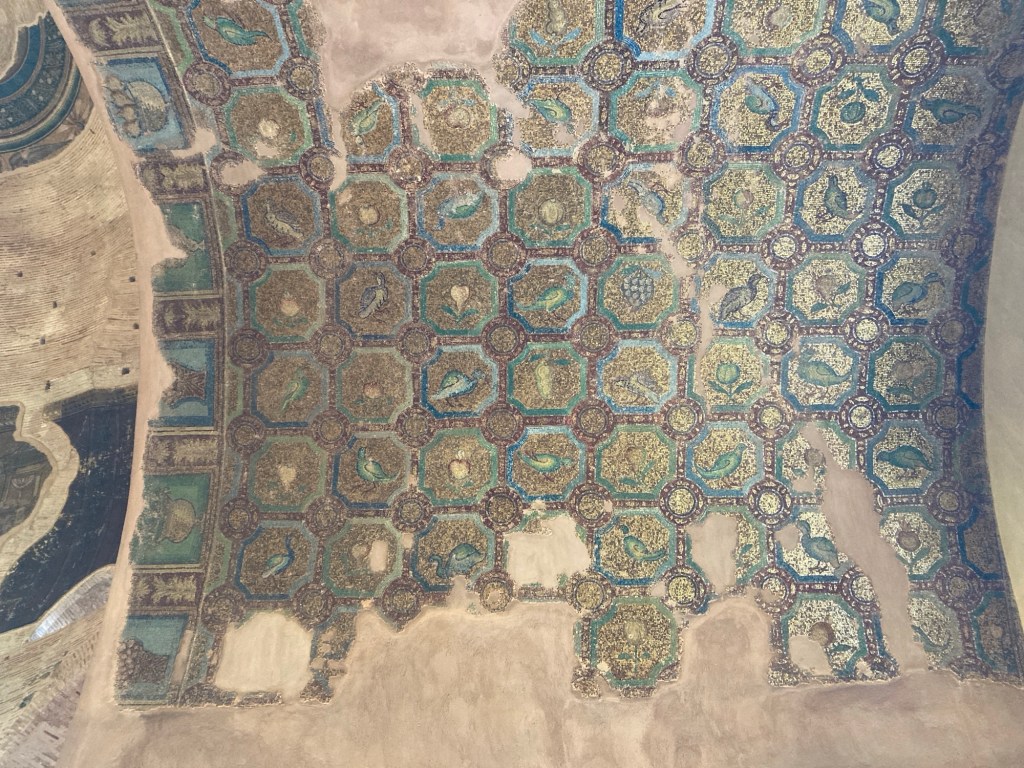
In 1590 it was converted into a mosque for a few hundred years, and a minaret was added. It’s the only minaret that was not removed when the city was liberated from the Ottomans.

Along with the serenity and hugeness of the church, the remaining ancient mosaics impressed me, with their brilliance and detail. So, so lovely, the art that has survived nearly two thousand years and doesn’t show its age. If my neck were stronger, I’d have craned it longer to feast my eyes on the colors of the birds especially.

I think services are held there on the feast of St. George. One doesn’t have to go down to go back, when the Rotonda is taking you; it sits elevated above the city. You just walk up the hill, walk inside, and there you are.

Thessaloniki – Day 1

My first day in the Greek city of Thessaloniki has been splendid — even though I went to the “wrong” church for Divine Liturgy. What brought me here I will tell you later, but I wanted to report back briefly to everyone who’s been waiting with bated breath to find out where the plane was taking me Saturday.

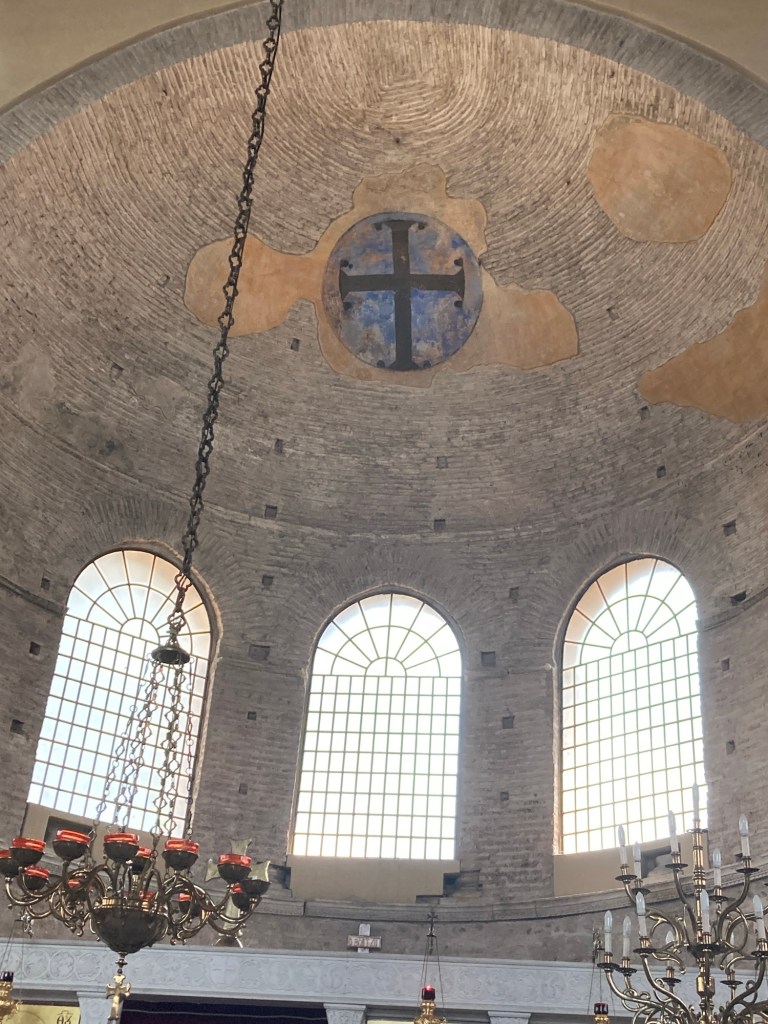
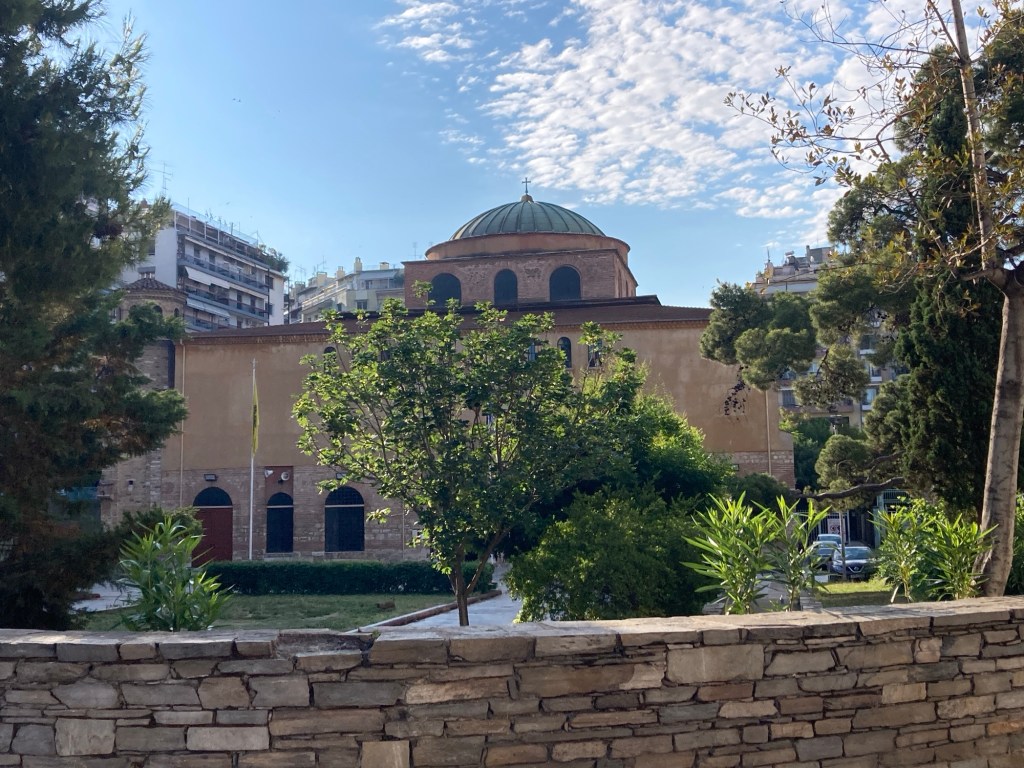
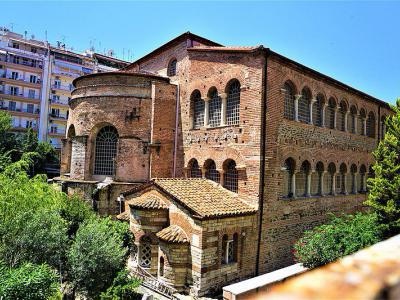
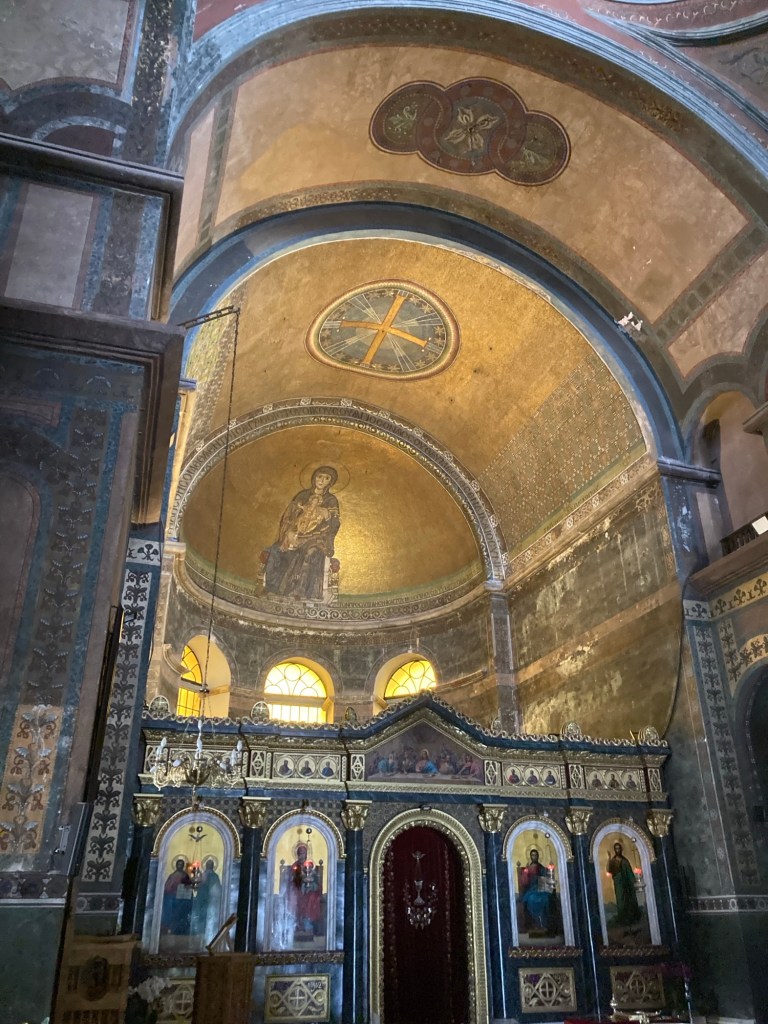
Hagia Sophia Church in Thessaloniki

I was told that the Sunday morning Matins service was at 7:30, Liturgy at 8:30. As I had crashed utterly spent into my hotel room in the evening, I didn’t have it in me to go to Matins.

I made the short walk in time to arrive a little early for Liturgy, before Matins had ended, and was immediately translated to ancient Christianity by the nine deep and strong voices rising into the heights of the space, amplified by the bare marble floors and stone walls. It really hit me then, that my prayers had been answered and I had made it to my second and last destination of this trip. Thanks to God ❤️

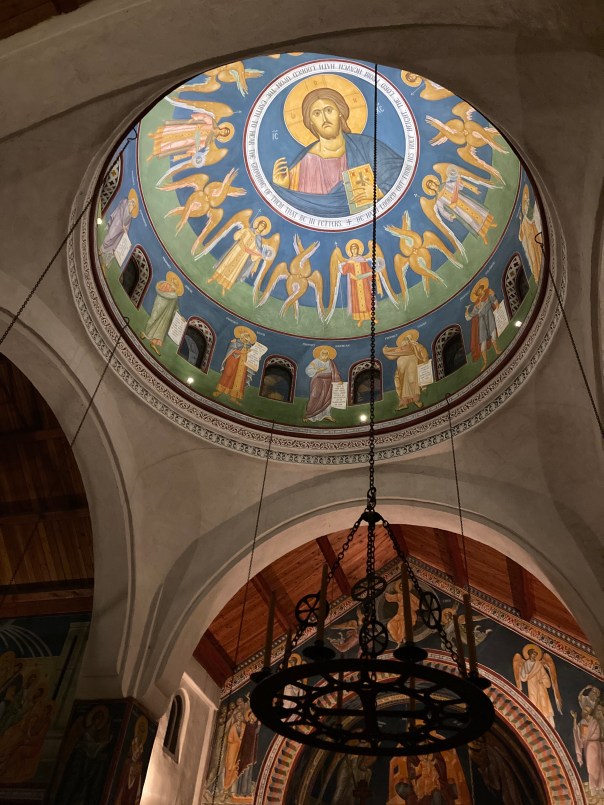
Ascension of Christ – Dome of Hagia Sophia Thessaloniki

After the service the person I was planning to meet didn’t show up… I texted her and we still couldn’t find each other, until she figured out that I was not at the church she had given me Google directions to, which was the Panagia Archeiropoietos. What happened was, the wrong church was pretty much on the path I was following to the other, and I just stopped looking at the map on my phone, and went into the first really old temple I came to. To be safe, my friend came and retrieved me herself from Hagia Sophia Church and took me to the right church briefly.

Acheiropoietos

Surely I will have at least a little more to tell you about these churches and others I’ll be visiting, and about the several people who have already been so hospitable to me. But right now it’s time for bed; I hope Byzantine chanters will sing in my dreams.

Hagia Sophia in Thessaloniki

In-between December days.

The first half of the week was a flurry of activity: First a Santa Lucia Eve procession that I was invited to, with a few families I have been getting to know because of my involvement in a homeschool group. With the eldest girl wearing a wreath studded with candles, we processed through the neighborhood singing “Santa Lucia” in Italian — I admit I was only humming the tune because I haven’t become that involved to have learned the words in Italian or even English. Then back at the house, we added “Stille Nacht” (Silent Night) in the original German. Tea and Santa Lucia buns in their delicious quintessential selves finished out the evening’s simple program. I took the picture three days later so the greenery is a bit dried out.

The next night our women’s book group at church got together. Originally that meeting was to be a soup dinner for 10 at my house, but the time and place got changed because of a funeral; it was a big relief for me, because as soon as December arrived, I couldn’t imagine getting ready for a party at the same time I was getting ready for a trip, which this year is the case: I’m headed to Soldier and Joy’s for Christmas.

At the first part of the funeral, in the evening.

I made split pea soup, and we had a very festive group and evening, eating fish chowder, pumpkin soup and lentil tomato soups as well — plus accompaniments. Of course, cookies and vegan brownies, too! I don’t think I mentioned before what books we have been reading this time. They were Strength in Weakness by Archbishop Irenei Steenberg, and The Secret Garden by Frances Hodgson Burnett. I’d been wanting to gather my thoughts on The Secret Garden for about five years, so this was the impetus I needed to buckle down. I’ll share more about my resulting amateur analysis in the new year.

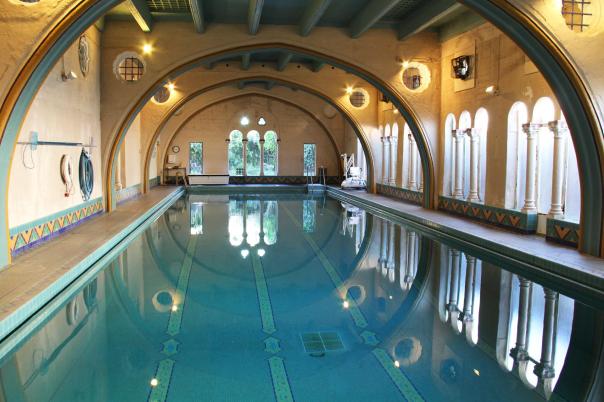
By Julia Morgan

Thursday I attended a tea party of about a dozen ladies and girls, several of whom I was meeting for the first time. Many of them are very accomplished, cultured and educated, and there was lots of fascinating conversation about our personal histories, world events, information about our local towns and the architecture of particular houses that were built by a relation of the woman sitting next to me. She was the only one there who is older than I, and she has been involved in our town’s history from way back, and continuing.

It was while this talk was flowing around me that the name of Julia Morgan, architect, made me pay closer attention; a bit more information about the time frame in which she worked, and I began to wonder if my grandfather was one of the contractors that she worked with in the San Francisco Bay Area; she designed more than 700 houses in California. I will be doing more research on that, but in the meantime I show you these photos of the Berkeley City Women’s Club building, in which my grandmother (on the other side of the family) was very active, and where she took us swimming when we visited her. That building has been called a “little Hearst Castle,” referring to the real (huge) Hearst Castle in San Simeon, California, the estate that Morgan designed with William Randolph Hearst.

Since the tea party I have switched gears and stayed home, slowly working on wrapping presents, packing bags and organizing my thoughts in preparation for my departure. One by one little things that need to be done come to mind and I do them, or write them down. It is not very systematic, and the whole process seems to require frequent attention to everyday tasks like building the fire and tending the frozen fountain. I guess it’s because I’m not systematic that I require banks of time for the creative flow to happen. As I am fond of quoting G.K. Chesterton:

“I am not absentminded. It is the presence of mind
that makes me unaware of everything else.”

Even things I’ve been procrastinating on for months must be put off no longer, whether or not they have anything to do with the trip — like making a phone call. My daughter Kate says everyone does the same at the end of the year, finally sending in reports or contacting loved ones, I guess because they don’t want to come back from Christmas break with “old business,” whether it’s work or family related, dutiful or joyful.

Now that I’ve procrastinated enough to get another unnecessary thing done, the writing of this post, I will have to hustle a little bit and fold the clothes I laundered, to figure out what to take with me. Before I know it, these in-between days will have ended and I’ll be boarding an airplane and on my way to a happy reunion with several of my dear family. I hope that on Christmas Eve we will sing “Stille Nacht.”

Where to walk, what to read…

I already own a book on architecture that is just at my level, The Architecture of Happiness. But reading on the internet tempts me to explore many different realms… further than I actually want to go, when it comes right down to it.

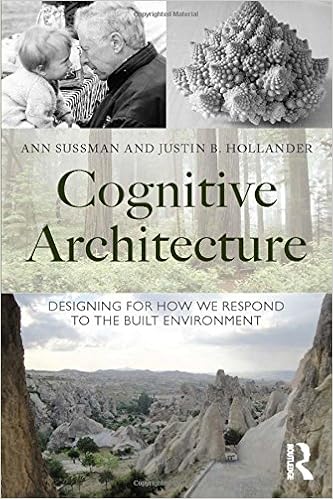
Something I read back in the fall made me want to see the book Cognitive Architecture, by Sussman and Hollander, and my library’s “Link” feature helped me to get it, from southern California. It came in just before Christmas, and just before I needed clear away piles of books and papers, seeds and seed catalogs, to make space for a few Christmas decorations.

So I barely glanced at it, and quickly put it…. somewhere. I was pretty sure it was upstairs, probably in my bedroom, and when I found it last week — after looking everywhere several times over the last month — it was in an odd little stack of things, with a prayer book and a Christmas card and other unrelated stuff. One reason I hadn’t seen it earlier was that it was so much smaller than I remembered it.

Paris

So small, my immediate thought was, maybe I could actually get through this book! Even though I’ve sort of moved on and my current goal is to whittle down the number of half-finished books I already have, without adding more.

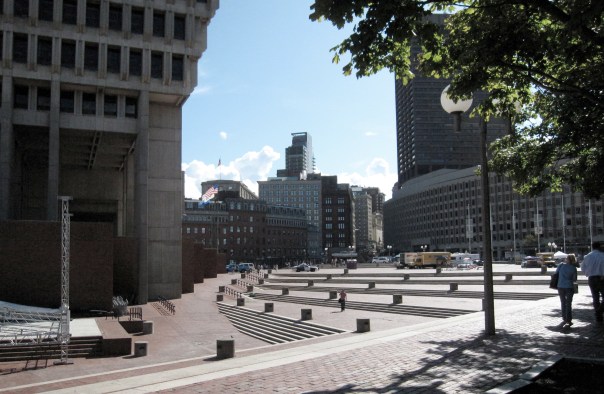
So I only browsed, and it is pretty interesting, about designing buildings for the way people live and behave, the sort of “animal” that humans are. One example is, that people in cities are known to like to walk or congregate on the edges of open spaces or streets, near buildings or walls, so that the buildings “have their backs.” But not so much if the building is turned in on itself and doesn’t seem open to the people, with low windows, for example, for easy window shopping. An example of a space not conducive to this protected and friendly feeling is the Boston City Hall Plaza, which is known as an unloved space and is up for renovation:

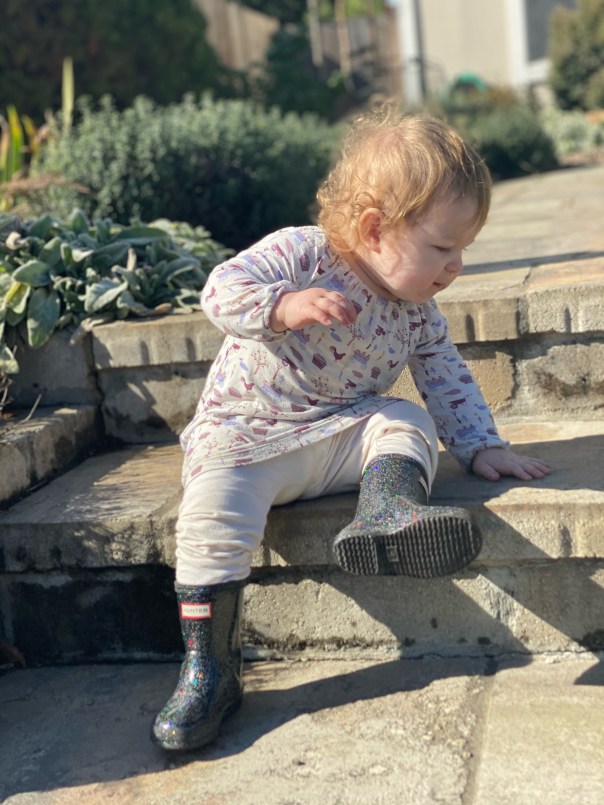
It is known that people prefer not to climb stairs if they can avoid it. I know that doesn’t apply to toddlers. This is my neighbor Grace who was enjoying going up and down my front steps this afternoon.

I discovered that one of the authors, Ann Sussman, has co-authored a fascinating article, “The Mental Disorders that Gave Us Modern Architecture”!

Many of the other points of human-centered design were not new to me. I had learned a lot from De Botton’s book, and I also have this one that Pippin gave me, in which I can browse actual buildings and their architects, which is more appropriate for me, who am not considering a career in design.

I wonder if I have other books I could write about without having read them, and in that way get some satisfaction from my failures…? I’ve enjoyed making use of this one to organize the Architecture compartment of my mind, and I found a pleasing poem in it as well:

THINGS

What happened is, we grew lonely
living among the things,
so we gave the clock a face,
the chair a back,
the table four stout legs
which will never suffer fatigue.

We fitted our shoes with tongues
as smooth as our own
and hung tongues inside bells
so we could listen
to their emotional language,
and because we loved graceful profiles
the pitcher received a lip,
the bottle a long, slender neck.

Even what was beyond us
was recast in our image;
we gave the country a heart,
the storm an eye,
the cave a mouth
so we could pass into safety.

-Lisel Mueller