Category Archives: art

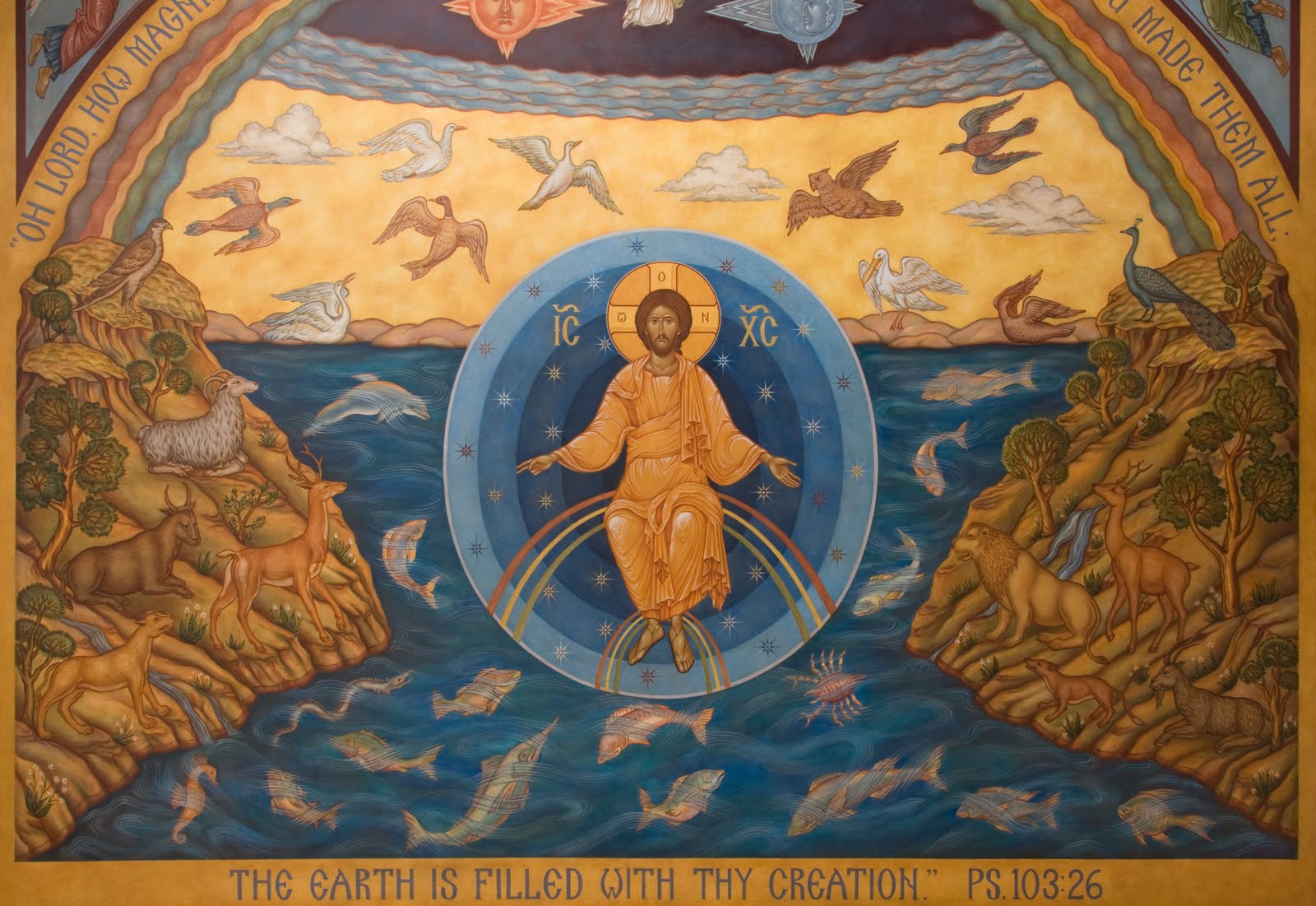
The Earth Is Filled With Thy Creation

It’s the first day of the church year.

I’m reposting from two years ago this icon that celebrates a major focus of the celebration, because I don’t want to miss the joy even if I don’t have time today to consider and write more.

Abundance and a New Year

September 1st marks the start of the church calendar,
and is a good time to remember the goodness of God’s creation.
I love this icon and the way it expresses the superabundance
of life and beauty in this world that is our home.
Lord, thank You for everything. Bless us in the coming year!


 You can see more detail on the iconographer Christina De Michele’s website. The icon is a church mural in Riverside, California.

Venetian Painters

The covered buttons on Ottaviano Grimani’s shirt jumped out at me when I came around a corner and looked up at the huge painting. Of course I couldn’t find a copy online that conveyed the stunning quality of the buttons, but the search was instructive.

This portrait by Bernardino Licinio was in the Masters of Venice show of 50 paintings that came from a collection that the Habsburgs assembled in Vienna, works of Venetian artists of the High Renaissance, mostly the 16th century.

Since I haven’t paid any attention lately to what is going on in San Francisco, I would have missed this opportunity altogether if my friend “Lorica” hadn’t invited me to go just before the show closed.

I loved that it was small and focused — we didn’t visit any of the permanent collection — so that my easily-overwhelmed brain could stay calm and receptive as we slowly moved from one room to another of the De Young Museum. The time flew, as Lorica elaborated and added to the information posted near the paintings. I am woefully ignorant, and she was the perfect guide for someone like me, who can’t chew very big auditory bites.

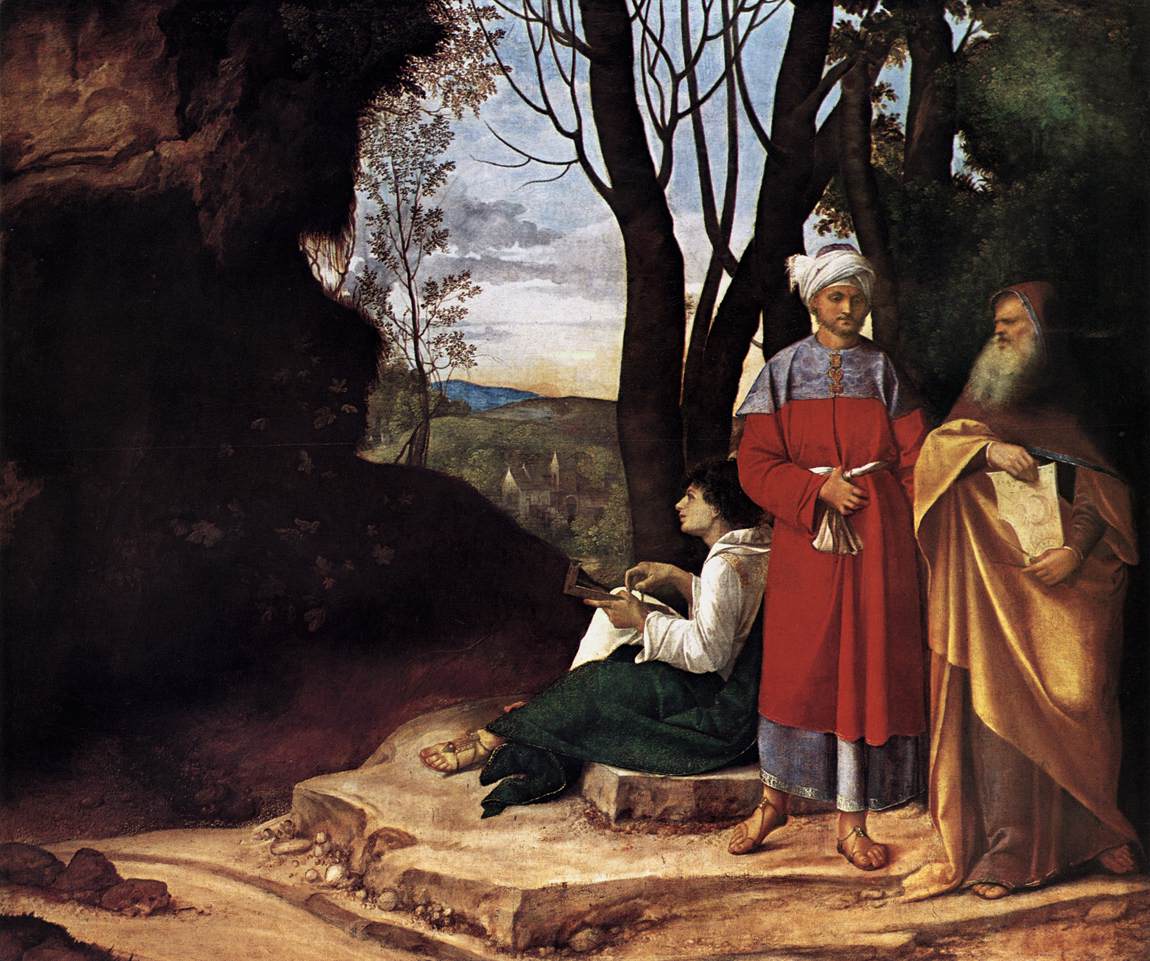
Giorgione’s Three Philosophers

It seems somehow shameful, but I am doing it anyway: posting some of my favorites here in truly pathetic versions of themselves. As soon as I came home I looked for them on the Internet so I could show my husband, and as it had been only a couple of hours since I’d seen the masterpieces in their glory, I was terribly saddened to see that aspects of the originals that had given me so much pleasure were flattened to the point of extinction.
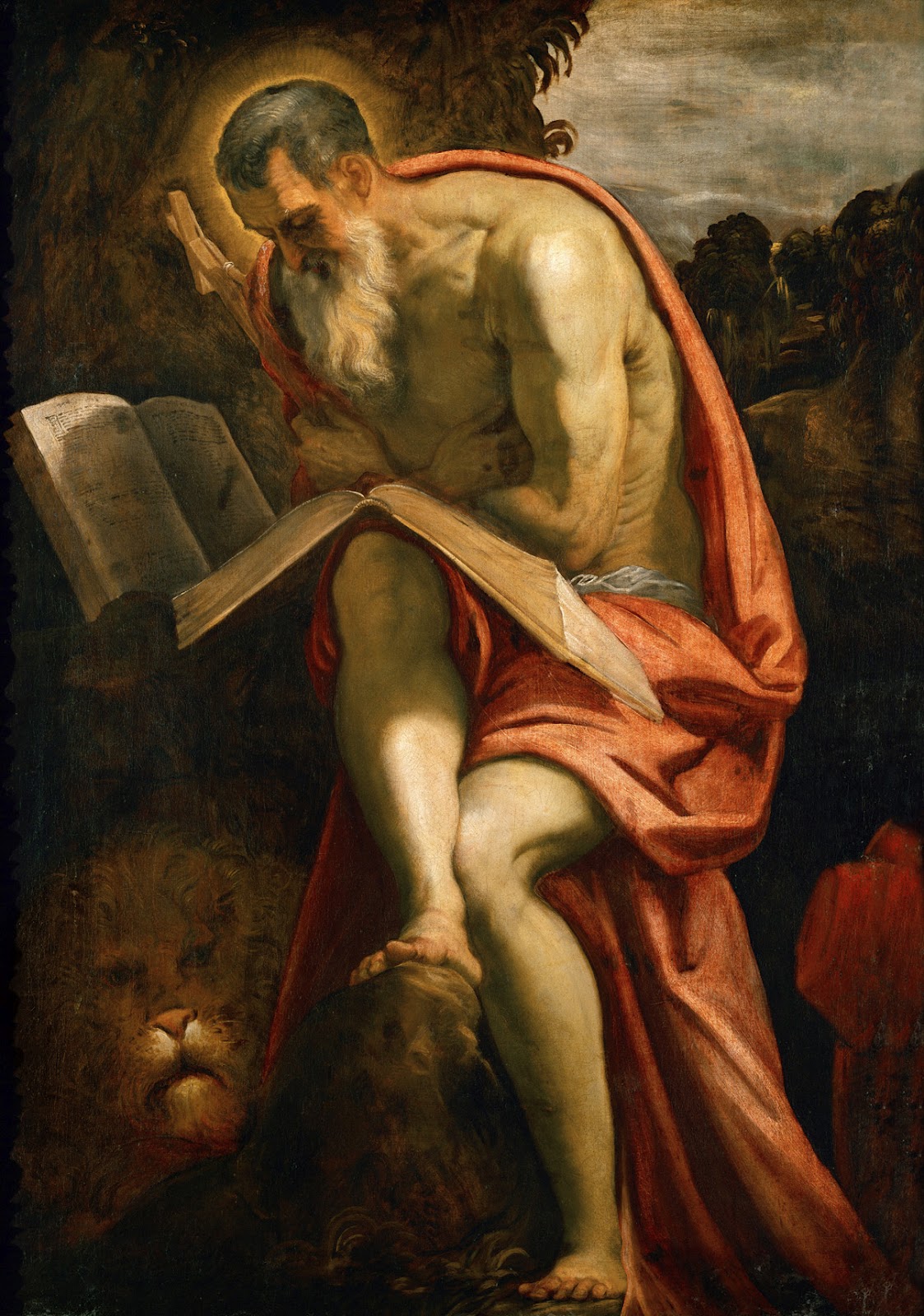
St. Jerome by Tintoretto

That was an Aha! moment, as I contemplated the truly 3-D nature of paintings. And I realized why one would want to visit a show like this several times — because looking at the little postcards one can bring home is a sorry substitute for Being There.

The first thing I noticed about St. Jerome, who translated The Vulgate, was his smiling eyes. He must have been so happy to be reading God’s Word. (Lorica told me that he was known to be grouchy.) And the face of the lion was lovely, Aslan-like. Neither of those endearing features comes through in this little copy.

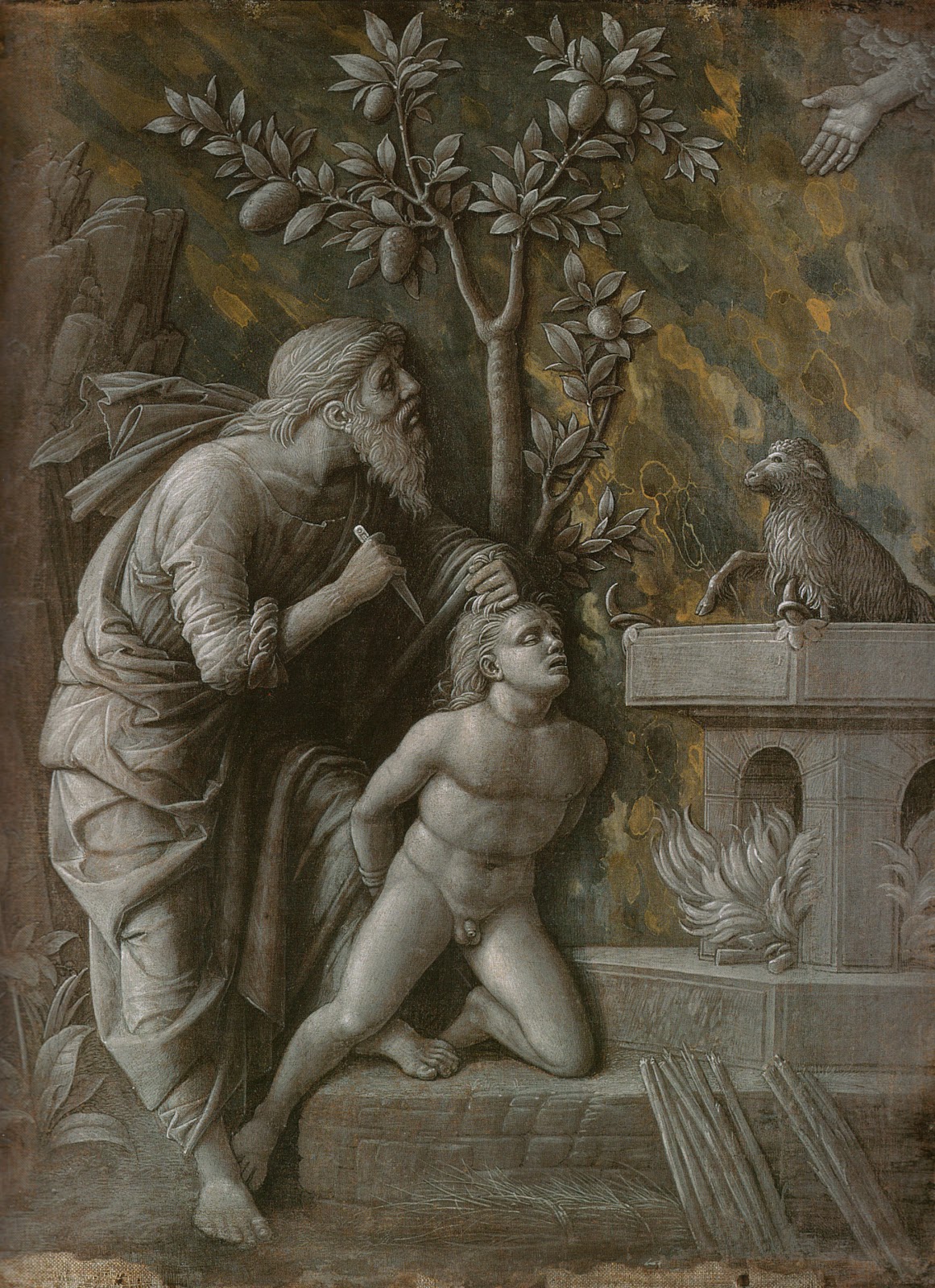
At left is The Sacrifice of Isaac by Mantegna, which I loved. The whiteness and statue-like quality of the painting was new to me, and the whole composition so complete in its portrayal of the event, and with beautifully “carved” figures. The little ram presenting itself, God’s hand presenting it….

One painting of which I could only find a decent representative online a few years after writing this post was Titian’s Entombment of Christ. I have inserted it in an update. My guide pointed out to me that it seems to be all about Mary, as she and her richly blue cape are the focal point of the composition.

Titian entombment 1200px-Entierro_de_Cristo_(Tiziano)

Another Biblical scene, Adoration of the Magi, by Bassano the Younger. I think it’s charming in the way it depicts the bustling arrival of the worshipers and how the man in green wastes no time in getting as close as possible to the Christ Child.

Some of the other artists whose paintings we saw were Veronese and Bordone, and Pordenone, whose Christ With the Cross (below) admittedly a very Italian version of our Lord, is still quite arresting, and keeps my thoughts on the Love of God.

Looking at the little pictures here, remembering the great works that I had so recently wondered at — it all made me think I hadn’t been paying enough attention while we were in the museum. After all, it was the chance of a lifetime, and I had been so casual, strolling around dully as though I could just hop over to Vienna anytime I wanted and see the paintings again.

One can see that I need to get to the art museums more often, and that my education in art appreciation has barely begun.
Long and Boring Road

Our family loves the books by Byron Barton, like Trains and Machines at Work. Plenty of everyday and exciting things happen in these books, and the stories are told with few enough words that toddlers end up memorizing the text and can “read” the book to themselves or to others.
  
Along a Long Road seems like it is trying to be such a book, but I think it fails miserably. Unfortunately I don’t have a toddler to try it out on. On second thought, I wouldn’t try it out on anyone, because I don’t do that. I have to preview a book and make sure that I like it before I will read it to a child, and I could barely get through this book by Frank Viva.

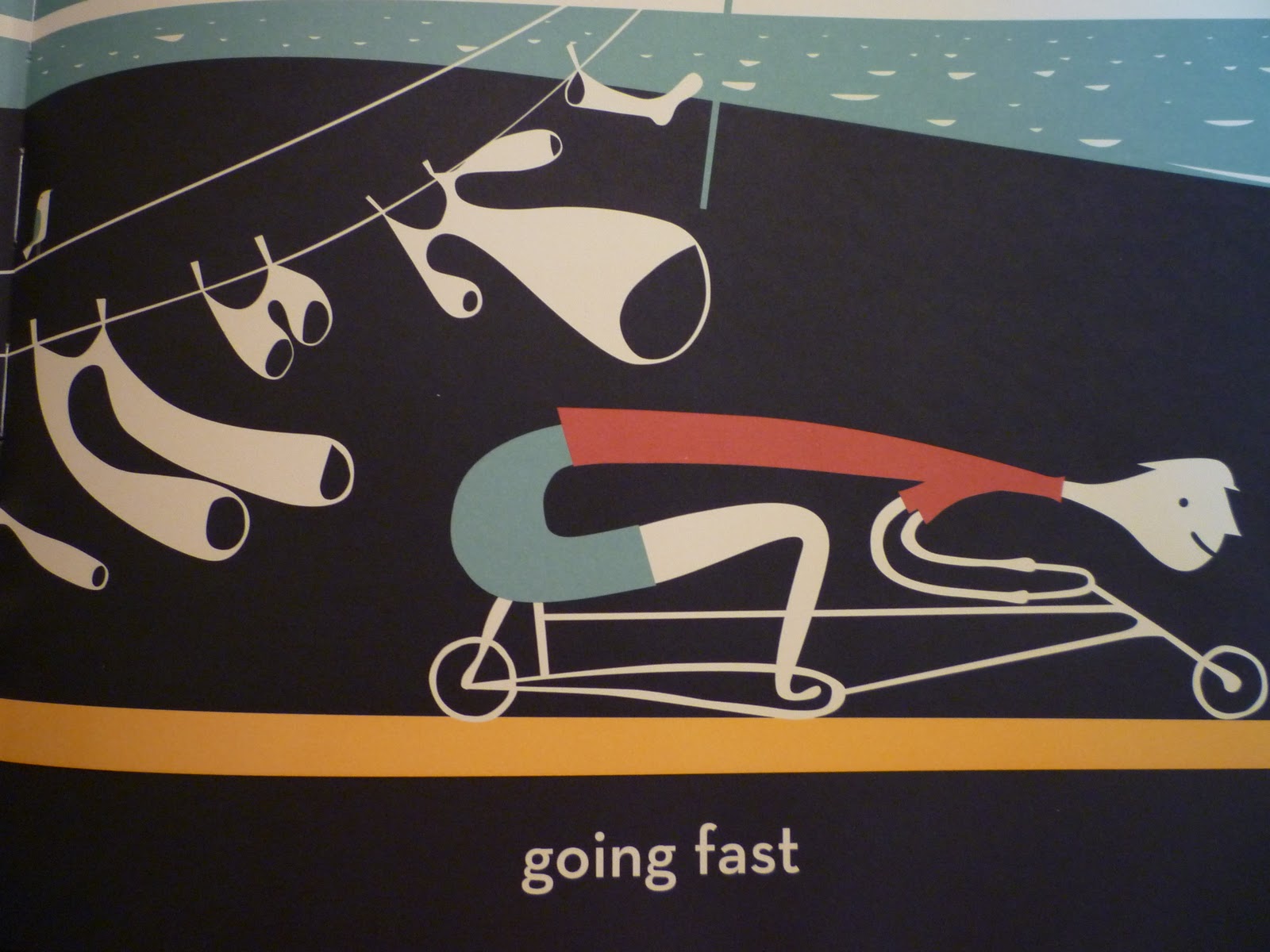
The picture book features stylistic pictures of the long road, made shiny by some plastic coating, and a very long man riding his long and stretchy bicycle. According to the text he rides and rides, “again and again.”

I haven’t known small children to be very interested in bicycles. They like their trikes, and boys especially seem to love heavy road equipment, trains, and motorcycles. One more reason to pass on this book.

About the only thing both my husband and I liked was the picture of a pregnant woman whom the cycling man passes. I suppose there are plenty of items along the road that one could talk about with a child, but no story to keep the long road from getting tedious.

I quickly got tired of the man and his weirdly shaped vehicle, expressed in only three colors, plus black. The artwork reminds me a little of an odd and favorite book of ours, The Clock, by Esphyr Slobodkina of the abstract expressionist movement. Slobodkina is better known for her picture book Caps for Sale, but long ago I found a beat-up copy of The Clock, which is a captivating story.

Maybe Along a Long Road would be pleasing to a very early reader, or a delayed reader, who might be able to relate to the sign for lottery tickets or a distant view of a carnival, and who would find satisfaction in reading the words “again and again” again and again. Not that I can imagine a child like that. If anyone out there has had another experience with Viva’s arty book, I would like to hear about it, even though I will soon take it back to the library for good. Give me Barton any day.

Limón in the Cazuela

The Cazuela That the Farm Maiden Stirred by Samantha R. Vamos is a delightful Hispanic incarnation of The House that Jack Built. It tells the story of a rice pudding from the farm to the table. The reader is introduced to two new words, first in English, every time he turns the page. From then on, those key words are only written in Spanish.

Before I opened the book, Mr. Glad was enjoying it and noticed that the word for lime was much like our lemon. That made me wonder what the word for lemon is.

New World Spanish-English Dictionary sits on the reference shelf here as a leftover from the days when four of our children in turn studied Spanish. Even though their father and I never did study that language that is so useful, almost essential, in California, we’ve lived here our whole lives and have picked up some vocabulary, sometimes by consulting this word book, as I did on this occasion.

The hen helps by grating the limón

I don’t know why, but my dictionary is wrong about limón. It says that it means lemon, and that if you want to talk about a lime you say lima. I found it hard to believe that this book written by a woman with a Hispanic name, illustrated by a man with a Hispanic name, with the intent of teaching 21 words, would get any wrong.

But I have a friend who is married to a Mexican man and teaches at a bilingual school, and I couldn’t pass up the opportunity to ask my local expert. She wrote, “Okay babe. Limón means lime and limón agria or limón Amarillo can mean lemon. There is a lemon-like fruit called Lima limón. There are not lemons like we have here in the U.S. in Mexico.” That seemed a pretty authoritative word on the subject.

This is a picture book, an Easy Reader, so I must not forget to mention the illustrations, which as you can see from these sample pages I photographed are party-bright, full of the joy and fun of cooking together.

At the back you will find a glossary with pronunciations, in case your Spanish is rusty, and best of all, a recipe for rice pudding. What I would love to do with a young child is read the book, make the pudding together while using the English and Spanish words to talk about the ingredients, and then read the book again while the cazuela simmers.

I would rather one of my grandchildren helped me in the kitchen, while we keep the animals outdoors or in the pages of the book. But an arroz con leche pudding with plenty of crema and some zest of limón would suit me just fine.