Category Archives: art

Eat this scroll.

One of the readings for Holy Monday is from Ezekiel, a description of what the prophet saw in his vision of creatures and wheels:

…a whirlwind was coming out of the north, a great cloud with raging fire engulfing itself; and brightness was all around it and radiating out of its midst like the color of amber, out of the midst of the fire. Also from within it came the likeness of four living creatures. And this was their appearance: they had the likeness of a man. Each one had four faces, and each one had four wings. Their legs were straight, and the soles of their feet were like the soles of calves’ feet. They sparkled like the color of burnished bronze. The hands of a man were under their wings on their four sides; and each of the four had faces and wings. Their wings touched one another.

The creatures did not turn when they went, but each one went straight forward. As for the likeness of their faces, each had the face of a man; each of the four had the face of a lion on the right side, each of the four had the face of an ox on the left side, and each of the four had the face of an eagle. Thus were their faces. Their wings stretched upward; two wings of each one touched one another, and two covered their bodies.
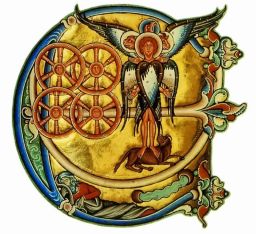
And each one went straight forward; they went wherever the spirit wanted to go, and they did not turn when they went. As for the likeness of the living creatures, their appearance was like burning coals of fire, like the appearance of torches going back and forth among the living creatures. The fire was bright, and out of the fire went lightning. And the living creatures ran back and forth, in appearance like a flash of lightning.

Now as I looked at the living creatures, behold, a wheel was on the earth beside each living creature with its four faces. The appearance of the wheels and their workings was like the color of beryl, and all four had the same likeness. The appearance of their workings was, as it were, a wheel in the middle of a wheel. When they moved, they went toward any one of four directions; they did not turn aside when they went.

As for their rims, they were so high they were awesome; and their rims were full of eyes, all around the four of them. When the living creatures went, the wheels went beside them; and when the living creatures were lifted up from the earth, the wheels were lifted up. Wherever the spirit wanted to go, they went, because there the spirit went; and the wheels were lifted together with them, for the spirit of the living creatures was in the wheels.

I was interested to see how artists might have rendered these images. Many of the pictures were quite psychedelic, and just as mind-boggling as the descriptions Ezekiel gave. My favorite was this quiet sculpture, detail of an Amiens Cathedral facade which shows only two wheels, and a prophet who might be seen as receiving his vision, or perhaps meditating on the whole of it — which would be impossible to render in stone. The complexity and drama are only hinted at by the way the wheels are interwoven or interweaving.

The church fathers have written that the four living creatures are the cherubim, the guardians of the throne of God. The burning coals are holy men, the lamps signify the light of the gospel, and the wheels signify Holy Scripture; St. Gregory the Great tells us that “the New Testament lay hidden by allegory in the letter of the Old Testament.”

Ezekiel closes his description (beyond this day’s reading) with the words, “This was the vision of the likeness of the Lord’s glory. I saw it, and I fell down on my face….” and God spoke to him, gave him an assignment, and gave him a scroll, saying:

“Son of man, eat this scroll, and go and speak to the children of Israel.” So I opened my mouth, and he fed me the scroll. Then he said to me, “Son of man, your mouth shall eat and your stomach will be filled with this scroll that is given you.” So I ate it, and it was in my mouth as sweet as honey.

My Bible footnotes remind me that the faithful can also know that sweetness that Ezekiel tasted, as the Psalmist sings:

How sweet to my taste are Your teachings.
More than honey and the honeycomb in my mouth.

This probably works best when we love and obey those teachings… Lord, have mercy!

Heal me, O LORD, and I shall be healed;
save me, and I shall be saved:
for thou art my praise.

Jeremiah 17:14
In the midst of heady scents.

It is such a blustery day. My helper in the garden was not able to come at all in March, in spite of trying and getting rained out. I think he might come today, though even if the rain stops, it’s so windy and cold, I do not want to go out there and join in the clean up and pruning and weeding. I will just stay in and do a few Greek lessons, and show you more pictures of the garden.

At right is a birthday card I received from my grandson. He’s doing an extensive series of these drawings of which this is only one family member, so I don’t think he was necessarily implying any resemblance. But I immediately felt that this motherly looking cat was a kindred spirit.

More birthday gifts illustrate this post, made by several of the younger, most practical and artistic grandchildren. The ones who live in California keep writing cards and letters wondering when they will next see me; these, combined with the departure of the Colorado clan after they had been available for hugs for a whole week, gave me the idea of making a quick trip north to see Pippin’s brood this weekend — but stop… breathe… It looks better to wait until after Pascha, and more easily accomplished. So I’m looking forward to that, though even then it will be a challenge to squeeze it in. Because of May travels.

In the front garden, more Yellows and Oranges are flowering to complement the purples and blues. The freesias have never smelled so divine; maybe it is the heavenly dampness in the air that carries their scent to my head such that I want to sit down on the wet sidewalk and swoon a while. In the lower right of the picture below you can see the new ceanothus covered with its Lenten purple. The green shag carpet is baby nigella, which I need to thin out severely as soon as the weather is favorable.

The hen hotpad above is the exception in the group — not made by a grandchild, but sent by my dear friend in Arizona ❤

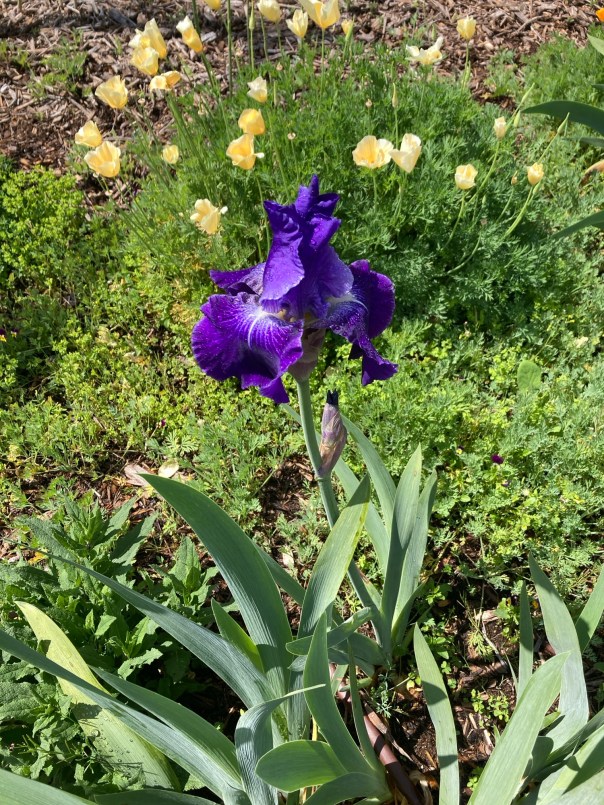
The irises in the front, which are supposed to be tall, but have been short lately, are sending up tall stems with buds now, and they are beginning to open, just as the yellow California poppies are coming on. Now, if the rain will just stop, and the wind turn into a gentle spring breeze…

No one has played an April Fool’s joke on me today — I don’t think. How about you?

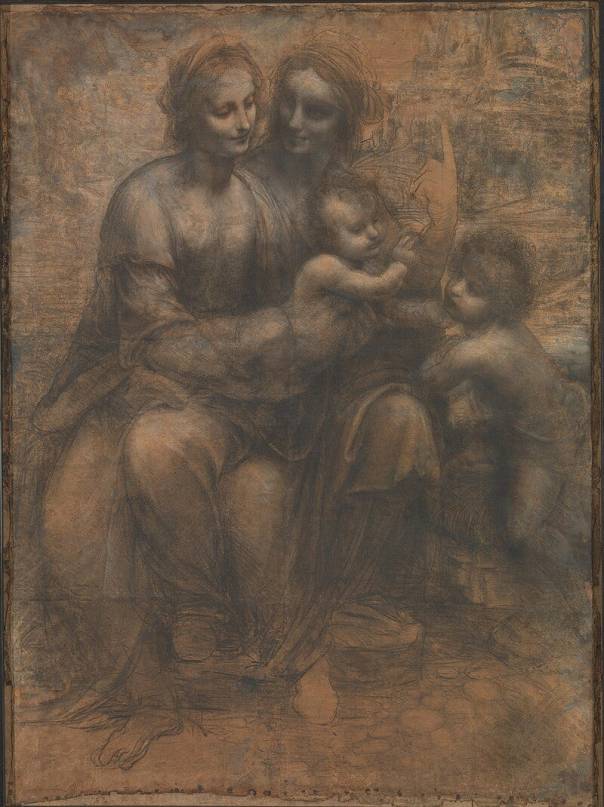
The Burlington House Cartoon

The Virgin and Child with St Anne and John the Baptist – Leonardo Da Vinci, 1499/1500

All I know about this drawing of “The Virgin and Child with St. Anne and John the Baptist” I learned from George Bothamley, who posted the picture on his site Art Every Day. He tells us that it is the largest drawing we have from Leonardo Da Vinci, and we don’t know if he ever completed a painting based on it. On second thought, I do know something that Bothamley couldn’t teach me, just by looking at it with my own eyes and being captivated by the image, which to me is full of joy.

Bothamley explains that the cartoon is “Widely known as ‘The Burlington House Cartoon’ due to it once being the most prominent artwork in the collection in Burlington House at London’s Royal Academy.”

You can read the rest of what he said about it: here.

To make broken things beautiful.

From Mother Melania:

Japanese kintsugi mending tools“Have you ever heard of kintsugi? Literally ‘golden joinery,’ kintsugi is ‘the Japanese art of repairing broken pottery by mending the areas of breakage with urushi lacquer dusted or mixed with powdered gold, silver, or platinum … As a philosophy, it treats breakage and repair as part of the history of an object, rather than something to disguise’ (Thanks, Wikipedia!). I won’t presume to discuss the Japanese philosophies related to this art. But there are certainly deeply Christian parallels to be drawn. Three come immediately to mind.

“First are those who valiantly and humbly endure life’s inequities or unjust persecution, such as Job, Patriarch Joseph, Jeremiah, and the beggar Lazarus. Crushed in various ways through no fault of their own, these saints became beautiful not despite the cracks, but because of how they dealt with them. Without such trials, these saints would never have become as great as they are.

“Second are those who sinned greatly but repented deeply, such as King David, Peter, and Paul. Their great sins are there for all to see and the sins remain sinful. Yet, Christ healed their fractured souls with the gold of their repentance and faithfulness.

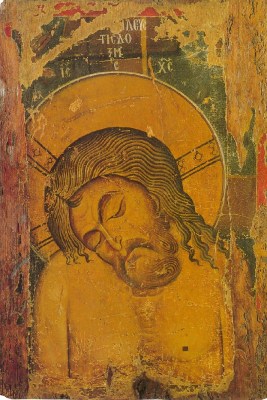
“Then there is Christ Himself. He didn’t just valiantly and humbly endure unjust persecution: He came to earth for that very purpose – for OUR sake. So, His wounded side and hands remain in eternity as visible signs of the beauty of His victorious self-sacrificial love.

“So, let’s take heart. Are we innocently enduring persecution? Christ can make us beautiful through our trials. Have we fallen into serious sin? We can repent and still become great saints. We can even go past these things to suffer freely for love of Christ and His people. Thus, we shall most deeply resemble Him Whose greatest glory is that He was freely broken for our sake.”

—Abbess Melania, Holy Assumption Monastery