My direct experience with horses was mostly long ago when some of my childhood friends owned them and I rode a few times. My late husband and I might have gone on a ride once, too. 95% of what I know about the animals intellectually I learned just a few months ago, from the Flicka series of books by Mary O’Hara. I’d wanted to read them for more than thirty years, as I saw my children enjoying them one by one. Finally I was in the mood and our well-worn paperback copies were still on the shelf — just the right size, too, for reading in bed at night until my eyes would begin to close.
Mary O’Hara
I’ve never read anything like them; I kept wondering who was O’Hara’s intended audience. I used to think they were young adult novels, but now I realize they aren’t. They feature plot threads of coming-of-age, and the young love between one boy and a girl who also loves horses was very sweet and believable. But the adults’ perspective on their children, and the drama of their marriage, seemed to me to be beyond the scope of what a young person would be interested in.
I was surprised at how much the books were about the animals, the wild horses that are the main business of the Wyoming ranch where the family lives and where the boys are expected to participate in the work and bear serious responsibility to a degree that is rare these days. When I read this ancient poem it took me back to O’Hara’s stories, and especially the intimate knowledge of horse behavior that she seems to have.
In the books, not all of the wild horses that the horse tamers deal with are ultimately harnessed and saddled like the one in Ivy’s drawing, and everyone in the ranch family appreciates and respects their free and spirited friskiness and is careful not to entirely kill it.
THE THRACIAN FILLY
Ah tell me why you turn and fly, My little Thracian filly shy? Why turn askance That cruel glance, And think that such a dunce am I?
O I am blest with ample wit To fix the bridle and the bit, And make thee bend Each turning-end In harness all the course of it.
But now ’tis yet the meadow free And frisking it with merry glee; The master yet Has not been met To mount the car and manage thee.
-Anakreon (582 – 485 BC) Greece Translated by Walter Headlam
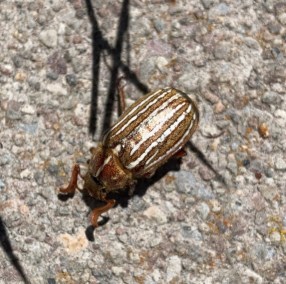
I forgot to show you the summer “bugs” I saw on my trip last week. I know you wouldn’t want to miss them, so I’ll put them at top here. Also so that I can have a flower or something more traditionally pretty at the bottom.
They were all the large size of insects that I only ever see when camping or in the forest, and Pippin does live in the forest. As soon as I would step outside in the early morning my senses took me to mountain camping trips, where the air at the beginning of the day is cool and dry and piney.
Robber Fly
One 95-degree midday Ivy called me over to see a creature resting in the shade on the tree swing. It was a surprisingly still subject, which enabled me to identify it as a Robber Fly. And the morning that I departed, a huge Western Sculpted Pine Borer landed on Pippin’s arm. She brushed it off and then collected it on a paper, where it sat, possibly stunned, and posed.
Western Sculpted Pine BorerButterfly Milkweed
My first morning we found a chipmunk on the front doorstep, which a cat had brought as an offering. The second day the sliding door would not shut, and the children and I finally figured out that a dead mouse was jammed between the two doors. I could not access it to get it out, but when she got home Pippin managed after laboring with a yardstick. The next morning another mouse was left at that back doorstep, which I disposed of. Four cats live with the family and at least two are hunters.
We watched “My Octopus Teacher” one night. Have I already mentioned that movie? I also saw it with my Colorado children last summer, and like it very much. I’ve heard a couple of people say that they wish there were less of the narrator and more of the octopus, but if it weren’t for the narrator-photographer, who visited the octopus nearly every day for a year, there would be no story. He had to tell it in his way.
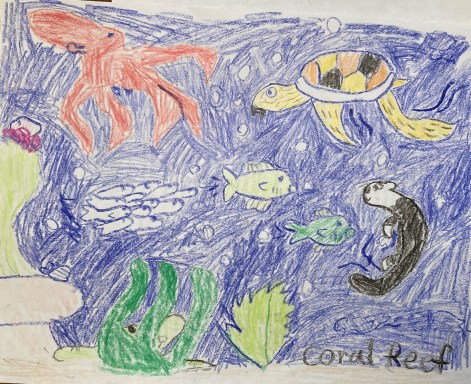
As it is about how the whole experience of interacting with the octopus helped him move into a healthier life and frame of mind, I have to take it as it is, take the human subject as he is. Without agreeing with all of his presuppositions about nature, I very much appreciate that his relationship with the creature was thrilling and healing. Ivy declared that it is her favorite nature movie. Over the next several days she drew one picture after another of ocean landscapes.
Often the children would draw while I read to them, and I read for at least an hour every evening before bed. Mostly this time I read from The Little Bookroom by Eleanor Farjeon. I gave this book to my grandchildren a few years ago, thinking it was an anthology she had compiled of others’ works. But no, all the stories are by Farjeon herself.
They are the most unusual children’s stories I’ve ever read, a combination of fairy tale style with more realistic everyday happenings, and silly stories that make us laugh and laugh. But all happy hearted, and many brimming with pure Goodness. If Scout had not been away at Boy Scout Camp, he would have insisted that we read “The Princess Who Cried for the Moon,” a very long story about a whole kingdom of people who don’t have their thinking caps on.
Eleanor Farjeon
I still haven’t read the whole lot, but I did notice that the last entry in this edition is not a story by Eleanor but a piece titled, “Tea with Eleanor Farjeon,” by my beloved Rumer Godden. I read that one aloud, too, and Ivy was interested but Jamie drifted away. Eleanor sounds like the sort of old lady I would like to be. I wanted to quote from Godden’s article, but I can’t find my own copy of the storybook at the moment.
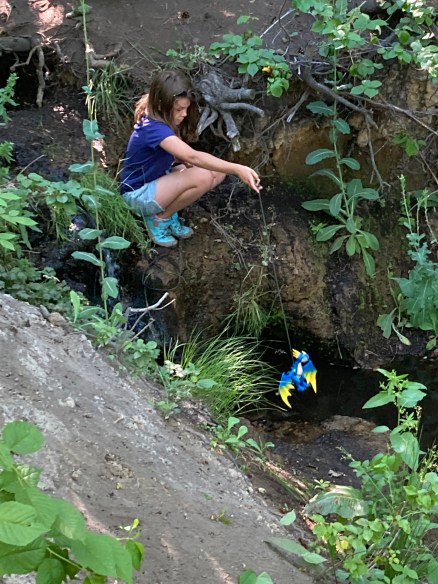
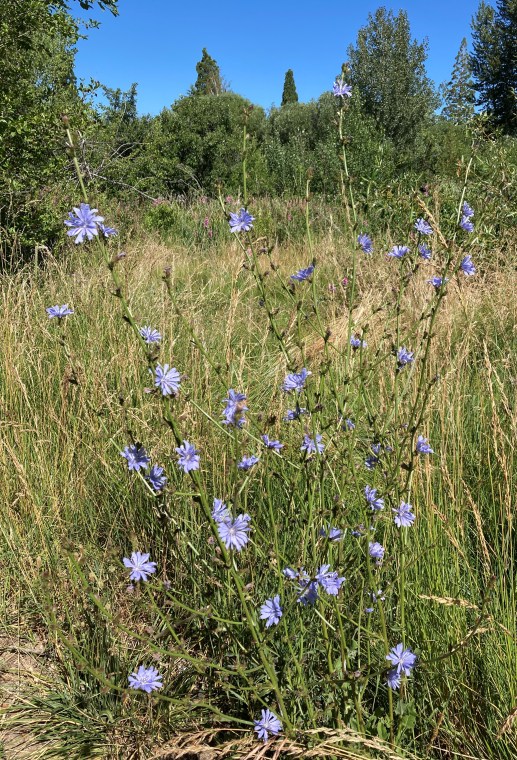
I spent six nights last week at Pippin’s Mountain Homestead, longer than any other visit. That gave me time to go with the children to the library and to have a breakfast picnic in their favorite park that features a tiny waterfall and “jungle.” Ivy made her dragon to fly over the creek, and I discovered chicory and more.
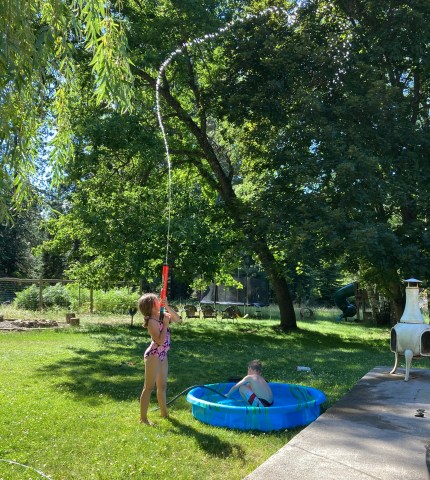
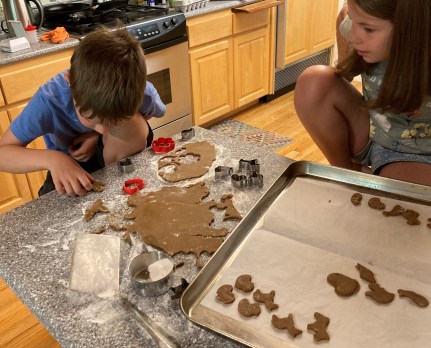
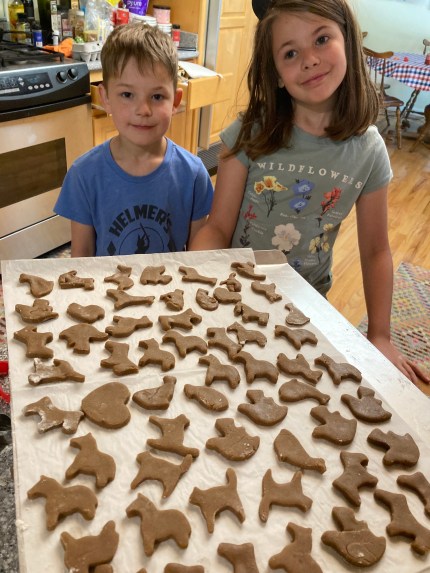
There was lots of water play in the back yard, resulting in burned shoulders. And a big batch of gingerbread for cutting out with my new tiny animal cutters.
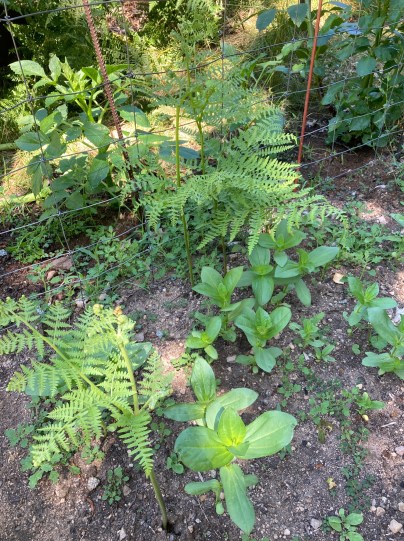
I suppose it’s because Pippin’s garden in the middle of the forest gets extra water, that the ferns constantly encroach. I was watering the new zinnia and dahlia sprouts and wondering at the robust ferns still popping up everywhere. They push against the deer fence that surrounds the vegetable and dahlia enclosure, and try to colonize the whole inside space, too.
Where I pulled out a few fronds to let sunlight on to a strawberry bed, we saw that frogs had been living among them. And while I aimed the hose at small flower plants, Duncan cat lay nearby in his cool and ferny hideaway and begged me to leave that colony as is. And for now it remains, another corner of the estate hospitable to critters.
Windows above my kitchen sink and near my computer look out on the garden. When the evening sun’s slanting rays make flower stalks shimmer, it is my favorite sort of painting to gaze at, and I can hardly believe it is right here in my back yard — especially in spring when swaths of those blooms are popping up in turn and in overlapping layers, first the white ixia, then blue penstemon and the palest yellow-white California poppies, now the lavender and the rusty yarrow, and banks of little daisies I can never remember the name of.
Probably I should go back and read some of Elizabeth Von Arnim’s descriptions of gardens, to teach me how to convey the scene that makes me so happy. Not only in Elizabeth and Her German Garden but even more in The Enchanted April she expresses her love for this kind of overflowing, colorful and scented landscape, and gardens that are so prolific with blooms that bowls of them bless the rooms of the Italian castle in April (in April, too).
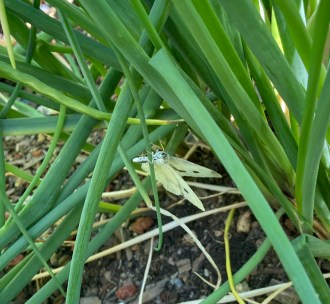
I don’t have a cutting garden most of the time, but right now I am still getting a few heavenly-sweet sweet peas with short stems. When I was snipping them to stick into a tiny vase today, I spied a Cabbage White in the patch of chives. As I understand, those caterpillars eat just about anything, and some years I have seen evidence of that behavior. I wonder how this year will be….
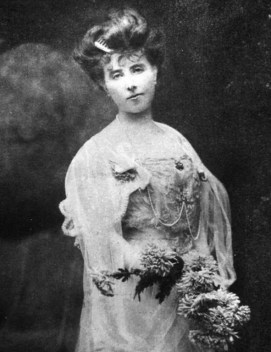
I just discovered that I have never once reviewed a book by Elizabeth von Arnim, or posted a quote by her, on my blog. I guess this is because my relationship with her as a person and writer is about much more than any one of her books; and isn’t it always somewhat of a mystery why we connect with particular authors? Mary Kathryn says it is the writer’s voice that she connects with, and it doesn’t matter what they write about, if one loves that particular voice.
The distance in time and culture between Elizabeth and me seems vast, though it is “only” 100 years. Our life experiences are worlds apart, but as I’ve listened to her voice and her stories, rich with humor that makes me laugh out loud, I’ve been comforted again and again. Today, I didn’t know her name would even come up. Since it has, and while it is yet springtime, here are some words from her that express the feelings of us both:
“Oh, I could dance and sing for joy that the spring is here! What a resurrection of beauty there is in my garden, and of brightest hope in my heart.”
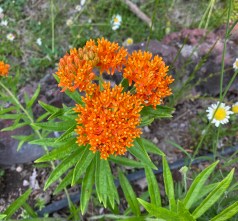
Today when I went out to try for a picture of the Lambs Ears, I discovered that the Narrow-Leaf Milkweed flowers have started to open. These are the plants from which I collected Monarch butterfly eggs to incubate indoors, a few years ago. Aphids always decimate the plants, and after that first year’s destruction I realized that any hatched caterpillars would run out of food fast, because the leaves are literally slim pickings to begin with, and then the aphids suck all the life out of them. (By the way, you don’t want to bring in ladybugs to eat the aphids on your milkweed plants because ladybugs also eat Monarch eggs!!) Back then I had to feed my Monarch caterpillars from my Showy Milkweed plants which have large leaves and which the aphids don’t bother so much.
So far the aphids have not arrived — or at least, not noticeably. And the two plants of this species of milkweed come up bigger every spring. I see in the photo enlarged here that ants are among the insects hanging out there, so maybe the aphids will come soon. But for now, their delicate flower crowns are pristine. The bees will soon be “dancing” around them for joy.
I’m still in the middle of Jacque Ellul’s great work, The Technological Society, which is really helpful in understanding the way our modern world works. When Ellul talks about technique he does not mean merely the physical machinery or medicine or digital technology, but more importantly, the manner in which so much of our life is managed according to systems and measurements; our activities are prompted and organized according to the primary value of efficiency. Here he explains it himself: “Technique”
Not bothered by the fact that I haven’t finished that book (or his Humiliation of the Word, which I also loved), I began to listen to another one by the author: Propaganda. Propaganda is just one facet of the technological society. Ellul’s books are so thought-provoking and full of insights, it’s hard for me to pick a few of the best paragraphs to share. But here is one, which I broke up into smaller parts for ease of reading:
“To the extent that propaganda is based on current news, it cannot permit time for thought or reflection. A man caught up in the news must remain on the surface of the event; he is carried along in the current, and can at no time take a respite to judge and appreciate; he can never stop to reflect. There is never any awareness — of himself, of his condition, of his society — for the man who lives by current events.
“Such a man never stops to investigate any one point, any more than he will tie together a series of news events. We already have mentioned man’s inability to consider several facts or events simultaneously and to make a synthesis of them in order to face or to oppose them. One thought drives away another; old facts are chased by new ones. Under these conditions there can be no thought. And, in fact, modern man does not think about current problems; he feels them. He reacts, but he does not understand them any more than he takes responsibility for them. He is even less capable of spotting any inconsistency between successive facts; man’s capacity to forget is unlimited. This is one of the most important and useful points for the propagandist, who can always be sure that a particular propaganda theme, statement, or event will be forgotten within a few weeks.
“Moreover, there is a spontaneous defensive reaction in the individual against an excess of information and — to the extent that he clings (unconsciously) to the unity of his own person — against inconsistencies. The best defense here is to forget the preceding event. In so doing, man denies his own continuity; to the same extent that he lives on the surface of events and makes today’s events his life by obliterating yesterday’s news, he refuses to see the contradictions in his own life and condemns himself to a life of successive moments, discontinuous and fragmented.”
-Jacques Ellul, Propaganda: The Formation of Men’s Attitudes, 1965




 Often the children would draw while I read to them, and I read for at least an hour every evening before bed. Mostly this time I read from The Little Bookroom by Eleanor Farjeon. I gave this book to my grandchildren a few years ago, thinking it was an anthology she had compiled of others’ works. But no, all the stories are by Farjeon herself.





 Probably I should go back and read some of Elizabeth Von Arnim’s descriptions of gardens, to teach me how to convey the scene that makes me so happy. Not only in Elizabeth and Her German Garden but even more in The Enchanted April she expresses her love for this kind of overflowing, colorful and scented landscape, and gardens that are so prolific with blooms that bowls of them bless the rooms of the Italian castle in April (in April, too).
 I just discovered that I have never once reviewed a book by Elizabeth von Arnim, or posted a quote by her, on my blog. I guess this is because my relationship with her as a person and writer is about much more than any one of her books; and isn’t it always somewhat of a mystery why we connect with particular authors? Mary Kathryn says it is the writer’s voice that she connects with, and it doesn’t matter what they write about, if one loves that particular voice.
 Today when I went out to try for a picture of the Lambs Ears, I discovered that the Narrow-Leaf Milkweed flowers have started to open. These are the plants from which I collected Monarch butterfly eggs to incubate indoors, a few years ago. Aphids always decimate the plants, and after that first year’s destruction I realized that any hatched caterpillars would run out of food fast, because the leaves are literally slim pickings to begin with, and then the aphids suck all the life out of them. (By the way, you don’t want to bring in ladybugs to eat the aphids on your milkweed plants because ladybugs also eat Monarch eggs!!) Back then I had to feed my Monarch caterpillars from my Showy Milkweed plants which have large leaves and which the aphids don’t bother so much.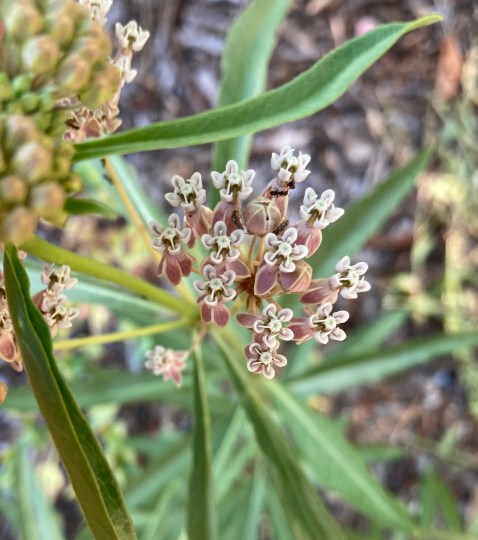
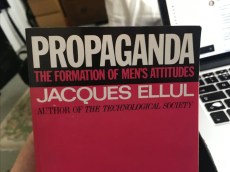 Not bothered by the fact that I haven’t finished that book (or his Humiliation of the Word, which I also loved), I began to listen to another one by the author: Propaganda. Propaganda is just one facet of the technological society. Ellul’s books are so thought-provoking and full of insights, it’s hard for me to pick a few of the best paragraphs to share. But here is one, which I broke up into smaller parts for ease of reading:
 “Such a man never stops to investigate any one point, any more than he will tie together a series of news events. We already have mentioned man’s inability to consider several facts or events simultaneously and to make a synthesis of them in order to face or to oppose them. One thought drives away another; old facts are chased by new ones. Under these conditions there can be no thought. And, in fact, modern man does not think about current problems; he feels them. He reacts, but he does not understand them any more than he takes responsibility for them. He is even less capable of spotting any inconsistency between successive facts; man’s capacity to forget is unlimited. This is one of the most important and useful points for the propagandist, who can always be sure that a particular propaganda theme, statement, or event will be forgotten within a few weeks.

