“What Was Said to the Rose” is a poem by Rumi, the Sufi mystic. I listened to it along with several others on a recording played through my car’s stereo on my drive up to daughter Pippin’s house last month.

For the first hour or more I didn’t listen to anything. I am surprised to find that I like just looking at the scenery in our beautiful state. I live in Northern California, and so does Pippin. But she is five hours farther north than I am, and still not at the top of the state.
Some people who have never been here imagine the cities of Los Angeles and San Francisco and have no idea that there is anything north of the latter. But if you’ve read my blog very long you know that there is a wide realm of land to love, and every time I drive through it I love it more.
It is said that Rumi is the most popular poet in the United States. I have one book of his poems, which I rarely crack, and I heard a recording of the translator Coleman Barks reading Rumi a few years back. I enjoy Barks’s personality and southern drawl almost as much as Rumi’s poems. You can hear him reading this poem on a YouTube recording; I think it might be from the same event I was listening to.
Rumi was a Persian Muslim mystic in the 13th century. It seems that the order of whirling dervishes was formed to propagate his poetry and wisdom. He does write as though his meditation and asceticism opened his heart to God, whom he calls “The Beloved” in many poems. The tone of this one is representative of many that I have read, and it inspires praise and joy in me. The version I transcribed here does not have the first line as its title.
WHAT WAS TOLD, THAT
What was said to the rose that made it open
was said to me here in my chest.
What was told the Cypress that made it strong
and straight, what was
whispered the jasmine so it is what it is, whatever made
sugarcane sweet, whatever
was said to the inhabitants of the town of Chigil in
Turkestan that makes them
so handsome, whatever lets the pomegranate flower blush
like a human face, that is
being said to me now. I blush. Whatever put eloquence in
language, that’s happening here.
The great warehouse doors open; I fill with gratitude,
chewing a piece of sugarcane,
in love with the one to whom every that belongs!
–Jalal al-Din Rumi, 1207–1273, translated by Coleman Barks
Perhaps I listened to some music after Rumi. I hope I didn’t jump right into Percy Jackson’s Greek Heroes, which though it references the ancients, is on the opposite side of the literary world from Rumi. I reviewed Rick Riordan’s earlier series a few years ago, about Percy Jackson the demigod and his adventures with the super dysfunctional divine side of his family. I can’t remember much of that one book I read, but when I discovered that the author had more recently retold the original Greek myths (starting with Percy Jackson’s Greek Gods) I thought it would be an even more helpful and fun addition to my haphazard effort to be better educated.
It is more hilarious than the original series. I think that it might also be more entrenched in the middle-school vernacular, including that four-letter “S” word for anything disappointing or bad that is so mainstream now that my own grandchildren are using it in my presence. It’s a sign of the degradation of society, but I guess that fits right in with this collection of stories, because certainly the Greek gods exhibit lots of degraded behavior themselves. Still, it makes me not want to recommend the book to kids.
As I drove up t he interstate I could not helping laughing out loud at the lighthearted descriptions of the silly gods and goddesses and the way that Percy tells the drama and draws the characters using modern-day cultural phenomena and slang. Aphrodite sits around reading fashion magazines and looking at herself in the mirror, and various beautiful humans and gods are described as “hot.” The egotism of many of the gods is easily recognized as being like that of some foolish celebrities in the news, or the kids at school who get into trouble, or hurt someone innocent, because of their stupidity and selfishness.
I played a few minutes for Kate the other day and she laughed a lot, too, but she could see why after a couple of hours of these stories I might get tired of them. Is it really necessary to write for such a narrow target audience? How soon will these books sound dated to that age group? I don’t really care that much. The stories are hugely entertaining even for this grandma, and I hope Riordan won’t stop writing for a long time. I don’t know that I will buy a hard copy, though, even though the illustrations are well done.
I turned off my tablet when I got close to Pippin’s house. I drove into the driveway and unloaded my goodies, including an armful of books for the children that I had bought at the thrift store. We read about Ping and Paul Bunyan, and I was glad that these dear hearts aren’t at the age for hearing about Percy and his cohorts yet. They’ll be ready for Rumi sooner.
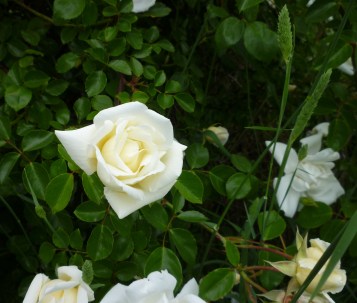


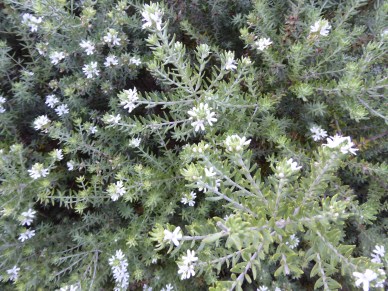
 oo, and found families of ducks to take pictures of. We didn’t spend too long, but I managed to take many pictures with identifying signs next to the plants that I liked, so I didn’t have to take the time to write down names.
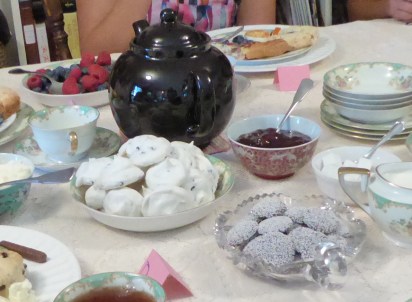
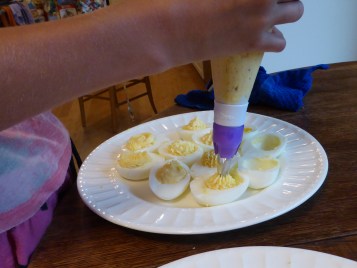 scones with jam and creme fraiche; chocolate pastilles; ham and Swiss quiche made on puff pastry; fresh blueberries and raspberries; chocolate orange sticks; some fancy chocolate and sprinkle-dipped Rice Krispy treats we discovered on one shopping trip; and of course the tea, black and rooibos, and hot cocoa for little girls who preferred that. They all did.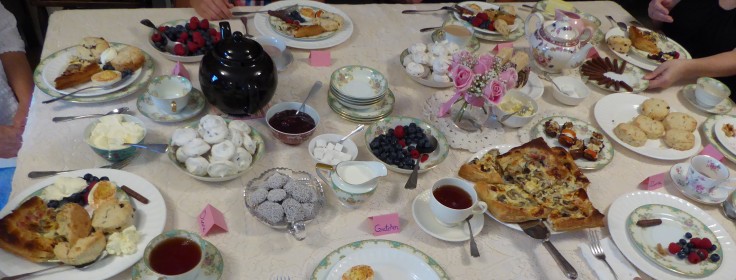
 ae – but could I find the paper I wrote on, just now? No! So I washed dishes and listened again to the last few chapters of the book till I could find the place again.
 ger than before, and I’m sure her parents are wiser, too.
 One of the books that Richard Wilbur wrote for children is Pig in the Spigot, which any lover of words should enjoy, whether you are a child or not. I can see reading it with a child who is well on the way to reading, but when I was homeschooling I often would introduce material “too early,” and that can work, too. If used with a notepad and pencil, I bet I could make this book serve as reading/phonics lessons for at least a week.

