Category Archives: books

RFC for Butter Week

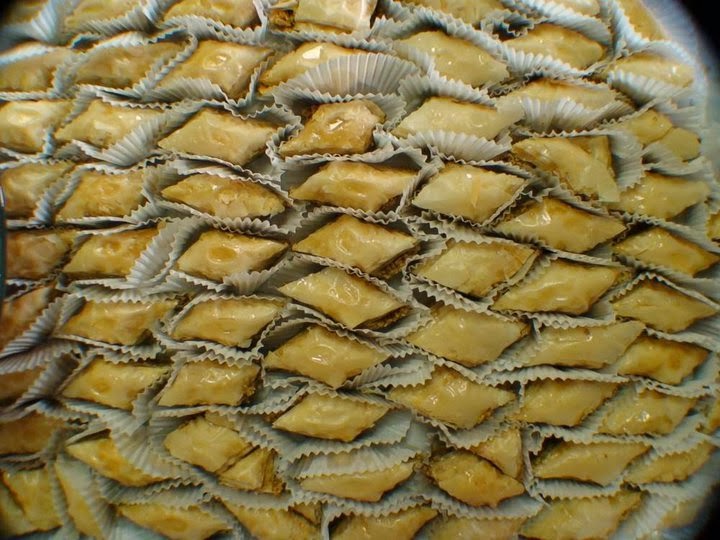
Please don’t try Roger Farrar Capon’s baklava recipe. He describes it as “french-fried,” and yes, it does involved a large quantity of oil ! which I declare a horrid perversion of the spirit of baklava. This is the first thing I have found in The Supper of the Lamb that has so disappointed and surprised me. I guess no one can be perfect.

But the perfect baklava recipe does exist, simplicity itself for method; and for taste, the divine melding of flavors, of which that of Butter is central. It is the one used in my parish to make umpteen sheet pans of baklava every year for festivals and celebratory meals, and I will eventually make it at home and share the recipe here.
As I write, we Orthodox Christians are in the midst of what is sometimes called Butter Week, the week before Lent properly begins, and the last in which we eat dairy products (but start fasting from meat). The perfect time to tell about Capon’s attitude toward butter, which I am very sympathetic to. For example, at the end of a section on sauces he shares:

One last secret. There is almost no sauce that will not be improved by having a lump of butter whisked into it the moment before it is served. In addition to what it does for the flavor, it provides the sauce itself with a patina, a sheen which delights the eye even before the palate begins to judge. It is an embellishment not lightly to be forgone. Dishes should come to the table vested, robed. Don Giovanni is marvelous any way you can get to hear it. But given a choice between seeing it performed full dress, or on a bare stage with the cast in T shirts and sneakers, no rational man would hesitate. A great sauce deserves a great finish. Whatever you do, therefore, don’t omit the final grace — the loving pat of butter.

Those last words remind me of my grandmother, who showed this kind of love in her kitchen and to those she fed, including herself, and she lived healthily and on her own past the age of 100. I can still picture her standing by the stove and tucking fat pats of butter into the slits she had made in our baked potatoes just before taking them to the dining table.

Capon considers bread and butter, or cheese, to be basic ferial (everyday) food for those meals that one is keeping simple and light, for the sake of being able to enjoy real feasting less often. I’ll write more on that principle later. In contrast to bread and butter, we have what RFC calls “the epitome of baking”: pastry. He gives a lot of time and great detail to teaching us how to make puff pastry and Danish pastry, which must be made with butter, of course. I personally am not interested in this kind of cooking at my stage of life, and am happy to eat my butter in a hundred places other than pastry. Capon explains further that butter

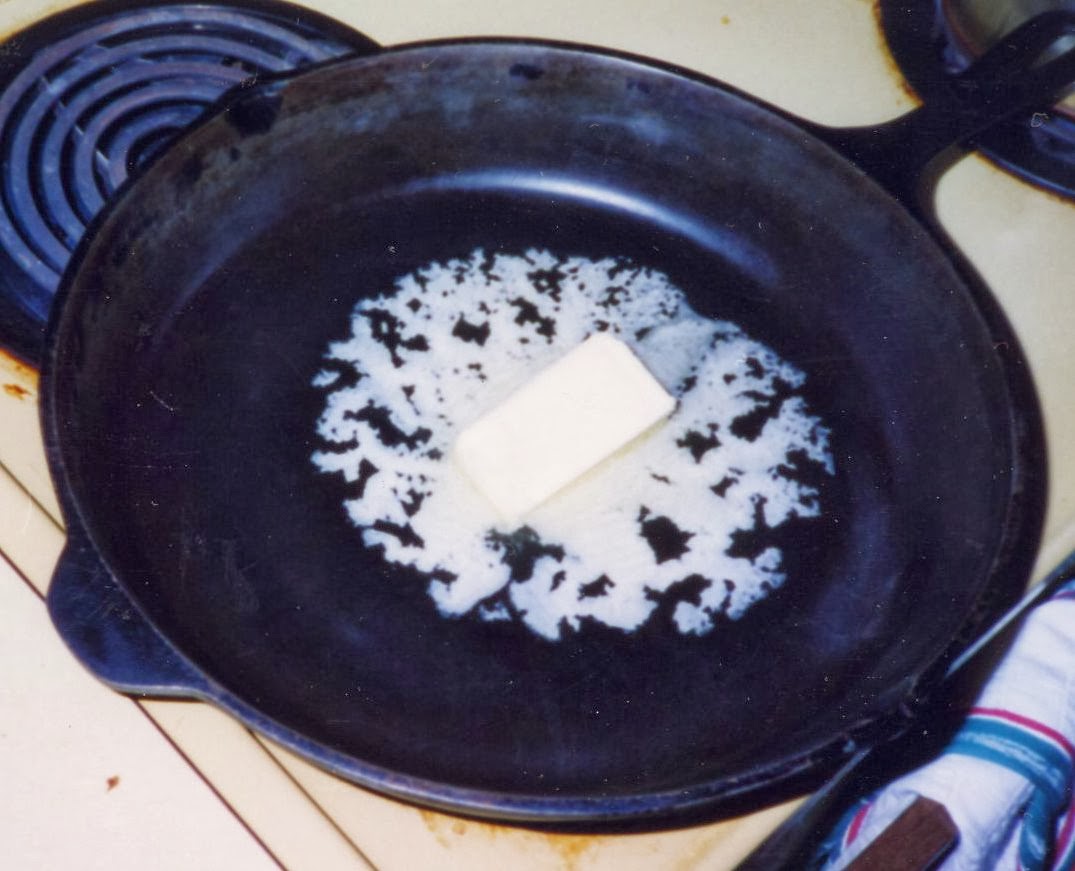
…is not, in any except the merely technical sense of the word, grease. It melts at the temperature of the tongue, and consequently goes down as easily as cream. (You do not like to drink cream? I am sorry. Let us agree to disagree and get on with it.) Any man who cannot tell the difference between butter and margarine has callouses on the inside of his mouth…Butter is a substance in its own right, justified by its own delectability, not by its contributory services. It is a unique and solid sauce; it is apt to more dishes than anything in the world, and it is, like all the greatest sauces, worthy of being eaten plain.

Besides pastry, there are many recipes at the back of the book that feature this blessed food, including what look to be very nice cakes and cookies. I think all of us have plenty of that kind of recipe already, and if you don’t, just look on my own Recipes and Vague Instructions page on this blog. I wholeheartedly agree with RFC that butter “glorifies almost everything it touches.”
Other posts in this series are:
RFC is the man we need.
RFC begins with the meat.
RFC considers blood and sacrifice.
RFC makes one of nature’s marvels.

RFC makes one of nature’s marvels.

In the chapter titled “Living Water” in The Supper of the Lamb, in which we learn how to make Brown Stock and White Stock, Robert Farrar Capon continues, “…you are now ready for the really astonishing part of the exercise.” It’s the lead-in to another of the recipes that are scattered throughout the first two-thirds of The Supper of the Lamb, with more of them concentrated in the recipe section at the back.

Many of the recipes seem a little outdated now, but I doubt I’d have taken to the foods featured in Supper even in 1969 when it was first published, because I was just learning to live on my own and to eat rice and vegetables. Our ferial eating in those days was sparser of meat and wine than RFC could have imagined, and Diet for a Small Planet was the go-to cookbook. It would be another ten or fifteen years before I bought my first leg of lamb.

Nowadays I am well supplied with recipes for most everything I could possibly want to cook, but Capon’s next suggestion sounds so strange and appealing that I think I will have to try it eventually. If I had to choose between meat and butter, two foods at the top of my list of culinary loves, I guess I’m just sensible enough to choose meat, and when RFC tells me I can capture its “heart and soul” in my kitchen, I can’t resist his encouragement to create something of which he also claims, “…you will find yourself whittling off little pieces to dissolve on your tongue at odd times of the day.”

I’ll just give you the whole recipe here, because though we no doubt can find a version online, I naturally like the style of this one. It will be my last “meaty” post on this book, because in my church we are beginning our Lenten fast from meat very soon, and it’s time for me to turn the page.

HOMEMADE MEAT GLAZE
(Meat Extract)

Take the strainerful of bones and scraps [from which you have made the stock] and put them back into the stockpot. Add any scraps of meat you have around: poultry, pork, veal — even leftover hamburger — just stay away from lamb and ham. Meat extract can, of course, be made from the used bones alone, but anything that brings more natural gelatin to the pot is welcome. Cover everything deeply with cold water, adding no salt at all, and boil for two or three hours more.

That done, strain once again, this time into a large saucepan. Discard the bones. (They have been worked to death. Even the dog will look down his nose at them now.)

Boil the contents of the pan hard, skimming the froth from the top now and then, until the liquid is drastically reduced. When it is down to about a pint, transfer it to a smaller pan and boil on, over slightly reduced heat. Continue boiling until it reaches the consistency of a thick, blackish-brown syrup (half a cup, give or take a little). Pour this into a heatproof jar, cool, and refrigerate.

You now have, perhaps for the first time in your life, real meat extract — one of nature’s marvels. It is, of course, highly concentrated gelatin, but it has been imbued with the heart and soul of meat. Its taste is beautiful. Moreover, in spite of the fact that no speck of salt went into all those quarts of water the second time around, it is salted to perfection. Its consistency is, admittedly, a little forbidding; It is not unlike a young and tender shoe heel. Refrigerated, it will keep in this state for weeks; but, obligingly enough, it melts at the temperature of the mouth. If you are any lover of food at all, you will find yourself whittling off little pieces to dissolve on your tongue at odd times of the day.

Use it ad lib. Its general effect is to give a sauce soul and substance without overpowering the proper flavor of the dish. Experiment. It improves almost anything. A tablespoonful melted in warm Hollandaise imparts a certain roundness and resonance to what is sometimes an excessively light and lemony sauce. A piece dropped on top of a hot fried egg (plus a dash of Tabasco, if you are up to it) is delightful. And in the form of Colbert Butter, it is the perfect accompaniment to steaks, chops, fish, or poultry — not to mention a piece of matzoh at three in the afternoon.

RFC considers blood and sacrifice.

I owe you something more, however — something darker — on the subject of meat: The minor leads inexorably to the monumental. Lamb has set our feet in a large room indeed. Man not only dines: he also kills and sacrifices. The room in which he relishes the animal orders lies between slaughterhouse and temple. There are death’s heads at each end of the table of the world.

In The Supper of the Lamb: A Culinary Reflection Robert Farrar Capon introduces what is perhaps the most poetic chapter with this paragraph. He explores our human proclivity to hunting and butchering and the Jewish temple sacrifices in a long poem that I mostly didn’t have the patience for, though I liked its division into sections named for the categories of the car game:

Animal, Vegetable, Mineral;
Testing the textures of creation,
savoring the styles of its coinherence.

After describing the neat and clean Mineral parts of our world, he moves on to the Vegetable, “the kingdom of seed, birth, life….And for the first time,/ the reek of death.” But

Onions die quietly,
Cabbages shed no blood;
All plants forgive:
By the waters that comprise them
They wash man’s hands
And let him walk away.

Eating vegetables is so innocent. But Capon doesn’t want to ignore the reality of our place as carnivores, so he unapologetically moves on to the Animal kingdom

each man owning the honest interchange by which he steals his livelihood; each woman’s hand intimate with the crack of wrung neck and severed spine….

It is not possible or even desirable to distill the writer’s poem into a fully satisfying theology, but I wanted my readers to know that he does satisfy himself with the mysteries of God’s plan of salvation, of which the temple sacrifices were a foreshadowing of Christ’s sacrifice on the cross.

The world awaits
The unimaginable union
By which the Lion lifts Himself Lamb slain
And, Priest and Victim,
Brings
The City
Home.

Other posts in this series are:
RFC is the man we need.
RFC begins with the meat.

wintertime loves

We in the arid parts of the West have been exulting in rain the last week or so. It’s so comforting and even glorious to wake in the night and hear the rain still coming down. Then to wake in the morning and see it is still falling. We had puddles in the back yard! Thank you, Lord!
Mr. Glad and I do live in northern California, but daughter Pippin lives even farther north in the state, and we drove there early this week for a short visit. Often February is a very snowy month at her place, but this year they’ve had more dry weather and rain than snow, and even the rain stopped while we were there, so we could get outdoors easily for work and recreation.

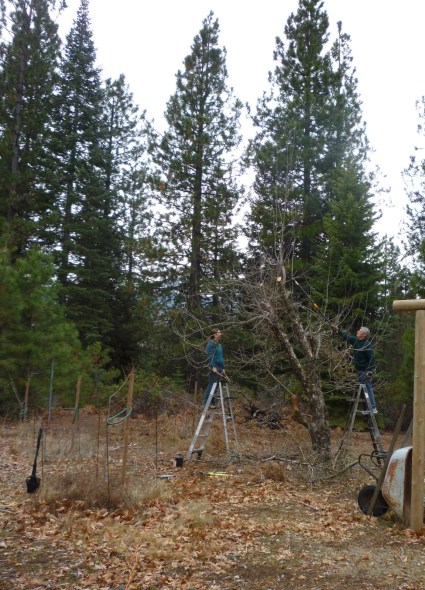
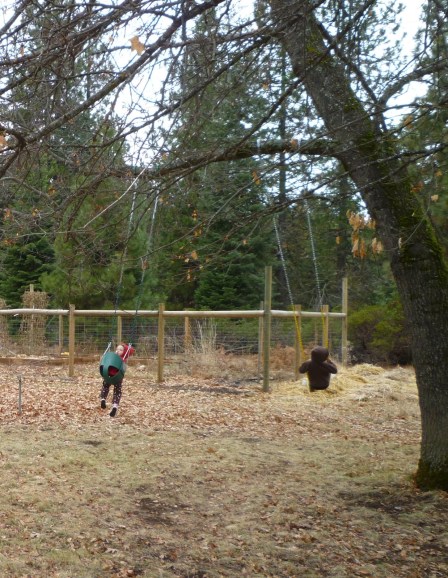
One day we made a family project out of pruning old apple trees that Pippin and The Professor are trying to revive from years of neglect. I floated back and forth between lopping branches and swinging the kids.

I would get Scout and Ivy going and then run over
to take a picture of the adults on ladders.

Another day we took a short trip to Castle Crags State Park and walked a trail alongside the Sacramento River. Considering the dryness of this year, I was amazed at the thick moss and ferns.

 A pale green, almost white lichen grew on rocks and tree stumps.

yew trees on the riverbank

Everything was wet from the recent rains, and many times our feet slipped on the invisible mosses — or was it algae? — growing on wooden bridges or river rocks.Ivy practiced throwing pebbles into the river, and once she got the hang of it she did not want to do anything else. The supply of rocks was endless.We went to the confluence of Castle Creek (in the foreground below) and the Sacramento River, from which you can get great views of the jagged rocks above, called the Castle Crags. They are high enough that the recent precipitation there was in the form of snow, and some was still unmelted and visible.


My dear husband showed me this large and artsy rock, which you can also see in the photo at the very top of this post, in its original setting. I wanted to take it home. It was a little too heavy for me to carry, so The Professor hauled it back to the car. It came with us on our journey home and is now living by our house. Mr. Glad classified it as a confluitic rock. 🙂

Winter days are short enough that at the end of our busy days there was plenty of time for cozy gatherings in the kitchen or by the wood stove. I read many books to the children. Scout’s current favorite, which I read about on a blog before Christmas and gave to him, is Bumblebee at Apple Tree Lane, and we read it several times.

Ivy likes The Little Fur Family best right now. We danced to the children’s favorite recordings, and also listened to bird calls on the Stokes Field Guide to Bird Songs CD. After ten minutes of loons and other waterfowl, Ivy must have deduced that those bird songs were some kind of dance music, too, and she started twisting and prancing around.

Hot soup is what you need on a winter’s night, so Pippin and I learned how to make French Onion Soup, using the recipe in The New Best Recipe: All-New Edition by Cook’s Illustrated Magazine. The secret that the Cook’s testers learned is that red onions give the best flavor. Our result was sooo good.

And cookies! Pippin had some dough left in the freezer from her Christmas Peppernuts, the recipe that I concocted a long time ago but haven’t made for years. We like our nuts to be nut-sized, so we always cut the frozen dough into little cubes and bake them long enough that they come out crispy. Next Christmas I’ll give the recipe.But for now, since I do love cookies, they make a good ending to my story of a wintry family visit that was warm and sweet.

peppernuts 13-14