Category Archives: books

Limón in the Cazuela

The Cazuela That the Farm Maiden Stirred by Samantha R. Vamos is a delightful Hispanic incarnation of The House that Jack Built. It tells the story of a rice pudding from the farm to the table. The reader is introduced to two new words, first in English, every time he turns the page. From then on, those key words are only written in Spanish.

Before I opened the book, Mr. Glad was enjoying it and noticed that the word for lime was much like our lemon. That made me wonder what the word for lemon is.

New World Spanish-English Dictionary sits on the reference shelf here as a leftover from the days when four of our children in turn studied Spanish. Even though their father and I never did study that language that is so useful, almost essential, in California, we’ve lived here our whole lives and have picked up some vocabulary, sometimes by consulting this word book, as I did on this occasion.

The hen helps by grating the limón

I don’t know why, but my dictionary is wrong about limón. It says that it means lemon, and that if you want to talk about a lime you say lima. I found it hard to believe that this book written by a woman with a Hispanic name, illustrated by a man with a Hispanic name, with the intent of teaching 21 words, would get any wrong.

But I have a friend who is married to a Mexican man and teaches at a bilingual school, and I couldn’t pass up the opportunity to ask my local expert. She wrote, “Okay babe. Limón means lime and limón agria or limón Amarillo can mean lemon. There is a lemon-like fruit called Lima limón. There are not lemons like we have here in the U.S. in Mexico.” That seemed a pretty authoritative word on the subject.

This is a picture book, an Easy Reader, so I must not forget to mention the illustrations, which as you can see from these sample pages I photographed are party-bright, full of the joy and fun of cooking together.

At the back you will find a glossary with pronunciations, in case your Spanish is rusty, and best of all, a recipe for rice pudding. What I would love to do with a young child is read the book, make the pudding together while using the English and Spanish words to talk about the ingredients, and then read the book again while the cazuela simmers.

I would rather one of my grandchildren helped me in the kitchen, while we keep the animals outdoors or in the pages of the book. But an arroz con leche pudding with plenty of crema and some zest of limón would suit me just fine.

Apples I Have Known – in a book

Janet blogged recently about an apple-picking expedition, with photos that reminded me of excursions to the apple orchard that has been our family’s favorite vender for decades. We didn’t make it out there this year — yet.

The number of munching, saucing and pie-baking kids and grandkids that we had around here at times could consume quite a few bags and boxes of fruit during apple season, and our grower friend featured almost 30 varieties of apples, which kept his barn open to customers for a deliciously long time.

My daughter whom I call by the name of a favorite apple gave me a small book that is fun to peruse when the apple farm closes, or when there isn’t enough demand for fresh fruit in the house. It is all about various kinds of apples, with bright watercolors of those featured. Some old varieties, some newer.

Above is the Cortland that Janet is enjoying. If you want to read the text in any photo just click on the picture to enlarge it.

The Arkansas Black is one of that large selection on the local apple farm, and I have cooked with it many times.

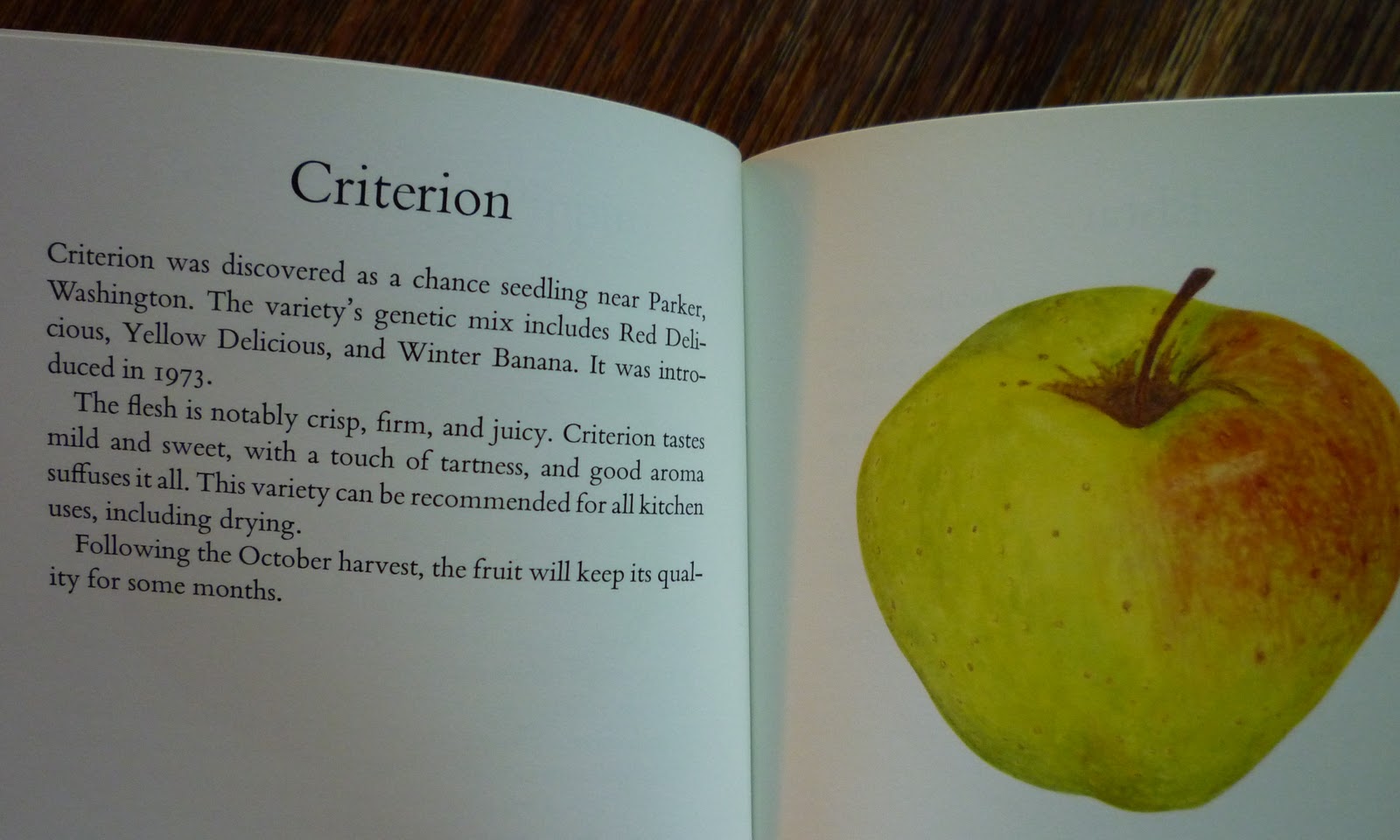
Another friend and neighbor grew an orchard full of Criterions and sold gallons of the fresh juice out of his barn. Our older kids helped on the ranch, thinning the crop and such like, and no doubt these extra sweet and crisp fruits contributed to their good health.

Jonathans were a favorite of my father, as I discovered late in his life when I was given a boxful of runts. Late in the mountain season I sat in his cabin cutting up the fruit for applesauce, and he ate a dozen while youthful memories flooded his head.


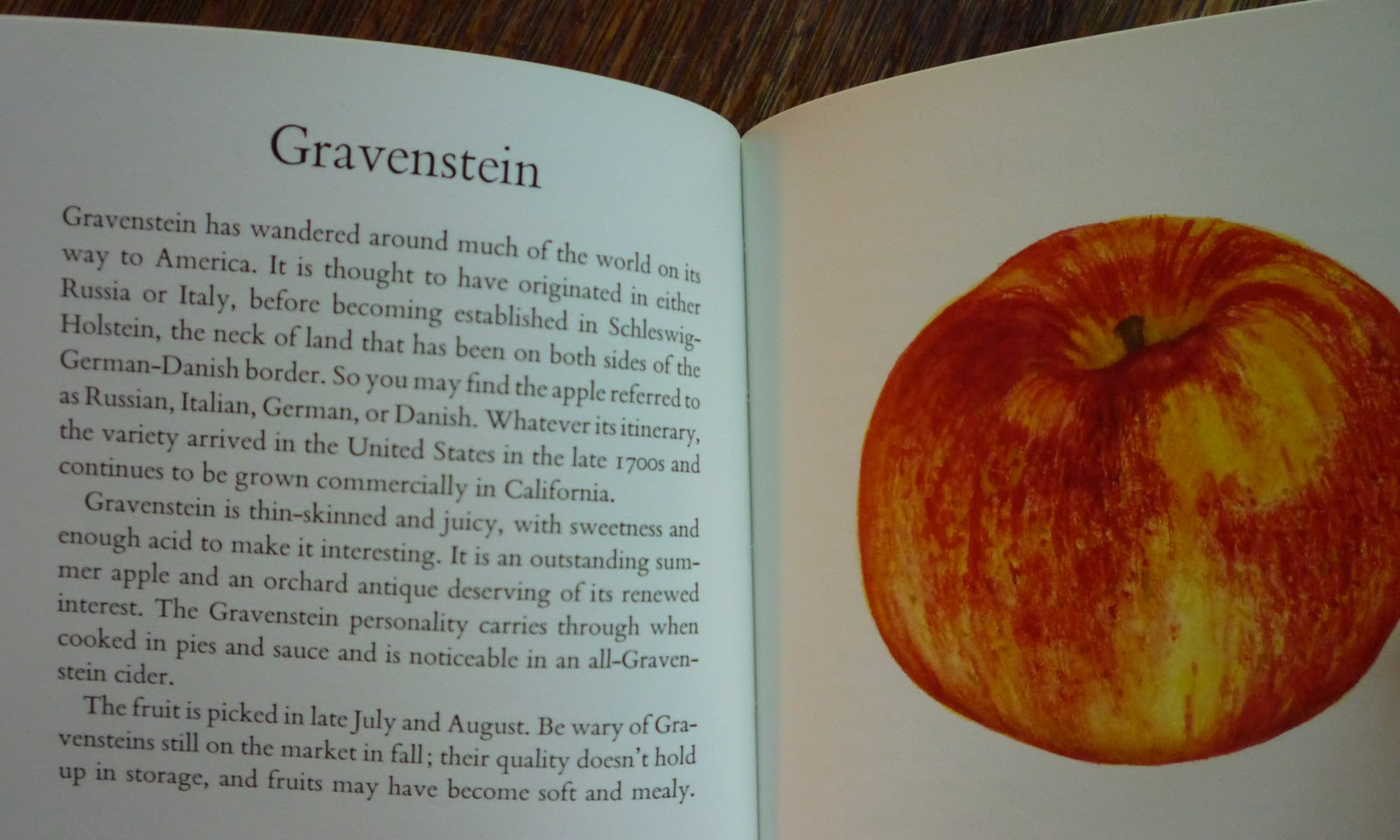
And the Gravenstein — it’s got such a tang that as I write about it I start salivating. Its season is short, but there are plenty of orchards in our part of the country, and it adds the most appley flavor to whatever you cook with it. I have made many a curried apple turkey loaf with Gravenstein sauce.

I like the pictures of all the odd apples that I’ve never encountered, especially the sort of ugly knobby ones, or those with russeting or bumps, or elliptical shapes.

But my favorite apple of all, and naturally the best-for-me entry in this book, is one that was more available in stores when I first learned to bake pies. After using the same apples for many years, I have to admit that only Pippins make a pie that with my whole being I can rejoice in as Apple Pie. To prove my love, I am feeling a need to make a trip to Our Orchard this week and get a boxful.

Swan Lake stories


I really got into the Swan Lake story last Spring. It all started with an Amazon.com recommendation, from which I learned that Mark Helprin had written a book-length adaptation of the tale that was most famously told by Tchaikovsky’s ballet. There were surprisingly few reader reviews of his book given that they were nearly all gushingly positive, some saying it was the best book they had ever read.

I’ve long been curious about Helprin and the many books he’s written. Some of my family and friends have read his novels, stories, and non-fiction pieces. I had a feeling that I should appreciate him more than I did, and I planned to try again to read his fiction. I was sure his Swan Lake would be good, and I nearly ordered it without previewing it. But then I saw that it was first of a trilogy, and people were less thrilled with the sequels, so I got it from the library instead to see for myself before investing on behalf of a grandchild.

While I was at it, I borrowed three other juvenile versions of the story, so I would have something to compare with. On the first day of Lent I read all four of the books — I know, it was an odd thing to do that day — and scratched out some thoughts. After returning the books to the library in the interest of focusing on more appropriate matters, I forgot all about the subject, until today, when I decided I should gather everything up finally.

Helprin’s version (©1989) would have to be counted my least favorite of the four. It’s the length of a short novel, and his story is fleshed out with several characters who don’t appear in the more common tellings. It’s the most changed, interesting and complex story, but maybe too complicated. The story’s flow is interrupted with goofy details and sidetracks that detract from the moral weight. The narrator’s voice is not that of a believable old man, not that of the man who has enough wits about him to accomplish what he does. Yet he’s supposedly a sage.

I also did not like the loose morals of the characters, who literally “shack up” together and have a child, who figures in the politics of the realm in the sequels, as I understand. The prince never does behave in a very noble fashion that I can see. And what’s the good of a fairy tale if the prince is at best only a foolish boy?

I’m really not competent to even know what it is about Helprin’s fictional style that puts me off. Probably it’s only a personal preference or lack of foundation that makes it hard for me to enjoy him. But I think that I’m through trying.

My next-least favorite of the bunch of Swan Lake tales that I read was Swan Lake, retold by Anthea Bell, illustrated by Chihiro Iwasaki (©1984). I liked the watercolors, but there weren’t enough pictures of swans for my taste. And the story line was thin.

Swan Lake, adapted and illustrated by Donna Diamond (©1980) was second-best of my stack. It was thorough story-telling, including more motives and complications, with nice black and white, dreamy paintings.

My favorite was Swan Lake, retold and illustrated by Lisbeth Zwerger (©2002). The illustrations were pleasing to me, and after mentioning several versions of the ending, the author makes it into a happily-ever-after story.

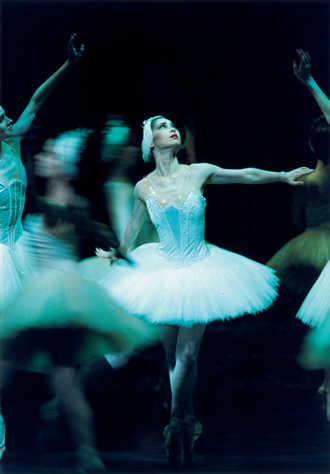
After all my literary wanderings, I’m left wondering if perhaps this tale is best told through a ballet performance. I know that even in that form there have been widely divergent versions of the story, but I can’t help thinking that the rich visual and musical elements would make the whole experience more satisfying than did any of these books.

Heavy or Lightweight Books

The other night when I came to the last page of The Fountain Overflows, I turned right back to the beginning and started it all over again. I couldn’t bear to leave the Aubrey Family, or Rebecca West’s lovely writing. I kept my pen in hand so that I could note even more phrases or passages that were notable examples of her masterful style, or of the psychology of children. And this time through I mean to circle words I don’t know from the very start, to look up in the dictionary sometime — maybe. Most of the time I forget to do that.

I don’t research those words as I go along because I am usually lying in bed and can’t handle something as heavy as a dictionary; most books I buy these days I get in paperback so that I can read them while curled up or generally horizontal under the blankets. Sometimes, though, I fail to notice that a particular book in the catalog has 800 or 1000 pages between its paper covers, and when it arrives at my door I realize that it can’t be accommodated at bedtime.

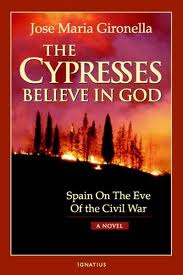
Vacations don’t seem to include the long afternoons I’d require to enjoy the big books in a lawn chair next to a lake or under a tree. That’s what I thought I would need if I were ever going to start The Cypresses Believe in God: Spain on the Eve of the Civil War (806 pages), by Jose Maria Gironella.

But last week, after leaving the library, of all places, my foot folded over at a curb and my ankle was sprained — voilà! Here was my chance! — and for three days I’ve been living in the world of Spanish culture and politics in the 1930’s, at the same time I am lying in the recliner with my foot up.

I was going to tell also about the paperback copy of The Brothers Karamozov, and Stephen Lawhead’s Hood (first book in the King Raven Trilogy about Robin Hood), who are both waiting on the shelf, but as I look at them more closely I notice that they are not at all in the same weight category as Cypresses. They are smaller in cubic inches, nearly the same size as each other, though Hood is under 500 pages and Brothers K about 700. Dostoyevsky is much heavier physically — the book, I’m talking about now — and I am confident in other ways, too. No taking that one to bed.

c. 1923

But maybe when I finish Fountain I could manage to heft Hood or at least have it lying next to my pillow. Unless I feel the need to read Rebecca West’s The Birds Fall Down again. When I came to the end of that novel I also had that urge to read it again soon, for somewhat different reasons.

The first time I heard of this author it was for her book Black Lamb and Grey Falcon. That title captivated me right off, but I thought the subject of her famous book would be helpful to me in understanding Balkan history and culture.

I borrowed it from the library, a hardback and huge book with small print, when I still had plenty of teaching and childraising to do, and I don’t think I ever got through one chapter. But now that I’ve read two other compelling books by her, and see that these three I’ve encountered are completely different from one another….I wonder if I can get Black Lamb and Grey Falcon in paperback?

[Update: more posts have been written about The Fountain Overflows,

The opposite of not getting in trouble. and

The endless troubles of everyday life.  ]