Category Archives: church

Transfiguration

You were transfigured on the mountain, 
O Christ God,
revealing Your glory to Your disciples 

as far as they could bear it.
Let Your everlasting Light also shine upon us…. 
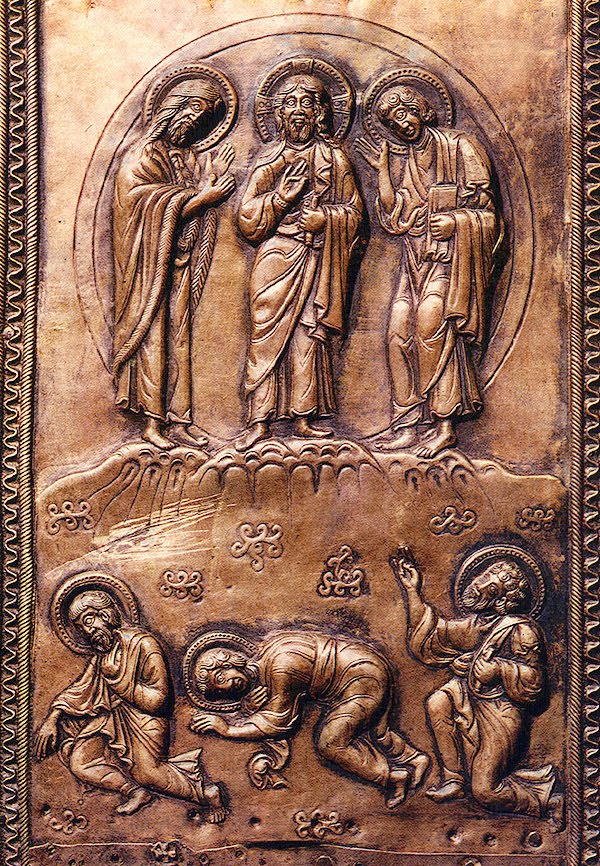
On this feast day it was good to go back and read my ruminations about Fr Arseny on the date last year. This year, unfortunately, I’m missing the services at church, but I have the troparion (above) playing in my mind.

Also another chorus from long ago, one that I don’t think is popular currently in the Protestant world, that goes like this:

The Lord is my light and my salvation,
Whom then shall I fear? Whom then shall I fear?
The Lord is the strength of my life,
The Lord is the strength of my life.
Of whom then shall I be afraid?

At least, that is how it plays in my memory.

This icon I found on the Orthodox Church in America site, where its source was not given. Does anyone know?

Responding to Unpleasantness

Posted on The Morning Offering, this from St. Symeon the New Theologian:

“Faith in Christ is… a good and patient disposition of the soul in enduring all temptations, whether griefs, sorrows or unpleasant happenings, until God’s favour looks down upon us; thus we would imitate David who says: ‘I waited patiently for the Lord; and He inclined to me and heard my cry’ (Ps. 40:1).”

Unpleasant happenings are my excuse for many kinds of sins, from overeating to speaking quickly and unkindly. If I would, at the first notice of unpleasantness, direct my soul to wait on God, wait to speak, wait to eat, etc., I would be enduring temptation. It appears that not all temptations are of the type from which one can flee, or that can be actively resisted. But in any circumstance we can rest in Christ. I don’t write from much experience.

On the other hand, St. Symeon did. He was abbot of a monastery when the monks attacked and nearly killed him. Don’t be confused by his title; his theology was not new, but he was younger than another man with the same name, hence the clarifier.

The Orthodox Church has given only three saints the title of Theologian. I love that the quote above hearkens back to old theology, that of a man whose tradition was of the school My Soul Follows Hard After Thee.

Feasting from Day to Day

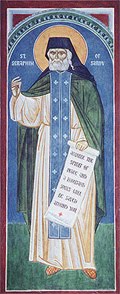
Yesterday was the feast day of my parish, St Seraphim of Sarov, and a glorious day it was. I’m showing the fresco from the front of the church. I myself was overjoyed, my cup running over, just being at church where our bishop was present as well as a temple full of us regular parishioners and many guests. There was an ordination, and beautiful children, and much praise of God, followed by a cheery and relaxed festal meal so that we could continue glowing together for a while.
Today we remember St Elijah the prophet, and I just want to pass on this blog entry at Christ is in Our Midst!, with its wonderfully expressive painting of Elijah’s chariot.

Censure or Repentance – Father Moses

 From Father Moses of the Holy Mount of Athos:

An offspring of [the sin of] pride is censure, which is unfortunately also a habit of many Christians, who tend to concern themselves more with others than themselves. This is a phenomenon of our time and of a society that pushes people into a continuous observation of others, and not of the self. 

Modern man’s myriad occupations and activities do not want him to ever remain alone to study, to contemplate, to pray, to attain self-awareness, self critique, self-control and to be reminded of death. The so-called Mass Media are incessantly preoccupied with scandal-seeking, persistently and at length, with human passions, with sins, with others’ misdemeanors. These kinds of things provoke, impress, and, even if they do not scandalize, they nevertheless burden the soul and the mind with filth and ugliness and they actually reassure us, by making us believe that “we are better” than those advertised.

Thus, a person becomes accustomed to the mediocrity, the tepidity and the transience of superficial day-to-day life, never comparing himself to saints and heroes. This is how censure prevails in our time – by giving man the impression that he is justly imposing a kind of cleansing, by mud-slinging at others, albeit contaminating himself by generating malice, hatred, hostility, resentfulness, envy and frigidity. Saint Maximos the Confessor in fact states that the one who constantly scrutinizes others’ sins, or judges his brothers based on suspicion only, has not even begun to repent, nor has he begun any research into discovering his own sins.

Thanks to the rector of our parish for posting this passage in the church bulletin.