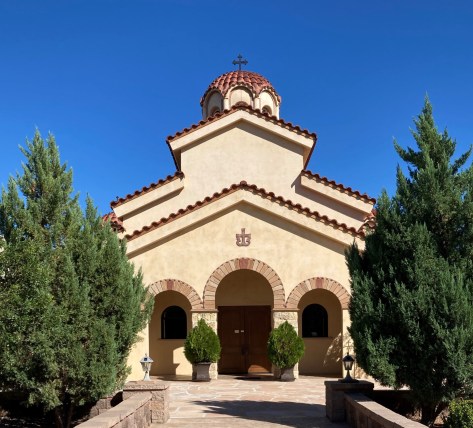
We Orthodox Christians begin our Advent, our Nativity Fast, in November, because our Advent is 40 days long. So whether we celebrate Christmas on December 25th or January 7th, we’re ahead of western Advent. My parish is of the December 25th, and today was our first day of the fast.
It was the coldest day yet in my garden, and my fountain had a layer of ice on it. The water level was also a bit low so I poured a few pitchers of tepid water in there, and pulled redwood needles out of the filter to get it going again. Then I spent the rest of the morning at church, baking Communion bread with other women. With three ovens going at once, we got the kitchen quite toasty!
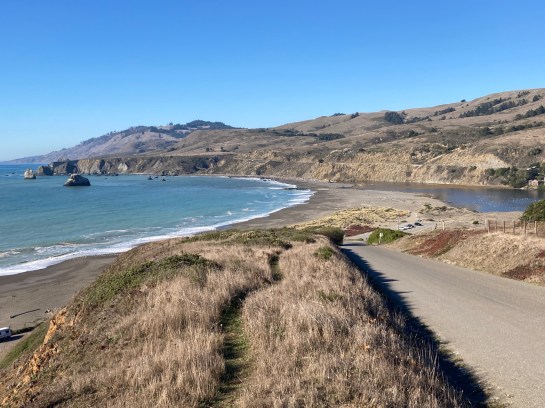
I drove straight from there to pick up my friend Mother S. who is in town visiting family for Thanksgiving. She loves the beach, so we drove out to Jenner-by-the-Sea, where the Russian River flows into the Pacific. I took very few pictures this time, but it was a perfect day, not a cloud in the sky, 60 degrees and sunny! We parked in the lot down near the beach, after taking pictures from this spot on a hill, from which you can see where the river comes in. I squished my bare feet into the sand, but didn’t walk out into the surf.
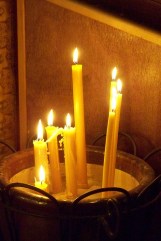
It was a lot of driving, but well worth it. By the time I got Mother S. home again, I barely had time to get to the service I was aiming for, back at church. It was a combination of a Paraklesis for Advent and the Blessing of Water. I had left my phone in the car so I didn’t take pictures of the small church lit only by candles.
I think it was good for me to not have that option of taking pictures, because when I eliminated the role of observer, I could be fully present and participating, not standing apart in my mind, so to speak, distracted by photographic possibilities. I was just being me, in church, praying.
It might have been for that reason that I was able to pay attention and be deeply affected by the prayers and hymns that were specific to this day and these services. They were metaphorically super-rich, and many of them were in the form of exhortations and expressions of wonder from us or from the Virgin, on the subject of the Incarnation. We were giving commands to rejoice, to get ready, to glorify God — to the universe, to the cave, to Zion, even to our mortal nature.
I’ve transcribed a few of the verses below:
O Bethlehem, receive Christ: for, made flesh, he comes to dwell in thee, opening Eden to me. Make ready, O Cave, to behold most strangely contained in thee, him who cannot be contained, who now is made poor in the wealth of his tender mercies.
Christ comes to be born, granting in his goodness a strange rebirth to those sprung from Adam. Be glad, the whole nature of mortal man, thou that art barren and bearest not: the master has come to make thee a mother of many children.
Rejoice exceedingly, O Zion: make ready, O Bethlehem. The Upholder of all things, sending a star before him, has made known his condescension without measure. He before whom the heavenly powers tremble, our only God, without change is born in very truth from the Virgin.
Today the Virgin cometh to the cave to give birth in an ineffable manner to the pre-eternal Word. Rejoice, therefore, O universe, when thou hearest, and glorify with the angels and shepherds him who shall appear by his own will as a new child, the pre-eternal God.
It was a glorious beginning to Advent. I feel that I’ve gotten a boost of expectation that will help keep my heart tuned to the upcoming joyous Feast of the Nativity of Christ.
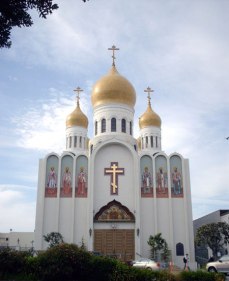
My godmother Charity and I took a trip to San Francisco yesterday, to the Orthodox cathedral affectionately called “Joy of All Who Sorrow.” I have mentioned visits to this holy place a couple of times before. The relics of St. John (Maximovitch) of Shanghai and San Francisco reside here, and draw pilgrims from around the world.
We wanted to present our petitions to the Lord with the help and intercession of St. John.
As many of my prayers have to do with my children and grandchildren, I was touched to see this icon near the front of the cathedral soon after I came in:
Being so large, the church has lots of space for iconography, an overwhelming number of images to take in, in one visit. This sweeping 360 degree tour of the cathedral might be interesting to give you an idea of the whole of the interior. It starts with the exterior and you have to click on the little square picture at the upper right of the frame to see the interior.
A photo of my companion hints at the feeling of being in the space:
Since my last visit here, I have become familiar with the traditional depictions of various saints and can recognize more of them, even if the names on them are in Cyrillic script. But I didn’t know this couple, whom Charity guessed to be Ss. Peter and Fevronia, and which the man at the candle desk in the narthex confirmed:
I have only recently learned about this royal couple, but they have long been famous in Russia, because:
“The Day of Saints Peter and Fevronia since the days of Kievan Rus and until 1917, was broadly celebrated in Russia because it is believed that the Saints Peter and Fevronia are the patrons of marriage and family, as well as the symbols of love and fidelity. On this day it was common to go to church, where the people asked for love and family grace.” (Wikipedia)
Their holiday has been revived in this century, now celebrated every July 8.
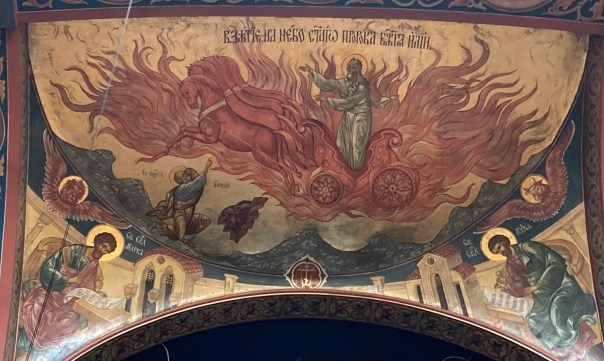
On the west wall I was surprised by a very large icon of Elijah in his chariot of fire:
One icon that blessed me very much was of the Holy Myrrhbearing Women. I am always especially interested in them because one is my patron saint, but this is the first time I have been so touched by their expressions, which seemed more emotional than is typical. (I really don’t know much about art, so take anything I say with a huge grain of salt!)
Just today I was reminded that icons are re-presentations of those depicted, an opportunity for us to engage further with the saints whom we know and love in the Lord. I offer one excerpt from an article by Fr. Lawrence Farley in which he explains why we ask saints to pray for us:
“If the living and departed are both united to Christ, they are by virtue of this union also united to one another. Even while on earth all Christians are united in a bond of mutual prayer and intercession (Ephesians 6:18)—how much more will our departed brethren pray for us when they are closer to Christ in heaven?”
In the huge Holy Virgin Cathedral full of saints re-presented to me, made present in a mysterious way, I experienced that reality which was also expressed by Bishop Dimitri (Royster) at the glorification of St. Herman of Alaska:
“The Church on earth lives in a loving fellowship with the saints who have already run their race, who have fought the good fight, and have received their crowns (2 Timothy 4:7) (James 1:12). This is what the Apostle means when he says that we are compassed about or surrounded by the witness-martyrs or saints. We are assured both of their presence and their interest in us. In fact, they are concerned about the whole world and its salvation, for ‘there is joy in heaven over the repentance of one sinner’ (Luke 15:7).”
It encouraged my heart to be with so many, many saints at the cathedral. I know that the ones presented in icons are only a few out of the great Cloud of Witnesses who are examples and friends for us, who love and pray for us. Their faith is like a magnet that draws me in to the Kingdom, and keeps me from getting discouraged. Their love is a comfort to my heart, and no wonder, for I was in the cathedral named for her whom we know to be the “Joy of All Who Sorrow.”
Lord, O Lord, who hast delivered us from every arrow that flieth by day, deliver us also from everything that walketh in darkness. Receive the lifting up of our hands as an evening sacrifice. Make us worthy to pass without blame through the course of the night, untempted by evil. And deliver us from all anxiety and cowardice that come to us from the devil. Grant compunction to our souls, and make our thoughts mindful of the trial at thy dread and righteous Judgment.
Nail down our flesh with the fear of thee, and mortify our earthly members, that in the stillness of sleep we may be enlightened by the vision of thy judgments. Take from us every unseemly fantasy and pernicious carnal desire. Raise us up at the hour of prayer, established in faith and advancing in thy commandments: through the grace and goodness of thine Only-begotten Son, with whom thou art blessed, together with thine all-holy, good, and life-giving Spirit, now and ever and unto ages of ages. Amen.
-St. Basil the Great
This is the last of the three sample prayers of St Basil that I’d planned to share,
from the book Orthodox Christian Prayers. Previous: First Hour and Sixth Hour.
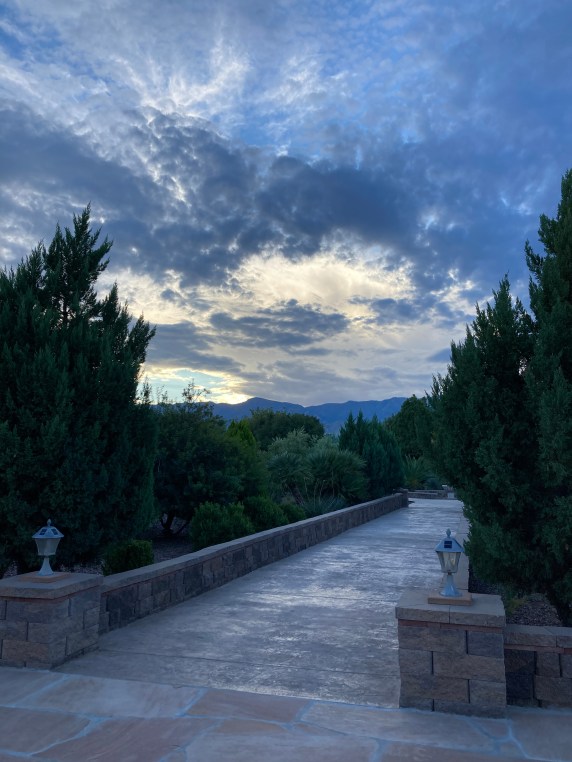
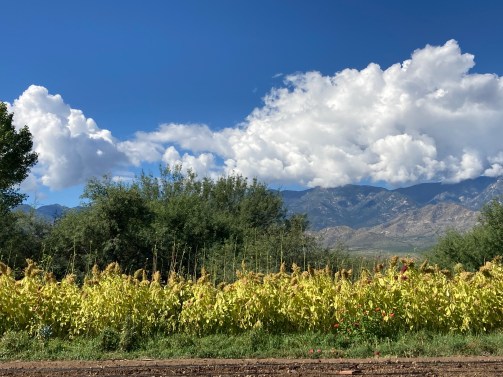
The monsoon season officially ended in Arizona on September 30, but at least one rainstorm was not keeping to that calendar. The evening that we arrived at the high-desert monastery we enjoyed a loud thunderstorm and showers that continued through the morning.
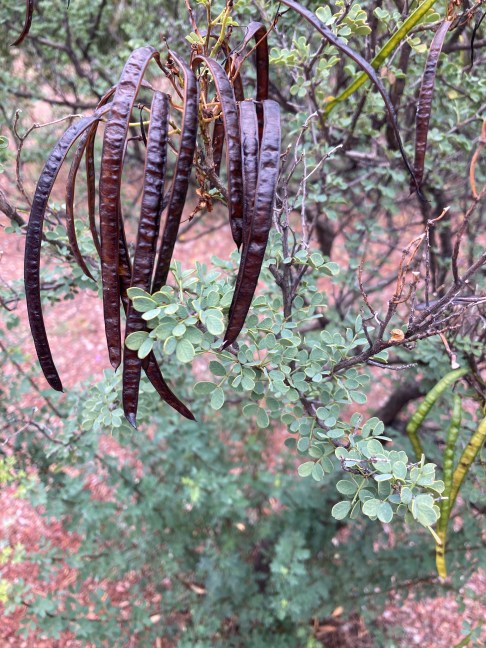
Velvet Ash
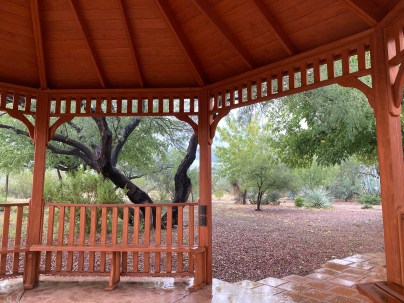
When I got caught in a shower while taking a walk I discovered this gazebo near at hand, where I waited a few minutes until the rain lessened.
Now that I have returned to northern California (where we are still waiting for our own wet season to begin in force) I feel that the spiritual watering I received is liable to evaporate to nothing if I don’t take more time than I have so far, to process what seems like a deluge of impressions and experiences.
I’ve been thinking about an article from Father Stephen Freeman, about Living in the Real World. Here is an excerpt:
A monk lives in a monastery. He rises early in the morning and prays. He concentrates his mind in his heart and dwells in the presence of God. He will offer prayers for those who have requested it. He will eat and tend to the work assigned for him to do. And so he lives his day. He works. He prays.
And someone will say, “But what does he know about the real world?” But what can they possibly mean? He walks on the earth. He breathes the same air as we do. He eats as we do and sleeps as we do. How is his world any less real than that of anyone else on the planet?
A man lives in a city. He wakes in the morning, turns on the TV as he gets ready for the day. He dashes out the door (he’s running late). He gets to his car, listens to the news on the radio, takes a couple of calls on his cell phone. He gets to work and for every minute he does something that he thinks of as “work,” he spends at least another checking his email, looking quickly at Facebook, and maybe checking the news. He gets into an argument at lunch about what should be done somewhere else in the world and who should do it. Angry and distracted, he is frustrated with himself because he swore he was not going to have that same argument today. He goes back to work with the same routine. After work he drops by a bar, has a couple of drinks and decides to stay and watch some of the game. He gets home late and heads to bed.
Who is living in the real world? The man-in-the-city’s life is “real,” it actually happens. But he is distracted all day from everything at hand. He never notices himself breathing unless he’s out of breath. He swallows his food as quickly as possible. Even the beers he has at the bar are as much for the buzz as for the taste.
If the man refrained from these things his friends might taunt him, “What are you? Some kind of monk?”
What is the “real” that we should live in?
The sisters at the monastery demonstrate a quality of life that is closely grounded in the earthly, incarnated existence that God has given us, with all its limitations and glories. Their orderly life, hard work and continual prayer create an oasis of beauty and holiness.
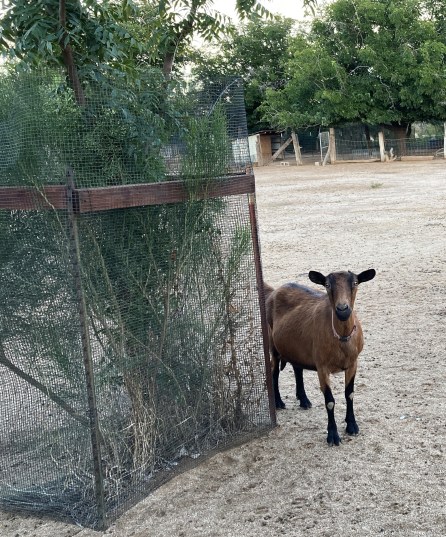
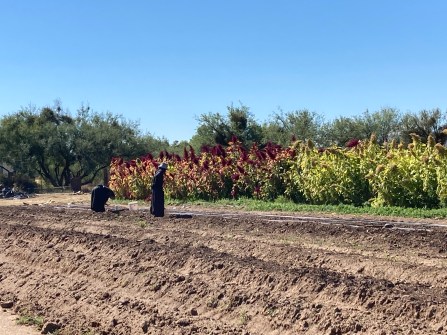
From their chickens, ducks and guinea fowl they collect eggs. From a little herd of goats they get plenty of milk for their own use and to sell to soap-makers. Pomegranate and apple orchards and vineyards supply more fruit; and they take the fruit of 850 olive trees to press into oil and cure into olives for eating. Over the years they’ve learned to drive tractors and do construction of their buildings, among dozens of other skills.
Guest quarters and bookstore are in this building.Goat milk feta was available to guests for breakfast.
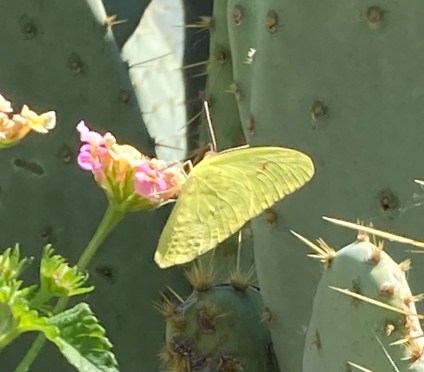
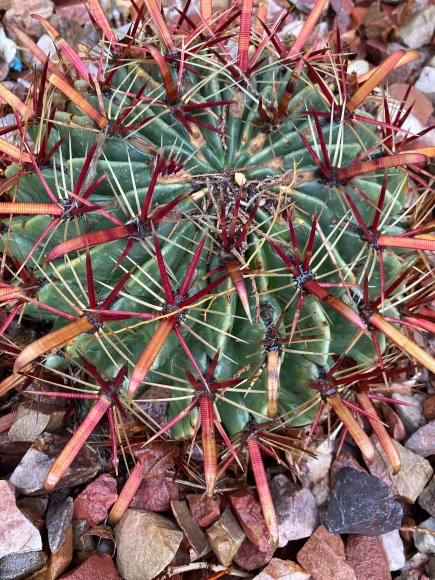
I took many pictures of plants and butterflies! Lantana is interspersed with prickly pear cactus in the landscape, and we saw several species of swallowtail butterflies, skippers, this Cloudless Sulphur, and Queen Butterflies feasting on those flowers.
While at the monastery our group of women woke in time for Matins at 5:30. Vespers was at 3:50 and Compline after dinner. One morning of our visit Divine Liturgy was served soon after Matins. (The sisters have more services in the night, just for them.) Standing and praying in church (and sitting when we couldn’t stand any longer) was a huge shower of blessing, of course.
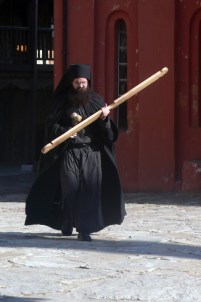
One of the sisters walks around the property beating the hand-held talanton (semantron) to announce both services and meals. This picture of the talanton is from Mt. Athos; St. Paisius Monastery tries to keep the monastic rule and tradition of Athonite monasteries.
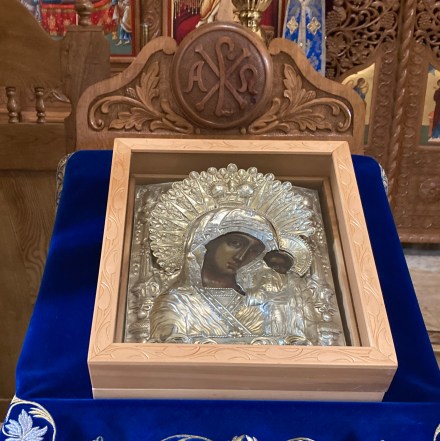
When we arrived they were coming to the end of the Feast of the Cross, with the accompanying red altar cloths. Soon the cloths had been changed to blue, which is the default color, in honor of Christ’s mother, the Theotokos.
One image that comes to mind regarding the idea of pilgrimage is from the novel Kristin Lavransdatter, set in medieval Norway. Kristin sets off on foot with only her infant child for company, and walks to a holy site far enough away that she has to sleep outdoors on the way, I don’t remember how many nights. Her food is whatever she has brought in her bag.
Such a pilgrimage that takes serious commitment and protracted journeying would no doubt lend a different flavor to the experience, compared to our group’s monastery visit that was so easy and comfortable, and quick. Do I even qualify to be called a pilgrim?
One afternoon I sat on a bench next to this quiet moth, about an inch across, and I felt some camaraderie with his dull color. (He was much more “boring” in his actual size.) Maybe I, too, could just cling to the monastery for a time, blending in as much as possible with its unique color, the way the moth clung to the bench, and soak up the grace by clinging.
My friend Lorica comes into my story at this point. She was in our group, and had compiled a booklet of songs for us, titled “Spiritual Songs for a Pilgrim Journey.” We sang from it in the van on our drive from the Tucson airport.
Whither goest thou, oh pilgrim, with thy staff in hand? Though the wondrous mercy of the Lord go I to a better land.
The lines above remind me that my whole life’s journey might be called a pilgrimage, and this too-brief trip was a reminder of what my Real Life consists of. I want one day to return to St. Paisius or to visit another monastery to help me further on my way — if I do I hope it is for a much longer visit! — but in any case, it is through God’s wondrous mercy that I travel in the right direction moment by moment, wherever I find myself.
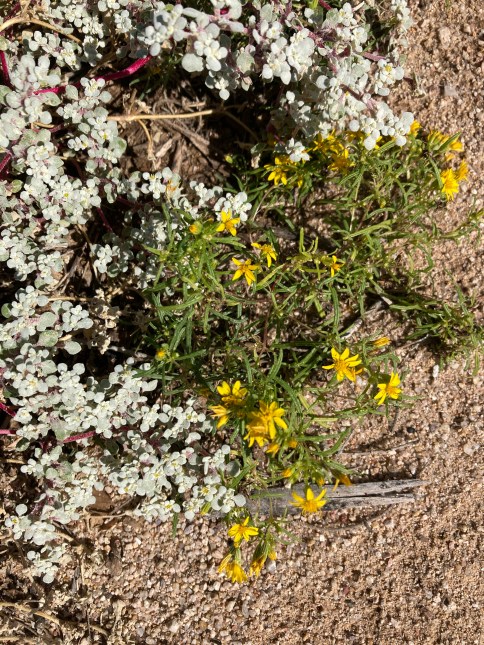
Lorica helped me in another way, on our first full day of our visit. As we were having a tour around the property, she said, “Something that we are walking on is very aromatic.” I hadn’t noticed, but I looked down and saw these little yellow daisies growing like weeds along and in the path. I broke off a stem and we knew that that was the aromatic plant. It was delicious to my own senses, and new.
I learned that it is the Southwestern native pectis papposa, or chinchweed, and they say it can sometimes be found in Mexican markets sold as limoncillo.
On the day of our departure, I was standing by the van waiting for the others and watching the butterflies again, when I noticed a big clump of chinchweed right there. A stem of it just fit into a pocket of my backpack, so I brought it home as a memento of the visit. It is sitting near me now on the sideboard, dried up and having lost not quite all of its spiciness.
The intangible things that I brought home from the monastery — I pray those stay with me longer, whatever they are. Because the aroma is sweet, and powerful. I think it’s the scent of holiness.
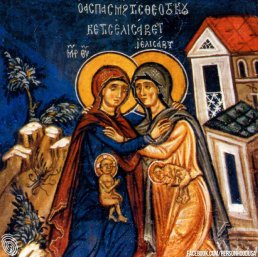 We Orthodox Christians begin our Advent, our Nativity Fast, in November, because our Advent is 40 days long. So whether we celebrate Christmas on December 25th or January 7th, we’re ahead of western Advent. My parish is of the December 25th, and today was our first day of the fast.

 I think it was good for me to not have that option of taking pictures, because when I eliminated the role of observer, I could be fully present and participating, not standing apart in my mind, so to speak, distracted by photographic possibilities. I was just being me, in church, praying.















 Such a pilgrimage that takes serious commitment and protracted journeying would no doubt lend a different flavor to the experience, compared to our group’s monastery visit that was so easy and comfortable, and quick. Do I even qualify to be called a pilgrim?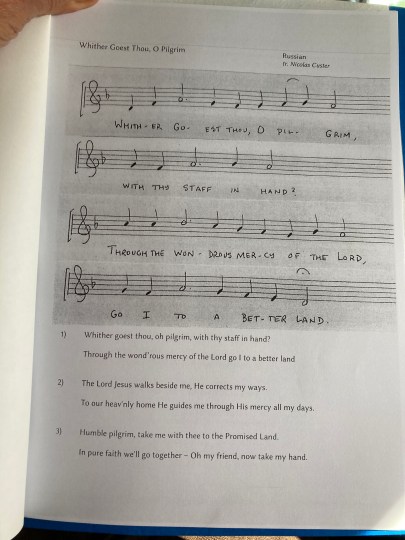
 I learned that it is the Southwestern native pectis papposa, or chinchweed, and they say it can sometimes be found in Mexican markets sold as limoncillo.