Long before I found my home in the Orthodox Church, a friend introduced me to the Private Prayers of Lancelot Andrewes, which sustained my devotional life for a long time. Andrewes was one of the translators and editors of the King James Bible and died in 1626. Various arrangements of his prayers and sermons have been compiled; the edition I have uses the F.E. Brightman translation (from the Greek, Latin, and Hebrew of the original) of 1903, and includes an essay by T.S. Eliot, which I am reading again after a long time, having taken the book of prayers from my shelf to refresh my memory on several points.
Eliot compares the homilies of Andrewes with those of John Donne, and says that Andrewes is “the more medieval, because he is the more pure, and because his bond was with the Church, with tradition. His intellect was satisfied by theology and his sensibility by prayer and liturgy.”
When he writes of the emotional sensibilities of the preacher, it reminds me of the tone of our Orthodox worship:
“When Andrewes begins his sermon, from beginning to end you are sure that he is wholly in his subject, unaware of anything else, that his emotion grows as he penetrates more deeply into his subject, that he is finally ‘alone with the Alone,’ with the mystery which he is seeking to grasp more and more firmly….Andrewes’s emotion is purely contemplative; it is not personal, it is wholly evoked by the object of contemplation, to which it is adequate; his emotion wholly contained in and explained by its object.”
That dear man loved Christ! Here is the first of his Morning Prayers, typically rich in the words of Holy Scripture:

 Following closely from that, the ancient prayer hymn of the church, known as “Gloria in excelsis Deo” or the “Great Doxology.” This was the one in Andrewes’s collection that most thrilled my heart and made it say, “Amen.” When prayed aloud it seems to carry the soul quickly to heaven while the body is most feeling its lowliness and affinity with the humble earth.
In the Orthodox Church we have begun the weekday Lenten Matins, and I managed to get there this morning and make that wonderful start to the day. One of the best parts of the service for me is our version of the “The Great Doxology,” which made me think about Christ-lover Andrewes, one of my first mentors in the kind of prayer that connects me to the church that has prayed through the ages.
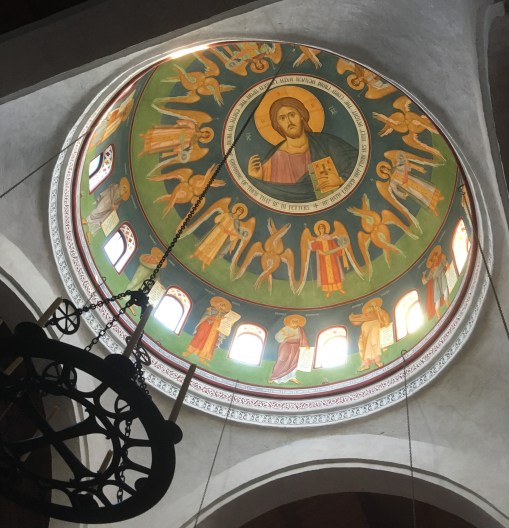
Below is the text as we sing it in my parish, and here: The Great Doxology, is a video I found, if you would like to hear it sung, not too differently from what I’m used to. Of course, every parish and every choir does it uniquely, and I like the way we sing it the best. 🙂 This morning I was sitting on the other side of the cathedral from my usual, and enjoyed the perspective on the dome and the icon of Christ Pantocrator, with the words in the encircling border: “He hath looked out from His holy height. The Lord from heaven hath looked upon the earth, to hear the groaning of them that be in fetters.”
THE GREAT DOXOLOGY
Glory to God in the highest,
and on earth peace, good will among men.
We praise Thee, we bless Thee, we worship Thee, we glorify Thee,
we give thanks to Thee for Thy great glory.
O Lord, Heavenly King, God the Father Almighty;
O Lord, the Only-begotten Son, Jesus Christ; and the Holy Spirit.
O Lord God, Lamb of God, Son of the Father,
that takest away the sin of the world, have mercy on us;
Thou that takest away the sins of the world, receive our prayer;
Thou that sittest at the right hand of the Father,
and have mercy on us.
For Thou only art holy, Thou only art the Lord,
Jesus Christ, to the glory of God the Father, Amen.
Every day will I bless Thee, and I will praise Thy name forever,
yea, forever and ever.
Vouchsafe, O Lord, to keep us this day without sin.
Blessed art Thou, O Lord, the God of our fathers,
and praised and glorified is Thy name unto the ages. Amen.
Let Thy mercy, O Lord, be upon us, according as we have hoped in Thee.
Blessed art Thou, O Lord, teach me Thy statutes.
Blessed art Thou, O Master, grant me understanding of Thy statutes.
Blessed art Thou, O Holy One, enlighten me by Thy statutes.
Lord, Thou hast been our refuge from generation to generation.
I said: O Lord, have mercy on me, heal my soul,
for I have sinned against Thee.
Lord, unto Thee have I fled for refuge;
teach me to do Thy will, for Thou art my God,
for in Thee is the fountain of life; in Thy light shall we see light.
Continue Thy mercy unto them that know Thee.
Holy God, Holy Mighty, Holy Immortal, have mercy on us.
Holy God, Holy Mighty, Holy Immortal, have mercy on us.
Holy God, Holy Mighty, Holy Immortal, have mercy on us.
Glory to the Father, and to the Son, and to the Holy Spirit,
both now, and ever, and unto the ages of ages. Amen.
Holy Immortal, have mercy on us.
Holy God, Holy Mighty, Holy Immortal, have mercy on us.
 “Turn your cares into prayers and you will change ice to flowing water.”


 Gladsome Lights