Category Archives: church

We pray and kiss her good-bye.

The picture below is of a cemetery that I have visited a few times in the last two years. This week I was here for the burial of Nina, about whom I told you not long ago, when she was still going strong.

Fvl cemetery Radonitsa 15

Nina said recently, and smiling, I’m sure, that she didn’t really want to celebrate another birthday on this earth; and though she wasn’t sick or in pain, her heart did stop one day, just before she would have turned 104.

When I heard that she had died I was still in the mountains, and it made me sad to think I would not be able to pray at her funeral – so I was pleasantly surprised to learn that it would not take place until later. It’s not traditional to wait that long, but perhaps the birth of one of her great-great-grandchildren, who was present at the service and two weeks old, had something to do with the delay.

It was to love and honor Nina that I made the effort to get to church that morning, and not because I knew her or her family very well. I wasn’t feeling energetic or “spiritual” and you might even say I was in a bad mood. So I was completely surprised at how personally and deeply I was affected.

Her casket was in the center of the church. We were all gathered around singing, and the priests and deacons were censing Nina and the church, because something fundamental and important and holy was going on. Yes, they were censing Nina. Father addressed the common but mistakgl photos ninaen idea that people often express about the dead, saying, for example, “That’s not my mother!” as though the material aspect of the self was unessential. “Well, who is it, then?” he asked.

Father Stephen in a recent blog told about a Protestant church in his town that forbids the presence of the body at funerals. He writes, “Biology is easily the most fundamental aspect of our human existence. We do not ‘have’ bodies – we ‘are’ bodies.”

I’m so thankful that in my church we do not whisk away the body, but instead acknowledge it as the most “fundamental aspect” of the person and the way that we have known them their whole life. We sang a hymn about “the last kiss,” and we had the opportunity to kiss and venerate Nina’s holy body, with which she worshiped God and loved so many people during her many years on the earth.

I did think a lot about my husband that day, and I wept, because I still feel the raw places where he was torn away from me; but because it has been over a year since his own falling asleep, I was less distracted by my own grief and able to pay closer attention to the service than I could at the two funerals I attended last spring and summer. I noticed Christ with us at Nina’s funeral, and the palpable love of the Holy Trinity, which we reflected in and from our own bodies, still more or less intact.

gl Nina graveside

The liturgy of the funeral service is rich and deep. It is a commending of the believer to God, praying, “Grant rest in blessed repose, O Lord, to the soul of your servant,” many times, solemnly and lovingly, with Psalms and many readings from the Gospels and other scriptures, such as this passage from John, in which Jesus tells His disciples,

Verily, verily I say unto you, he that heareth My Word and believeth in Him that sent Me, hath everlasting life and shall not come into condemnation, but is passed from death unto life…. the hour is coming and now is, when the dead shall hear the voice of the Son of God; and they that hear shall live. For as the Father hath life in Himself, so hath He given to the Son to have life in Himself, and hath given Him authority to execute judgment also, because He is the Son of Man.

Marvel not at this; for the hour is coming in which all that are in the graves shall hear His voice and shall come forth….

gl blessing grave w holy water

Hearing words like this, I couldn’t dwell too long on the horrible unnaturalness of death, and the sorrow of a soul being torn from its body. Again, I am helped by the way that Fr. Stephen explains our perspective:

In the traditional theology of the Eastern Church, this world and the “next,” are not two worlds. We use the language of place (heaven and earth) for lack of language not for accuracy. There is more to the created order than we see (“all things visible and invisible”). But that which is not seen is not inherently separate from that which is. Sacrament (mystery in the East) is a way of describing the relationship between what is seen and what is unseen. Everything is sacrament, icon and symbol.

In such a setting, death is a change, but not an end. That which we see, the body, remains important and worthy of honor. A funeral, the service of remembrance, is a sacramental gathering in the presence of God. The body is honored, even venerated. The life of remembrance, eternal remembrance, begins.

gl shovel of dirt into grave

I hadn’t planned to go to the cemetery for the burial, for various reasons, but I didn’t want to leave this event that seemed to have a stately and grace-filled momentum – I wanted that grace!

So I drove over with a couple of other women, and stood with the family and fellow parishioners, including that brand-new baby, while we committed our dear friend to the earth – for a time. The epistle we had just heard echoed in my mind,

(I Thessalonians 4) 13 But I would not have you to be ignorant, brethren, concerning those who are asleep, that ye sorrow not, even as others who have no hope.

14 For if we believe that Jesus died and rose again, even so will God bring with Him those also who sleep in Jesus.

15 For this we say unto you by the Word of the Lord: that we who are alive and remain unto the coming of the Lord, shall not precede those who are asleep.

16 For the Lord Himself shall descend from Heaven with a shout, with the voice of the archangel and with the trumpet of God; and the dead in Christ shall rise first;

17 then we who are alive and remain shall be caught up together with them in the clouds to meet the Lord in the air. And so shall we ever be with the Lord.

If you would like to read more about the Orthodox funeral service, there is a good article on this site. It’s all very encouraging!

With the saints give rest, O Christ, to the soul of Thy servant where sickness and sorrow
are no more, neither sighing, but life everlasting
.

gl harrowing med resurrection anastasis

I taste morsels of all that He is.

This morning I was able to attend Divine Liturgy for a special parish commemoration. Everything about the service spoke of Christ, gave us Christ, but what I heard in the homily in particular is pertinent to what I had already wanted to write here today.christ good shepherd lg

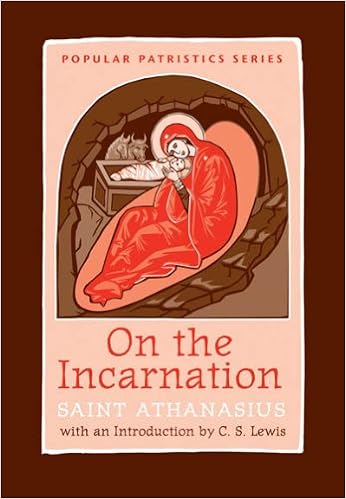
Our human nature is good, our rector reminded us, but we have a virus called sin and death that has made us all very sick. Christ in His love took on our human nature in the Incarnation, and walked among us showing us what human life was intended to be, teaching us about the Father, and about Himself.

Then He “became sin” and defeated death, and gives us His own Life to live by. Those are the bare and necessarily dry bones of that part of the homily, and of the living Word Who was lovingly expressed in hymns and prayers and communed in bread and wine.

At home, I’ve been reading the Gospel of John. It might as well be for the first time, I am that surprised by the immediacy of it. I felt that in my heart and psyche I became the Samaritan woman, rejoicing with tears when she caught on to Who was talking to her, and her life was transformed. She had encountered God, and left behind not only her water pot, but all that was rotten and decaying of her old life.

http://www.manuscript.ge/image.php?pic=o3bq2fppl2g6ufx.jpg

When He Who holds the cosmos together was mocked and spat upon, I was aghast. As I read the words of Jesus clearly explaining how He had come from the Father and was the Bread of Life, I couldn’t see how anyone could read this book and not come to faith. But of course — we all have that virus, to a greater or lesser degree. It causes blindness, it makes us distracted, and dull of mind or heart. I have read these words of Christ many times and I assented in my mind, I have clung to the truth of the Gospel, but was never struck so deeply before. Certainly I hadn’t done anything to make this happen; it was a gift.

And the Word was made flesh, and dwelt among us,  (and we beheld his glory, the glory as of the only begotten of the Father,) full of grace and truth. -John 1:14

At the same time I am reading On the Invocation of the Name of Jesus, by Lev Gillet, on prayer, and have been greatly helped by the author’s gentle exhortations. It is all about God With Us. Because Jesus wasn’t only here on earth for three years, changing the lives of people He met face-to-face, but by the Holy Spirit He is present with anyone who prays. Here is an excerpt:

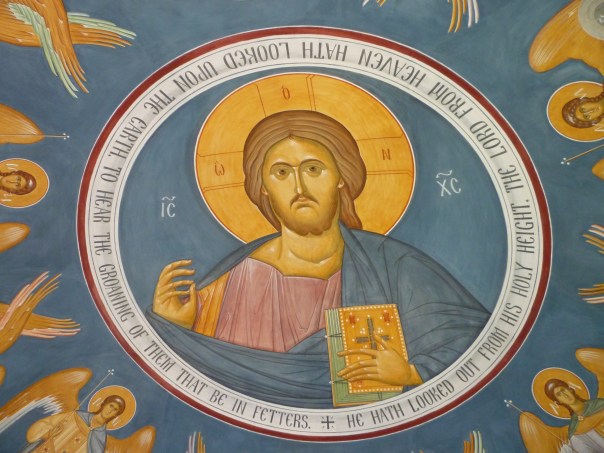
Jesus Himself is the supreme satisfaction of all men’s needs. And He is that now, as we pray. Let us not regard our prayer in relation to fulfillment in the future, but in relation to fulfillment in Jesus now. He is more than the giver of what we and others need. He is also the gift. He is both giver and gift, containing in Himself all good things.christ pantokrator st catherines 16th cent

If I hunger he is my food. If am cold he is my warmth. If I am ill he is my health. If I am persecuted he is my deliverance. If I am impure he becomes my purity. He “is made unto us…righteousness, and sanctification and redemption.” (I Cor. 1:30) This is quite another thing than if he had merely given them to us. Now we may find in his name all that he is. Therefore the Name of Jesus, in so far as it links us with Jesus Himself, is already a mystery of salvation.

Whosoever shall call upon the name of the Lord shall be saved. -Romans 10:13

Amen, Lord Jesus!

Do the spooky thing.

My late husband many times told me that I thought too much. He would like to have read this recent article by Fr. Stephen who tells me the same thing, and I commend it to your reading, even though, as Fr. Stephen admits, “…our thinking about thought is decidedly spooky.” We do need to think in order to learn the proper place of thinking, and the difference between thinking about God and being with God.

It is the latest in a series in which the author tries to get through our modern noggins the reality that we are more than our thoughts and feelings, and that the Christian faith is not essentially an idea. How could it be, when God is not an idea?

I think I get this, and I have written about it and quoted others about it for my own edification many times. It remains that I was born in this modern era and I’ve soaked up its ways as regularly as I’ve eaten my breakfast. It’s hard to live in the truth that I am learning, but each point that Fr. Stephen makes in each successive article helps a little more. This last one is full of concrete illustrations, such as:

1) eating your saIMG_1452 chunkndwich
2) burying your dead
3) being bored in church
4) the mythology of Star Trek
5) what Christ’s blood is
6) taking antidepressants

To contrast the secular mind with the spiritual or the Christian mind would be to perpetuate the misconception of our selves, and the article is fittingly titled “The Secular Mind Versus the Whole Heart.” In the comments section the author often elaborates on and clarifies statements in response to commenters, so don’t miss that part. Read it here.

The clear eye on the map.

The Poem-a-Day selection for yesterday was about maps, by Carl Sandburg. I read it when I came home from church this afternoon, after hearing a homily about a map. In Liturgy we learned that the map to the Kingdom is in our heart — but many other things are in the heart, as is obvious from our own lives and from the daily news. One consequence that can result from contemplating the news of the world is an increase of fear and anxiety in our hearts.

The experience related in Sandburg’s poem seems to echo what St. Macarius describes, following the Prophet Jeremiah,  who said, “The heart is deceitful above all things, and desperately wicked: who can know it?

St. Macarius: “Within the heart is an unfathomable depth. There are reception rooms and bedchambers in it, doors and porches, and many offices and passages. In it is the workshop of righteousness and of wickedness. In it is death, in it is life….The heart is but a small vessel; and yet dragons and lions are there, and there likewise are poisonous creatures….rough, uneven paths are there, and gaping chasms.”

EXPERIENCE

This morning I looked at the map of the day
And said to myself, “This is the way! This is the way I will go;
Thus shall I range on the roads of achievement,
The way is so clear—it shall all be a joy on the lines marked out.”
And then as I went came a place that was strange,—
’Twas a place not down on the map!
And I stumbled and fell and lay in the weeds,
And looked on the day with rue.

I am learning a little—never to be sure—
To be positive only with what is past,
And to peer sometimes at the things to come
As a wanderer treading the night
When the mazy stars neither point nor beckon,
And of all the roads, no road is sure.

I see those men with maps and talk
Who tell how to go and where and why;
I hear with my ears the words of their mouths,
As they finger with ease the marks on the maps;
And only as one looks robust, lonely, and querulous,
As if he had gone to a country far
And made for himself a map,
Do I cry to him, “I would see your map!
I would heed that map you have!”

-Carl Sandburg

Our pastor was preaching on Matthew 6, where Christ teaches us:

The light of the body is the eye. If therefore thine eye be single, thy whole body shall be full of light. But if thine eye be evil, thy whole body shall be full of darkness. If therefore the light that is in thee be darkness, how great is that darkness!

No man can serve two masters; for either he will hate the one and love the other, or else he will hold to the one and despise the other. Ye cannot serve God and mammon.

Therefore I say unto you, take no thought for your life, what ye shall eat, or what ye shall drink; nor yet for your body, what ye shall put on. Is not the life more than meat, and the body than raiment?

Behold the fowls of the air, for they sow not, neither do they reap, nor gather into barns; yet your heavenly Father feedeth them. Are ye not much better than they? Which of you by taking thought can add one cubit unto his stature?

It’s interesting to look at several translations of the words describing the healthy or unhealthy eye: cloudy or clear, evil or single, diseased or unclouded. Of course, Christ is our Light, He said so Himself, and if we keep our eye on Him, He will light the path, He will be the map in our heart, so that we find the best things that St. Macarius tells about:

“The heart is Christ’s palace…There Christ the King comes to take His rest, with the angels and the spirits of the saints, and He dwells there, walking within it and placing His kingdom there….the heavenly cities and the treasures of grace: all things are there.”

When Christ places His kingdom there, we understand that our heavenly Father is obligated to take care of us — He loves us and is, after all, our Father. Much more than any earthly father He loves us and wants to provide for our needs.

Today I also read a poem by Wendell Berry, on this blog, and he expresses and heeds the exhortation in today’s Gospel:

THE PEACE of WILD THINGS

When despair for the world grows in me
and I wake in the night at the least sound
in fear of what my life and my children’s lives may be,
I go and lie down where the wood drake
rests in his beauty on the water, and the great heron feeds.
I come into the peace of wild things
who do not tax their lives with forethought
of grief. I come into the presence of still water.
And I feel above me the day-blind stars
waiting with their light. For a time
I rest in the grace of the world, and am free.

-Wendell Berry

What a contrast Berry’s focus is to Sandburg’s narrator who wanders where “no road is sure,” and who longs for a good map. “We have been given the map!” I want to tell him. Keep your eyes on Christ, and walk on past the dragons and gaping chasms. Cling to Him, keep bringing your focus back to Him as a light that is far brighter than your “mazy stars,” and you will find your way to Christ’s palace, and take your rest, too, with the saints and angels, amid the treasures of grace.