Category Archives: church

A heart of flesh – and joy.

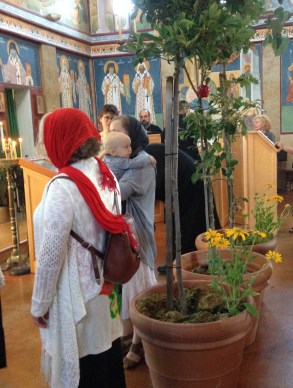
Pentacost vigil 2016crpWe have come to the Great Feast of Pentecost, and at the Vigil tonight we reverently resumed singing “O Heavenly King,” having withheld that prayer since Pascha, while we were “waiting” liturgically for the Holy Spirit to be poured out. All the vestments are green now, and the church is decorated with extra redwood branches, trees and flowers to remind us of our life in Christ, and to express our joy at the feast.

While we sang the long Psalm with its refrain, “His mercy endureth forever,” four chandeliers with a dozen candles each were set to swinging back and forth just above us, and when we looked beyond them, we could see the icon of the Savior, looking down with love and compassion.

One of the scripture readings tonight was from the Prophet Ezekiel, chapeter 36, and it explains some of the reasons why we are full of thanks and gladness:

I will take you from the nations and gather you from all the countries and bring you into your own land. I will sprinkle clean water on you, and you shall be clean from all your uncleannesses, and from all your idols I will cleanse you. And I will give you a new heart, and a new spirit I will put within you. And I will remove the heart of stone from your flesh and give you a heart of flesh. And I will put my Spirit within you, and cause you to walk in my statutes and be careful to obey my rules. You shall dwell in the land that I gave to your fathers, and you shall be my people, and I will be your God.

Pentecost fresco 6-14

The Holy Spirit is descended!

It’s my love language, too.

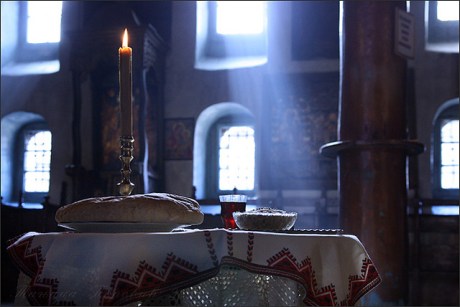
remembering the departed in Orthodox Chrisitian Church - offering bread, boiled wheat and red wine that are blessed by the priest

I want to share an article that is a kind of conversion testimony; it was published earlier this year with the title For the Love, on the blog Persona. The author well conveys the gratitude I also feel for the Church that encourages us above all to love people, and gives us tools for doing that. Tools? What am I saying? The Church gives us The Holy Spirit, a Person of the Holy Trinity Who live in Love, who are the source of any love.

Soon we will be remembering my goddaughter in prayer and song, on the one-year anniversary of her repose in the Lord. These days it is natural for me to think often about the dead, and not only my husband. For that reason I also appreciate what what Fr. Stephen Freeman has to say about our relationship to the departed, and  how, “With the radical individualism of the modern world, the mystery of communion and true participation (koinonia) have been forgotten….” 

The witness that follows is of someone who is discovering koinonia. I join with the writer of Persona in thankfulness for the ways the Church helps me to continue loving my dear Kathleen.

FOR THE LOVE

I attended my first service in an Orthodox Church in December of 2010. In April of 2012 I was chrismated (confirmed) in the church. What I don’t know about the Church could still fill several books, and I’m not very good at being Orthodox.

It’s a tradition that appears confusing and Byzantine to outsiders, with all of its incense and strange pictures, its standing and prostrating and crossing oneself. It seems legalistic, with all of the fasting and written prayers and candle-lighting. Praying to saints and the Virgin Mary? To Protestants, these things are often red flags, warnings of impending Catholicism.

I was frightened when I was first exposed to Orthodoxy. I was educated in a Protestant seminary, where I took classes on the theology of Martin Luther and the spiritual development of women as my electives (I have layers). I found it much easier to read about spirituality than to actually pray. I calmed my doubts with well-reasoned arguments, and I weighed and measured every sermon I heard to assess the soundness of its doctrine. I loved God with my mind.

Yet what drew me to Orthodoxy was not, ultimately the soundness of its doctrine or the reasonableness of its apologetics. From my earliest exposure to the tradition I acknowledged that it was quite likely the oldest expression of Christianity. But what ultimately brought me into the church was not a well-reasoned argument on the merits of prayer to the saints or an articulate defense of the use of icons and veneration of the Theotokos (the Virgin Mary). What ultimately brought me to the church was, quite simply, love.

As I participated in the life of the church, I was moved again and again by the love of the people. Yes, I was attracted by the love shown to me by the priest in my parish, and the new friends I made there. But what changed me, what won me over was realizing that at the root of all the practices that I didn’t understand, that seemed superfluous or legalistic, was love.

The Orthodox do not pray to saints because they feel that they cannot go directly to God. They don’t venerate the Theotokos because they feel that Christ alone is not enough. They don’t prostrate or light candles or fast because they feel they must earn their salvation. The Orthodox Church does what it does because they love – the Trinity, each other, the departed, saints – the Church loves them all. More than that, the church understands that we all love, and it gives us concrete ways to express ourselves.

For me, this all became very real a few months before I became a catechumen and began my (formal) journey towards Orthodoxy. When I was a teenager, someone very close to me passed away. The anniversary of her death approached, and I was sad. When I told my priest, he told me that the Church gives us a prayer service that we can pray on the anniversary of a loved one’s death. I went to the church and we lit a candle and prayed for her, and those of us who loved her.

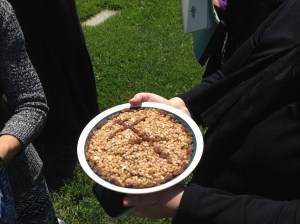
koliva with roses 4-15

The Orthodox Church understands that we love people. It encourages us to love deeply. And then, when they’re gone, to be comforted by the love the Church has for them, and for us. At the death of a member of the church, listen to how they are spoken of – in glowing terms, seeing only the best, most beautiful parts of the brother or sister in the faith.

The Church invites us to look upon the saints with a similar love. They are not only examples to follow, but as beloved family members. Prayer, lighting candles, keeping their feast days are the ways that we express our love across time, across the chasm of death.

I told my mother recently that Orthodoxy speaks my love language. In Orthodoxy, faith moved from an intellectual proposition that I accepted to a radical love that changed me. I want to love in the way that the Church loves its people. I want to look at others and see the beautiful image of God and love them with fire and determination. I want to feel the genuine affection that I see for bishops and priests and monks. I want that love to move me outward, to serve and pray and be a better version of myself. I want others to know that they are loved.

I fail all the time. I’m not very good at being Orthodox. But I’d rather try and fail at this than succeed at almost anything else.

–from the blog Persona
In this case, He truly wasn’t there.

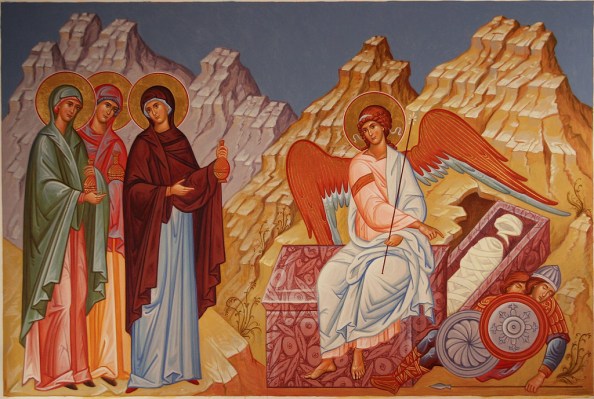
The second Sunday after Pascha we remember the myrrhbearers, the women who came early in the morning to Christ’s tomb to anoint his body. This article from our parish bulletin gave me great joy, as did the excursion I made with some others from church to several cemeteries this week, where we proclaimed Christ’s Resurrection to those in the graves. Our rector told us that we were also myrrhbearers that day, and he reminded us, “This is not a place of rotting and decomposed bodies, but a place of awaiting the Resurrection; what could be more joyful than that?”

IMG_2185

…The women came to anoint a body, a body that had ALREADY been anointed. What a strange thing to do. After all, as virtually every American mother assures her child the first time that he or she attends a funeral, the loved one isn’t THERE! Only his body! If the seven myrrh-bearing women were to have heard our 21st century dismissal of the human body, they would have been astonished. Perhaps they would have assumed that we are pagans, like the philosophers who declared soma sema — “the body is a tomb” — and who cremated their dead to allow the soul to escape that prison. But this was not the philosophy of our beloved myrrh-bearers. Mary Magdalene, when she saw the empty tomb, declared in grief, “They have taken away the LORD” and then asked, “Where have they taken him?” She didn’t ask, “Where have they taken his body?” In her mind, and to the mind of the Jewish faithful (except for the confused Sadducees!), a person was embodied: they looked for not mere spiritual continuation after death, but for the reunion of soul with body, a resurrection! And so do we as Christians! “I look for the resurrection of the dead.” Physical things matter to God….

IMG_2178

Anointing his body, then, was not such a bizarre thing to do. For this holy Tabernacle of God, this Prophet of prophets, this High Priest forever, this King of Kings, is worthy of every anointing honor that we can give him—though He has no NEED of our praise! In fact, it is He who anoints us with the Holy Spirit. But there is something for which He is looking—our faith. This ending of Mark summarizes for us many of the stories that are told in more detail in the other gospels. Briefly we hear about the women’s astonishment, and the  refusal of the apostles to believe, the surprise on the road to Emmaus, the disbelief in the upper room, and how Jesus “upbraided them” because of their disbelief. The One who struggled in the Garden with his chosen path knows what it is to be weak—though He himself was never faithless. And so, He calls to us, as he did to the early disciples, telling us not to be faithless but believing.

IMG_2170
simple barley koliva

The evidences of what He has done and is doing are everywhere around us and among us. Like the early disciples, we have confirmed before our very eyes the truth of His word. Anointed by the Spirit on Pentecost, they went out with the message, and braved many dangers, even death! As the last verse of Mark tells us, “…they went forth and preached everywhere, while the Lord worked with them and confirmed the message by the signs that attended it.” (Mark 16:20)

We too, God’s little anointed ones, are led by the Spirit, as St. Paul puts it; that leading may take us places we would rather not go. “For all who are led by the Spirit of God are sons of God. For you did not receive the spirit of slavery to fall back into fear, but you have received the Spirit of sonship. When we cry, ‘Abba! Father!’ it is the Spirit himself bearing witness with our spirit that we are children of God, and if children, then heirs, heirs of God and fellow heirs with Christ, provided we suffer with him in order that we may also be glorified with him. I consider that the sufferings of this present time are not worth comparing with the glory that is to be revealed in us.” (Romans 8:14-18)

–Excerpt from article by Edith M. Humphrey, Professor of New Testament at Pittsburgh Theological Seminary

Myrrhbearing women at the tomb

Zoë

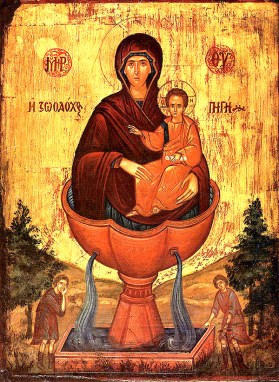
On Bright Friday, that is, the Friday after Pascha, the Orthodox Church commemorates The Life-Giving Spring of the Most Holy Theotokos. Though I had heard of the monastery by that name, it seems I had never paid attention on Bright Friday before to get the backstory; this year I heard about it twice. The story of a miraculous pool of water and how it was rediscovered is well told here.

I also learned that women with the name Zoë might have been named for this feast of the Theotokos. Zoë means life in Greek. In his Prologue of Ohrid St. Nikolai Velimirovich relates the story of a St. Zoë and her family, who were slaves in the second century. On the same day’s entry St. Nikolai’s homily is on this pertinent scripture from Jeremiah:

Be amazed at this, O heavens, and shudder with sheer horror, says the Lord. Two evils have my people done: they have forsaken Me, the source of living waters. They have dug themselves cisterns, broken cisterns that hold no water.

From the homily:

The Source of living water is the Lord Himself: inexhaustible, copious and sweet. The cistern is every man’s work which is performed in opposition to God and God’s law, and from which men expect progress, happiness and satisfaction for their hungeTheotokos lifegivingfountr and thirst….

….O Lord, Immortal Source of every good that the heart of man can desire and the mind of man can imagine, have mercy on us sinners and unworthy ones. With Thy powerful right hand, turn us away from our godless and vain works and quench our thirst with Thy sweet and living water.

Whether in her womb, or in a pool of healing waters, or in her example and exhortation to “Do whatever He tells you,” it is the life of the Lord Himself that His mother offers us.

This concludes my alphabetical posts. As in the first I acknowledged that Christ is Alpha and Omega, the first and last — according to the Greek alphabet — so here at “Z”, the last letter of our alphabet, we find that He is Zoë, Life itself.