Category Archives: church

In this case, He truly wasn’t there.

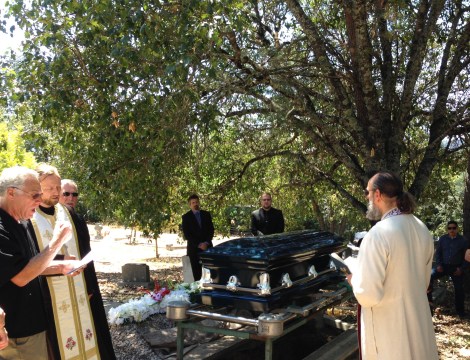
The second Sunday after Pascha we remember the myrrhbearers, the women who came early in the morning to Christ’s tomb to anoint his body. This article from our parish bulletin gave me great joy, as did the excursion I made with some others from church to several cemeteries this week, where we proclaimed Christ’s Resurrection to those in the graves. Our rector told us that we were also myrrhbearers that day, and he reminded us, “This is not a place of rotting and decomposed bodies, but a place of awaiting the Resurrection; what could be more joyful than that?”

IMG_2185

…The women came to anoint a body, a body that had ALREADY been anointed. What a strange thing to do. After all, as virtually every American mother assures her child the first time that he or she attends a funeral, the loved one isn’t THERE! Only his body! If the seven myrrh-bearing women were to have heard our 21st century dismissal of the human body, they would have been astonished. Perhaps they would have assumed that we are pagans, like the philosophers who declared soma sema — “the body is a tomb” — and who cremated their dead to allow the soul to escape that prison. But this was not the philosophy of our beloved myrrh-bearers. Mary Magdalene, when she saw the empty tomb, declared in grief, “They have taken away the LORD” and then asked, “Where have they taken him?” She didn’t ask, “Where have they taken his body?” In her mind, and to the mind of the Jewish faithful (except for the confused Sadducees!), a person was embodied: they looked for not mere spiritual continuation after death, but for the reunion of soul with body, a resurrection! And so do we as Christians! “I look for the resurrection of the dead.” Physical things matter to God….

IMG_2178

Anointing his body, then, was not such a bizarre thing to do. For this holy Tabernacle of God, this Prophet of prophets, this High Priest forever, this King of Kings, is worthy of every anointing honor that we can give him—though He has no NEED of our praise! In fact, it is He who anoints us with the Holy Spirit. But there is something for which He is looking—our faith. This ending of Mark summarizes for us many of the stories that are told in more detail in the other gospels. Briefly we hear about the women’s astonishment, and the  refusal of the apostles to believe, the surprise on the road to Emmaus, the disbelief in the upper room, and how Jesus “upbraided them” because of their disbelief. The One who struggled in the Garden with his chosen path knows what it is to be weak—though He himself was never faithless. And so, He calls to us, as he did to the early disciples, telling us not to be faithless but believing.

IMG_2170
simple barley koliva

The evidences of what He has done and is doing are everywhere around us and among us. Like the early disciples, we have confirmed before our very eyes the truth of His word. Anointed by the Spirit on Pentecost, they went out with the message, and braved many dangers, even death! As the last verse of Mark tells us, “…they went forth and preached everywhere, while the Lord worked with them and confirmed the message by the signs that attended it.” (Mark 16:20)

We too, God’s little anointed ones, are led by the Spirit, as St. Paul puts it; that leading may take us places we would rather not go. “For all who are led by the Spirit of God are sons of God. For you did not receive the spirit of slavery to fall back into fear, but you have received the Spirit of sonship. When we cry, ‘Abba! Father!’ it is the Spirit himself bearing witness with our spirit that we are children of God, and if children, then heirs, heirs of God and fellow heirs with Christ, provided we suffer with him in order that we may also be glorified with him. I consider that the sufferings of this present time are not worth comparing with the glory that is to be revealed in us.” (Romans 8:14-18)

–Excerpt from article by Edith M. Humphrey, Professor of New Testament at Pittsburgh Theological Seminary

Myrrhbearing women at the tomb

Zoë

On Bright Friday, that is, the Friday after Pascha, the Orthodox Church commemorates The Life-Giving Spring of the Most Holy Theotokos. Though I had heard of the monastery by that name, it seems I had never paid attention on Bright Friday before to get the backstory; this year I heard about it twice. The story of a miraculous pool of water and how it was rediscovered is well told here.

I also learned that women with the name Zoë might have been named for this feast of the Theotokos. Zoë means life in Greek. In his Prologue of Ohrid St. Nikolai Velimirovich relates the story of a St. Zoë and her family, who were slaves in the second century. On the same day’s entry St. Nikolai’s homily is on this pertinent scripture from Jeremiah:

Be amazed at this, O heavens, and shudder with sheer horror, says the Lord. Two evils have my people done: they have forsaken Me, the source of living waters. They have dug themselves cisterns, broken cisterns that hold no water.

From the homily:

The Source of living water is the Lord Himself: inexhaustible, copious and sweet. The cistern is every man’s work which is performed in opposition to God and God’s law, and from which men expect progress, happiness and satisfaction for their hungeTheotokos lifegivingfountr and thirst….

….O Lord, Immortal Source of every good that the heart of man can desire and the mind of man can imagine, have mercy on us sinners and unworthy ones. With Thy powerful right hand, turn us away from our godless and vain works and quench our thirst with Thy sweet and living water.

Whether in her womb, or in a pool of healing waters, or in her example and exhortation to “Do whatever He tells you,” it is the life of the Lord Himself that His mother offers us.

This concludes my alphabetical posts. As in the first I acknowledged that Christ is Alpha and Omega, the first and last — according to the Greek alphabet — so here at “Z”, the last letter of our alphabet, we find that He is Zoë, Life itself.


A thing of indecent horror.

344px-Cross_classe“When St. Paul preached in Athens, the world was thronged with crosses, rooted outside cities, bearing all of them the bodies of slowly dying men. When Augustine preached in Carthage, the world was also thronged with crosses, but now in the very centre of cities, lifted in processions and above altars, decorated and jewelled, and bearing all of them the image of the Identity of dying Man.

“There can hardly ever have been — it is a platitude — a more astonishing reversion in the history of the world. It is not surprising that Christianity should sometimes be regarded as the darkest of superstitions, when it is considered that a thing of the lowest and most indecent horror should have been lifted, lit, and monstrously adored, and that not merely sensationally but by the vivid and philosophic assent of the great intellects of the Roman world. The worship in jungles and marshes, the intoxication of Oriental mysteries, had not hidden in incense and litany a more shocking idol. The bloody and mutilated Form went up everywhere; Justinian built the Church of Holy Wisdom to it in Byzantium, and the Pope sang Mass before it on the hills where Rome had been founded. The jewelled crosses hid one thing only — they hid the indecency. But original crucifixion was precisely indecent. The images we still retain conceal — perhaps necessarily — the same thing; they preserve pain but they lack obscenity. But the dying agony of the God-Man exhibited both….”

-Charles Williams in  The Descent of the Dove: A Short History of the Holy Spirit in the Church

mosaic Ravenna Apollinare 6th wiki


6th century Byzantine mosaic in the apse of the basilica of Sant’Apollinare in Classe,  Ravenna, Italy. Photo in the public domain, on Wikipedia Commons.

Let’s open our hearts up to this.

I don’t know if I have ever before considered the difference between the betrayals of Judas and Peter. In a recent podcast for Holy Week Sister Vassa Larin gave a talk on this subject that I found very moving.

Judas is most famous for handing Jesus over to the authorities for the price of 30 pieces of silver. Right up until that momentous event he had been the disciple who had the responsibility for “the bag,” that is, he was the treasurer for the company of Jesus and his friends.

In the Gospel of John we read this telling account:

Then, six days before themary christ-at-bethany Passover, Jesus came to Bethany, where Lazarus was who had been dead, whom He had raised from the dead.  There they made Him a supper; and Martha served, but Lazarus was one of those who sat at the table with Him. Then Mary took a pound of very costly oil of spikenard, anointed the feet of Jesus, and wiped His feet with her hair. And the house was filled with the fragrance of the oil.

But one of His disciples, Judas Iscariot, Simon’s son, who would betray Him, said, “Why was this fragrant oil not sold for three hundred denarii and given to the poor?” This he said, not that he cared for the poor, but because he was a thief, and had the money box; and he used to take what was put in it.

But Jesus said, “Let her alone; she has kept this for the day of My burial. For the poor you have with you always, but Me you do not have always.”

What Sister Vassa points out is the lack of love for the Lord that Judas shows  here. She gives an example from modern life, to help us imagine: What if you are a mother whose son brings you flowers, and all your husband can say about the gesture of love is, “What a waste of money!” What would that tell you about his own love for you? And how would you feel?

Christ washing feet interruptingthesilence

We don’t know why Judas had failed to respond to the love of Christ and to reciprocate, but it seems that even at that last supper where he was present with the other disciples, Jesus was giving himself to Judas until the end, humbly washing his feet right along with the others, and offering him in particular a piece of bread from His own hand. As Jesus was speaking about how they ought to love and serve one another, He was doing the same. But Judas did not get it. In the words of Canticle Nine for Holy Wednesday, “…in exchange for money he rejects fellowship with Christ….how hast thou forgotten what Christ taught thee, that thy soul is more in value than the whole world!”

Afterward, when he saw that Jesus was condemned, he regretted what he had done, but Sister Vassa says it seems to be for ethical reasons that Judas regrets it, and not because he sinned against someone he loved. He distances himself from his sin and from the Lord even in his words, not using the name of Jesus but only referring to him as “innocent blood” that he had wrongfully betrayed. Judas immediately gives in to despair and commits suicide. He did not have the loving connection to Christ that would have been the starting point for going in a different direction, back to the fold where he had previously been loved and accepted. As Sr. Vassa says, “Even if you betray someone, love enables you to weep and repent; there is a connection, a personal relationship that still exists even when you fall short.”

mystical supper monreale

Peter, on the other hand, soon after saying that he would lay down his life for Christ, three times denied that he even knew the Lord. He was cut to the heart when Jesus looked pointedly across the courtyard at him, and he realized he had done just what the Lord had warned him about earlier that evening. Peter went out and wept bitterly, which is an appropriate response if you have betrayed and hurt someone you love.

And if you are the betrayed? Some of us may have to share this experience of the human condition, as Christ did. Only God can forgive sins, but as much as possible we would want to respond as our Savior did to Peter, and be glad if those who sin against us are repentant and come back.

Sister Vassa: “When Peter is restored by the risen Lord, the conversation is not about saying sorry, it’s not explicitly about pardon or forgiveness, ‘Let’s get down to analyzing what you did wrong.’ No, it is about affirming love. Three times Christ asks, ‘Do you love me?’ The Lord does not say, ‘What do you have to say for yourself? What have you Peter Christ - do you love medone?’ Peter is allowed thrice to affirm that which is salvific for him; that’s what saves Peter. It’s not even faith; love precedes faith.”

During Holy Week there are many doors through which we might enter to be with the Lord, many personal stories we can relate to, some more than others, but all of which are instructive. Let’s stay with Him, Who is Love. Thanks to Sr. Vassa for her wisdom, and I will close with a longer passage from her podcast:

We can’t forgive sins – only God can forgive sins. “Your sins are forgiven you!” We are so used to hearing that, we almost take it for granted, but this was not clear to those who hadn’t met him yet. This was an incredible gift.

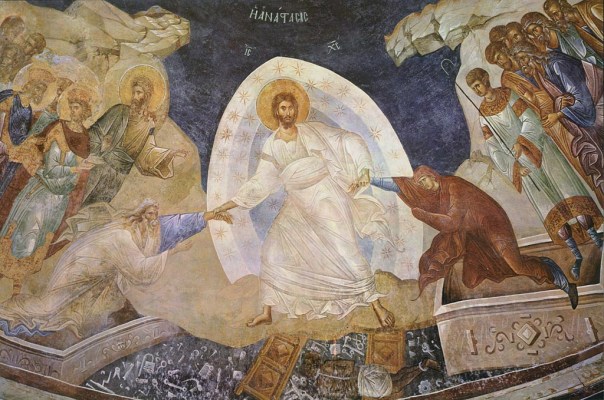
Most of us don’t know what it’s like to live without constant forgiveness. If there were no forgiveness, there would just be suicide. Where do you place those failures? What do you do with your sins? Just how dark would it be? Let’s contemplate the great self-giving and forgiveness going on this week, amidst the great darkness and betrayal and falling short, all the evil in the world crashing down on our Savior who’s not avoiding it. He’s taking it all on, accepting it, walking through it, letting it crush him, letting it kill him, and then he’s descending into the very hell of us, and bringing our humanity out in new life and having overcome all of that darkness. Let’s open our hearts up to this.