On June 27th we remember my patron saint, Joanna the Myrrhbearer. She is somewhat well-known among Christians as one of the women who cared for the needs of our Lord during his earthly ministry, and she was blessed to be present at the tomb on the morning of the Resurrection, and to hear the angel say, “Why seek ye the living among the dead?” The angel’s question is one that I have found it helpful to ask myself this year, since Pascha especially.
Today I read this poem by Naomi Shihab Nye on different ways to be famous, and it’s helping me enter into the spirit of my name day. I first read it in an anthology published ten years after the poet’s own collection that includes it, and somehow in my library copy of 180 More Extraordinary Poems for Every Day, selected by Billy Collins, the last two words of the poem had been changed to “did.” The meaning I extract from the one-word ending makes a big difference to me, and I prefer it, but I’m afraid it must have been a typo. I’m glad I read it the “wrong way” first, because it gives me two more possibilities to weigh and reflect on.
FAMOUS
The river is famous to the fish.
The loud voice is famous to silence,
which knew it would inherit the earth
before anybody said so.
The cat sleeping on the fence is famous to the birds
watching him from the birdhouse.
The tear is famous, briefly, to the cheek.
The idea you carry close to your bosom
is famous to your bosom.
The boot is famous to the earth,
more famous than the dress shoe,
which is famous only to floors.
The bent photograph is famous to the one who carries it
and not at all famous to the one who is pictured.
I want to be famous to shuffling men who smile while crossing streets, sticky children in grocery lines,
famous as the one who smiled back.
I want to be famous in the way a pulley is famous,
or a buttonhole, not because it did anything spectacular, but because it never forgot what it could do.
-Naomi Shihab Nye, from Words Under the Words: Selected Poems
During the Kneeling Vespers this afternoon I did not kneel, because I was sitting on a bench along the wall of the nave, with my little goddaughter Mary on my lap, and she had just fallen asleep. When a child falls asleep on my chest I am always astounded, and consider it the greatest honor, as though she were speaking right to my heart, “I feel safe and at peace with you, so I will give my warm body with its quiet breathing into your care.”
Today is Pentecost, or Holy Trinity Sunday, because not only do we remember that the Holy Spirit was given to us, and fell on the disciples 50 days after Christ’s Resurrection, but He was sent from the Father, by the Son, confirming the unity and will of the Holy Trinity, God in Three Persons.
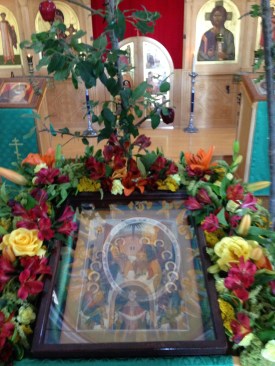
The photo of the framed icon above is reflecting the Pantocrator fresco in the dome above. If I squint hard enough I can see the face of Christ superimposed on the icon that depicts the Holy Spirit falling on the apostles.
The Holy Spirit is also remembered tomorrow, the day after this feast, on Holy Spirit Day. And today we had the Kneeling Vespers to prepare for that Liturgy; it’s the first time we have kneeled since Pascha, and the only time all year that we pray these particular prayers. I had brought a very little kneeling pad, cut from an old blue backpacking pad – our priest suggested we bring something like this – but as I didn’t need it, I offered it to a woman nearby and she was happy.
Because I had both arms around a dear baby, I wasn’t able to take a picture of her serene face, or to take out my notebook and write notes about the content of the seven long and poetical prayers, in three sets, or the hymns of that service….one normally wouldn’t want to do that anyway, but I felt that I missed so much that I would like to ruminate on further. We won’t hear these again until next year. I did look here just now and read a little about them:
Each set ends, sealed as it were with a lovely capstone, with one of the ancient vesperal prayers for light, from the Great Church of Holy Wisdom, in Constantinople. That much makes sense: praying for light as we re-enter the world from the heady days of Pascha-Pentecost, and enter “ordinary time” in our cycle of the church year. We need the light of Christ in the dark paths of this world, as our Gospel for the Feast proclaimed.
St. Seraphim with olive and birch
It was a day full of sunlight, and perhaps that added to the calm joy I was feeling, along with a certain amazement at the huge blessing of being in the Orthodox Church. This recent heightening of my awareness began last Sunday, when we remembered The Fathers of the First Ecumenical Council who in the 4th century labored body, soul, and spirit on behalf of the Body of Christ, to hold us fast to the Apostles’ teaching.
After the homily that day, I exchanged silent but knowing looks and hand-squeezes with a couple of people near me — we were all glad to be in this together, responding to the comforting words of our priest about how we don’t have to make up our faith as we go. If we also hold fast to the truth that has been given to us, we can give our energies not to intellectual debates, but to fulfilling the commandments of Christ.
Today’s feast is a celebration of the reality of God’s Holy Spirit in our lives, helping us to do just that, giving us Christ and His love to share among ourselves and with everyone in our lives. Really, God’s plan of salvation is impossible to fully comprehend…. One important point was brought home to us in today’s homily: Our purpose is to acquire the Holy Spirit.
A few months ago a lecturer asked a group of us, “What are the most fundamental doctrines of the Church?” How would you have answered? The answer was that the first doctrine is The Holy Trinity. So this feast is most important!
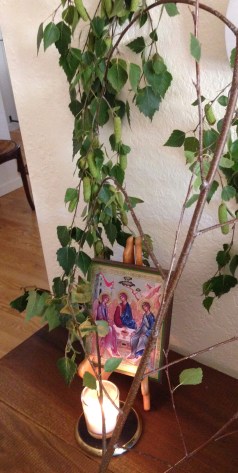
Lots of women and children were wearing green skirts or scarves. Some parishioners brought extra armfuls of birch branches into the church this morning, to hand out freely, or to prop up in corners here and there. I brought home a big blooming branch and stood it near my icon of The Holy Trinity.
In the Church, I live in a place where all the nourishment and medicine and support I need are available in the sacraments, and in the love and care of her saints poured into her over thousands of years now. They love and pray for us still.
Mary woke up just after Vespers was over. Her eyes opened and looked at my eyes, and then she sprang to life and was ready to go forth in her calling to grow in knowledge and grace, into the likeness of Christ. I want to rest in my Father’s arms in that childlike way, and be about my work in the strength that comes from His rest.
O Heavenly King, the Comforter,
The Spirit of Truth,
Who art everywhere present
and filleth all things;
Treasury of Blessings
and Giver of Life,
come and abide in us,
and cleanse us from every impurity,
and save our souls, O Good One.
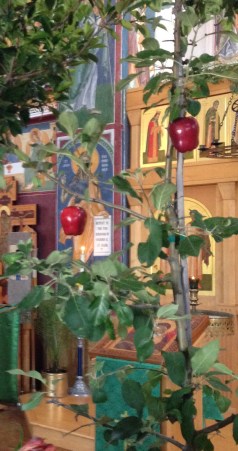
We have come to the Great Feast of Pentecost, and at the Vigil tonight we reverently resumed singing “O Heavenly King,” having withheld that prayer since Pascha, while we were “waiting” liturgically for the Holy Spirit to be poured out. All the vestments are green now, and the church is decorated with extra redwood branches, trees and flowers to remind us of our life in Christ, and to express our joy at the feast.
While we sang the long Psalm with its refrain, “His mercy endureth forever,” four chandeliers with a dozen candles each were set to swinging back and forth just above us, and when we looked beyond them, we could see the icon of the Savior, looking down with love and compassion.
One of the scripture readings tonight was from the Prophet Ezekiel, chapeter 36, and it explains some of the reasons why we are full of thanks and gladness:
I will take you from the nations and gather you from all the countries and bring you into your own land. I will sprinkle clean water on you, and you shall be clean from all your uncleannesses, and from all your idols I will cleanse you. And I will give you a new heart, and a new spirit I will put within you. And I will remove the heart of stone from your flesh and give you a heart of flesh. And I will put my Spirit within you, and cause you to walk in my statutes and be careful to obey my rules. You shall dwell in the land that I gave to your fathers, and you shall be my people, and I will be your God.
I want to share an article that is a kind of conversion testimony; it was published earlier this year with the title For the Love, on the blog Persona. The author well conveys the gratitude I also feel for the Church that encourages us above all to love people, and gives us tools for doing that. Tools? What am I saying? The Church gives us The Holy Spirit, a Person of the Holy Trinity Who live in Love, who are the source of any love.
Soon we will be remembering my goddaughter in prayer and song, on the one-year anniversary of her repose in the Lord. These days it is natural for me to think often about the dead, and not only my husband. For that reason I also appreciate what what Fr. Stephen Freeman has to say about our relationship to the departed, and how, “With the radical individualism of the modern world, the mystery of communion and true participation (koinonia) have been forgotten….”
The witness that follows is of someone who is discovering koinonia. I join with the writer of Persona in thankfulness for the ways the Church helps me to continue loving my dear Kathleen.
FOR THE LOVE
I attended my first service in an Orthodox Church in December of 2010. In April of 2012 I was chrismated (confirmed) in the church. What I don’t know about the Church could still fill several books, and I’m not very good at being Orthodox.
It’s a tradition that appears confusing and Byzantine to outsiders, with all of its incense and strange pictures, its standing and prostrating and crossing oneself. It seems legalistic, with all of the fasting and written prayers and candle-lighting. Praying to saints and the Virgin Mary? To Protestants, these things are often red flags, warnings of impending Catholicism.
I was frightened when I was first exposed to Orthodoxy. I was educated in a Protestant seminary, where I took classes on the theology of Martin Luther and the spiritual development of women as my electives (I have layers). I found it much easier to read about spirituality than to actually pray. I calmed my doubts with well-reasoned arguments, and I weighed and measured every sermon I heard to assess the soundness of its doctrine. I loved God with my mind.
Yet what drew me to Orthodoxy was not, ultimately the soundness of its doctrine or the reasonableness of its apologetics. From my earliest exposure to the tradition I acknowledged that it was quite likely the oldest expression of Christianity. But what ultimately brought me into the church was not a well-reasoned argument on the merits of prayer to the saints or an articulate defense of the use of icons and veneration of the Theotokos (the Virgin Mary). What ultimately brought me to the church was, quite simply, love.
As I participated in the life of the church, I was moved again and again by the love of the people. Yes, I was attracted by the love shown to me by the priest in my parish, and the new friends I made there. But what changed me, what won me over was realizing that at the root of all the practices that I didn’t understand, that seemed superfluous or legalistic, was love.
The Orthodox do not pray to saints because they feel that they cannot go directly to God. They don’t venerate the Theotokos because they feel that Christ alone is not enough. They don’t prostrate or light candles or fast because they feel they must earn their salvation. The Orthodox Church does what it does because they love – the Trinity, each other, the departed, saints – the Church loves them all. More than that, the church understands that we all love, and it gives us concrete ways to express ourselves.
For me, this all became very real a few months before I became a catechumen and began my (formal) journey towards Orthodoxy. When I was a teenager, someone very close to me passed away. The anniversary of her death approached, and I was sad. When I told my priest, he told me that the Church gives us a prayer service that we can pray on the anniversary of a loved one’s death. I went to the church and we lit a candle and prayed for her, and those of us who loved her.
The Orthodox Church understands that we love people. It encourages us to love deeply. And then, when they’re gone, to be comforted by the love the Church has for them, and for us. At the death of a member of the church, listen to how they are spoken of – in glowing terms, seeing only the best, most beautiful parts of the brother or sister in the faith.
The Church invites us to look upon the saints with a similar love. They are not only examples to follow, but as beloved family members. Prayer, lighting candles, keeping their feast days are the ways that we express our love across time, across the chasm of death.
I told my mother recently that Orthodoxy speaks my love language. In Orthodoxy, faith moved from an intellectual proposition that I accepted to a radical love that changed me. I want to love in the way that the Church loves its people. I want to look at others and see the beautiful image of God and love them with fire and determination. I want to feel the genuine affection that I see for bishops and priests and monks. I want that love to move me outward, to serve and pray and be a better version of myself. I want others to know that they are loved.
I fail all the time. I’m not very good at being Orthodox. But I’d rather try and fail at this than succeed at almost anything else.

 During the Kneeling Vespers this afternoon I did not kneel, because I was sitting on a bench along the wall of the nave, with my little goddaughter Mary on my lap, and she had just fallen asleep. When a child falls asleep on my chest I am always astounded, and consider it the greatest honor, as though she were speaking right to my heart, “I feel safe and at peace with you, so I will give my warm body with its quiet breathing into your care.”
 Mary woke up just after Vespers was over. Her eyes opened and looked at my eyes, and then she sprang to life and was ready to go forth in her calling to grow in knowledge and grace, into the likeness of Christ. I want to rest in my Father’s arms in that childlike way, and be about my work in the strength that comes from His rest.
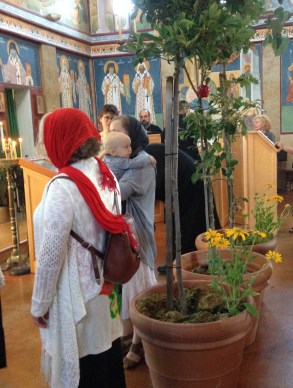 We have come to the Great Feast of Pentecost, and at the Vigil tonight we reverently resumed singing “O Heavenly King,” having withheld that prayer since Pascha, while we were “waiting” liturgically for the Holy Spirit to be poured out. All the vestments are green now, and the church is decorated with extra redwood branches, trees and flowers to remind us of our life in Christ, and to express our joy at the feast.