Category Archives: church

Mary also was given a gift.

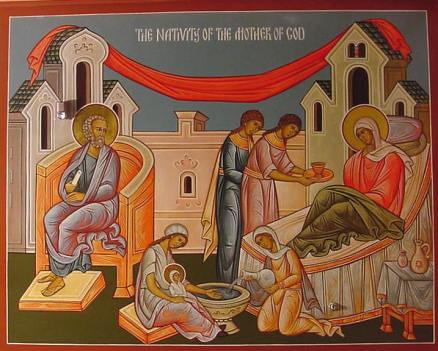
This week we Orthodox celebrate one of the Twelve Great Feasts of the Church, The Birth of Christ’s mother Mary, whom we Orthodox call the Theotokos. This name, which means God-bearer, honors Jesus Christ in that it contains the statement of our belief that He is “…very God of very God, begotten, not made, being of one substance with the Father.”

In this article about the feast Fr. Alexander Schmemann tells us that Mary’s birth was not unlike that of any other human, with all its gifts and potential. Putting it that way, though, belies the immensity of what happens when someone is born, if you believe Fr. Alexander who says that “…with each birth the world is itself in some sense created anew and given as a gift to this new human being to be his life, his path, his creation.” This is hard for me to wrap my head around; probably because it’s something that the heart has to learn.

Mary was given this gift – and she gave the world a great gift. Certainly she played a big role in our salvation history, and we love her for it, and love to celebrate her birthday.

These excerpts are from a slightly longer article here: On The Nativity of The Theotokos
Nat_Theot

THE BIRTH OF THE THEOTOKOS:

Son of God, Son of Man… God descending and becoming man so that man could become divine, could become partaker of the divine nature (2 Peter 1:4), or as the teachers of the Church expressed it, “deified.” Precisely here, in this extraordinary revelation of man’s authentic nature and calling, is the source of that gratitude and tenderness which cherishes Mary as our link to Christ and, in Him, to God.

And nowhere is this reflected more clearly than in the Nativity of the Mother of God. Nothing about this event is mentioned anywhere in the Holy Scriptures. But why should there be? Is there anything remarkable, anything especially unique about the normal birth of a child, a birth like any other?

The Church began to commemorate the event with a special feast…because, on the contrary, the very fact that it is routine discloses something fresh and radiant about everything we call routine and ordinary, it gives new depth to the unremarkable details of human life…. with each birth the world is itself in some sense created anew and given as a gift to this new human being to be his life, his path, his creation.

This feast therefore is first a general celebration of Man’s birth, and we no longer remember the anguish, as the Gospel says, “for joy that a human being is born into the world” (Jn. 16:21). Secondly, we now know whose particular birth, whose coming we celebrate: Mary’s. We know the uniqueness, the beauty, the grace of precisely this  child, her destiny, her meaning for us and for the whole world. And thirdly, we celebrate all who prepared the way for Mary, who contributed to her inheritance of grace and beauty….

And therefore the Feast of her Nativity is also a celebration of human history, a celebration of faith in man, a celebration of man. Sadly, the inheritance of evil is far more visible and better known. There is so much evil around us that this faith in man, in his freedom, in the possibility of handing down a radiant inheritance of goodness has almost evaporated and been replaced by cynicism and suspicion.

This hostile cynicism and discouraging suspicion are precisely what seduce us to distance ourselves from the Church when it celebrates with such joy and faith this birth of a little girl in whom are concentrated all the goodness, spiritual beauty, harmony and perfection that are elements of genuine human nature. Thus, in celebrating Mary’s birth we find ourselves already on the road to Bethlehem, moving toward the joyful mystery of Mary as the Mother to God.

—Fr. Alexander Schmemann

Always on the move.

red barrel on path

To be a Christian is to be a traveller; like that of the Israelite people in the desert of Sinai: we live in tents, not houses, for spiritually we are always on the move. We are on a journey through the inward space of the heart, a journey not measured by the hours of our watch or the days of the calendar, for it is a journey out of time into eternity.

Met. Kallistos Ware in The Orthodox Way

How we do faith.

https://blogs.ancientfaith.com/glory2godforallthings/wp-content/uploads/sites/15/2013/12/desert-monk1-266x300.jpgHow we pray, how we think, how we play and learn, even how we greet strangers — many topics come together in this article by Father Stephen, which provides needed good reminders for me. I’m just going to put the whole article here, but if you’d rather read it on his site, it comes from this post: Do Faith to Have Faith

There is an adage, “Do faith until you have faith.” It is often attributed to John Wesley, who said something like it. I’ve generally ignored such slogans – bumper-sticker Christianity troubles me. But there is something worth considering beneath this nostrum.

St. Paul says, “Do not be conformed to this world, but be transformed by the renewing of your mind…” (Rom 12:2). But how is the mind renewed?

There is a very mistaken approach to spiritual matters on the part of many. The assumption is that spiritual things must happen “spiritually.” And by this people mean, “Mental things must happen mentally.” There is an almost gnostic view within contemporary Christianity that equates spiritual with mental.

The mind is not changed by trying to think new thoughts.

Anyone who has ever tried to stop thinking about something, or who is dogged by obsessions knows how impossible it is to control thoughts. It is certainly more effective to try to replace a thought than to change it. But the very nature of thoughts make them easy to become repetitive and obsessive.

How do we come to think? How do we come to know?

There are many popular ideas about thoughts that are simply wrong. We rarely choose our thoughts. When we intentionally think about something, there is a decisional aspect involved. But thoughts arise by association, by suggestion, by habit, by fears, anxieties, desires, etc. Thoughts are only occasionally the result of a rational process. We are human beings – thinking bodies – our minds are not the “ghost in the machine.”

The great learning theorist, Jean Piaget, wrote about the part that “play” has in the learning of children. In many respects, play is a ritualized activity. Children “playing house,” go through rituals of housekeeping. I have sat at “tea” before at the table of a young daughter, sharing the meal with stuffed animals and dolls. The activity might have been “play,” but it was quite serious and important.

Children do not learn in a manner that differs from adults – they just do so much more of it! Adults learn by ritualized behaviors as well. Even learning to be a sales person is an effort to learn the “ritual” of selling things to people. I bought a car recently with one of my adult children. The “ritual” at the dealership was comical when it was not insulting. The salesman had to excuse himself to discuss a “deal” he offered me. I know that he will return with the sad news that his manager thinks it should be a little more than we agreed. I’ve been around long enough to know that there was very likely no conversation with the manager. I challenged the man (and the ritual) and we settled on a “deal” that was mutually satisfactory.

Very few human activities have no ritual component. It is both how we learn, and often how we act. When we meet strangers we usually greet them in one of several ritual manners, with words that are known to be well-accepted. If we had to think of new greetings for every stranger, human contact would be tedious, difficult, and even dangerous.

The Protestant theologian, Stanley Hauerwas, has written repeatedly and convincingly about the nature of the virtues. Things such as courage, patience, kindness, generosity, etc., are almost never spontaneous actions. They belong to what he terms a “set of practices.” His favorite example is his father’s profession: bricklaying. To lay brick, one works with a master brickmason. The apprentice learns the “practice” of laying brick. He does not think his way through the process – he learns to lay brick by repeating the rituals of the trade – its practices.

Hauerwas says that the Christian faith is a set of practices. Virtues are the habits acquired through the repeated work of the Christian life. If you have to think about being courageous, you will most likely fail.

Hauerwas’ thought, like most that is good in contemporary theology, is just a restatement of what the fathers have always taught. Christ states the nature of our faith quite clearly:

Then Jesus said to those Jews who believed Him, “If you abide in My word, you are My disciples indeed. And you shall know the truth, and the truth shall make you free.” (John 8:31-32)

We imagine this process to be in reverse. Our modern misunderstanding tells us that first, we will know the truth, then on the basis of that knowledge, we will abide in Christ’s word. But it is the “abiding,” the repeated doing of Christ’s commandments, that yields knowledge of the truth. Thus it is generally useless to argue about the truth of the faith. Until someone lives it, they will often not see its truth. We come to the faith, not because we see everything – its fullness. We come because, by grace, we have been allowed to see something. But we will only know the truth of that something if we ourselves do it.

Much of the Orthodox life is marked by ritual. There is a way of praying. There is a way of fasting. There is a way that we engage in worship. There is a way that we honor the saints and the icons. This life is called the “Orthodox Way.” It is indeed a set of practices. There are no ideas that are not also embodied in the way of life. It is said, “Lex orandi, lex credendi”: The “law of praying is the law of believing.” And in Orthodoxy, “praying,” is a practice, not just an expression of ideas. It is the reason that Orthodox liturgy rarely changes, and then only in a modest, incremental manner. To engage in liturgical reform is to risk the way of life. The danger of wholesale reform has been tried repeatedly in various Christian groups, generally with disastrous results.

If you want to be a saint, pray like one. Do faith until you have faith.

          — Fr. Stephen Freeman – Glory to God for All Things

Enduring and Truthful Fictions

Today is Book Lovers’ Day, my friend Myriah just informed me, and I’m so glad she did. It’s actually one of two days that are celebrated for and by people like us. To mark the day I am re-posting an old book review I wrote, from 2009. It’s a response to three books, so we could think of it as a triple treat for our readers’ party:

Three Truthful Fictions

In early summer I read three works of fiction in a short space of time:

Ah, But Your Land is Beautiful by Alan Paton
A Thousand Splendid Suns by Khaled Hosseini
The Folding Cliffs by W.S. Merwin

These were all pretty dramatic stories of historical fiction. Paton’s book follows closely the events in South Africa mid-20th century. Hosseini writes about Afghanistan in the last 30 years, and Merwin’s book is an epic poem about Hawaii, mostly in the 19th century.

I was sitting around after surgery with my foot up, and that was what had made it possible for me spend more time reading and thinking. Some things I thought about: How funny that the settings of these thr3 truthful fictions picee books were at three corners of the globe. Obviously they were not part of any theme. So were there some ways they were alike? What made them all worth reading to the end, when so many books I’ve tried lately were not?

Suffering was a large part of all the stories. The Afrikaners in Ah, But Your Land is Beautiful were treating all people of color unjustly and inhumanely. Whites who did otherwise suffered along with the oppressed, and often sacrificed their careers, homes, and reputations.

All the women suffer miserably in A Thousand Splendid Suns. War and famine, selfish and sinful men and women supported by bad cultural traditions, all combine to keep the women trapped in complicated and painful predicaments. Factions of Muslims hate one another.

The Folding Cliffs makes vivid the way conquering peoples oppress the vanquished, all the while thinking it is “for their own good.”

What benefit is there in dwelling on Man’s Inhumanity to Man? Don’t we already know how wretched we are? If that were all one gets from these stories, I don’t think they would be worth reading, but there is another bigger part to all of them, and that is Man’s Love. Just as Christ gave His life in love for us suffering humans, so He gives grace to men to rise above their suffering, show compassion to their fellow man, and do deeds of mercy.

“Courage is not simply one of the virtues but the form of every virtue at the testing point, which means at the point of highest reality,” said C.S. Lewis, and it is this courage that is shown by the young parents in Cliffs who flee to the hills and fight off government agents who are shooting at them, rather than have their family torn apart by the health officials who are shipping lepers off to Molokai like so many unclean animals. Their love is demonstrated in the test of courage.

In Land, the author and his companions find joy and fellowship in realizing the sacrificial, mercy-giving aspect of their humanity as they fight what seems to be a losing battle against political power. Perhaps they were living what Winston Churchill was talking about when he said, “We shall draw from the heart of suffering itself the means of inspiration and survival.”

Alan Paton in his autobiography Towards the Mountain writes of the experience:

“…the inhumanity of man to man could be made endurable for us only when we manifested in our lives the humanity of man to man….there is a wound in the creation and…the greatest use we could make of our lives was to ask to be made a healer of it.”

I haven’t lived with the kinds of suffering I read about, and that is partly why I think these writings are valuable, for as we read we take as our companions in mind and heart characters who are historically real or fictionally true, who can train us in Christian virtue.

Khaled Hosseini has given his countrymen and all of us a wonderful gift in the two books of his I am familiar with. In Kite Runner and in A Thousand Splendid Suns he paints a backdrop of horror, including much personal moral failure. Kite Runner exposed my own innate cowardice as I empathized with the protagonist, and as he was able to find healing and hope after repentance, I was also comforted.

In Suns the author gives a tender role model to women everywhere who are beaten down by life. The character of Miriam is the ultimate in misery, as she has no friends and no family who care about her, and she is barren, so her husband hates her. Then a young woman comes into her life, a woman who could easily slide into being another tormentor. But instead she shows kindness and becomes a true friend, and Miriam finds hope and courage, as well as other parts of her humanity and womanhood that had been obscured. She is transformed from a passive recipient of abuse into a woman who can return love, and she is happy, even in the face of continued abuse.

These stories have the potential to become part of the collective consciousness of a people, and help us to live more humanly, more humanely. I hope that Suns in particular can give vision to the women of Afghanistan, a vision of themselves as able to rise above their circumstances by means of love toward others.

We won’t eliminate the oppressors; our hope does not consist of that, as Father Alexander Schmemann has summarized:

“The fundamental Christian eschatology has been destroyed by either the optimism leading to the Utopia, or by the pessimism leading to the Escape. If there are two heretical words in the Christian vocabulary, they would be ‘optimism’ and ‘pessimism.’ These two things are utterly anti-biblical and anti-Christian…. It is for us, Christians, to reconstruct this unique faith, in which there are no illusions, no illusions at all, about the evil.”

Keeping with the theme of inspiring fiction, I’ll end with a quote by Whittaker Chambers from Witness (which book I love, but it is not fiction) about a novel that was formative for him. I haven’t read Les Miserables, but I noticed a few years ago that at least three important writers I knew of had mentioned they read it more than once as children. Sorry, I can’t remember who the others were. Chambers describes what can happen when a good writer connects with the reader:les miz pic

“I read and reread Les Miserables many times in its entirety. It taught me two seemingly irreconcilable things–Christianity and revolution. It taught me first of all that the basic virtue of life is humility, that before humility, ambition, arrogance, pride and power are seen for what they are, the stigmata of littleness, the betrayal by the mind of the soul, a betrayal which continually fails against a humility that is authentic and consistent. It taught me justice and compassion, not a justice of the law, or as we say, human justice, but a justice that transcends human justice whenever humanity transcends itself to reach that summit where justice and compassion are one….”