Category Archives: death

I slip on the downside of Fall.

Waterlogue-2015-11-08-20-02-54 berries
pyracantha on path (Waterlogue)

Only a couple of days ago I was in love with the season and my new plants and all. Then last night, as I was airily driving to Vespers, suddenly it descended like a solid black cloud, the realization that I would not have my beloved companion with me this year. The days are cooler and damper and one can take a walk at any time of day and it will be pleasant, but he will not be here to share the  delights of the season with.

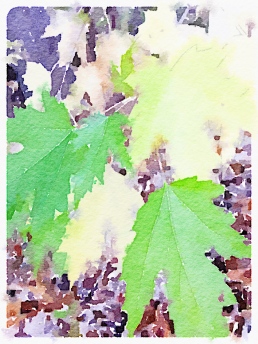
Today I took a walk alone, as I will have to do more often now, trying to hold on to what is left of me. I hoped the exercise would improve my weepy mood, and I thought I might take some pictures with my phone, because that urge is something  of me that remains, and it’s not overly challenging work.
Waterlogue-2015-11-08-19-59-19 leaves
turning leaves

The change in me is one of the griefs that is so disturbing. I don’t only miss my husband, my companion of 45 years, but I miss my very life, because it is changed at several levels. I know in faith, and even by the evidence of the recent months, that God’s plans for me are good, but now I feel the down side of the season’s changes in the way they mark the progress through the cycles of the years and seasons of life, and make me feel the sting of change and decay.

Last night I saw a photo slide past on my screen saver, set to shuffle family pictures, a snapshot taken of my husband when he was just a little boy on the beach, looking serene and calm. He didn’t know then that his life would speed up year by year, that he was racing toward the grave. I was stunned and angry. He comes forth like a flower, and is cut down: he flees also as a shadow, and continues not. (Job 14:2)

GL P1020633

The memorial service for which I made the koliva was also last night, just before Vespers, right after I was hit by the black cloud. As I served up little cups of the boiled wheat dish in the narthex several of us were remarking on how we can’t keep track of the passage of time; what year was it that Sarah reposed? We need help to remember, and to remember the things that we ought. It’s good for us to have these services and to pray for the dead partly because it reminds us that our own death is coming, and we should live in light of that.

IMG_0917 2015-11-08
Neighbor Elizabeth’s front yard

To remind myself of the realities that have sustained me through the last months, I spent some time this morning looking through the blog posts I have written since my husband’s death. I was surprised to find that the comments from you readers were the most comforting words to read, because you have suffered with me via my blog and have prayed for and affirmed me through everything. I wanted to write a private e-mail to so many of you, but I decided to write this post instead. Writing is a way for me to tame my wild thoughts and feelings as I organize them and put them into a perspective that is in tune with Truth, and the love of The Holy Trinity.

Several “real life” friends learned of my extra sorrow today. I received hugs and phone calls and e-mails, and prayers. I know that many of you pray for me often, and that is heartening. I ask my husband to pray for me too, as I know that in reality he is not far away, no matter how I may feel in the moment. Thank you all, for reading my blog, for praying. Thank you, God, for everything.

For God has not given us the spirit of fear; but of power, and of love, and of a sound mind.
(II Timothy 1:7)

by my front door

This man lived and made me love him.

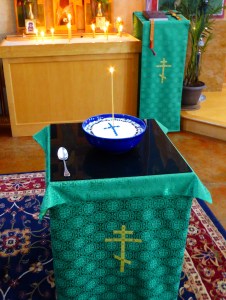
Today marks three months since my husband fell asleep in the Lord. I recently learned that P1000485in the Orthodox Church a memorial service is often held at three months (as we did at 40 days), and because we also are commemorating The Nativity of St. John the Baptist today, it was convenient to have these prayers right after the Liturgy. I made koliva again but decorated it a little differently.
I like what Metropolitan Anthony Bloom wrote on the subject of prayer for the dead:

What does it mean to pray for the dead? Are we asking the Lord to act unjustly? Certainly not. By our prayer, we bear witness that the dead have not lived in vain. We show that as well as the many worthless things they did in their lives, they also sowed the seed of charity. We pray for them with love and gratitude; we remember their presence among us. And our prayer for them must be supported by our lives. If we do not bear fruit in our lives of what the dead have taught us, our prayer for them will be feeble indeed. We must be able to say, “Lord, Lord, this man lived and made me love him, he gave me examples to follow and I follow them.” The day will come when we shall be able to say, “The good that you see in my life is not mine; he gave me it, take it and let it be this for his glory, perhaps for his forgiveness….”

The life oP1000496crpf each one of us does not end at death on this earth and birth into heaven. We place a seal on everyone we meet. This responsibility continues after death, and the living are related to the dead for whom they pray. In the dead we no longer belong completely to the world; in us the dead still belong to history. Prayer for the dead is vital; it expresses the totality of our common life.

–Metropolitan Anthony Bloom in Courage to Pray

What to do with the rocks.

DSCN0011english wall
English wall by Pippin

“I was tired of well-meaning folks telling me it was time I got over being heartbroke. When somebody tells you that, a little bell ought to ding in your mind. Some people don’t know grief from garlic grits. There’s somethings a body ain’t meant to get over. No I’m not suggesting you wallow in sorrow, or let it drag on; no I am just saying it never really goes away. (A death in the family) is like having a pile of rocks dumped in your front yard. Every day you walk out and see them rocks. They’re sharp and ugly and heavy. You just learn to live around them the best way you can. Some people plant moss or ivy; some leave it be. Some folks take the rocks one by one, and build a wall.”

― Michael Lee West, American Pie

St. Justin Martyr

Saint Justin the Philosopher and Martyr (AD 100-165; celeb. June 1st)

You can kill us but you cannot do us any real harm.

-Saint Justin Martyr

Justin is known in the Orthodox Church as Martyr Justin the Philosopher. In his youth he was unsatisfied with the philosophies of the day, and after becoming a Christian he opened a school of Christian philosophy. He refused to offer sacrifice to pagan gods and was beheaded along with the martyrs Justin, Chariton, Euelpistus, Hierax, Peonus, Valerian, Justus and Charito in 165. They are all commemorated on June 1.

The following gives the context of the above quote and is from his first apology in 150 A.D., which he wrote to the emperor Antoninus Pius in defense of innocent Christians:

“Reason dictates that persons who are truly noble and who love wisdom will honor and love only what is true. They will refuse to follow traditional viewpoints if those viewpoints are worthless…Instead, a person who genuinely loves truth must choose to do and speak what is true, even if he is threatened with death…I have not come to flatter you by this written petition, nor to impress you by my words. I have come to simply beg that you do not pass judgment until you have made an accurate and thorough investigation. Your investigation must be free of prejudice, hearsay, and any desire to please the superstitious crowds. As for us, we are convinced that you can inflict no lasting evil on us. We can only do it to ourselves by proving to be wicked people. You can kill us—but you cannot harm us.”