The second Tuesday after Pascha it is common for Orthodox to visit cemeteries to share the joy of Easter with the departed, just as Christ must have done when he “descended into Hades” first thing after His Resurrection. In our area it is a strong tradition among parishes and monasteries, and I learned to love this trip to the cemeteries early in my life as an Orthodox Christian.
Until this year I had only visited one of the many cemeteries that are included on this day, but now that my own husband lies “newly reposed” in different one, I wanted to go and sing “Christ is risen!” by his grave as well. Priests from two Orthodox churches arrived unintentionally at the same time and led the service right next to the yet unmarked grave of Mr. Glad. You can see the long rectangle where turf was replaced, in the center of this picture.
The cemetery where his body was laid is of the modern “endowed” sort. All of the grounds are kept up by the owners, paid for by the burial fees. This is the same cemetery that I first visited in 2012 and afterward wrote about in A Sleeping Place Is Blessed. Not two years later Mr. Glad realized it would be prudent to buy plots for us there.

Up the road a few miles at the next stop, we were met by Nina who was waiting by the graves of both of her husbands. I saw on the marker that her first husband died when I was still a child. Through the oaks down the hill we could see a third priest praying with two women at one gravesite.
This cemetery is of the old and non-endowed sort, where you are lucky if once a year some community organization chops down the larger weeds. And there is concrete, lots of it, in big broken squares and rectangles of curbs and cracked slabs over and around family groupings. I had forgotten about the hilliness, and about this difficulty of standing and walking on uneven concrete surfaces, an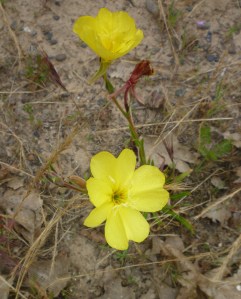 d my ankles began to hurt. Note to self: No Danskos next time.
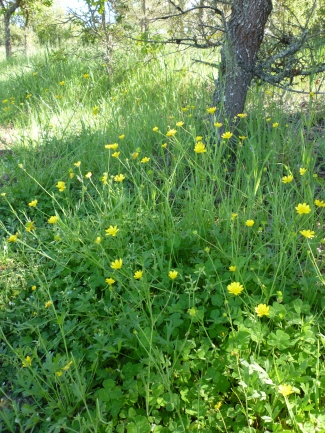
Besides the concrete, in the unpaved areas there are often foxtails and dust. But flowers grow in the cracks even in drought, and the rockrose that was planted long ago (photo at top) is vigorous. Last year it was really hot on Radonitsa (the Slavic word for this Day of Joy) but today it was cool and drizzly, so our shoes got wet on the lawns.
We didn’t have a big crowd at any of the cemeteries. A different group showed up at each place, with the most people at the third one, including several nuns from a nearby monastery; and women originally from Bulgaria, Ukraine, and Russia, presumably because they are used to doing a similar thing in their countries. Yevhenia, my new friend from Ukraine (that’s a phonetic spelling of how I try to pronounce her name, a form of Eugenia) said that in her country they bring tables and chairs to the cemetery so that they don’t have to rush off, and they picnic on festal foods while they think a while longer about death and God. They like to leave food on the graves, too, for poor people to pick up later on.
When I came home and read again about the Day of Rejoicing, I found that “The Slavs, like many ancient peoples, had a tradition of visiting family members’ graves during the springtime and feasting together with them.” It was an easy custom to continue after their conversion to Christianity, a faith that gave them a truly joyful message to bring along with the food, about Christ’s life-giving death.
 This third cemetery has a smooth endowed section with flat grave markers, down the hill from what is in this picture, and we all trailed over there on the paths between the large square plots, to finish the service near those newer graves. Not far off a group of three people we didn’t know was gathered around a gravesite that was heaped with flowers, one woman obviously weeping.
They watched and listened to us as we faced their direction and sang the Paschal Canon enthusiastically, and when Father walked around censing, and blessing the graves with holy water as he sang, he went as far as their spot and sprinkled water on it, too, just very naturally, but did not interrupt the service. When we finished we went to talk to them; the woman’s mother had died. Maybe the two men were her husband and son. She kept telling us, “Thank you!” through her tears, and we exchanged hugs and repeated greetings of “Christ is risen!”
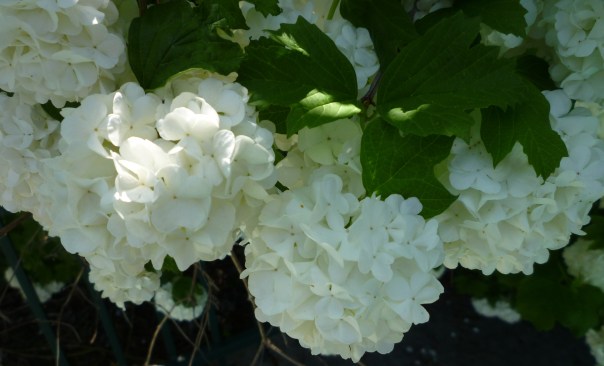
Some of us had colored eggshells left over from Pascha, to sprinkle on the graves. I didn’t have anything like that for Mr. Glad’s grave but a friend shared his with me. I hope to be ready next year, as I’ve conceived a plan, to make use of the blooms of our big snowball bush (viburnum) which are usually at their peak about this time. On the graves of those awaiting the Resurrection, they would be a lovely adornment.
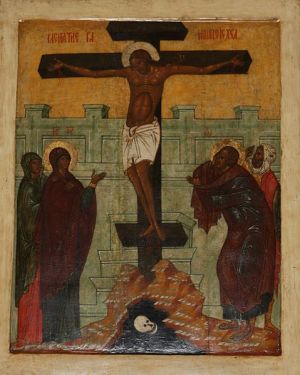 But as I’ve said here more than once already, I have the peaceful assurance that we are not absolutely separated, and a huge thankfulness as well that neither of us has been cut off from the Source of our life and existence. Sometimes we humans use the figure of speech that we will “die of grief,” because it feels that wrenching. But I know even as I am feeling it and railing against it, that I will live through it. This is all because Christ suffered for us, and he overcame death. My pain is like a pinprick compared to what Christ endured on our behalf. As for my husband, “Blessed are the dead who die in the Lord.”
 the beginning of Lazarus Saturday, when we remember an event that starts out very poignantly, with Jesus’s friends lamenting the death of their brother, and Jesus Himself weeping.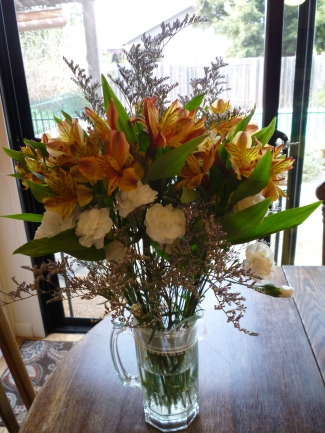
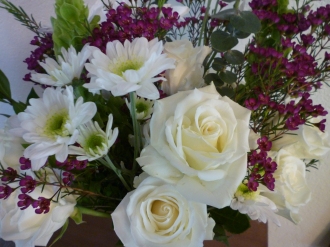
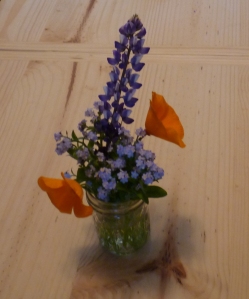 most nourished of anyone by all the sweet flower-love. These real and aromatic things helped to keep me aware of God’s presence as much as did the kind messages in cards, and the care packages of fruit and candy.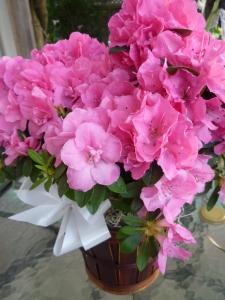
 The power of Resurrection is not a Divine “power in itself,” but the power of love, or rather, love as power. God is Love, and it is love that creates life; it is love that weeps at the grave and it is, therefore, love that restores life… This is the meaning of these Divine tears. They are tears of love and, therefore, in them is the power of life.