Category Archives: family

How long will the rocks of Berkeley last?

Berkeley Camellia in October

My sisters came to visit, and for the first time in about 50 years we returned together to places in Berkeley where we used to play. None of us has ever lived there, but as children we visited our maternal grandparents every summer.

Both of our parents had grown up in Berkeley, and last week we walked and drove the mostly hilly streets to find several of the houses in which our grandparents and our father and his sisters had lived. Of course we also stopped and stared at our other grandma’s house, savoring the memories that had been born in us there.

Not far away is Indian Rock Park, of which you can see pictures in my post about the neighborhood where Grandma and Grandpa lived for half a century. Indian Rock is huge — but not as big as we remembered it. And the park includes massive slabs and lava stones directly across the street, which I don’t know if I’ve ever played on. We didn’t go there this time, either, but climbed to the top of Indian Rock itself and sat a while, looking out over the tops of a thousand houses to San Francisco Bay.

Down Indian Rock Path

Not for very long, though, because we wanted to skip on down the steps of Indian Rock Path to Solano Avenue shops. Well, maybe not skip. But skipping is probably what we used to do!

Jade plant in bloom on the path

In our memories the excursion to the ice cream parlor took much longer than what we found this time, even though we have passed the age when one can be unconscious of one’s legs and feet whether walking uphill or down. That shop has a new name, but the wares are similar, and you can look at old scoops while you wait.

After lunch, because we wanted to return to the higher neighborhood, it was necessary to hike up, and this time we took the steep route of Marin Avenue. Again my experience seemed altogether different from that of years ago, when most evenings after dinner Grandma, at an age greater than any of us have reached yet, would lead us on brisk neighborhood walks. It was slower than then. And the crucial person was missing.

Marin Avenue is a hike.

Mortar Rock steps

We circled back to Mortar Rock, just around the corner from Indian Rock, and wandered there longer, just as we used to play there longer in our childhoods. More of those stone surfaces are easily climbable, and Grandma always felt better about us going by ourselves, because we didn’t have to cross a busy street to get there.

The houses next to these parks and paths don’t have much privacy. In this picture you can see how close they are, and how there are not fences blocking them from park goers and their glances.

When I first put my feet on the dry paths of Mortar Rock Park, suddenly a familar herby smell registered in my senses, making me look down to see long pointy dead leaves underfoot, just as my mind was linking to “bay tree.” I lifted my head and saw that the dappled shade was cast by at least two tall old California Bay Laurels (along with oaks and buckeye) whose several large trunks were curving high over the rocks.

And yes, there were the grinding mortars in the rock, empty of anything but leaves at this time of year. Do children still pretend to be Indians grinding acorns in them?

One of the houses we were searching for was only a few blocks from here, so we walked up the street, admiring the many flowers still in bloom in this mild climate. Banks of fuchsias always remind us of the long row of them that grew along the brick path in Grandma and Grandpa’s back yard.

More rocks! This house, though modern in design, has a very traditional and unchanging boulder to distinguish its front yard.


This one’s even more of a monolith. Having such a thing in your front yard would certainly lend drama to the landscaping. I wonder if the owners of the house are helped to keep a humble perspective on their lives, with the antiquity of their mineral friend constantly looming. So solid, and not going anywhere.

Lots of giant volcanic rocks dot the neighborhood. I saw these I didn’t remember on Santa Barbara Avenue, taking up a lot or two.

Rocks on Santa Barbara Ave., Berkeley CA

The weather was summery, and we seemed to walk always up, and up. It felt good to stop frequently to snap pictures of fall color or late summer flowers. Eventually we arrived at the first house of our father’s on our list, on Santa Barbara Avenue.

Another childhood home of my father, on Euclid, has had a facelift recently — we compared it with photos from 15 years ago when a patriarchal tree must have blocked the view and the warming sunlight, and the color was white. Paint and trees and even whole houses are easier to change or remove than those giant rocks.

Euclid house

And though it seems ages ago that we walked these streets together, and slept in the Berkeley bedroom wondering at the city lights spread out before us, most of these houses are not more than a hundred years old. Young things, really.

We went back to our car and drove to a few more houses, none so photogenic now. We bought gas at the station where our grandma used to buy hers, and we shopped at the market where she used to shop. We ate dinner at Spenger’s Fish Grotto where we’d eaten many times with our grandparents. And then my dear sisters and I finished our day with shopping at our grandma’s favorite Park & Shop market, now Andronico’s.

But a little earlier in the evening we’d added to our tour a visit to the cemetery where both Grandma and Grandpa are buried. None of us had visited since the last graveside service almost 20 years ago, and it took some exploring to find the marker. I felt closer to Grandma and Grandpa there at their grave than I had on the street in front of their house.

Cemeteries are where one finds another sort of stone, markers of lives that grew up like grass, and withered and died, most with life spans briefer even than flimsy wooden houses and certainly shorter than those huge stones people built neighborhoods around fairly recently. At the end of time, we read in 2 Peter, “… the day of the Lord will come as a thief in the night; in the which the heavens shall pass away with a great noise, and the elements shall melt with fervent heat, the earth also and the works that are therein shall be burned up.”

Indian Rock and all the granite in the Sierras, though it’s been around longer than we can imagine, will be gone, along with houses and gravestones. Then what is most enduring, the souls into whom God breathed life, will be raised. We are what on this earth is eternal.

I praise Modoc, and question Jefferson.

Surprise Valley, California

It looks to me like some cowboy lost a piece of his shirt on this barbed wire. I took the picture when we were poking around in Modoc County, “where the West still lives.”

Ten years ago our family met a cowboy who looked like The Marlboro Man himself, as we stood on a hillside watching him lead a string of horses through the sagebrush and across a creek, with pastel layers of aspens and mountains behind him.


This remote and rugged land is one of the areas that has perpetually been found within the proposed boundaries of The State of Jefferson, a longed-for 51st state that would include several counties in northern California and southern Oregon.

The modern Jefferson includes more counties.

Just last month the supervisors of Modoc and also those of its neighboring Siskiyou County voted to secede from the State of California, as the historic movement revs up again.

The Sacramento Bee reported:

[Mark Baird, one of the prominent activists] insists the State of Jefferson is the answer to revive logging, protect ranching and lure new businesses. He bristles at suggestions that these counties need to subsist on social services.

“It’s absolutely infuriating to people up here, this idea that we’re little children and we must have our hands held out,” Baird said. “Well, we would make our own way. We are intelligent, creative, hardworking people, and without the morass of failed social engineering experiments here, we would do fine.”

Barn in Yreka, in Siskiyou County, California

The Modoc county seat is Alturas, a word that means “valley on top of a mountain.” Much of this country is considered High Sage Plateau, with evidently enough water for many cattle ranches and hay fields.

If I hadn’t had a traveling companion to restrict my stoppings, I’d never have made it home for trying and trying again to get the perfect picture of black steers grazing on varying shades of green and yellow-green, with dark mountains behind them.

Nothing close to the perfect shot was to be mine. Either I was not high enough above the grassland to get the sweeping view, or the steers clumped up close to see if I were bringing their dinner, or, in the case of those next to our our motel in Alturas, they ran away when I was still 50 yards from the fence.

Many of these fine scenes were in Surprise Valley, which is even farther east than Alturas, east of Hwy 395, on the other side of the Warner Mountains. This valley’s elevation, if you drive up and down Surprise Valley Road as we did, is above 4,000 feet.

The photo below looks still farther east, toward a band of tan that might be an alkali lake, and up into the Hays Canyon range of mountains that lie mostly in Nevada.

Looking east from Surprise Valley to the Hays Range in Nevada

Besides your typical mountains, you can find the Glass Mountain Lava Flow on the western edge of Modoc County, though it lies mostly in Siskiyou County. On our previous visit we climbed on parts of that “mountain” and brought home huge pieces of obsidian and pumice. Everyone’s shoes no doubt suffered a month’s worth of wear on that terrain.


Glad kids scramble on Glass Mountain.

Murals on several buildings in downtown Alturas express aspects of the region that the residents appreciate. Modoc County has mule deer, herds of wild horses, Rocky Mountain elk, pronghorn, and birds galore. We didn’t make it up to Goose Lake, but the bird mural makes me think of Goose Lake Valley, rich in all kinds of bird life. The painted fowl look as though they could fly right off into the real sky.

At the bottom of the mural you can see landscape such as we also noticed on our way up to Alturas, when the rich farmland gives way in places to slopes on which the soil is evidently too rocky and poor to support anything more than the occasional juniper tree. But the existence of fencing makes me think that in the springtime they might run livestock on the greened-up grass.

juniper trees
Fisherman
Pronghorn

more murals

We ate breakfast at the Hotel Niles in Alturas.

I don’t know about the Jefferson thing. It’s a nice idea….can you believe we have a lot of family who reside in Jefferson counties both in Oregon and California? Probably none of our kin would be found at either of the cultural extremes within the succession movement, but at least one sports a license plate frame on her car declaring “State of Jefferson.”

Nowadays there is a public radio station that claims the name, and people can attend the Jefferson State Hemp Expo, “…founded on the belief that through awareness, education, and the cooperation and coordination of citizens and public officials, many complex social issues can be solved.” Note the emphasis on cooperation, not separation. Separation was formerly the goal of all Jefferson adherents, and a big part of the content of Jefferson as in its nickname “State of Mind.” Currently it does seem that many of the people who use the name don’t really expect anything to come of it. To at least a few it is probably just a brand they use to sell something.

another Surprise Valley view

At the other end of the spectrum, perhaps, are the hunters and most of the ranchers, and the politically conservative. This segment of the populace might include the woman who was noted in the police report column in the Alturas newspaper, which I perused while sitting on the bed in our motel room. She called the sheriff and said that if someone didn’t speedily do something about the dog that was threatening her alpacas, she herself would “dispatch” the dog. I doubt that was the word she used.

Maybe the serious secessionists would include the people who shoot at Belding Squirrels during the Annual Squirrel Roundup. These are a type of ground squirrel that looks like a prairie dog, and their large populations damage the cultivated fields (I’m guessing it’s by their holes and tunnels?), so once a year the residents hold a big fundraiser/pest-control event.

The giggling squirrel-shooter in this video I ran across is embarrassing, but you could turn off the sound, try to ignore the squirrels flying into the air, and see some nice footage of Surprise Valley in the background. The Roundup is held in March, so you will see less yellow and brown than in my pictures. If you make it to the very end you’ll be rewarded with a view of Mount Shasta, something that would not be possible from down in Surprise Valley. The moviemaker must have driven back over the pass to the west at the close of day.

The likelihood of all these diverse Jefferson people agreeing to secede seems slight to begin with, and that’s not the only challenging aspect of the project. Perhaps the nickname The Mythical State of Jefferson is the most appropriate. Whatever you call it, I do love this country.

On Cedar Pass, between Alturas and Surprise Valley

They are playing all around.

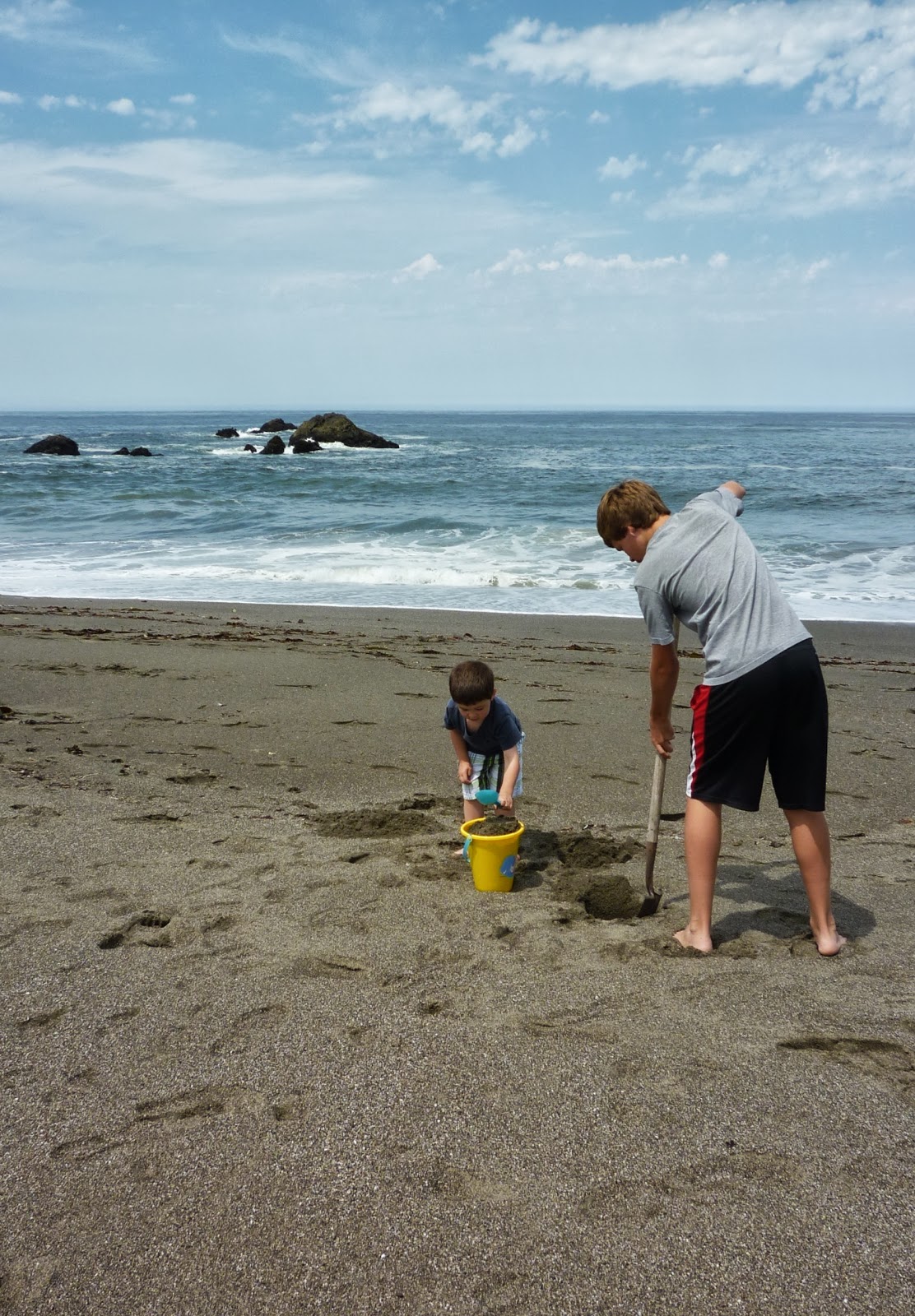
Happily, there is more talk about playing, and how children’s play fits in with the lives of adults — and that doesn’t mean driving them to nursery school or to the soccer field. We are referring to normal play that is not structured or organized or planned by adults.

Jody at Gumbo Lily wrote a wonderfully descriptive post about how her own grandchildren play near her while she works. Of course it makes most of us remember our own childhoods and the kind of fun we had all by ourselves. If you haven’t already, I hope you will comment on her post or here with some of your memories along that line.

Of outdoor play, I remember in my own early years making dolls’ houses in the dirt under orange trees, and the classic mud pies. If the children are “entertaining themselves,” and the adults are taking the opportunity to get some work done, the vast majority of what children do with their time is undocumented, and likely unremembered also. Two more ways we don’t control it.
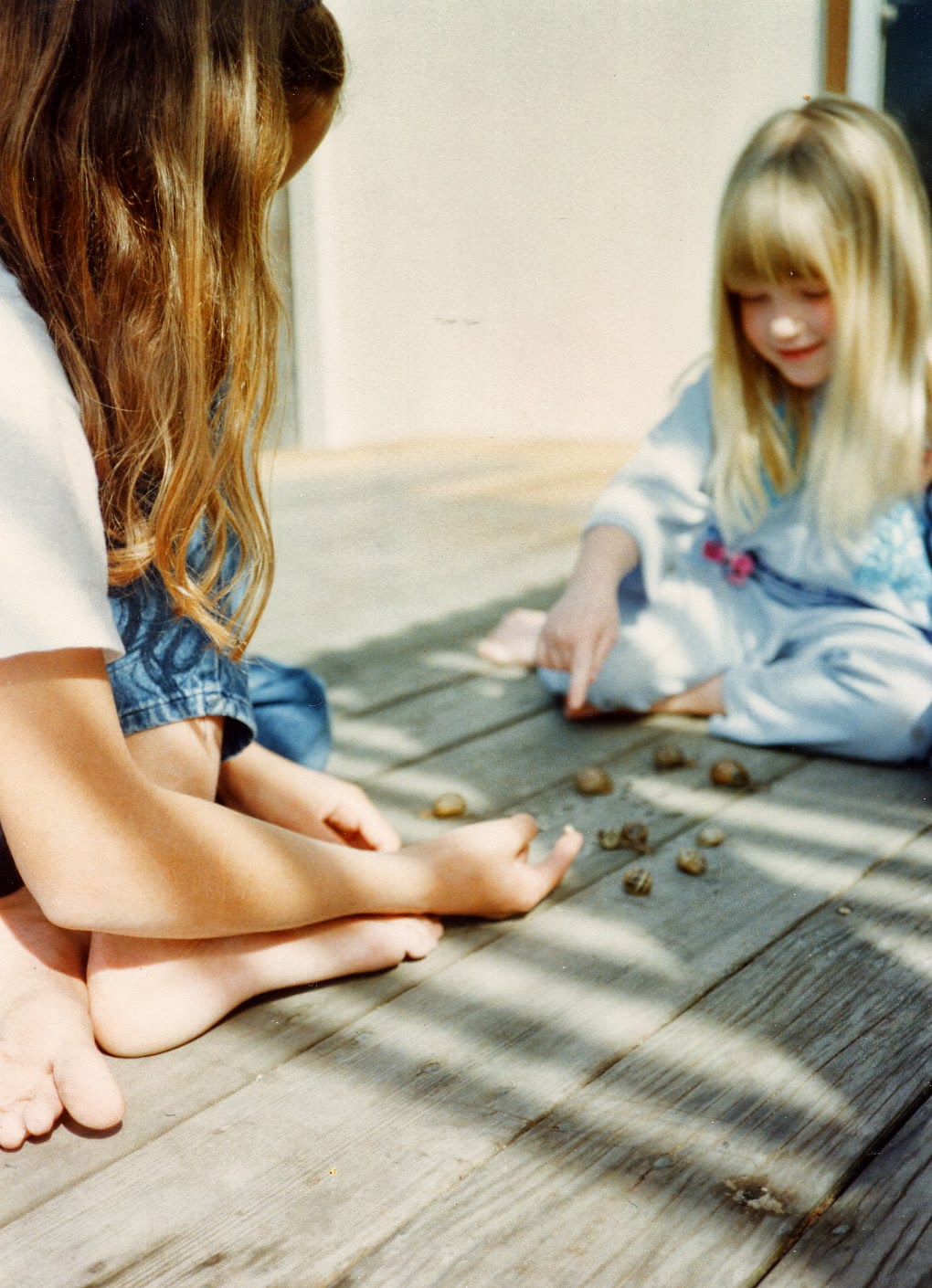
snail toys

And lest someone think that a big ranch is necessary for the kind of play we’re talking about, I’m posting the only picture I can find, other than what I put up on my last post, of me or my children playing alone. If they are occupied, and the adult is occupied, why, there is no one to hover with a camera.

This picture was taken just after we moved from the country to the city. When we had a huge garden next to a cow pasture and a blackberry bog, across the road from an abandoned orchard, we had no snails. So when we moved here where we now live, they were a new and fascinating object of play, which I definitely did not introduce as a science topic. I don’t know what all went on with those snails, but I had to laugh at the way every little thing can be a toy on what Jody call’s God’s playground.

Now read her blog, because her examples are nicer.

Mountain Air – smoke and writing


I returned this week from a solitary trip to the mountains, where I stayed in a cabin off the grid for four nights. I could easily write a book about my five days of journeying and lodging, probably a philosophical novel. Or would it be a how-to treatise with packing lists and suggested activities and prayers?

I’m always saying, “I could write a book about ____.” And it just occurred to me that I am always writing, as I endlessly analyze events as to their significance, and organize my thoughts, composing and reworking the lines in my mind. If I have a pencil or keyboard handy and hands free I might scribble down some of it, often in a notebook or in the margin of the book I’m reading. But the process has begun long before that.

It wouldn’t be a lie exactly, when people ask me what I do, to say, “I write.” Because I’m a process-oriented type, I can’t see a book ever resulting from my work, but no pressure — no one is clamoring for a discussion of the things in my pocket or the interrelatedness of the last ten books I read.

I thought I might do some sort of scribbling during my getaway, but I didn’t make much visible progress on my “books.” Many things that are fascinating to my self-centered self consumed my hours and my thoughts, and I do want to reflect on some of that here, hopefully without rambling on and on.


Today I just want to mention one sad thing about my experience: Smoke. The brown cinders from that horrid Rim Fire, the largest wildfire on record in the Sierra Nevada, had drifted south and made the air murky around Our Lake. One day was so bad that my eyes and throat and head hurt from the pollution. But I didn’t have to come home early, because it cleared up a little by the next morning.


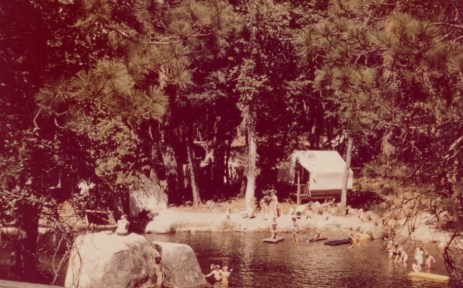
I can’t imagine what the landscape will look like, the next time we visit our beloved Yosemite and drive through the scorched forests. One thing I know: On August 25th the fire destroyed the Berkeley City Camp Tuolumne where my sisters and I as children vacationed with our grandparents.

It has been many decades since I did water ballet in that swimming hole in the Tuolumne River, or even visited the camp, and it won’t change my life that it is wiped out. But what a heartache for the people who spent dozens of formative summers in the context of that special place, and those for whom the rustic cabin life in an idyllic setting was a very recent tradition and expectation. I’m very thankful it was only smoke that invaded our family’s lake and village.