Category Archives: feasts

The Cross in the heart.

We are celebrating the Feast of the Elevation (or Exaltation) of the Holy Cross. This is a commemoration of historic events in the Orthodox Church, and an opportunity to ask ourselves what these outward expressions of faith have to do with our lives in the current age. The original events are more than a thousand years distant from us, but the human condition is unchanged.

“The Exaltation of the Lord’s Cross has arrived. Then, the Cross was erected on a high place, so that the people could see it and render honor to it. Now, the cross is raised in the churches and monasteries. But this is all external. There is a spiritual exaltation of the cross in the heart. It happens when one firmly resolves to crucify himself, or to mortify his passions—something so essential in Christians that, according to the Apostle, they only are Christ’s who have crucified their flesh with its passions and lusts (cf. Gal. 5:24). Having raised this cross in themselves, Christians hold it exalted all their lives. Let every Christian soul ask himself if this is how it is, and let him hearken to the answer that his conscience gives him in his heart.” 

-St. Theophan the Recluse, Letters on the Spiritual Life

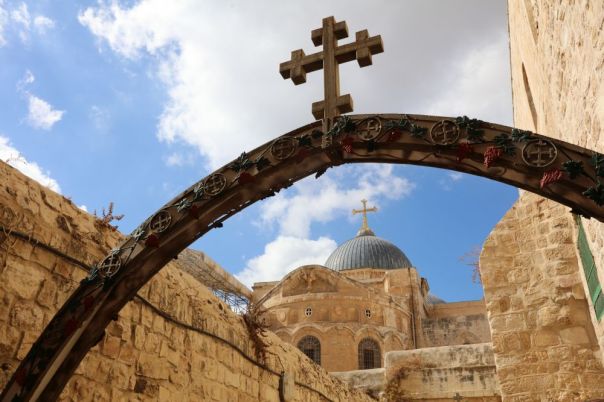
Church of the Holy Sepulcher, Jerusalem

A radiant inheritance of goodness.

For various reasons, mostly laziness, it is usually a challenge on Sundays to drive back to my Orthodox church for an evening service. We don’t have such services routinely, but today was one of the exceptions: One of the Twelve Great Feasts happens on Monday this week. As the liturgical day begins in the evening, we started celebrating this (Sunday) evening, because it is already Monday  🙂


Today was blessedly different: it seemed easy to return, and because of that I can copy an old post just as it was, to share now. Happy Birthday to Mary!

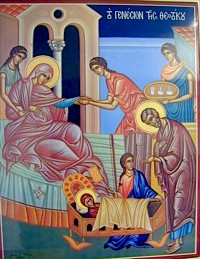
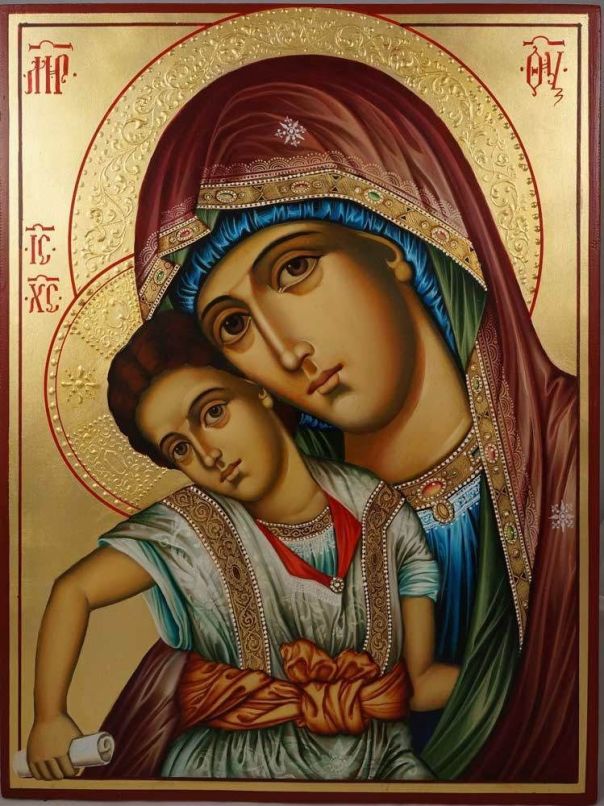
What a joy to be present at the “birthday party” for the beloved mother of our Lord! We began tonight, and will continue tomorrow, to rejoice at this first event of the church liturgical cycle, one of the 12 Great Feasts of the year. In honor and remembrance, I offer this sermon by Protopresbyter Alexander Schmemann:

SERMON ON THE NATIVITY OF THE THEOTOKOS

The Church’s veneration of Mary has always been rooted in her obedience to God, her willing choice to accept a humanly impossible calling. The Orthodox Church has always emphasized Mary’s connection to humanity and delighted in her as the best, purest, most sublime fruition of human history and of man’s quest for God, for ultimate meaning, for ultimate content of human life.

If in Western Christianity veneration of Mary was centered upon her perpetual virginity, the heart of the Orthodox Christian East’s devotion, contemplation, and joyful delight has always been her Motherhood, her flesh and blood connection to Jesus Christ. The East rejoices that the human role in the divine plan is pivotal. The Son of God comes to earth, appears in order to redeem the world, He becomes human to incorporate man into His divine vocation, but humanity takes part in this. If it is understood that Christ’s “co-nature” with us is as a human being and not some phantom or bodiless apparition, that He is one of us and forever united to us through His humanity, then devotion to Mary also becomes understandable, for she is the one who gave Him His human nature, His flesh and blood. She is the one through whom Christ can always call Himself “The Son of Man.”

Son of God, Son of Man…God descending and becoming man so that man could become divine, could become partaker of the divine nature (2 Peter 1:4), or as the teachers of Church expressed it, “deified.” Precisely here, in this extraordinary revelation of man’s authentic nature and calling, is the source of that gratitude and tenderness which cherishes Mary as our link to Christ and, in Him, to God. And nowhere is this reflected more clearly that in the Nativity of the Mother of God.

Nothing about this event is mentioned anywhere in the Holy Scriptures. But why should it be? Is there anything remarkable, anything especially unique about the normal birth of a child, a birth like any other? The Church began to commemorate the event with a special feast…because, on the contrary, the very fact that it is routine discloses something fresh and radiant about everything we call routine and ordinary, it gives new depth to the unremarkable details of human life…And with each birth the world is itself in some sense created anew and given as a gift to this new human being to be his life, his path, his creation.

This feast therefore is first a general celebration of Man’s birth, and we no longer remember the anguish, as the Gospel says, “for joy that a human being is born into the world” (Jn. 16:21). Secondly, we now know whose particular birth, whose coming we celebrate: Mary’s. We know the uniqueness, the beauty, the grace of precisely this child, her destiny, her meaning for us and for the whole world. And thirdly, we celebrate all who prepared the way for Mary, who contributed to her inheritance of grace and beauty…And therefore the Feast of her Nativity is also a celebration of human history, a celebration of faith in man, a celebration of man.

Sadly, the inheritance of evil is far more visible and better known. There is so much evil around us that this faith in man, in his freedom, in the possibility of handing down a radiant inheritance of goodness has almost evaporated and been replaced by cynicism and suspicion. This hostile cynicism and discouraging suspicion are precisely what seduce us to distance ourselves from the Church when it celebrates with such joy and faith this birth of a little girl in whom are concentrated all the goodness, spiritual beauty, harmony and perfection that are elements of genuine human nature. Thus, in celebrating Mary’s birth we find ourselves already on the road to Bethlehem, moving toward the joyful mystery of Mary as the Mother to God.

-Father Alexander Schmemman
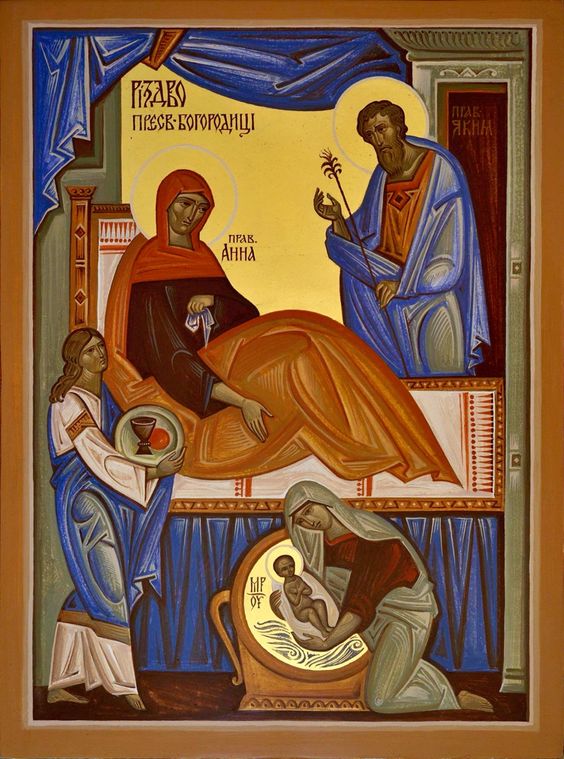
Nativity of Theotokos contemporary

Thy nativity, O Virgin,
has proclaimed joy to
the whole universe!
The Sun of Righteousness,
Christ our God,
has shone on thee,
O Theotokos!
By annulling the curse,
He bestowed a blessing.
By destroying death,
He has granted us
Eternal Life.

-Hymn for the feast

The death of John the Baptist.

The glorious beheading of the Forerunner,
became an act of divine dispensation,
for he preached to those in hell the coming of the Savior.
Let Herodias lament, for she entreated lawless murder,
loving not the law of God, nor eternal life,
but that which is false and temporal.

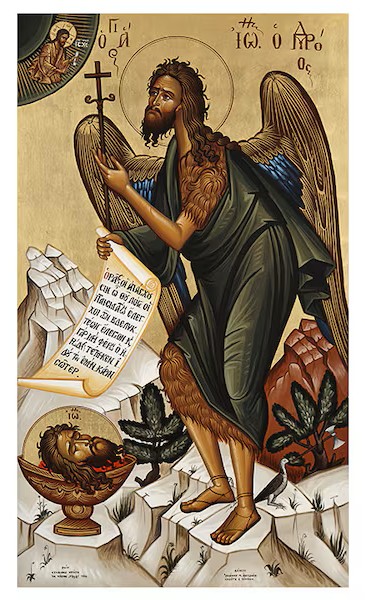
-Hymn for the Feast, of The Beheading of the Glorious Prophet, Forerunner and Baptist John.


Weeks and weeks of homebody bliss.

I’ve been home from my travels more than two weeks already, and before any more trips loom on the horizon, I have eight more weeks of homebody bliss remaining. It’s still high summer, when the days –or at least, the afternoons — are of the warm sort that energize and call me to the garden. This is the greatest good fortune. Glory to God, that I have a garden. Glory to God!

Stinking Chamomile

Other things besides the garden have helped to fill my days, and are filling my calendar into the near future. When I am home, I can be a host, and have guests! My house is happy when extra people are enjoying its spaces, and feeling the breezes blow through. That’s happened twice already in the last two weeks, and I’m expecting it to happen more.

When guests come in the summertime, they can stroll about the garden and pick a plum, and younger guests can play in the playhouse. The last one who did that made a soup entirely of tarragon and fountain water, and then dumped it into the fountain. Speaking of the fountain, when I am home I can keep it running, and keep it clean. It’s not very cheery to have a fountain turned off.

Lesser Goldfinch – internet photo

The birds are enjoying the summer. I hadn’t noticed the goldfinches much in the last couple of years, but this week they have been frolicking around the fountain; they seem to have plenty of time to play, probably because they’re not burning so many calories to keep warm. Today the house finches came along to drink and bathe as well. And one goldfinch made a side trip to the arbor, to perch on a long wisteria runner that was reaching out horizontally. He made short and quick jumps down toward the tip, which dropped a couple of inches in elevation with each jump, pecking at the buds, or maybe at insects, until he was at some critical point, after which I suppose he’d have found himself upside down if he’d held on — so he flew away.

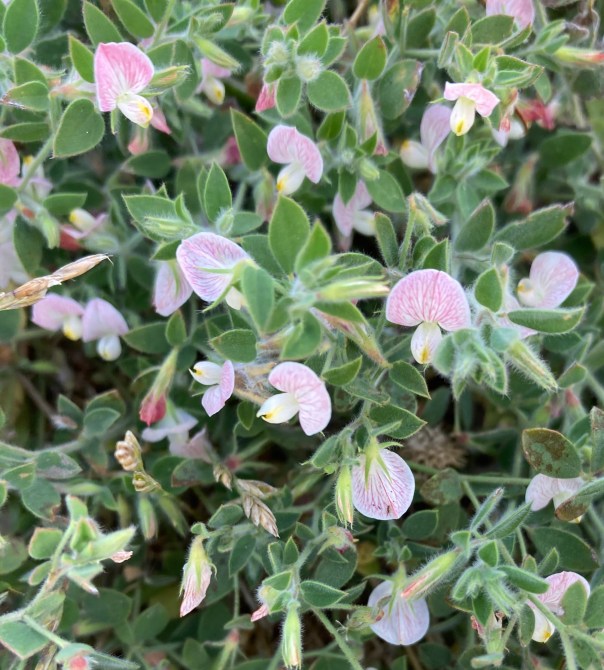
Spanish Clover

It was a wet spring here, and the early summer was cool, but now everything not in watered gardens is crisping up. I took my friend to one of my favorite parks for an easy hike, but it was so dry that the trail in many places had deep and wide cracks that made walking difficult, even in my boots. I guess I’d never been there at this time of year before? It did smell good out there, I must admit, and amid the crackling grasses we saw lots of wildflowers — first, masses of Yellow Star-Thistle, Centaurea solstitialis, an invasive plant that is in bloom now.

Yellow Star-Thistle

Star-Thistle is one of the many invasives that one can learn about on the website of the California Invasive Plants Council website, which I only just discovered. I think I’ll like to return there. The website of Yosemite National Park also features articles about such plants locally, and one of them tells about the great lengths different agencies go to, to control what is in California considered a weed. A Wikipedia article is unclear about whether the star-thistle is considered noxious in six or in 23 of the U.S. states where it is present. Are you my U.S. readers familiar with it? Evidently the purple star thistle is essentially the same thing, except for the color.

Star Thistle

The pennyroyal that amazed me at Tomales Bay also grew along the path in less spectacular displays; and Spanish Clover, and Stinking Chamomile (Anthemis cotula), photo above. That chamomile was new to me; Gwen sniffed it and said that indeed it did not smell good.

Domesticated and not-stinky chamomile is growing in my planter box, just one specimen that sprouted from the old seeds I threw in there before I went to Greece. I should plant it every year, it is so cheery.

Last week we celebrated the Procession of the Cross, and the festal cross stayed in the middle of the temple until the Forefeast of Transfiguration. Now we will celebrate Transfiguration for about a week until the Leavetaking of Transfiguration which is the day before we celebrate Dormition (Assumption) of the Theotokos in the middle of the month. I love the way the calendar anchors me to the church, and reveals the abundance of saints and events who fill the year with the glory of God.

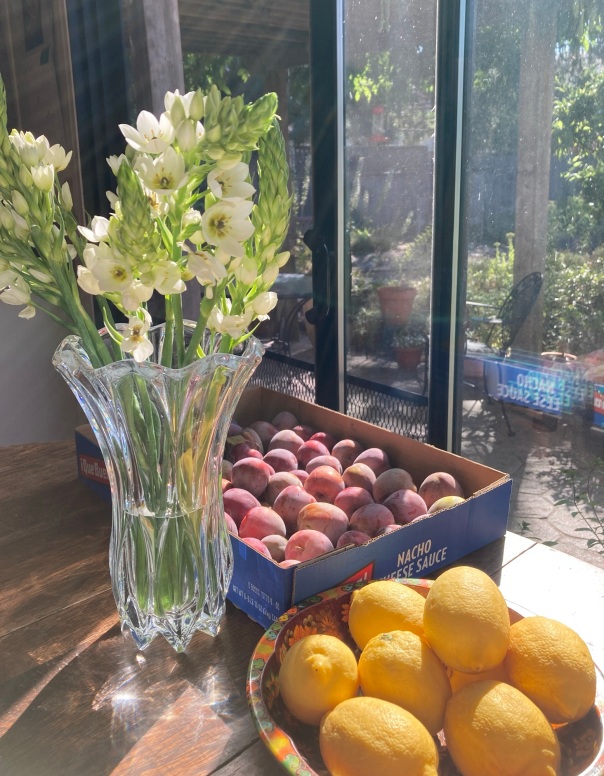
Before the service, before all the fruit had arrived.

As usual we brought baskets of fruit, and after Liturgy processed through the vineyard singing. It wasn’t as prickly as the trail I walked on last week, but it required careful stepping around grape prunings and blackberry brambles.

I pruned the lavender this week, and set it aside to take to a friend so she can add it to the straw in her chicken coop, to sweeten up the atmosphere:

A different friend came for lunch, and we were able to eat outside on the patio, after a leisurely tour of the garden. It was just warm enough to thoroughly relax, but not to wilt. I added snips of my parsley and tarragon to the salad we made together. I could have put a few calendula petals in as well, but I didn’t think of that.
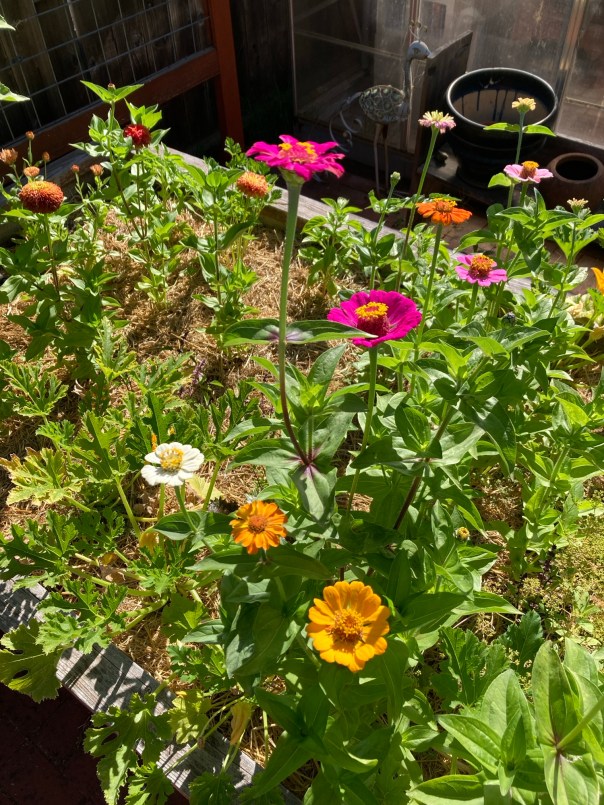
This has been a pretty unfocused ramble, I’m afraid, so rambling that I don’t know how to sign off. So, let’s just pretend we were talking together next to my planter boxes, and looking at the zinnias, and then I went into the house and didn’t come back.

But I will return eventually!