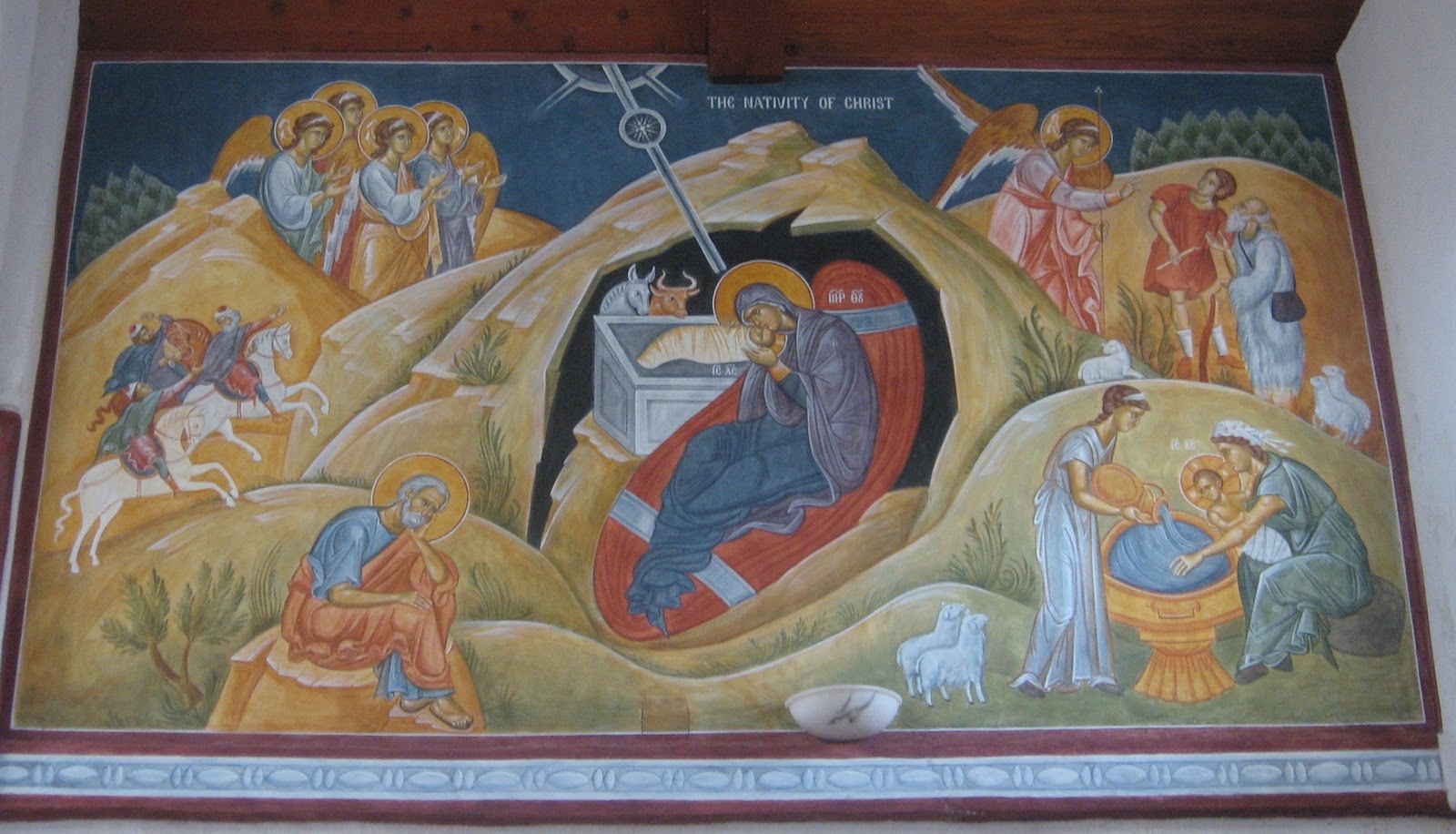
Christ is Born! Glorify Him!
 |
| Tolkien’s Northern Lights |
One of our children has a birthday on Pearl Harbor Day, which is today. So as not to take away from the specialness of that child’s celebrations, in the past we didn’t get into the swing of Christmas until the 8th, and even St. Nicholas Day passed without any notice, because in that era even I wasn’t cued in to feast days.
Now I’m thankful for that habit of delaying, which makes it easier to practice my present Orthodox unwillingness to jump ahead too much. And every day, every week in the church calendar holds a rich and festive remembrance of a person of faith or an event in our salvation history, so that the Waiting for Christmas period is full of bright days that make the time pass quickly. St. Nicholas, for example. But that holy man was at the center of much childlike fun yesterday, and we are moving on already!
Following our family traditions, then, Mr. Glad and I give ourselves permission to get and decorate a tree as early as tomorrow. Still I drag my feet, so as to nudge the bulk of merrymaking toward the Twelve Days of Christmas, the old-fashioned time to rejoice and feast. Our son-in-law fondly remembers Christmas in Ireland when for two weeks after Christmas many people were on vacation, and shops were closed. So much for the cash-register noise.
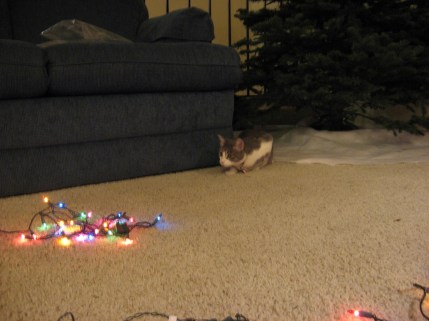 As we decorate the house, there are a dozen childlike joys to partake of, often involving memories of Christmases of 20 or even 50 years ago. And some of those are bittersweet, as memories can be. When Gus the Cat was still alive he made us laugh, the way he stalked the tree lights. This picture is a little bit sad for me, because we don’t have him anymore.
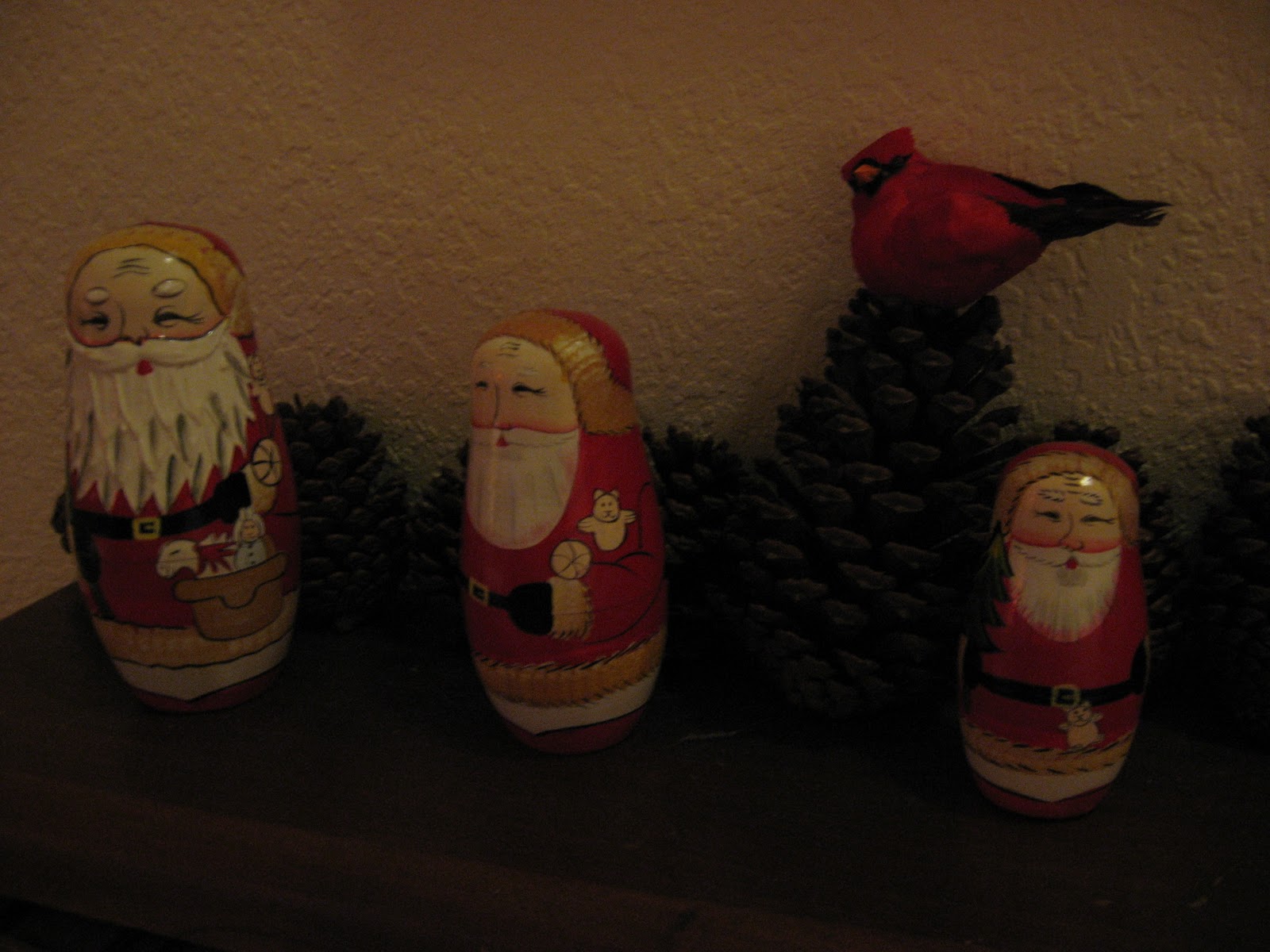
I like the tradition of keeping back the Baby Jesus from the crèche until Christmas Day; the manger waits empty until then. But in my Nativity set, the baby is glued to the manger, so He is forced to “arrive” way early. At least, these Santas are alone and in this photo they are sort of in the dark so far. Their situation changes when the Light of the World comes to earth.
Some of the participants in Pom Pom‘s Childlike Christmas party have written about their own memories of Christmas when they were children. Though it didn’t occur to my philosophical mind at first, it seems obvious now that what each of us retains with fondness of our own most distant Christmases Past will influence the definition of childlike for us.
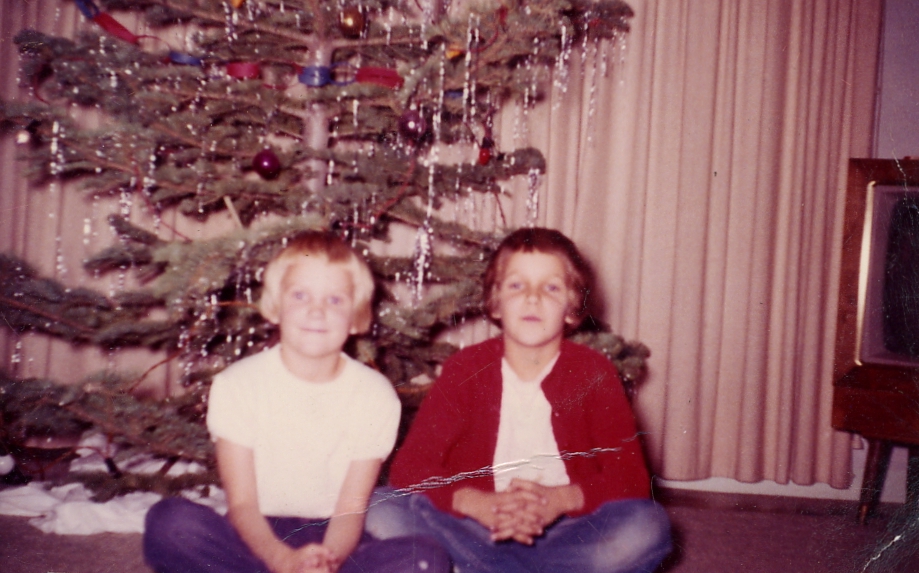 |
| Waiting for Christmas – GJ on the right. |
The black-and-white photo below shows a glimpse of Christmas as it was for me before I can remember, and it was taken at my grandma’s house in Berkeley, where we never gathered for Christmas the years that I can remember.
The important thing is that the picture is connected to my maternal grandma, and without fail we knew that Christmas had arrived when my grandma and grandpa’s car announced their coming by the crunching of the driveway gravel, and the trunk was opened to reveal its overfull load of wrapped presents, pies and sweet rolls. My siblings and I helped carry all the gifts from that bottomless hole into the house, and we piled them under the tree, from which they spread outward like an extravagant wave across the living room rug.
The pies and breakfast goodies were set out on the service porch where the temperature was cool enough to keep them for a day or two; after Christmas Eve dinner a slice of pie would always be set on the hearth so that Santa could have a snack that night when he stopped by.
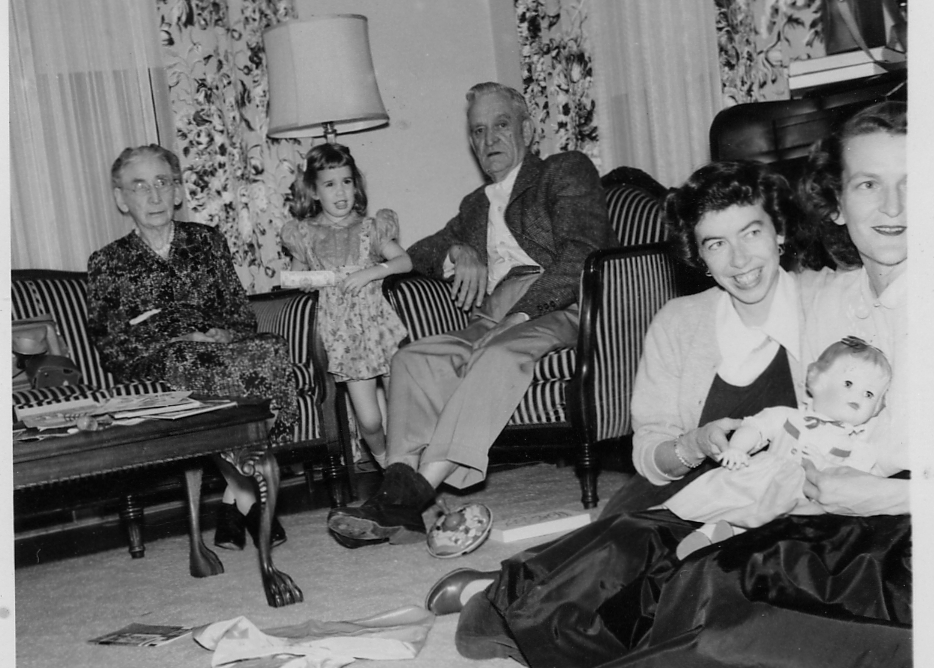 |
| My grandma and I are not in this photo. |
The photo shows my mother at right, holding a doll that I imagine was given to me that year, when I was only two. I like seeing that my grandpa, my cousins and my spinster aunt were there with us. And my grandma’s beautiful furniture that I loved!
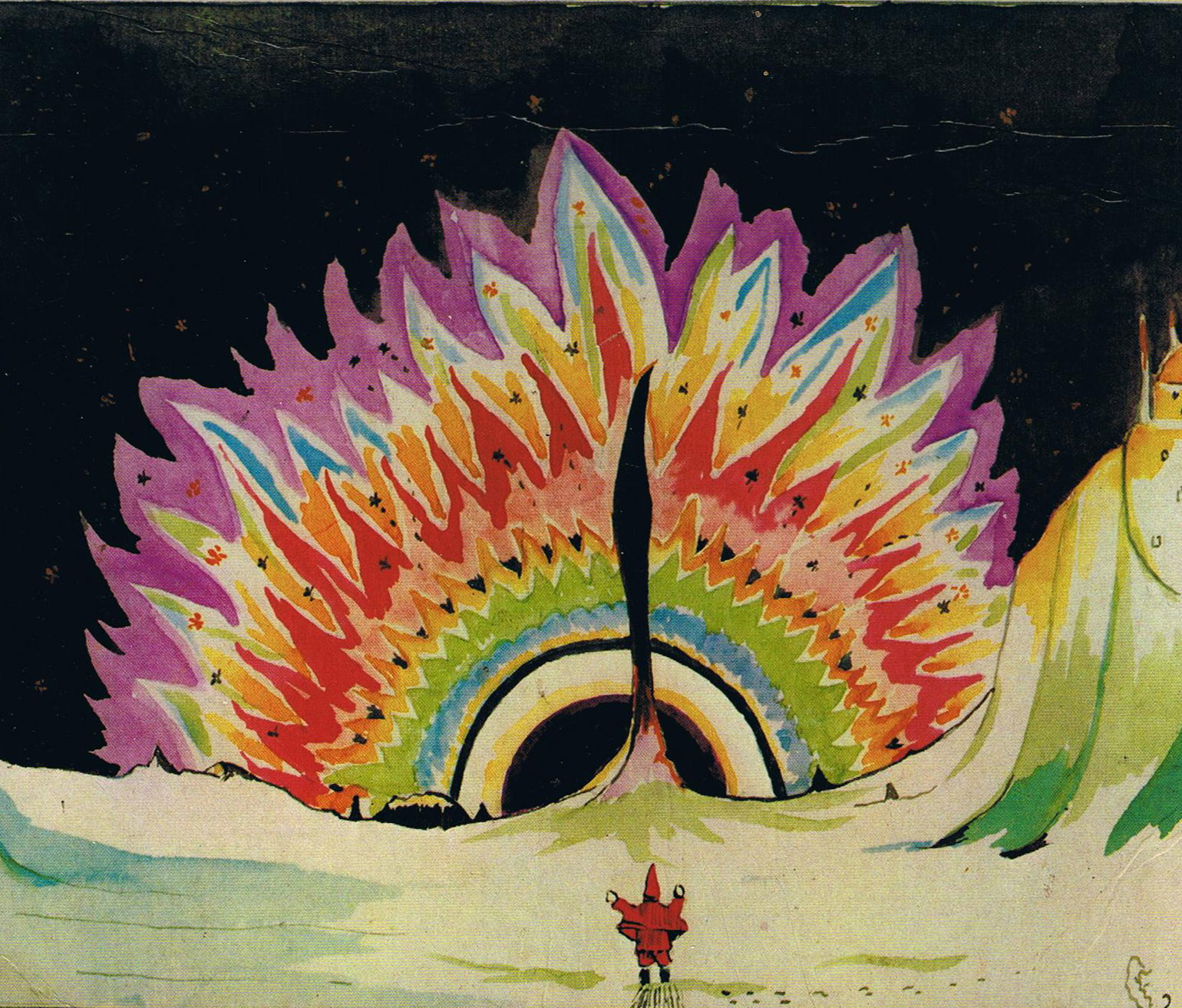
Now about the colorful picture at the top of this page: I have an edition (Houghton Mifflin, 1999) of the collected illustrated letters that J.R.R. Tolkien wrote to his children from Father Christmas, and I’d like to tell about them even though I haven’t even read them all myself yet, much less to any children or grandchildren.
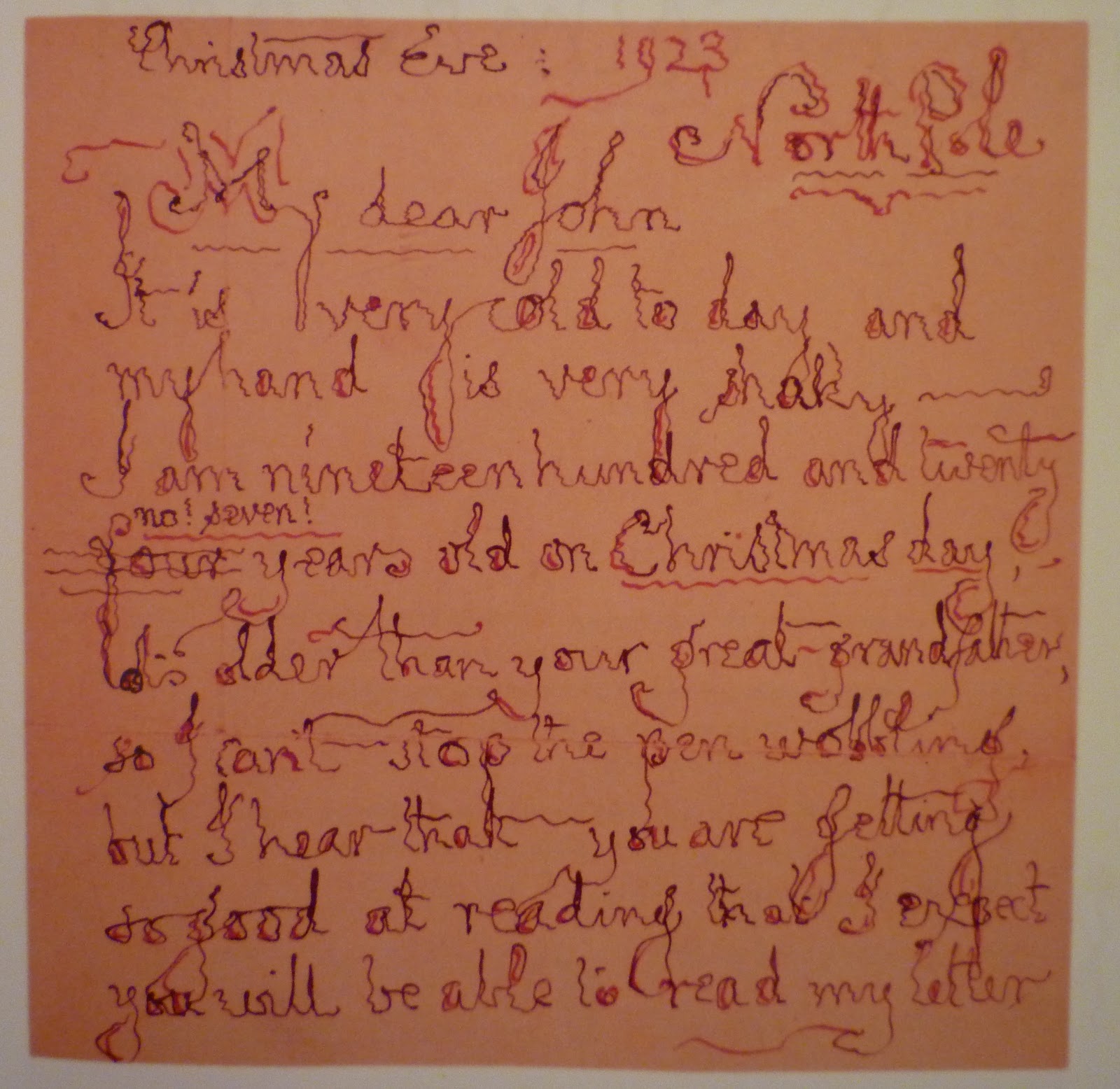
For over 20 years the Tolkien children received letters from Father Nicholas Christmas, often near to Christmas Day, but sometimes as early as October 31st. For all the ice and snow pictured, the drawings give the impression of a very cozy group at the North Pole, including Polar Bear and other helpers.
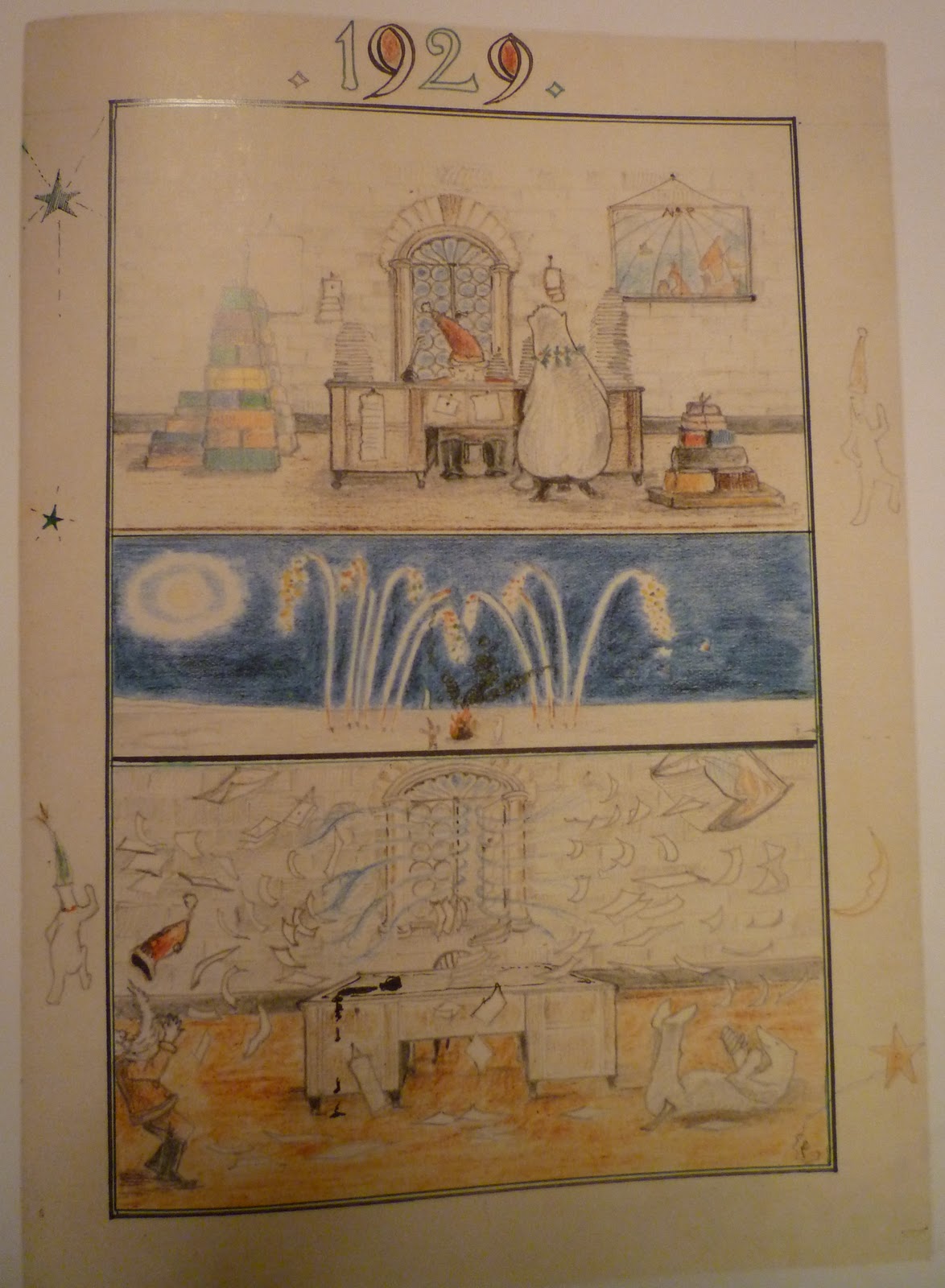 |
| illustration including Polar Bear |
This year, several of my grandchildren will be around in advance of Christmas Day and for a full week ! so perhaps we can read a few together. Or perhaps not, as I already have a long mental list of all the lovely things I can do with the children whom I haven’t had with me at Christmas for so many years.
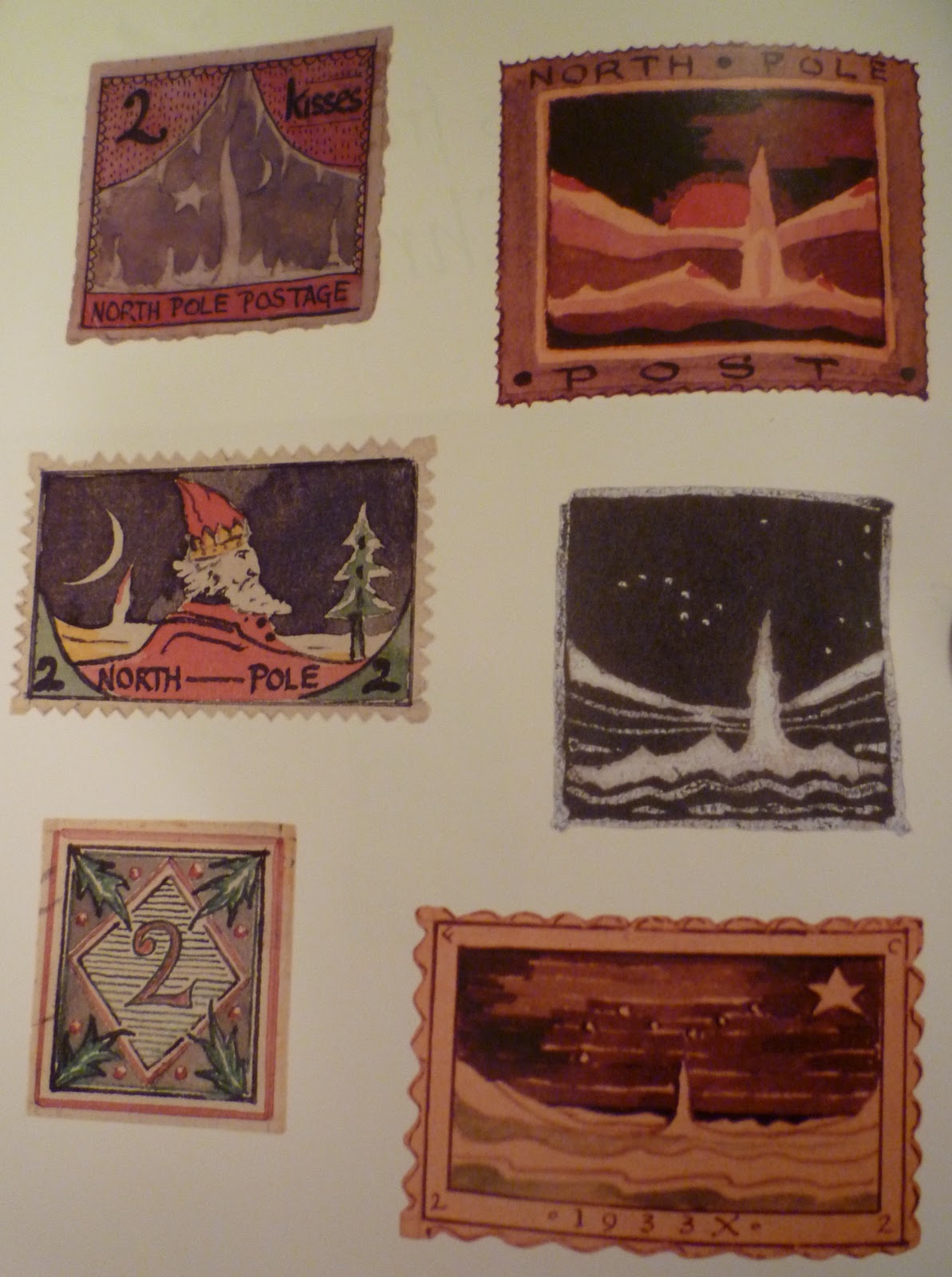 |
| Some of the pretty stamps |
I’m looking forward to an abundance of time to “waste” just being together for the Blessed Feast of the Nativity of our Lord and Savior Jesus Christ. This year I don’t have to have a long-distance Christmas relationship such as Father Nicholas Christmas had with the Tolkien children. But I bet I am just as busy as he before The Event as I scurry with my ribbons and lists around my cozy winter house.
The greatest pleasure and thrill of Christmas can’t be had without a little waiting, something like children of yore had to do, when their Christmas trees weren’t even ready for viewing until Christmas Day.
That thought is on my mind as I say Hello! to all the friends I see here at Pom Pom’s Childlike Christmas (blog) Party, a party for which we can show up four times over the next month! I had barely noticed the open invitation, with no time even to lay a finger aside of my nose, when she added me to the published guest list — I was signed up! I am happy to attend, Lord willing, by posting a blog each Wednesday.
It seems to me that the way we Eastern Orthodox Christians get into the Christmas spirit can be combined with the theme of children and simple pleasures that Pom Pom describes:
“Yesterday I asked my students, ‘Why the big greed festival over the holidays? Aren’t we fine right now? Don’t we have enough?’ …Here at Pom Pom’s Ponderings, we are going to think about the simple pleasures of the holidays, the childlike wonder that doesn’t involve the ka-ching ka-ching of the cash register….four holiday Wednesdays of posts that attend to the simple childlike thrills of Christmas. ….that babe in a manger and the children He loves and cherishes.”
The modern world likes to jump into Christmas immediately after Halloween or Thanksgiving, but the more traditional way to celebrate involves some Anticipation and Preparation. Children might think of it as Waiting and Getting Ready. Some of us have been in Advent, which we call the Nativity Fast, since November 15th.
I’m not experienced in helping children to forgo the treats that are pressed upon them in every shop and neighbor’s house at this time of year, but even before I found the Church and its traditions I tried to keep the family thinking ahead to a special Holy Day, and not just because of the presents.
We need some weeks to sing “O Come, O Come, Emmanuel!” and for it to register in our minds that God’s people had to wait many generations and thousands of years for the coming of the Savior. A little bit of suffering in the form of doing without the usual quantity of food, or rich foods, (in the Orthodox Church we eat less, and almost vegan, when fasting) can make it more real for us that the world before Christ was suffering under the curse of sin. We feel our own weakness, too, when eating less, and that can soften our hearts.
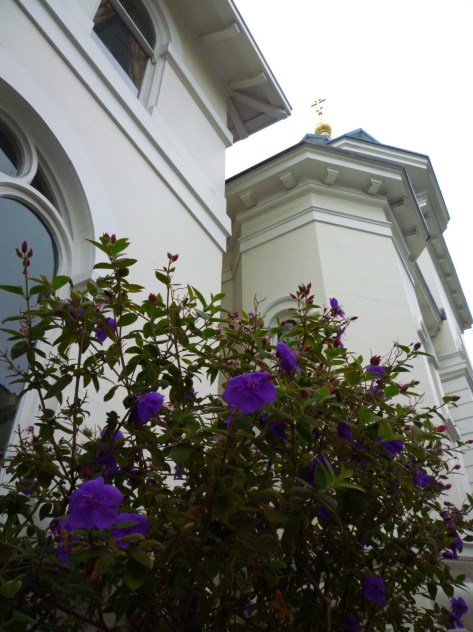
Why the photo of Holy Trinity Cathedral above? My church and sister churches sponsor Advent retreats every year, usually a day or half a day when we can hear a lecture and attend services together to help us focus on the coming feast in a fruitful way. Last year I went to one at Holy Trinity and took the picture. (By the way, I saw the same flowering plant at a winery last week and still don’t know what it is.)
One children’s book that might contribute to a child’s understanding of time and the processes that are necessary preliminaries to accomplishing a goal, in particular a few points on the timeline of our salvation history, is The Tale of Three Trees, “a traditional folktale retold by Angela Elwell Hunt with illustrations by Tim Jonke.”
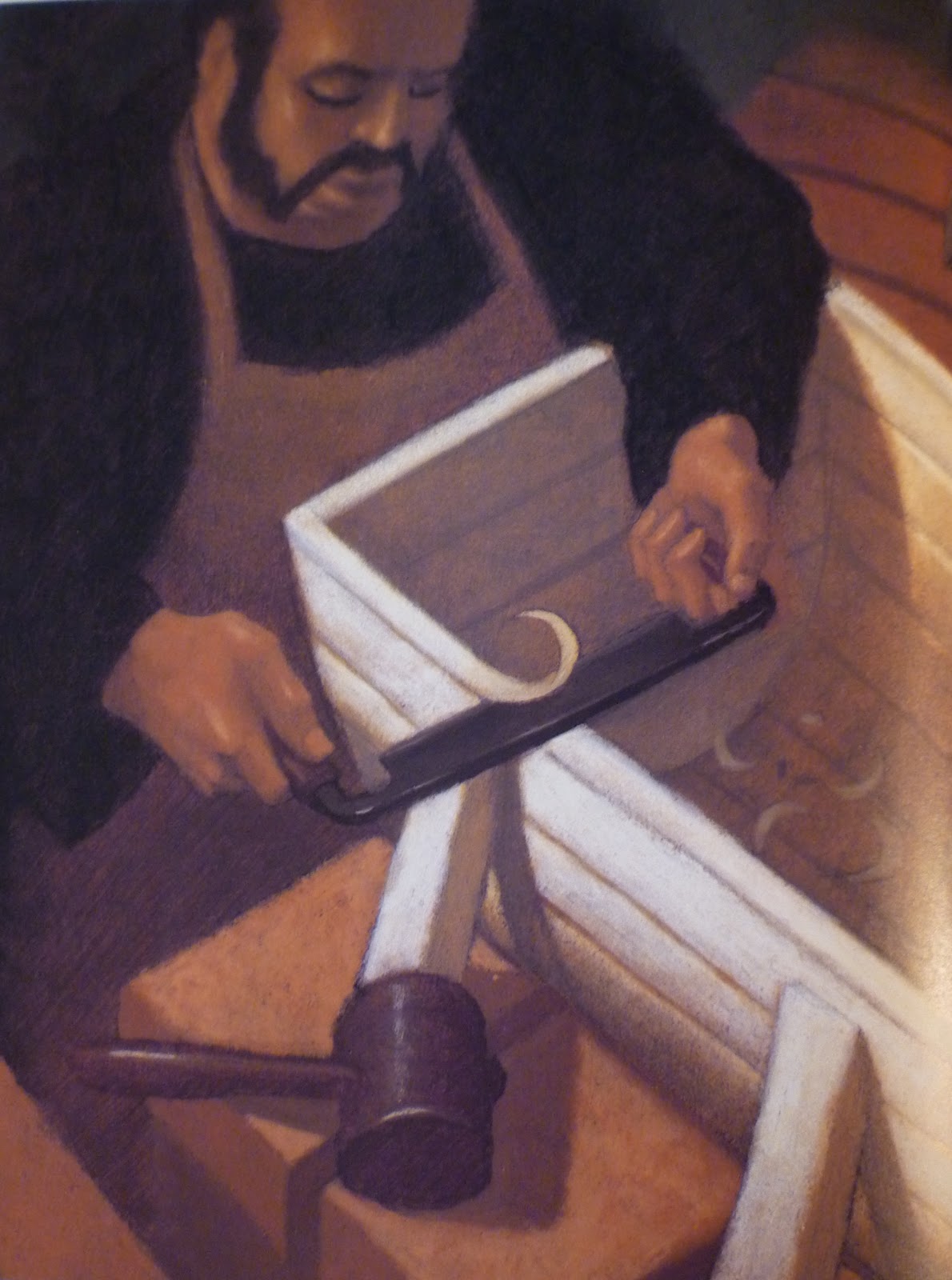 Three small trees stand on a hilltop and dream about what they might do when they are grown. One wants to be a treasure chest, one a sailing ship that carries kings, and one just wants to stay where it is and point to God.
It takes many years for them to get big enough to be cut for lumber and fashioned into items that play a part in the earthly life of our Lord. The first tree is made into a manger — and this first creation of wood that the Christ Child came in contact with establishes the story as one for Christmas.
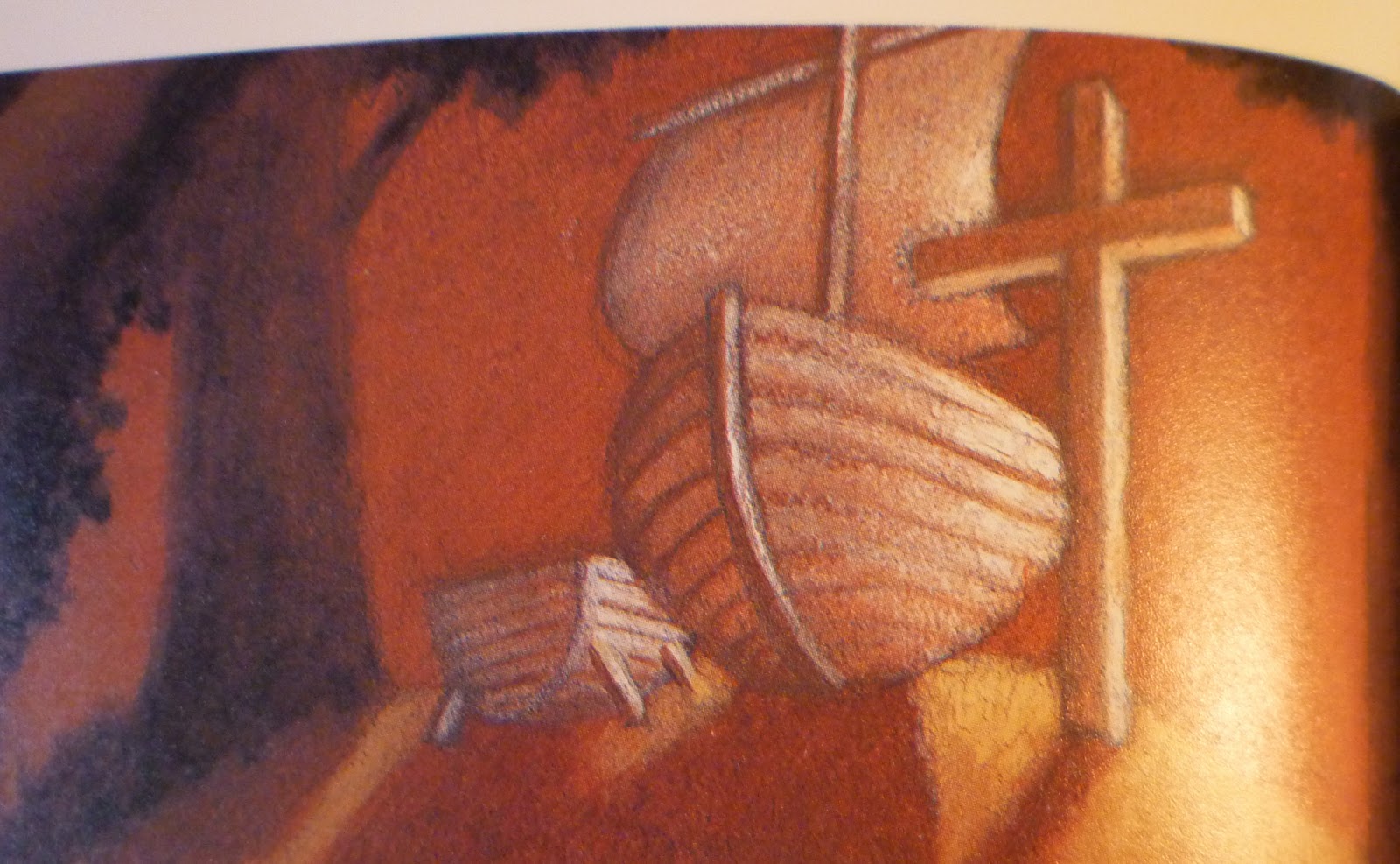
All the trees feel initial disappointment and humiliation, none more so than the one that is made into a rude cross and used for violent purposes: “She felt ugly and harsh and cruel.” But in the end all of the trees realize the blessedness of being used for the glory of God, and the young reader is reminded of the reason a Baby was born at Bethlehem.
Even our Lord Jesus went through a period of preparation, growing up as a man for 30 years before He began His ministry, but He surely wasn’t idle during that time. As we wait for Christmas we can prepare our hearts by prayer and fasting and acts of love.
Those of us with families are blessed to have many possibilities under what might be the Acts of Love category. (They might even include some noise of cash registers, but I won’t say any more about that at this party.) I know I have cookie-baking, doll-clothes-sewing, decorating and menu-planning and making up beds on my list.
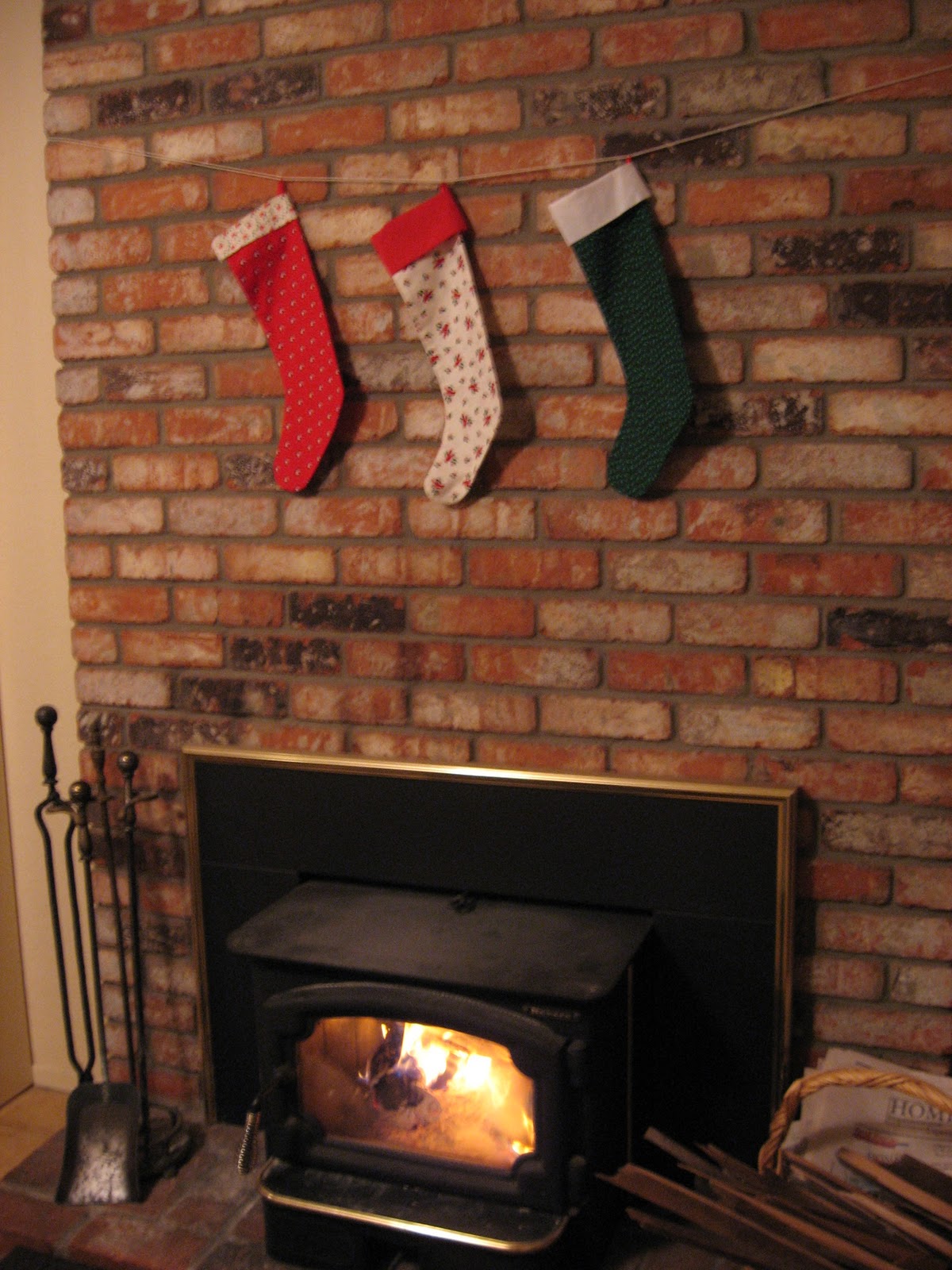 The truth is, I’m not very good at being child-like before Christmas. I feel so many responsibilities that children don’t have to concern themselves with, and I get pretty busy with all the fun type of preparations.
Somehow, though, all of that, when combined with participation in the church traditions and services, adds up to make me feel some of the longing and the weakness that are appropriate right now.
I’ll post on Wednesdays more about some of the simple pleasures that our family has enjoyed over the years, even while remembering that the fullness of joy, the acting like a child, will start on December 25th. And won’t it be wonderful!
 I’m preparing for the expected blessing of having three dear and longtime friends as house guests at different times over the next two weeks. While my home is full of busyness and women’s talk, in The Orthodox Church we’ll be commemorating some of those events of the church year that are becoming more lovely to me with every cycle of the church calendar. And because I doubt I’ll even think of blogging while I am hostessing, I am looking ahead, blogging ahead.
In the years when I was first learning about Orthodoxy, I’m thankful I was able to participate quite a bit in various services throughout the seasons, so that I got a good foundation in how the intellectual knowing is the lesser part of a relationship with God. With every year that passes I see this more, and also feel my inability to convey in words this Reality that is Christ in His Church. Even the most eloquent and holy men and women would communicate by their entire persons, and relatively little by words, the Love that has been shed abroad in their hearts.
Still, their words are more eloquent than mine and express a deeper grasp of the realites by far, so I am depending on them to tell a little of how the day-to-day structure of the Church Year gives the grace of God. It all flows from the Resurrection. From the Orthodox Church in America site:
Although the first of September is considered the start of the Church year, according to the Orthodox Church calendar, the real liturgical center of the annual cycle of Orthodox worship is the feast of the Resurrection of Christ. All elements of Orthodox liturgical piety point to and flow from Easter, the celebration of the New Christian Passover. Even the “fixed feasts” of the Church such as Christmas and Epiphany which are celebrated according to a fixed date on the calendar take their liturgical form and inspiration from the Paschal feast.
Next week we have the Leavetaking of Pascha, which I love very much, because it always seems to me that I haven’t been able to sing enough times those exultant hymns of “Christ is risen from the dead, trampling down death by death.” Every year I become more familiar with some of the words and tunes, and try to learn a new one. “Why seek ye the living among the dead? Why mourn ye the incorrupt amid corruption?” On Leavetaking of Pascha we’ll repeat the Easter service in its entirety – and then won’t sing those hymns again until next year.
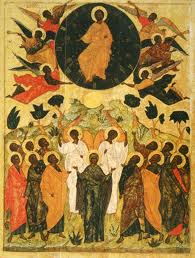
Even though we will still be in “the time of Easter” for another ten days, until Pentecost, we must say good-bye to the Feast of Feasts, so to speak, because we are coming up to the Ascension! Then we will update our greeting from “Christ is risen!” to “Christ is ascended!” the response to that being, “…from earth to heaven!”
In his book, The Year of Grace of the Lord, Fr. Lev Gillet tells at length the meaning of the Church Year. An excerpt from one paragraph, to which I have added breaks to make it more readable on the screen:
The liturgical year is, in fact, expressed as a calendar, but simply to identify it with a calendar would be totally inadequate. One could also say that the purpose of the liturgical year was to bring to the minds of believers the teachings of the Gospel and the main events of Christian history in a certain order. That is true, but this educational, pedagogical, function does not exhaust the significance of the liturgical year.
Perhaps we could say that its aim is to orient our prayer in a certain direction and also to provide it with an official channel which is objective, and even, in a certain way, artistic. This, too, is true, but the liturgy is more than a way of prayer, and it is more than a magnificent lyric poem.
The liturgy is a body of sacred “signs” which, in the thought and desire of the Church, have a present effect. Each liturgical feast renews and in some sense actualizes the event of which it is the symbol; it takes this event out of the past and makes it immediate; it offers us the appropriate grace, it becomes an “effectual sign,” and we experience this efficacy to the extent that we bring to it a corresponding inclination of our soul.
But still, this does not say everything. The liturgical year is, for us, a special means of union with Christ. No doubt every Eucharist unites us intimately with Christ, for in it he is “both he who offers and who is offered,” in the same way that every prayer, being the prayer of the members of the mystical body, shares in the prayer of him who is the head of the body and the only one whose prayer is perfect.
But, in the liturgical year, we are called to relive the whole life of Christ: from Christmas to Easter, from Easter to Pentecost, we are exhorted to unite ourselves to Christ in his birth and in his growth, to Christ suffering, to Christ dying, to Christ in triumph and to Christ inspiring his Church. The liturgical year forms Christ in us, from his birth to the full stature of the perfect man. According to a medieval Latin saying, the liturgical year is Christ himself, annus est Christus.
 Gladsome Lights