In 2025 we had a confluence of celebrations on this Lord’s Day, February 2nd. Though it is not the preeminent liturgical event of the day, I will first mention Zacchaeus Sunday, which is our signal that Lent is coming soon, as our homilist reminded us. He took his sermon from the story of Zacchaeus’s coming to Christ, and asked us to contemplate the circumstances of our own individual conversions, or the time when we began to take seriously the faith that we had been baptized into as children.
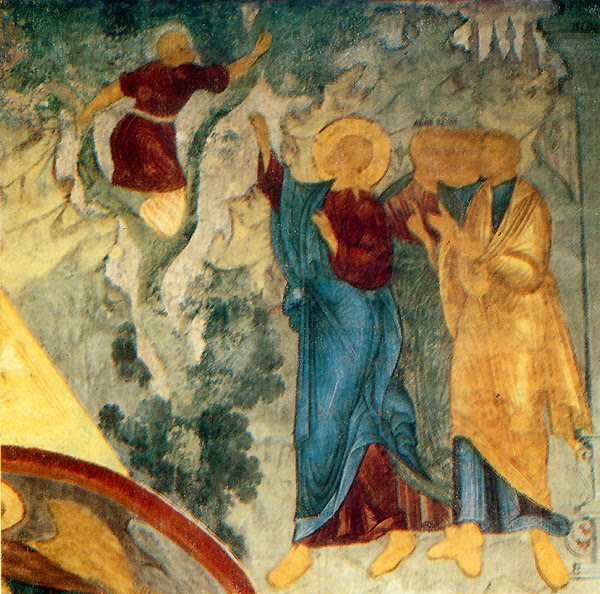
A 12-year-old catechumen was sitting next to me on the carpet as Father James began his talk, and I pointed out to him the fresco above us on the south wall of the nave, of this story of Zacchaeus. This one below is not ours, but as with many of these icons, the tax collector whom the Bible describes as “short,” and a Sunday school song tells us was “a wee little man,” is depicted as the size of a child. He climbed up into a tree so that he could get a better look at Jesus.
The children of our parish might have wished they had some trees to climb this weekend, because they had lots of extra wiggles to work out, last night and this morning. The rain has been constant for days now, and that kind of weather always seems to result in this phenomenon. Is it only the lack of outdoor play, or is there something in the air — ions? — that makes the little ones more alive than usual? What do you think?
We had at least a couple of dozen children under the age of five this morning, and many of those families were at Vigil last night, too. It is a huge blessing to have them. I missed last Sunday, and when I came into the beautiful temple for these two services, I was struck afresh by the lavish gift I have been given, to be a member of this parish. After a while, as I was noticing the children happily toddling around, or joining their squeals to the hymns, or sleeping in slings on their mothers, it came to me how much I love my church family at this particular time, when these babies are just the age that they are. There will never be another moment like this one.

Because we we stand during the services, the children have as much liberty as their parents want to give them, to walk around and feel at home in God’s house, which is their house, too. To teach them what is appropriate and reverent behavior is work that spans the years; I am often amazed at how patient and gentle the parents are, as they get them used to church etiquette to whatever degree is realistic, given their changing level of maturity.
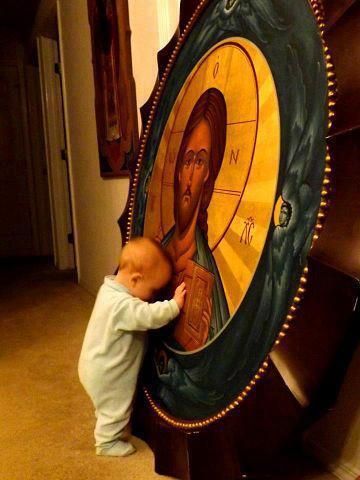
Many other people help the parents in this; one way it frequently happens is to literally step in and lead a toddler in another direction, when he is about to have a collision with a procession, or encroach on the altar space. We want the children to stand up close, so they have a better view than of the backs of legs, but it takes a while for them to get a feeling for how close is too close. Yesterday evening one little guy made a break for it and was headed right up through what is usually a kind of open space before the altar, and I was nearby in the best position to head him off. I scooped him up and brought him back ten feet, and held him in my arms for the next fifteen minutes or so.
It was the Feast of the Meeting of the Lord, or The Presentation of Christ in the Temple, and I have written before about how moving I find this account of Christ the firstborn son brought to the temple with an offering to God: Simeon had been waiting his whole life to meet the Messiah, and God told him that he would not die until he did. When the 40-day-old Jesus was revealed to Simeon as The One:
“Then took he him up in his arms, and blessed God, and said,
‘Lord, now lettest thou thy servant depart in peace, according to thy word:
For mine eyes have seen thy salvation, Which thou hast prepared before the face of all people;
A light to lighten the Gentiles, and the glory of thy people Israel.” (Luke Chapter 2)
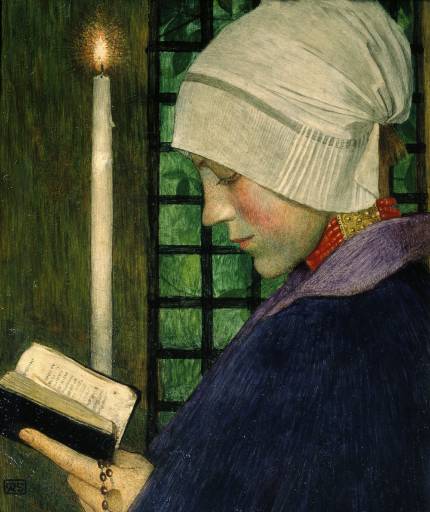
It seemed that we had more children than usual in church for this feast, which would be so fitting, wouldn’t it? — and so many of them again and again were taken up in the arms of one or another parishioner, among whom I was only too happy to be counted. How nourishing to their young souls, to be in a community where so many people are ready to love and hold them.
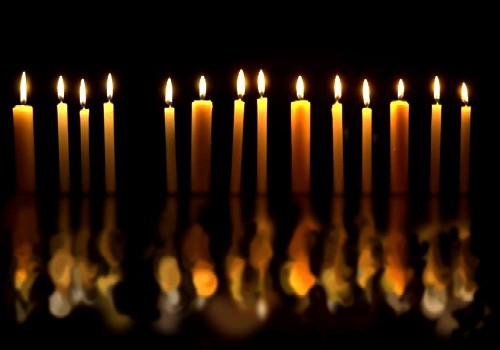
The third overlapping event we were participating in was Candlemas, which is actually not a separate feast, but just another name for it, which we Orthodox don’t usually use. But it has candle in the name, and we do always bless candles on this feast. Candles are certainly a symbol of Christ, whom Simeon recognized as the Light of the world. It is not a coincidence that Groundhog Day is the same day; it derived from the feast after its celebration spread to Germany. But you can read about that elsewhere, or watch this podcast of Jonathan Pageau talking about Groundhog Day with Richard Rohlin: “The Deep Symbolism of Groundhog Day.”
I read recently about how some Christians leave their Christmas decorations up until this feast, and I’d decided to take down my tree today. Not sure I will finish, having taken quite a while to assemble this post, but I have begun putting away the ornaments at least. And this little poem about all that just came to me, identified only as “an 18th century poem”:
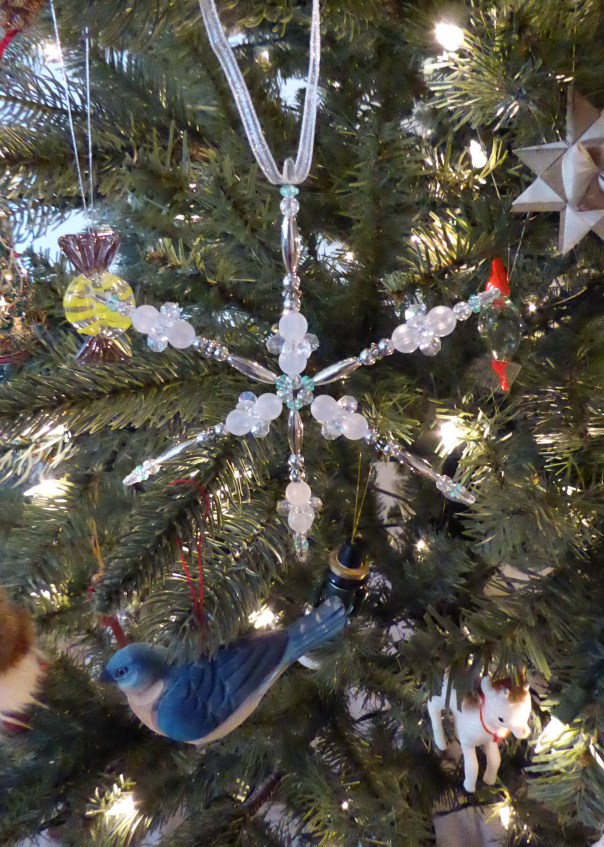 When New Year’s Day is past and gone;
And keep their Christmas all the year.
We Orthodox don’t fit in with the attitude of “the gentry” referenced in these verses; now that Zacchaeus Sunday has heralded the approach of Lent, we leave the feasts of Christmas, the Circumcision of Christ, Theophany, Epiphany and Candlemas behind us. Anyone who holds to the more ancient and traditional mode of life, where feasts punctuate ordinary or regular time, will know that feasts are most elevating when one has prepared for them. My next step in preparing for Holy and Great Pascha is to remove the Christmas tree — but I’ll keep the candles burning.
he that followeth me shall not walk in darkness,
but shall have the light of life.”
(John 8:12)
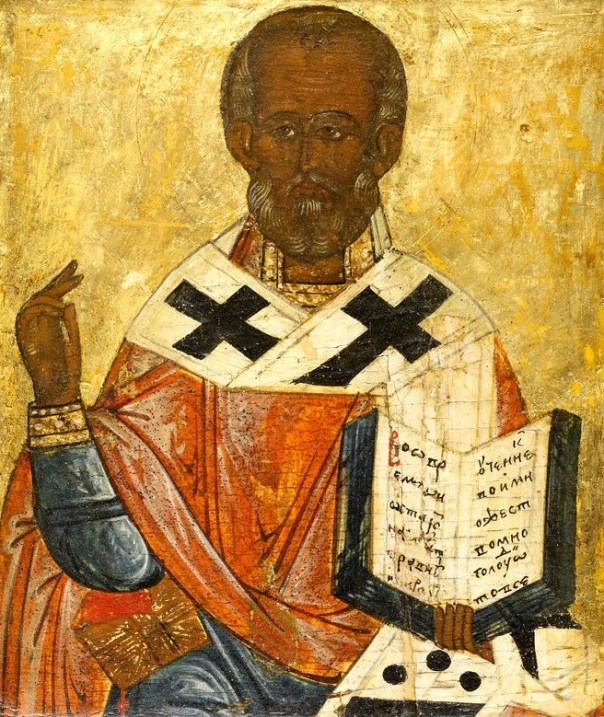 On the Feast of Saint Nicholas, I give you once more the words of Fr. Thomas Hopko from The Winter Pascha: