Category Archives: history

Elegant Surprises

Over the years I’ve had happy surprises in the garden, and disappointing surprises. Today I have a composite. My initial puzzlement began when I saw this view from my kitchen window; back in the corner by the fence I could see two whitish flower stalks:

gl P1040703 foxglove view

I was confused, because they were of a kind I had not planted, so I went out to get a closer look, and it didn’t take many steps in that direction before I saw that yes, thegl P1040708 foxglove behind ribes 6-16y were lovely foxgloves!
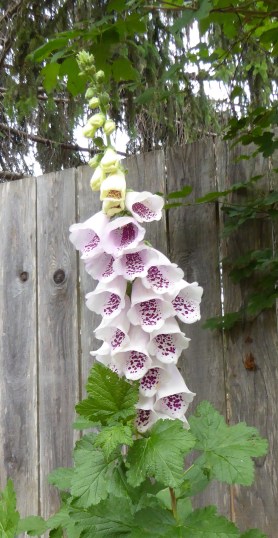
I haven’t grown foxgloves for a good while, I did not save any foxgloves plants from my old garden, and in the past when I did grow them it was far from this area of the garden. However, close to this spot I had planted one of the Indigo Woodland Sage plants that I had carefully saved for months in an old watertrough. It was there a couple of months ago, and now it is  nowhere. Did a bit of foxglove come with the mulch, as I assume was the case with my surprise horsetail grass on the other side of the garden?

You may also be confused, seeing a decidedly not-foxglove leaf form here.  That’s because the foxglove is emerging from behind a currant bush and hiding all its own leaves back there.

I’m sadly surprised that the salvia didn’t make it. It was a vigorous grower under what I considered less favorable conditions in the past; perhaps it didn’t like the shade from the snowball bush, nor the pushy calla lilies. But I know where to get another one if I want to try it somewhere else in the garden.

gl P1040717 3 sagesIn the meantime, across the way I have three salvias growing in a sort of triangle: Indigo Spires is huge, the Clary Sage is growing very close to the ground so far, and a little culinary sage plant lives modestly.

Today is windy and cool. I was wearing my flannel nightgown last night and I was still cold. The morning was overcast, though, and not so windy, and that’s perfect for picture-taking. I got a good photo of my acanthus.

gl acanthus 6-2015
acanthus mollis


“My acanthus” sounds odd, because I haven’t wanted to take ownership of that element of my new landscape that was suggested by the designer. When I had met acanthus in the past I always thought it scraggly and too like a thistle; one I particularly remember by someone’s front door was huge and full of spiderwebs and litter besides. But a year ago I greatly lacked confidence and creativity, so I didn’t know what to suggest otherwise. I let several plants go in and thought without energy about what I might replace them with next fall.

My attitude began to change when a friend told me that acanthus leaves as a decorative form were common in ancient Roman architecture. Before that I was trying think of the plant as a representative of a Scottish thistle, which is also not beautiful to me, but it is meaningful historically, in several ways. Soldier and Joy featured purple thistle flowers as boutineers at their wedding. But honestly, that wasn’t doing it for me.

When the acanthus began to send up its elegant flower stalks, I softened. This morning after I took the picture, I looked on Wikipedia and found that the leaf form is ubiquitous in ancient architecture and popular in more modern art such as William Morris’s wallpaper designs.

And not only the Romans, but Byzantines and Greeks liked to use it.  Here is an example from the Hagia Sophia:
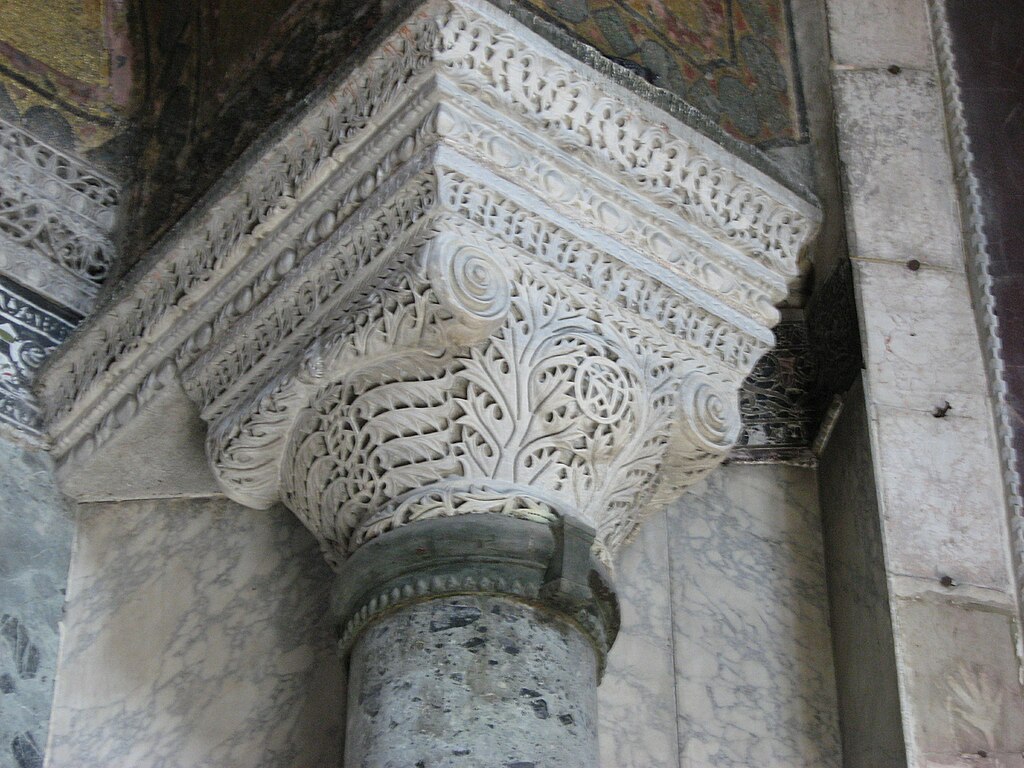
by Gryffindor, on Wikipedia Commons

gl Iceland poppy June 14 2016


So, I am surprised that I have changed my mind about acanthus. I’m glad I wasn’t in too big of a hurry to switch it out. I’m very pleased with my whole garden, actually, and I no longer feel that it belongs to someone else.

It doesn’t seem that most of it is taking three years to “leap,” and it really is full of delights every day. Those Iceland Poppies are certainly a wonder, how they keep blooming here in the middle of June! It’s strange to have the poppies right alongside echinacea; those two normally aren’t normally seen together.

gl P1040713 erigeron fleabane
erigeron

gl P1040712 bindweed on ribes


To my consternation, the bindweed is more prolific than ever. I seem to be constantly pulling it out, but it sneaked past me and climbed to the top of a currant branch before I noticed. Very inelegant behavior, that.


gl P1040699

The hydrangea I was gifted has nothing in common with this succulent except that they are both in pots on the patio.

gl P1040714 yarrow fields

There are yarrow fields, a variety of achillea called “terracotta.” Beyond it you can see that I have finally got the olives into their pots, and if one is not level it’s actually the one in the foreground — I guess that means the photo is not level. Anyway, the garden is in pretty good order now, and when you come for a tour you may be surprised to find, no thanks to me, patches of elegance.

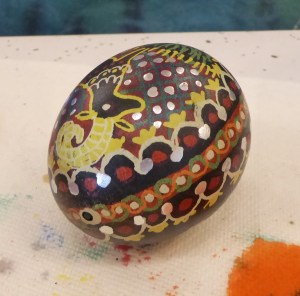
Again I attempt Ukrainian art.

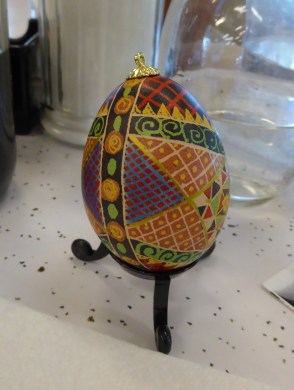
gl P1040397 pysanky in house 16Under the Soviet regime the making of pysanky was forbidden as a religious practice, but as this art form had pre-Christian beginnings and had spread well beyond Ukraine by the 20th century, it by no means was repressed for long.
In my world there is no connection of Ukrainian pysanky eggs to the realities of Christian faith and practice, though over the centuries people have come to use eggs as symbols of many truths or events. Many artists in my parish have through the years given informal instruction in this wax-resist method of dyeing eggshells, and this spring between Holy Week services I was able to take advantage of a class in which I was the only student.

gl pysanky crp
About 15 years ago…

Twice before, about 30 years ago and again 15 years ago, I took part in homeschool group efforts to try this art — the more recent occasion I actually organized the class! — and both times I’d enjoyed the process much more than the quality of my own results. A few of the pysanky in the top picture are from those attempts, but the only one I am certain I created myself is the one I did last week; the bowl of eggs is a combination of my collection and housemate Kit’s.

Pysanky2011
From the Internet

P1040312

You use the same method that is called batik: you dye the egg and then apply a design in beeswax over that color in the places you want it to appear in the final product. As someone said, you have to think in reverse.

I’m not good at remembering a strategy with a sequence of steps to be taken in the future, or in reverse either, so without a lot of planning and notes to myself, which I didn’t want to take the time for, the results I get are pretty random and surprising.

P1040315

At least, following my teacher’s example, I did draw a design with pencil on my eggshell. Several hours stretched ahead of me, but I knew I could easily get bogged down in the design phase — my weak area — and never get an egg made, so I sketched something like I often doodle when talking on the phone, and even that wasn’t quick. Then I dipped my egg in the lightest color, yellow.

Because I had drawn those crosses and dots on the plain white egg, using the hot wax pen called a kistka, the wax would keep the successive layers of dye from infusing the egg shell and those areas would remain white in the finished design.P1040314

As I continued applying wax, whatever lines went on the now-yellow egg would remain yellow. And so on through whatever dippings I made.

My teacher Tatiana had told me at the outset, “It takes about two hours to make a pysanka.” I think hers each took less time than that. It seemed that by the time I had dipped my egg in two colors, she had finished hers. It had been a light brown egg to begin with, so the undyed triangles are creamy.

P1040316crp

She applied some metallic color with a pen to make her design even more brilliant.

P1040323crp

P1040326

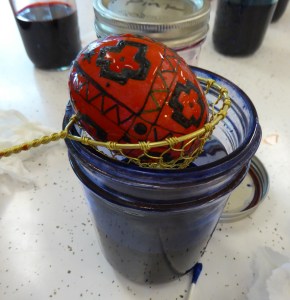
I dipped my egg in the red dye, and she began her second design:

P1040325

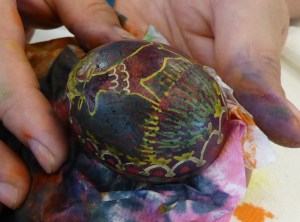
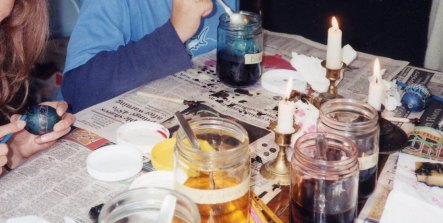
Meanwhile, when she learned that I would like a purple color, Tatiana suggested a series of immersions in colors that she thought might bring about that result, as she lacked a straight purple dye in her collection of jars. I tried it and we were both very pleased with this deep and glowing shade which, when I took the picture below, I was in process of covering with wax as much as possible in hopes of retaining a good amount of it in my finished design.

P1040329

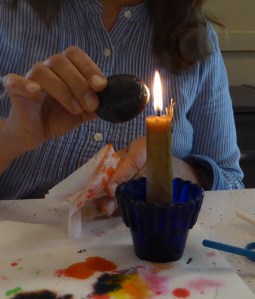
My teacher was removing the wax from her second egg, and soon I had done my final dip of black and held my egg to the candle as well.

P1040327crp

P1040336crp


At this point it’s back and forth between melting patches of wax with the candle heat and rubbing it off with a paper towel, until you have worked your way all around the egg and only the dyed eggshell remains. I was warned not to hold the egg too long near the candle, because I might burn it.

Here is Tatiana’s second egg, with some silver metallic embellishments…


P1040328

And here is mine… It had taken me nearly four hours!

P1040339

I don’t like it very much, I’m sorry to say. I would not use that green color again in such a prominent part of the design. And I know, I should try some curved lines next time. I hope my next time is sooner than another 15 years from now — I’m sure my hand will be even less steady by then. And once again, even though I am not thrilled with the end product, the whole process is like magic to me, the design hidden more deeply step by step until finally the waxy black cloak is taken away and the final picture is revealed in its uniqueness. Let’s do this some more!

A thing of indecent horror.

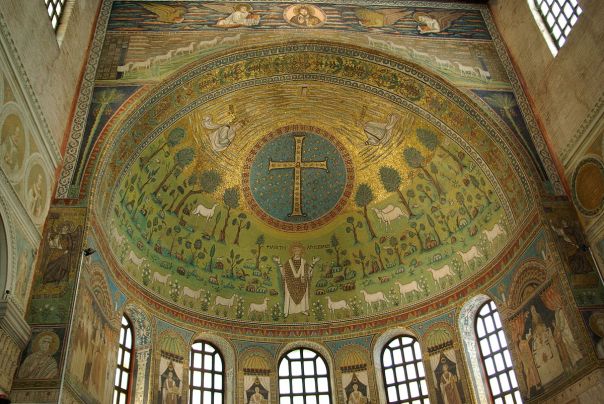
344px-Cross_classe“When St. Paul preached in Athens, the world was thronged with crosses, rooted outside cities, bearing all of them the bodies of slowly dying men. When Augustine preached in Carthage, the world was also thronged with crosses, but now in the very centre of cities, lifted in processions and above altars, decorated and jewelled, and bearing all of them the image of the Identity of dying Man.

“There can hardly ever have been — it is a platitude — a more astonishing reversion in the history of the world. It is not surprising that Christianity should sometimes be regarded as the darkest of superstitions, when it is considered that a thing of the lowest and most indecent horror should have been lifted, lit, and monstrously adored, and that not merely sensationally but by the vivid and philosophic assent of the great intellects of the Roman world. The worship in jungles and marshes, the intoxication of Oriental mysteries, had not hidden in incense and litany a more shocking idol. The bloody and mutilated Form went up everywhere; Justinian built the Church of Holy Wisdom to it in Byzantium, and the Pope sang Mass before it on the hills where Rome had been founded. The jewelled crosses hid one thing only — they hid the indecency. But original crucifixion was precisely indecent. The images we still retain conceal — perhaps necessarily — the same thing; they preserve pain but they lack obscenity. But the dying agony of the God-Man exhibited both….”

-Charles Williams in  The Descent of the Dove: A Short History of the Holy Spirit in the Church

mosaic Ravenna Apollinare 6th wiki


6th century Byzantine mosaic in the apse of the basilica of Sant’Apollinare in Classe,  Ravenna, Italy. Photo in the public domain, on Wikipedia Commons.

A feast of a book.

From a certain angle, the spring seems so calm: warm, tender, each night redolent and composed. And yet everything radiates tension, as if the city has been built upon the skin of a balloon and someone is inflating it toward the breaking point.

This paragraph from All the Light We Cannot See by Anthony Doerr conveys the tone of the whole book, which I am only halfway through. Too soon, certainly, to be writing a review, but I can’t help myself, I have to share the joy. My copy was a Christmas gift from Kate and Tom; Kate said it was the best book she’d read all year.

I got into it right away, but it isn’t the kind of book you want to rush through. In that way it reminds me of The Red Horse by Eugenio Corti. They are both set during World War II with all its horrors, but even they can’t blot out the love that glows in these novels. Reading them is like being in the company of the best sort of humans, illuminated by a wise and able storyteller, someone who seemingly effortlessly paints lush pictures in your mind of the landscape of humanity and even of the dark places in individual souls, but who somehow leaves you with hope. You don’t want to leave, and while you are at this feast you want to linger over every bite, every description and metaphor that wants to pull you into another aspect of life and reality.

One of the protagonists is a young blind girl, Marie-Laure. Doerr’s descriptions of  her imagination make me wonder if he spent a lot of time under a blindfold, learning what sensory riches are available to those who can’t depend on their eyesight. Telling the story from her point of view enlarges the world that we get to live in as we read. One such moment is when she is accompanying the housekeeper on errands, often to give food to the needy:

…[Madame] burgeons, shoots off stalks, wakes early, works late, concocts  bisques without a drop of cream, loaves with less than a cup of flour. They clomp together through narrow streets, Marie-Laure’s hand on the back of Madame’s apron, following the odors of her stews and cakes; in such moments Madame seems like a great moving wall of rosebushes, thorny and fragrant and crackling with bees.

The other protagonist is an orphan boy, to whose orphanage a Nazi officer pays a visit, in a moment that hints at the impending gloom:

The lance corporal looks around the room — the coal stove, the hanging laundry, the undersize children — with equal measures of condescension and hostility. His handgun is black; it seems to draw all the light in the room toward it.

I have read very little 20th, and less 21st-century fiction,  but I can identify two elements of this novel’s style as those that I am more likely to encounter in newer books: Present-tense narration, and alternating chapters set in different time periods and about different characters whose lives, we predict, will merge in the end.

More than once in the past I’ve laid aside a book because one or more of these devices was annoying or contrived, but in this case the suspense is only heightened by getting glimpses of what the future will hold for for these young people. The plot was already deliciously thickened by the second chapter, because of these tiny bits of foreknowledge.

So many books I have gobbled up too fast, trying to get to the main point, to find out What Happened, promising myself that I will go back and read the story again so I can pay closer attention and do justice to the other facets of the creation the author has made. Doerr makes it so that I have no compulsion to rush. Everyone is in a process, we all have time. Take time to notice the feel of the air and the way the seasons are changing, the story progressing. Though the war is hanging over them (and the reader) and using them and hurting them, it is not everything. There is a bigger world, a whole universe, of which this one crazy man and his evil system is but a very small room.

Marie-Laure has felt trapped in her house near the sea for months — her father doesn’t think it safe for her to go out exploring the way they used to do back in Paris, now that they are occupied by the Germans. But Madame takes matters into her own hands and walks the girl down to the beach for the first time in her life. As they get close to the shore, Briny, weedy, pewter-colored air slips down her collar.

And then her feet touch the sand:

...wet, unwrinkled sand. She bends and spreads her fingers. It’s like cold silk. Cold, sumptuous silk onto which the sea has laid offerings: pebbles, shells, barnacles. Tiny slips of wrack.

Her world that was dreamily expansive when she was younger and raised by her doting father, and then became overshadowed and dirtied by the privations and separations of wartime, begins to open up again.

The German orphan boy Werner also has a rich childhood, because of kind people and in his exploration of the abundance of wonders in the physical world. He holds within himself a knowledge of the good even through years when he is victimized into participating in the wickedness.

The depictions of the heroes of this book, children growing up, ring true to me. I don’t think it is easy to get that right, and it’s not surprising. No accomplished author is that close to the experience of being a child, and no one can have had the experience of every child. It seems to me a very great gift to be able to “create” young people especially, and to reveal them so deeply and keep them real.

Maybe this will only be Part One of my review, but just in case, I will end with my own reflection of one theme that emanates from this novel: You are never ultimately trapped in a dark place. Light fills this universe of which the darkest moments are only specks, and light is in you.