“…for modern students of religion—generally speaking—monotheism involves a fundamentally mathematical thesis, ‘There is one God,’ as distinct from ‘more or fewer’ than one God; start counting gods, and when you get to one, stop counting. Consequently, all those who believe in one God must logically believe in the same God.
“This approach to monotheism is what allows our contemporaries to speak of ‘the monotheistic religions.’ Their thesis is simple: ‘Since there is only one God, all those who believe in one God believe in the same God. Their differences are those of development and/or expression.’
“This thesis is not only simple; it is simply absurd. Biblical monotheism is not about mathematics; it is about God’s identity: Who is this one God? Who he is, is the essential question.”
During the Kneeling Vespers this afternoon I did not kneel, because I was sitting on a bench along the wall of the nave, with my little goddaughter Mary on my lap, and she had just fallen asleep. When a child falls asleep on my chest I am always astounded, and consider it the greatest honor, as though she were speaking right to my heart, “I feel safe and at peace with you, so I will give my warm body with its quiet breathing into your care.”
Today is Pentecost, or Holy Trinity Sunday, because not only do we remember that the Holy Spirit was given to us, and fell on the disciples 50 days after Christ’s Resurrection, but He was sent from the Father, by the Son, confirming the unity and will of the Holy Trinity, God in Three Persons.
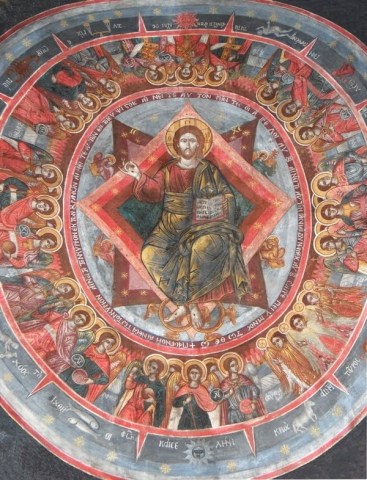
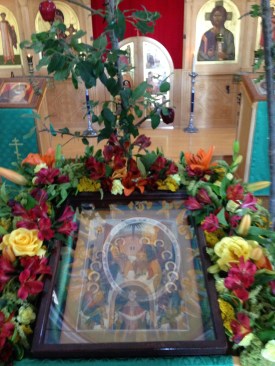
The photo of the framed icon above is reflecting the Pantocrator fresco in the dome above. If I squint hard enough I can see the face of Christ superimposed on the icon that depicts the Holy Spirit falling on the apostles.
The Holy Spirit is also remembered tomorrow, the day after this feast, on Holy Spirit Day. And today we had the Kneeling Vespers to prepare for that Liturgy; it’s the first time we have kneeled since Pascha, and the only time all year that we pray these particular prayers. I had brought a very little kneeling pad, cut from an old blue backpacking pad – our priest suggested we bring something like this – but as I didn’t need it, I offered it to a woman nearby and she was happy.
Because I had both arms around a dear baby, I wasn’t able to take a picture of her serene face, or to take out my notebook and write notes about the content of the seven long and poetical prayers, in three sets, or the hymns of that service….one normally wouldn’t want to do that anyway, but I felt that I missed so much that I would like to ruminate on further. We won’t hear these again until next year. I did look here just now and read a little about them:
Each set ends, sealed as it were with a lovely capstone, with one of the ancient vesperal prayers for light, from the Great Church of Holy Wisdom, in Constantinople. That much makes sense: praying for light as we re-enter the world from the heady days of Pascha-Pentecost, and enter “ordinary time” in our cycle of the church year. We need the light of Christ in the dark paths of this world, as our Gospel for the Feast proclaimed.
St. Seraphim with olive and birch
It was a day full of sunlight, and perhaps that added to the calm joy I was feeling, along with a certain amazement at the huge blessing of being in the Orthodox Church. This recent heightening of my awareness began last Sunday, when we remembered The Fathers of the First Ecumenical Council who in the 4th century labored body, soul, and spirit on behalf of the Body of Christ, to hold us fast to the Apostles’ teaching.
After the homily that day, I exchanged silent but knowing looks and hand-squeezes with a couple of people near me — we were all glad to be in this together, responding to the comforting words of our priest about how we don’t have to make up our faith as we go. If we also hold fast to the truth that has been given to us, we can give our energies not to intellectual debates, but to fulfilling the commandments of Christ.
Today’s feast is a celebration of the reality of God’s Holy Spirit in our lives, helping us to do just that, giving us Christ and His love to share among ourselves and with everyone in our lives. Really, God’s plan of salvation is impossible to fully comprehend…. One important point was brought home to us in today’s homily: Our purpose is to acquire the Holy Spirit.
A few months ago a lecturer asked a group of us, “What are the most fundamental doctrines of the Church?” How would you have answered? The answer was that the first doctrine is The Holy Trinity. So this feast is most important!
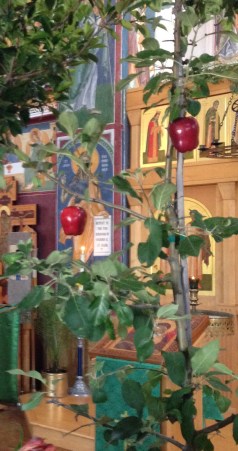
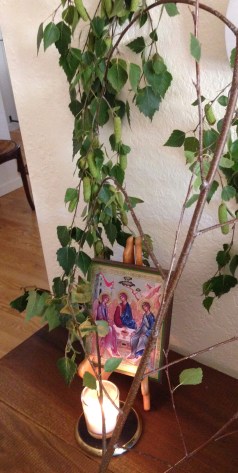
Lots of women and children were wearing green skirts or scarves. Some parishioners brought extra armfuls of birch branches into the church this morning, to hand out freely, or to prop up in corners here and there. I brought home a big blooming branch and stood it near my icon of The Holy Trinity.
In the Church, I live in a place where all the nourishment and medicine and support I need are available in the sacraments, and in the love and care of her saints poured into her over thousands of years now. They love and pray for us still.
Mary woke up just after Vespers was over. Her eyes opened and looked at my eyes, and then she sprang to life and was ready to go forth in her calling to grow in knowledge and grace, into the likeness of Christ. I want to rest in my Father’s arms in that childlike way, and be about my work in the strength that comes from His rest.
O Heavenly King, the Comforter,
The Spirit of Truth,
Who art everywhere present
and filleth all things;
Treasury of Blessings
and Giver of Life,
come and abide in us,
and cleanse us from every impurity,
and save our souls, O Good One.
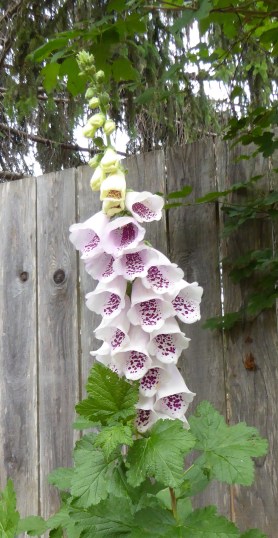
Over the years I’ve had happy surprises in the garden, and disappointing surprises. Today I have a composite. My initial puzzlement began when I saw this view from my kitchen window; back in the corner by the fence I could see two whitish flower stalks:
I was confused, because they were of a kind I had not planted, so I went out to get a closer look, and it didn’t take many steps in that direction before I saw that yes, they were lovely foxgloves!
I haven’t grown foxgloves for a good while, I did not save any foxgloves plants from my old garden, and in the past when I did grow them it was far from this area of the garden. However, close to this spot I had planted one of the Indigo Woodland Sage plants that I had carefully saved for months in an old watertrough. It was there a couple of months ago, and now it is nowhere. Did a bit of foxglove come with the mulch, as I assume was the case with my surprise horsetail grass on the other side of the garden?
You may also be confused, seeing a decidedly not-foxglove leaf form here. That’s because the foxglove is emerging from behind a currant bush and hiding all its own leaves back there.
I’m sadly surprised that the salvia didn’t make it. It was a vigorous grower under what I considered less favorable conditions in the past; perhaps it didn’t like the shade from the snowball bush, nor the pushy calla lilies. But I know where to get another one if I want to try it somewhere else in the garden.
In the meantime, across the way I have three salvias growing in a sort of triangle: Indigo Spires is huge, the Clary Sage is growing very close to the ground so far, and a little culinary sage plant lives modestly.
Today is windy and cool. I was wearing my flannel nightgown last night and I was still cold. The morning was overcast, though, and not so windy, and that’s perfect for picture-taking. I got a good photo of my acanthus.
acanthus mollis
“My acanthus” sounds odd, because I haven’t wanted to take ownership of that element of my new landscape that was suggested by the designer. When I had met acanthus in the past I always thought it scraggly and too like a thistle; one I particularly remember by someone’s front door was huge and full of spiderwebs and litter besides. But a year ago I greatly lacked confidence and creativity, so I didn’t know what to suggest otherwise. I let several plants go in and thought without energy about what I might replace them with next fall.
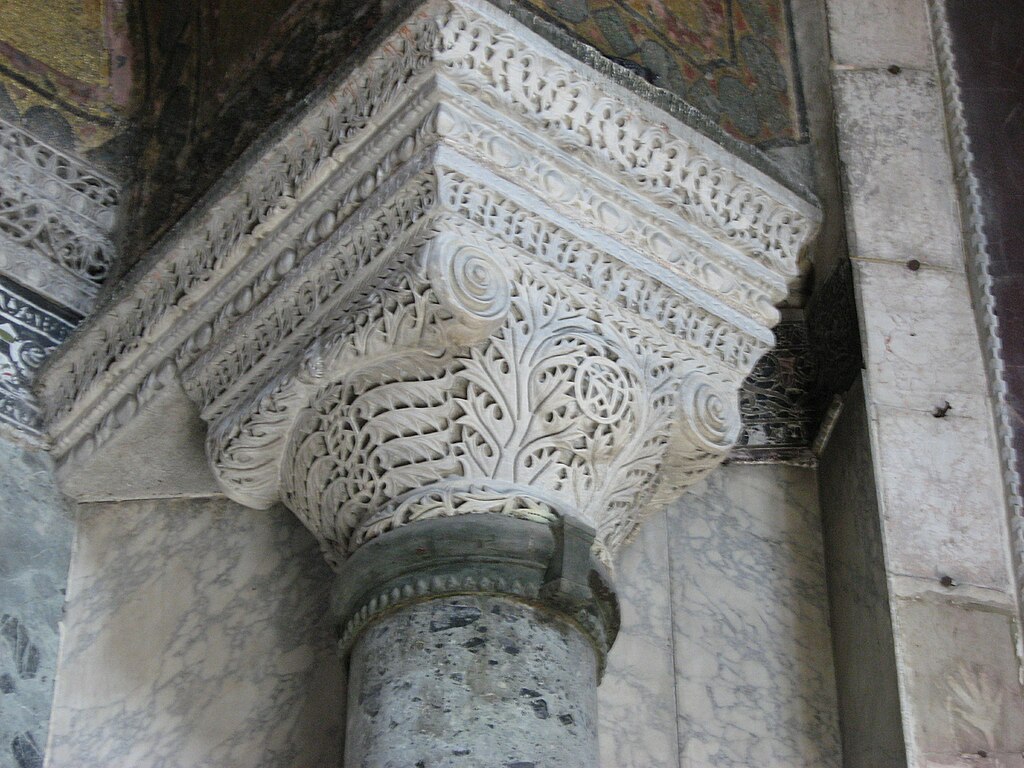
My attitude began to change when a friend told me that acanthus leaves as a decorative form were common in ancient Roman architecture. Before that I was trying think of the plant as a representative of a Scottish thistle, which is also not beautiful to me, but it is meaningful historically, in several ways. Soldier and Joy featured purple thistle flowers as boutineers at their wedding. But honestly, that wasn’t doing it for me.
When the acanthus began to send up its elegant flower stalks, I softened. This morning after I took the picture, I looked on Wikipedia and found that the leaf form is ubiquitous in ancient architecture and popular in more modern art such as William Morris’s wallpaper designs.
And not only the Romans, but Byzantines and Greeks liked to use it. Here is an example from the Hagia Sophia:
by Gryffindor, on Wikipedia Commons
So, I am surprised that I have changed my mind about acanthus. I’m glad I wasn’t in too big of a hurry to switch it out. I’m very pleased with my whole garden, actually, and I no longer feel that it belongs to someone else.
It doesn’t seem that most of it is taking three years to “leap,” and it really is full of delights every day. Those Iceland Poppies are certainly a wonder, how they keep blooming here in the middle of June! It’s strange to have the poppies right alongside echinacea; those two normally aren’t normally seen together.
erigeron
To my consternation, the bindweed is more prolific than ever. I seem to be constantly pulling it out, but it sneaked past me and climbed to the top of a currant branch before I noticed. Very inelegant behavior, that.
The hydrangea I was gifted has nothing in common with this succulent except that they are both in pots on the patio.
There are yarrow fields, a variety of achillea called “terracotta.” Beyond it you can see that I have finally got the olives into their pots, and if one is not level it’s actually the one in the foreground — I guess that means the photo is not level. Anyway, the garden is in pretty good order now, and when you come for a tour you may be surprised to find, no thanks to me, patches of elegance.
Under the Soviet regime the making of pysanky was forbidden as a religious practice, but as this art form had pre-Christian beginnings and had spread well beyond Ukraine by the 20th century, it by no means was repressed for long.
In my world there is no connection of Ukrainian pysanky eggs to the realities of Christian faith and practice, though over the centuries people have come to use eggs as symbols of many truths or events. Many artists in my parish have through the years given informal instruction in this wax-resist method of dyeing eggshells, and this spring between Holy Week services I was able to take advantage of a class in which I was the only student.
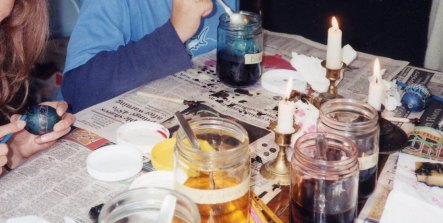
About 15 years ago…
Twice before, about 30 years ago and again 15 years ago, I took part in homeschool group efforts to try this art — the more recent occasion I actually organized the class! — and both times I’d enjoyed the process much more than the quality of my own results. A few of the pysanky in the top picture are from those attempts, but the only one I am certain I created myself is the one I did last week; the bowl of eggs is a combination of my collection and housemate Kit’s.
From the Internet
You use the same method that is called batik: you dye the egg and then apply a design in beeswax over that color in the places you want it to appear in the final product. As someone said, you have to think in reverse.
I’m not good at remembering a strategy with a sequence of steps to be taken in the future, or in reverse either, so without a lot of planning and notes to myself, which I didn’t want to take the time for, the results I get are pretty random and surprising.
At least, following my teacher’s example, I did draw a design with pencil on my eggshell. Several hours stretched ahead of me, but I knew I could easily get bogged down in the design phase — my weak area — and never get an egg made, so I sketched something like I often doodle when talking on the phone, and even that wasn’t quick. Then I dipped my egg in the lightest color, yellow.
Because I had drawn those crosses and dots on the plain white egg, using the hot wax pen called a kistka, the wax would keep the successive layers of dye from infusing the egg shell and those areas would remain white in the finished design.
As I continued applying wax, whatever lines went on the now-yellow egg would remain yellow. And so on through whatever dippings I made.
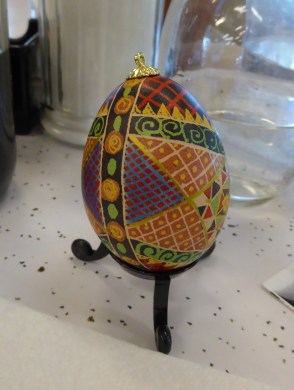
My teacher Tatiana had told me at the outset, “It takes about two hours to make a pysanka.” I think hers each took less time than that. It seemed that by the time I had dipped my egg in two colors, she had finished hers. It had been a light brown egg to begin with, so the undyed triangles are creamy.
She applied some metallic color with a pen to make her design even more brilliant.
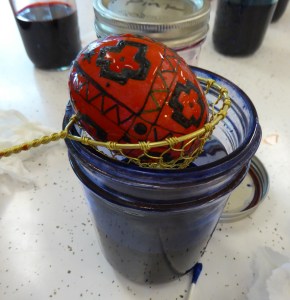
I dipped my egg in the red dye, and she began her second design:
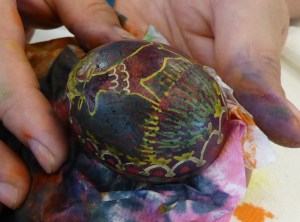
Meanwhile, when she learned that I would like a purple color, Tatiana suggested a series of immersions in colors that she thought might bring about that result, as she lacked a straight purple dye in her collection of jars. I tried it and we were both very pleased with this deep and glowing shade which, when I took the picture below, I was in process of covering with wax as much as possible in hopes of retaining a good amount of it in my finished design.
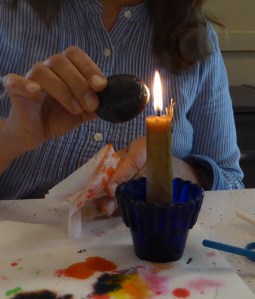
My teacher was removing the wax from her second egg, and soon I had done my final dip of black and held my egg to the candle as well.
At this point it’s back and forth between melting patches of wax with the candle heat and rubbing it off with a paper towel, until you have worked your way all around the egg and only the dyed eggshell remains. I was warned not to hold the egg too long near the candle, because I might burn it.
Here is Tatiana’s second egg, with some silver metallic embellishments…
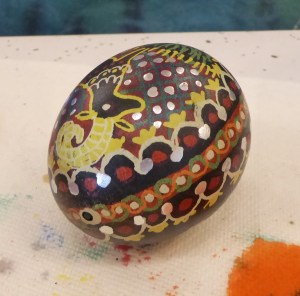
And here is mine… It had taken me nearly four hours!
I don’t like it very much, I’m sorry to say. I would not use that green color again in such a prominent part of the design. And I know, I should try some curved lines next time. I hope my next time is sooner than another 15 years from now — I’m sure my hand will be even less steady by then. And once again, even though I am not thrilled with the end product, the whole process is like magic to me, the design hidden more deeply step by step until finally the waxy black cloak is taken away and the final picture is revealed in its uniqueness. Let’s do this some more!
 “…for modern students of religion—generally speaking—monotheism involves a fundamentally mathematical thesis, ‘There is one God,’ as distinct from ‘more or fewer’ than one God; start counting gods, and when you get to one, stop counting. Consequently, all those who believe in one God must logically believe in the same God.
 During the Kneeling Vespers this afternoon I did not kneel, because I was sitting on a bench along the wall of the nave, with my little goddaughter Mary on my lap, and she had just fallen asleep. When a child falls asleep on my chest I am always astounded, and consider it the greatest honor, as though she were speaking right to my heart, “I feel safe and at peace with you, so I will give my warm body with its quiet breathing into your care.”
 Mary woke up just after Vespers was over. Her eyes opened and looked at my eyes, and then she sprang to life and was ready to go forth in her calling to grow in knowledge and grace, into the likeness of Christ. I want to rest in my Father’s arms in that childlike way, and be about my work in the strength that comes from His rest.
 y were lovely foxgloves!
 In the meantime, across the way I have three salvias growing in a sort of triangle: Indigo Spires is huge, the Clary Sage is growing very close to the ground so far, and a little culinary sage plant lives modestly.


 Under the Soviet regime the making of pysanky was forbidden as a religious practice, but as this art form had pre-Christian beginnings and had spread well beyond Ukraine by the 20th century, it by no means was repressed for long.