It’s been a while since I picked up David Bentley Hart’s The Experience of God, and I was pleased to see that I’m a third of the way through the book, nearing the end of the first part, on Being. I wasn’t pleased to find myself struggling to follow his train of thought as he picked apart what is known as Anselm’s argument, and was relieved when he moved on after a few pages, saying that he didn’t want to get “entangled in needless complications on this matter.”
Though I am philosophical by nature, I’m woefully unschooled in the discipline and its fundamentals. How many times have I looked up words like phenomenology, ontology, and epistemology? Whatever I read on the subject is an attempt to correct that lack, and I appreciate Hart’s clarity and organization; he does seem to be writing for someone like me.
When we say that God is Being or “the source and ground of all reality,” following in the tradition of centuries of philosophers and theologians, many contemporary thinkers say it is because we are “mired in sheer nonsense.” Hart tells what he considers an important source of this lack of agreement:
…The analytic tradition is pervaded by the mythology of “pure” philosophical discourse, a propositional logic that somehow floats above the historical and cultural contingency of ideas and words, and that somehow can be applied to every epoch of philosophy without any proper attention to what the language and conceptual schemes of earlier thinkers meant in their own times and places. This is a pernicious error under the best of conditions, but it has worked arguably its greatest mischief in the realm of ontology, often as a result of principles that, truth be told, are almost entirely arbitrary.
I enjoy learning about particular people of the past and of their contributions to the wealth of humanity’s philosophical legacy. Hart mentions Meister Eckhart and his idea of “Is-ness,” and that takes me back to when I was a college freshman and privileged to be in a tutorial course that was an introduction to Meister Eckhart. I certainly had no intellectual grid prepared to fit him into then! How nice to have him come around again when I can appreciate his place in history.
Hart’s book was on the table with my bowl of stew this morning, but now the breakfast philosophy session has come to an end and other tasks are calling; I will go forward with the prayer that the presence of Him Who Is will sustain me. Given my ignorance of that floating kind of logic, I shouldn’t have any trouble keeping my feet on the ground and my self in the flow of history, soon to close out the year twenty-fifteen.
It’s been a while since I shared a passage from The Worm Forgives the Plough, but I hadn’t yet run out of favorites. This one isn’t so poetic in itself, but it’s about a tree that other poets have sung about, and which I would enjoy visiting.
Once I saw Mount Etna in full volcanic eruption. It was a sight which held my attention. But at the bottom of the mountain there was another manifestation almost as fascinating — the Chestnut Tree of the Hundred Horses which is said to be the largest tree in the world. Thirty men holding hands do not quite succeed in surrounding it, while a hundred horsemen can find ample room beneath its foliage, as indeed was actually proved when Joan, Queen of Aragon, was caught in a storm nearby and took shelter there with her enormous retinue. And at the bottom of this tree a hold runs straight through, wide enough to admit two carriages abreast. It still yields a good crop of chestnuts.
— John Stewart Collis in The Worm Forgives the Plough p.215
From where I sit at my computer I can’t see the vast expanse of naked hard dirt that makes up most of my back yard now. All I can see is an unchanged view which includes the manzanita, and the conifer branches hanging above the fence.
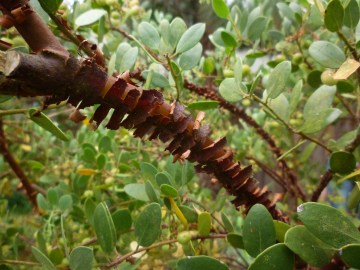
Manzanita in the peeling stage.Manzanita blooming in February.
The Landscape Ladies said that my manzanita is a nice shrub and worth keeping. That has been a very comforting word for me to play over in my mind, as I wait for something material (I wrote “concrete” first, but I have had quite enough of concrete for a while.) to be created in the yard. It means that I succeeded in pruning it in such a way that it kept its natural twisty shape.
The last few days I have been feeling unsettled more than my usual, excepting the splendid day when Soldier and Joy and the little boys came over and my capable and willing son did so many handyman things. He helped me prune the strawberry bush into a tree shape.
I read stories to Liam, and a visit to the world of Benjamin Bunny with him snuggled against my chest was the most nurturing activity – for the grandma! I actually cooked that day, too; I baked a frittata. Joy brought a peach pie, and I am heating the last slice in the oven as I type, for my dinner. Having friends J&C around for a couple of weeks has been good; C. is a professional nutritionist — how convenient, eh? — who cooks healthy things, and they have been modeling for me the kind of cooking-and-eating behavior I hope to learn again.
Manzanita before planting 2002
For several nights I haven’t been sleeping soundly. Today marks five months of widowhood, and I attended the funeral of a man in my parish, and felt that I was keeping a memorial to my husband at the same time, so that was good, but heavy.
I drove the grandfather of little Mary my god-daughter home after the reception, and that put me in the neighborhood of my favorite thrift store. I went in and tried on a few things, but it was too stressful somehow. I didn’t have the emotional energy. Trader Joe’s is also in that neighborhood so I stopped by there…buying food is more soothing, right? After loading my groceries into the car I sat in it and phoned some friends who want me to come for lunch soon, and I told them I can’t do it this week, because I am “in a slump.” They are people who want to love me, but they are too needy themselves and don’t know how they drain me instead.
On the recommendation of a blogging friend, I am reading Grieving Mindfully: A Compassionate and Spiritual Guide to Coping with Loss by Sameet M. Kumar, a book that tells me to pay attention to what is going on and not to try to escape it.
A quote: “Like suffering and grief, resilience — which means having the elasticity and buoyancy to recover from the experience of enduring suffering and pain — may also be a part of the natural order.”
As long as the speed of resilience we are talking about is along the lines of a memory foam pillow, and not a foursquare ball, I think I can believe in it. And I trust it is a natural thing, or at least a supernatural thing….in any case, I can’t make myself “bounce back,” if I even wanted to, which I don’t. There is no getting back to Before, anyway.
Kumar writes, “Mindfulness can help you get reacquainted with the vast potential of each moment of your life — it is the antidote to the endless waiting for tomorrow.” This attitude is what I learn from Orthodoxy, to be present with God all the time, everywhere. Now that is potential! But for now, being present in the moment means accepting my grief, and accepting that my emotional resources are fairly used up by this kind of activity. As the author says, “…come in full contact with yourself and learn to ride the waves of grief.”
Working in my garden never drains me, even if it makes me physically tired. Last night I sawed and lopped the dead parts of the osmanthus, and trimmed back the Raphiolepis next to it. I’m running a soaker hose on the osmanthus (Sweet Olive) to encourage its recovery from drought, and the faucet is whining from the backed-up pressure. It’s not a nice noise, but most of the time, now that the yappers are gone, I live in a very quiet neighborhood. As I think back over the 25 years I’ve lived here, so many things have evolved and developed on and around the property.
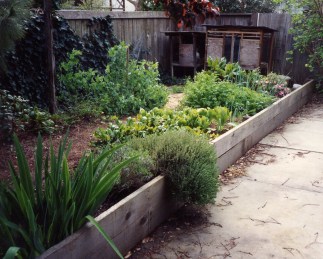
Glad workers take on a project.
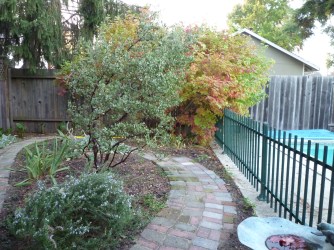
Thirteen years ago we had to replace all the pool decking, and we took out the diving board to give us more room in our patch of ground at the end of the pool. We leveled out the raised bed and went outside our comfort zone to build some brick paths. We found lots of bricks from a previous patio or something, buried under the pool decking, and we added gray concrete bricks to tie into the colors of the patio.
The back yard design I am working on now includes a different sort of path, and we are going to remove this brick walkway so that the whole yard will be of a piece. I think the bricks from the Glad Paths might be used to expand the patio into the area where the plum tree was.
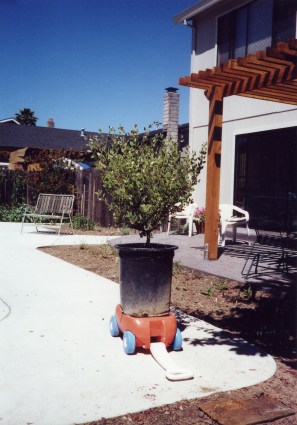
Manzanita in the ground.
The homemade paths served a good purpose for quite a while, but they were never ideal, and I’m not sentimental about them. The manzanita — I should name that bush, perhaps something rhyming like “Juanita” — surprised us in growing steadily north and away from the midpoint between the paths. We came to understand that it was trying to grow out from under the canopy of conifers to the south.
That path that was slim at the outset soon became impossibly narrow on the side that the shrub — I will call her “Margarita” — was growing toward. The only reason I had ever thought of pruning a wild mountain bush like this was to make the pathway passable, but as Margarita grew and grew, there was no way I could both maintain her nice curves and keep the path open.
widened path
When Mr. Glad retired we expanded the path a bit on that side.
The book on mindfulness makes some very good points, but coming from a Buddhist foundation it is lacking an understanding of why we suffer, and of all the riches that are available to us humans. The author says that people “have a tendency to associate suffering and distress with something being wrong,” but that “Grief has always been part of the order of things, and always will be. As part of suffering, grief too is a natural law.”
I can’t mention this book without saying how sadly wrong he is about that. Death and suffering and grief came into the world through sin, but Christ died to put an end to death. Because it is wrong! It was not in His plan. When He comes again in glory He will wipe away every tear from our eyes, and there will be no more death, neither sorrow, nor sighing, nor pain. For the former things are passed away.
We will do more than bounce back then; we will be given new bodies for our souls to be reunited with, and we will be like Him, for we will see Him as He is. Now things are cloudy and blurry, and we walk in faith, with His loving presence and grace always offered to us. He is constant and unchanging, a very present help in trouble.
In this world, on the other hand, we have constant change, often for the worse. Sometimes just the change itself is hard to bear, even if it is objectively an improvement. In the little realm of my garden I have lamented the lack of sunlight, but now that I have taken out one tree and thinned another, the area that was fairly shady will now be able to support more sun-loving plants, and I’m happy about that.
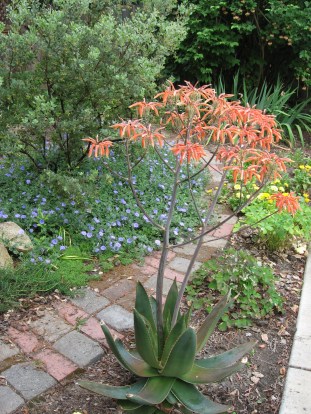
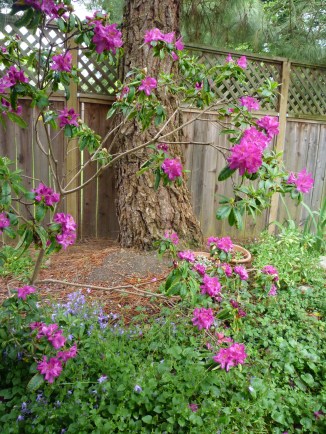
But I’ll be a little sad to see the rhododendron go, thought I didn’t care for its color. And the campanula, and sweet woodruff! They will probably be history. So just for memory’s sake — which of course is the purpose of all these pictures — here is a last view of the Woodland Garden patch of yard.
I’m looking forward to some new garden scenes to take pictures of, but glad to have Margarita Manzanita still in view. And come to think of it, I am waiting for tomorrow, waiting in Hope of the Resurrection. But as Martin Luther said, “If I knew that Christ were going to return tomorrow, I would plant a tree today.”
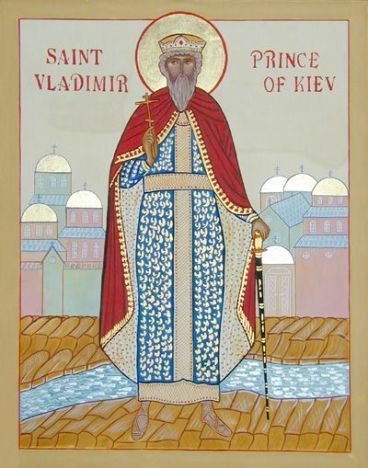
Today is the 1,000-year commemoration of the repose of St. Vladimir, Enlightener of Russia. He was the emperor whose decision to convert to Orthodox Byzantine Christianity transformed Russia and turned its history in a new direction, in about 988. I was lucky enough to attend Liturgy today, in a parish with Russian roots, and to hear a homily on St. Vladimir from a priest who had graduated from St. Vladimir’s Seminary. The Orthodox Church in America has posted online a long and rich story of the saint if you would like to read more of his exploits than I can tell here.
The most famous story among the faithful is an account found in the Primary Chronicle of Russia, written about this time, of how Vladimir, when he was still a confirmed pagan, sent emissaries to check out the churches and faiths of his neighboring lands.
They were completely unimpressed with the Muslim Bulgars, partly because of the ban on alcoholic beverages; of the German churches they reported, “We beheld no glory there.”
But in Constantinople at Hagia Sophia: “…they led us to the place where they worship their God, and we knew not whether we were in heaven or earth, for on earth there is no such vision nor beauty, and we do not know how to describe it; we only know that God dwells among men. We cannot forget that beauty.”
This has been the experience of so many of us converts to Orthodoxy, that we can well believe the story, which is not held to be as certain as the facts about the politics of the time and how Prince Vladimir made an arranged marriage with the daughter of the Byzantine Emperor, and was baptized before the marriage. However it came about, his conversion was providential and has had tremendous ramifications for the last 1000+ years.
He ordered the baptism of all his subjects, who dutifully went down to the River Dneipr en masse the next morning. Here I want to quote from the OCA article about how this event resulted in the continuing celebration of another meaningful church feast day:
It is difficult to overestimate the deep spiritual transformation of the Russian people effected by the prayers of St Vladimir, in every aspect of its life and world-view. In the pure Kievan waters, as in a “bath of regeneration,” there was realized a sacramental transfiguration of the Russian spiritual element, the spiritual birth of the nation, called by God to unforeseen deeds of Christian service to mankind.
“Then did the darkness of the idols begin to lift from us, and the dawn of Orthodoxy appear, and the Sun of the Gospel illumined our land.” In memory of this sacred event, the regeneration of Rus by water and the Spirit, the Russian Church established the custom of an annual church procession “to the water” on August 1. Later, the Feast of the Procession of the Honorable Wood of the Life-Creating Cross of the Lord, which Russia celebrated with the Greek Church, was combined with the Feast of the All-Merciful Savior and the Most Holy Theotokos (established by St Andrew Bogoliubsky in the year 1164). In this combination of feasts there is found a precise expression of the Russian theological consciousness, for which both Baptism and the Cross are inseparable.
Prince Vladimir soon started to destroy pagan idols, some of which he had commissioned himself, and began serious reforms that would create a new Christian culture. He built monasteries and many and magnificent churches; hospitals, schools and orphanages. The capital city during this era was Kiev, and these first years of Christianity in Russia were a time of growth and prosperity and art. The hundreds of churches in Kiev were renowned for their beauty, for example, the fascinating Church of the Tithes, which has been destroyed many times and whose rebuilding is under discussion again at this time.
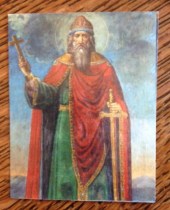
My own first experiences of Orthodox worship were not outwardly as splendorous as Hagia Sophia, but like those emissaries I felt the splendor of Heaven coming down on me. (Just this week I added to my page newly renamed “Orthodoxy and Me,” to tell much more of my story as a story and not just scattered parts.) In my parish we have a man who was born a Jew and took the name of Vladimir at his baptism somewhat late in life. This morning he joyfully passed out these little icon cards as gifts, and we were all glad that he was there so we could say, “Happy Name’s Day!”
 It’s been a while since I shared a passage from The Worm Forgives the Plough, but I hadn’t yet run out of favorites. This one isn’t so poetic in itself, but it’s about a tree that other poets have sung about, and which I would enjoy visiting.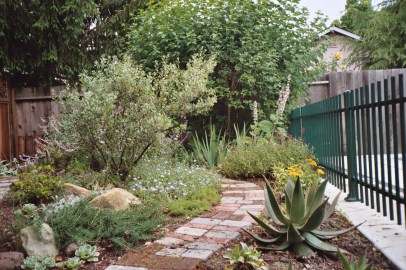

 Spiritual Guide to Coping with Loss by Sameet M. Kumar, a book that tells me to pay attention to what is going on and not to try to escape it.


 .
. moration of the repose of St. Vladimir, Enlightener of Russia. He was the emperor whose decision to convert to Orthodox Byzantine Christianity transformed Russia and turned its history in a new direction, in about 988. I was lucky enough to attend Liturgy today, in a parish with Russian roots, and to hear a homily on St. Vladimir from a priest who had graduated from St. Vladimir’s Seminary. The Orthodox Church in America has posted online a long and rich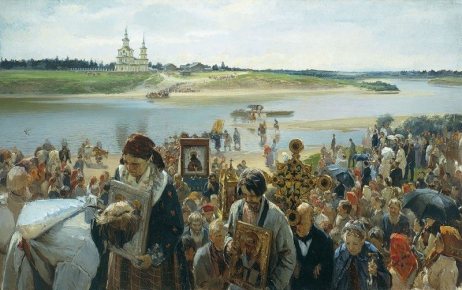
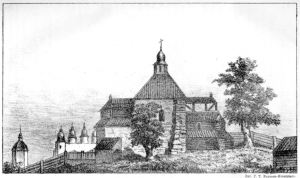 Christian culture. He built monasteries and many and magnificent churches; hospitals, schools and orphanages. The capital city during this era was Kiev, and these first years of Christianity in Russia were a time of growth and prosperity and art. The hundreds of churches in Kiev were renowned for their beauty, for example, the fascinating
  is under discussion again at this time.
 Gladsome Lights