Category Archives: history

Athanasius – All the disciples despise death.

On this Sunday in the Orthodox Church we remember the Holy Forefathers, the faithful ancestors of Christ, many of whom are named in a long list in the services yesterday and today, men and women like David, Jael, Daniel, Rachel, Moses and Ruth….
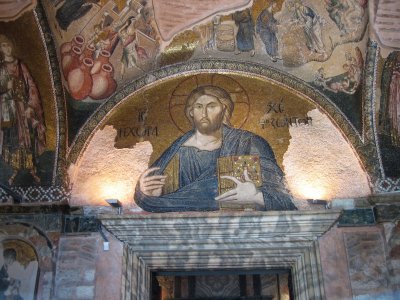
“The Land of the Living” – Chora

And the hymns sing of how they all, long since passed from this earthly existence, are even now “in the Land of the Living.” Thomas Hopko in The Winter Pascha mentions a church near Constantinople where a huge mosaic of Christ is named: “The Land of the Living.” I found a photo of it (above).

I learned in the short account of the life of Athanasius at the beginning of his On the Incarnation that the last and worst persecution of Christians ended in Egypt in 311 A.D., when Athanasius was about fourteen. From the age of five he had lived with the constant threat of death, and with the ever-present reality of persecution of his friends and family. The behavior of the ungodly is irrational and inhuman, and tends to cause great pain and suffering, often unto death, not only of the innocent but also of the most Christ-like. As an adult the scenes and events of his childhood seem to be fresh in his mind when he writes:

“A very strong proof of this destruction of death and its conquest by the cross is supplied by the present fact, namely this. All the disciples of Christ despise death; they take the offensive against it and instead of fearing it, by the sign of the cross and by faith in Christ trample on it as on something dead. Before the divine sojourn of the Saviour, even the holiest of men were afraid of death, and mourned the dead as those who perish. But now that the Saviour has raised his body, death is no longer terrible, but all those who believe in Christ tread it underfoot as nothing, knowing full well that when they die they do not perish, but live indeed, and become incorruptible through the resurrection. But that devil who of old wickedly exulted in death, now that the pains of death are loosed, he alone it is who remains truly dead.”

I started composing this post about death and the saint’s childhood before the horrific murders at a Connecticut school last week. I found the description Athanasius gives, of people bravely and even joyfully facing death daily, foreign to my 21st-century suburban self. But the topic turns out to be pertinent, and the recent stories of gutsy teachers in our own country inspiring — especially when taken with the letter from our Archbishop Tikhon after that event:

“Concerning those who have fallen asleep, Saint Paul exhorts us not to “grieve even as others who have no hope” [1 Thessalonians 4:13]. And yet, herein he does not forbid us from grieving. Now is the time for us to weep, but we must weep with the firm hope that comes from our faith in our Lord Jesus Christ. “Shed tears, but remain calm; weep modestly, and with fear of God,” writes Saint John Chrysostom. And following this example, each of us must strive to transform our sorrow into prayer.

Just this week I was asked to tell one of my favorite Bible verses, one that readily comes to mind without effort. It is always this one, that speaks of our complete dependence on the Lord as our LIFE, whether living or dying. Our leaves will not wither, because Christ Himself is The Land of the Living.

But I am like a green olive tree
in the house of God:
I trust in the mercy of God
for ever and ever.
Psalm 52:8

St. Andrew and His Cross

Where we sang this morning

Happy St. Andrew’s Day! I had the honor and joy of celebrating the feast in church this morning. Added to the usual liturgy and communion were prayers and song lifting up one of our dear elderly parishioners who died in the Lord early today. Now the memory of his repose will always be tied to this feast.

Andrew was the first of Jesus’s disciples, and centuries ago became the patron saint of Scotland and other countries. I wore my tartan plaid skirt as I always do on November 30th, and this year I had a new purple Celtic scarf to wear, recently brought from Scotland by Pearl.

Some of you might remember that I wrote about this years ago; I’m sorry to say that while trying to repost those thoughts this morning I deleted them instead. Ah, well, it turns out to be a blessing, because the accident caused me to find that just today John Sanidopoulos has written a thorough history of how it happened that the Scots chose this saint for their patron, and his cross for their official national flag.


This form of cross is called a saltire and is linked to St. Andrew because he was crucified on a diagonal cross in the first century. I learned that the first use of the X-shaped symbol was on medieval soldiers’ clothing, probably a white image on a black background. And today there are many Scottish nationalistic garments and items that hearken back to this design, like this belt buckle.


It was only in the last decade that Scotland made St. Andrew’s Day an official bank holiday. The nation also has another flag you might be more familiar with, the Lion Rampant, the unofficial national flag that belongs to the kings and queens of Scottish history. And there is the Union Flag of the entire U.K. Time was, Scotland could not legally fly its official satire on its national holiday of St. Andrew, but that sorry situation has been rectified of late.

These national days and flags have been part of the cultural consciousness since the 14th century, a consciousness that naturally changes from generation to generation. The original and deeper meanings of this cross are probably lost in the background fog of the mind of the nation.  It is encouraging to think that even if they have largely forgotten him and their Christian heritage, St. Andrew continues to pray for the people of Scotland.

Every season feeds upon the past. -Gioia


VETERANS’ CEMETERY
The ceremonies of the day have ceased,
Abandoned to the ragged crow’s parade.
The flags unravel in the caterpillar’s feast.
The wreaths collapse onto the stones they shade.
How quietly doves gather by the gate
Like souls who have no heaven and no hell.
The patient grass reclaims its lost estate
Where one stone angel stands as sentinel.
The voices whispering in the burning leaves,
Faint and inhuman, what can they desire
When every season feeds upon the past,
And summer’s green ignites the autumn’s fire?
The afternoon’s a single thread of light
Sewn through the tatters of a leafless willow,
As one by one the branches fade from sight,
And time curls up like paper turning yellow.
— Dana Gioia
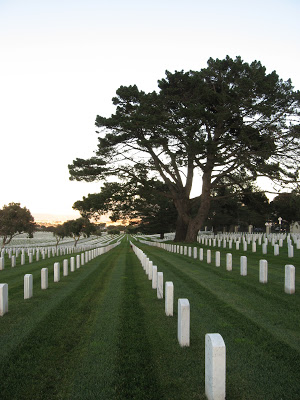
Golden Gate National Cemetery