My father-in-law has been forgetting things. In fact, in the last many months he can’t remember most events longer than a couple of minutes after they take place. If they happened 60 or 80 years ago there is a good chance that he will remember them, but what one would call his short-term memory, that which he is losing, is broadening in scope. Ten years ago he often told us stories about things that happened 10, 20, 30 years previous, and I heard some of those stories enough times to remember them myself.
One had to do with his old leather jacket. We were at the assisted-living place where he lives, about to go out to dinner, and I wanted to take his recent favorite jacket home to launder, so I handed him another old favorite to put on. As we took the elevator down and signed out at the front desk, he got several compliments on his appearance. I told the concierge, “He and his cousin both bought leather jackets in Spain when they were on a trip there together more than 30 years ago.”
 “I did?” he chuckled. “I’m glad you remember these things.” I remember some other stories he used to tell, but lately I hear new stories, from further back. Even his daughter was surprised to hear, when the conversation at a Christmas gathering turned to pets, “We always had fox terriers.” She didn’t know anything about a fox terrier tradition, because the dogs of her childhood were dachshunds and schnauzers. But W. was referring to the first dog he remembered, when he was a boy, named “Spot.” And he’s told us a few times since about Spot.
When we passed a purple house on the way back from a doctor’s appointment one afternoon, he said, “That reminds me of a woman in our church who we always called ‘The Purple Lady.’ Everything she had was purple. I haven’t thought of Mrs. Finnegan for a long time.” That was a church of his childhood, 75 yeas ago. It’s as though the loss of one data set has forced his mind to resort to a long-neglected mine of memory if it wants to keep busy.
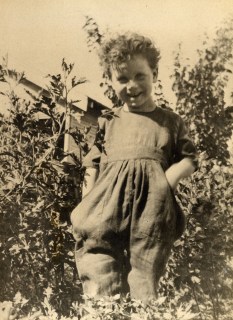
 One tale that is like the overarching First Story of his life, sweetly involves his wife, my late mother-in-law. And it happened when he was only about five years old, so I hope it will be the last one to be forgotten. Their families were friends–an aunt and uncle had even married–and they lived only a couple of blocks from each other. W. came by and walked F.K. to school on the first day of Kindergarten. They were always companions, never dated anyone else, and married when they were 21. The picture was taken in 2nd grade, cropped from the class photo where they were sitting next to each other.
W. has some good habits, which trump the rational; that is, he doesn’t have to remember to do these tasks. On another laundry-gathering visit, I asked him to take off his clothes and put on clean ones right then, so I could take the dirty ones home. When I came back into the bedroom, he had neatly folded the pants and hung them back on their hanger on the doorknob, and hung up the shirt likewise. Because he always does. And he had already forgotten why he was changing his clothes in the middle of the day.
He has a habit of being friendly and gentlemanly, so that he kept trying to help ladies scoot their chairs up to the table even when he was becoming unsteady on his feet. And he cracks really funny jokes–new ones–in the emergency room or anywhere there are people, strangers or friends.
God only knows if I have any good habits that will remain when I lose my mind’s faculties. How many pair of pants needed folding before it made a habit that endured? If I start now, building the habits I think might serve me, or God, is it too late?
I once heard Wynton Marsalis exhorting young people about the power of the daily habit of practicing their musical instruments: “Every day you go around making yourself into you.” We are not what we dream of being, we are not our vision of ourselves, or God’s plan for us, but a collection of usually little, seemingly insignificant acts that add up to a unique person.
I see people I love weaken and become confused by the afflictions of age and the loss of memory, like Vivian, who asked her daughter, “Am I myself?”
“Yes, Mom, you are.”
But there are people who don’t seem to know themselves, and certainly multitudes who have forgotten their own important stories. One aunt of ours thought she was in her right mind, but did not recognize her own daughter, and told her she was an impostor.
The possibility that I might forget important people, forget who I am, is certainly disturbing. It happens to a lot of people, being another way we are not in control, even of our own memories.
The scariest thing imaginable is to forget God. When Christ said to “take no thought for the morrow,” surely this thought was included! I have to quickly move on, and rest in the belief that it’s more important for God to remember me, than for me to remember Him. And I pray He will not soon forget someone who has tried to “stick to Christ like a burr to a coat,” as Martin Luther’s wife Katharina is said to have resolved.
Recently I read Tolkien’s “Leaf by Niggle,” which added a new dimension to my musings on this mysterious unknown toward which we are all headed. Niggle and his art are eventually forgotten by everyone on earth, and what he accomplished in his life “down here,” which was always less than he should have done, and always incomplete, has faded somewhat from his own memory. God remembers him, though, and makes use of Niggle in surprising and grand ways. What Niggle learns of Love becomes a story, a work of art and even a spiritual retreat, called by his own name, that continues to benefit souls out of time.
In the Orthodox Church we sing a simple hymn, “Memory Eternal,” at the end of memorial services, and in me it is a prayer for just this wondrous kind of thing God can do, to wrap us up in Himself and carry us through whatever shadowy places we encounter, whether in our minds or along our pathways, until our minds and hearts, and all things, are made new in that heavenly and everlasting Kingdom.
 visiting, they would settle down in armchairs side-by-side and smoke together.





 Gladsome Lights