Category Archives: history

Architecture of War and History

The uses and abuses of architecture, that subject that interests me but which I barely dabble in, got my attention again recently through an article by George Packer in the Feb 1, 2010 issue of The New Yorker. In his “Letter from Dresden: Embers,” Packer writes that the German city “has the unstable character of a place with a romantic self-image and a past that it would rather not discuss.” But we will discuss Dresden’s past, and ask also, if its latest building project in present time is vandalism, or an enlightening statement.

Before reading Packer’s piece I was fairly ignorant about this city, but as is often the case with New Yorker articles, this one led me on several tangents. The gist of Packer’s thesis is that Dresden is well served by having a gutsy architect like Daniel Libeskind to design its new national military museum, because the artistic violence of his plan is exactly what Dresdeners need to shake them out of their nostalgia and set their view of history straight.

Since reading that article I’ve gone on to learn a little more about the architect, the city, and what took place there toward the end of World War II. I also happened to read a novel that ties in to the reluctance of Germans to talk about the war and come to grips with that painful history. Of course, I haven’t taken my own photos. But if I do get to Germany I’ll be sure to visit these buildings and write another more personal blog post. For now, I want to set down what little I learned–I should say, the questions that have been raised–and if I put it here it’s available for anyone else who might like to know.

It was on February 13, 1945 that the Allies bombed Dresden, an event that some say resembled the horror of Hiroshima, and that the Neo-Nazis brand as equal to the Holocaust. What troubles people about the Dresden of today is the city’s selective reporting of its history, the portrayal of its wartime past as only victimization.
Matthias Neutzner is a local historian interviewed for the New Yorker article: “Neutzner said that Dresdeners remained unusually resistant to the past: ‘The city was erased in one night, and it was very easy for German propaganda to transform this city of art into a city of innocence which had nothing to do with the crimes of war.’

“In Dresden, Neutzner said, the story of the war has effectively been reduced to just one day: ‘It started and it ended on February 13, 1945.’ Neutzner’s aim is to get the city’s residents to remember ‘that this was the sixth year of a huge war, that there were twelve years of Nazi crimes, there were eight small concentration camps in Dresden with three thousand prisoners. All this is completely unknown in Dresden.'”

The diaries of Victor Klemperer are held up as an essential source text for those who want the whole story. He was one of the fewer than 200 Jews who remained in the city on that day of destruction in 1945, out of more than six thousand prewar. Published in the 1990’s, the three volumes in English are I Will Bear Witness, To the Bitter End, and The Lesser Evil. Packer writes that they tell “in mundane and relentless detail how the humanistic city of his youth turned into a place of terror that ostracized, humiliated, warehoused, tortured, and, finally, annihilated its Jews.”
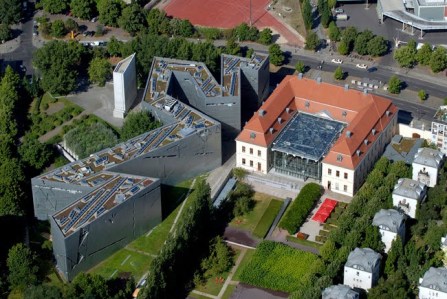
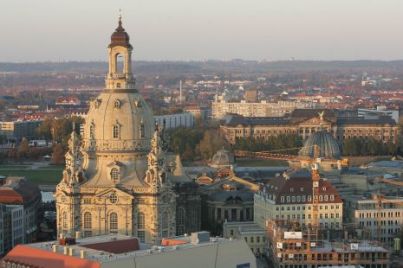
Since the war the city has been busy rebuilding, trying to restore architectural Dresden as much as possible to its lovely pre-war state by recreating buildings like the Frauenkirche cathedral. This activity contrasts with the attitude of another war-torn city, Berlin, where the “new architecture often has the quality of what Bertolt Brecht called Verfremdung, or the V-effect–estrangement, distancing. Berlin makes little attempt to hide the worst decades in German history. After 1989, the city placed its vanished Jews near the center of its collective consciousness, understanding that this was part of the price of reclaiming its international status.”

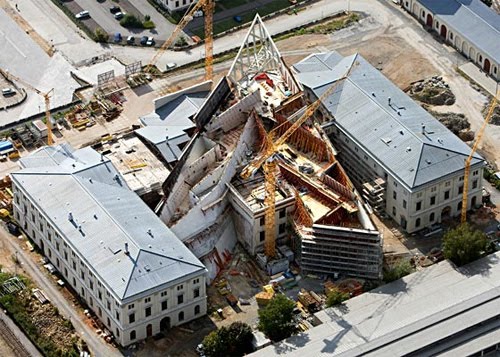
It was the Jewish Museum in Berlin, shaped, as one person said, “like a deconstructed Star of David,” that in 2001 made a name for Polish-American architect Daniel Libeskind, the one chosen to design the Military History Museum in Dresden, a renovation of the former military arsenal building that has been serving as a museum since 1897.

Not everyone likes this architect’s style. Back in 2003 Deroy Murdock cautioned against Libeskind and his art in a National Review article quoting heavily from the architect’s own words, poetic and otherwise, calling his poetry grotesque and his Berlin museum ghoulish. Murdock was lobbying against Libeskind as a contestant in the running to design the new World Trade Center in New York, and in fact, he did end up designing the overall site plan.

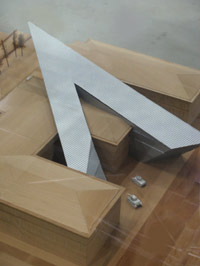
I must admit that Libeskind’s poetry strikes me as twisted and broken, not lovely. But history shows mankind to be perverse as well, and Libeskind thinks it’s healthy to face one’s past and its ugliness, so that you can get a more balanced and true understanding of reality from which to make progress. The arrow-shaped addition to the old museum, cutting through the building just as the Holocaust made a gash through the 20th Century and human history, nonetheless rises to a higher elevation where visitors will get a broad and fresh perspective on the whole city, a view that wasn’t possible from the former museum.

Spiegel Online quotes Libeskind as saying, “…sentimentality is not a foundation on which you can build a new city.” To make a sure foundation, it would be necessary to know where the bedrock is, and where the sand. The architect has built in a degree of disorienting experience a step above the mere visual. Packer writes, “The effect of these [oddly angled] inclinations, Libeskind said, should be above all physical: ‘It’s like a collapse, isn’t it? You feel it in your knees….You can’t be neutral in these spaces.'”

He goes on to say, “The triangular structure on the front of the arsenal points to the direction from which Dresden was bombed. It also interrupts the smooth flow of that big arsenal. It creates a question mark about the continuity of history and what it means. It gives people a point of reflection.”

It’s these philosophical question marks that get my mind’s wheels turning. I can see how trying to recreate the city as it was in the 1930’s would convey that you want to go back to that better time. But was it any better, the society and people who participated in the extermination of their fellow humans? Even if it were, going back is not an option. We need to live where we are now, and go forward, trying to learn from the past, even though it speaks to us of our failings.
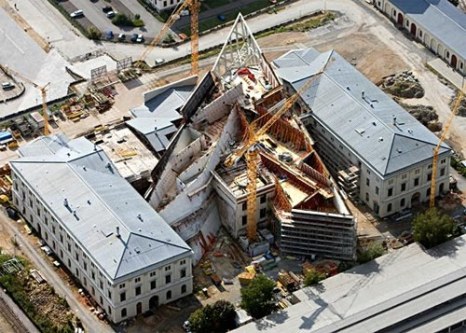
The new military history museum is scheduled to be completed this year and to open in 2013. Studio Daniel Libeskind’s statement about the project explains: “The central theme of the Military History Museum is the human being: those who went into the war and those who have remained at home; people of different eras and people of different generations.”

As the facade of the old building “represents the severity of the authoritarian past in which it was built, the other [new “arrow” facade] reflects the openness of a democratic society and the changed role of its military. In the new elevation of the Museum both are visible at the same time and one through the other.”

Packer concludes: “…though the museum is crude architecture, its bluntness should give it power as a civic institution: nothing more subtle than this could offer Dresden the possibility to break from its self-delusions.”

Update: Comments generated a Part II to this discussion, here: Architecture of War and History, Part II

Kristin Lavransdatter

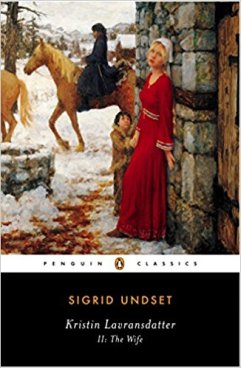
Kristin Nunnally wifeThe first time I came to the end of Kristin Lavransdatter I resolved to read it again very soon. The friend of a friend reads the trilogy once a year, and certainly it could stand up to that degree of intimacy; Kristin’s world of Norway in the 14th Century is vast with well-developed characters, complicated politics, and a daily life where the pervasiveness of the church and Christian faith often shows cracks revealing the old pagan traditions as an under layer.
My own initial discovery, in the translation from Norwegian into English by Charles Archer, seemed to provide a mere introduction, partly because I was reading too fast, eager to see how the heroine’s life turned out. There were so many people involved, as I noticed midway, I started taking notes on how they were related to the protagonists, knowing that it would help me understand their significance. My plan was to take even more extensive notes from the outset on my next reading.

That was more than ten years ago, and by the time I got to my second reading this year I was willing to try the new translation by Tiina Nunnally, touted by pretty much everyone as a better one, in that it does not involve the unnecessary–and, to some people, stilted and cumbersome–older English words and syntax. I had rather appreciated the language, as a reminder that Kristin’s world was not much like my own, no matter how similar some of her womanly and just plain human concerns resembled those of people everywhere down through the ages.

This time, I was reading in bed, lying down before sleep, or at the gym on the treadmill, so my smart plan to take notes wasn’t feasible. I had to make my second tour through the novel as I’ve been admonished to travel through a foreign country, fully expecting and planning that it won’t be the last time I visit. They say that is the only way to make yourself relax enough to enjoy and retain what you do manage to see and encounter.

And I did see new and different things this time through. There are many books I truly want to read more than once, but not many novels have I actually gone back to again, so this kind of rereading was not a familiar exercise. As I came to remembered parts of the Kristin tale I was surprised to see that they didn’t take up as many pages as I thought they would need. Many sub-plots and attributes of Kristin’s family and friends were as good as new to me; evidently I missed them completely before.

As infused with a sacramental faith as the medieval world of these books is, I’m sure they influenced me on my path to Orthodoxy. Now that my own perceptions and beliefs are being forged into something more like the tradition that was Kristin’s foundation, I think I am better able to appreciate some parts of the story. The deathbed scenes were striking, for the way the Christian reverence for the body, and the repentant heart of the Christians, were displayed. I’d like to write more on how they compare with descriptions of similar scenes in the Islamic culture of The Cairo Trilogy.

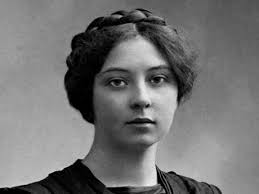
For a few pages near the end of this recent reading I found myself thinking that I was getting boreSigrid Undsetd with medieval Norway, or at least, that I didn’t want to spend time on a third reading when there are so many other books still to be known. That feeling didn’t last long, because by the time I came to the last pages I knew that I still have a lot to gain from acquaintance with the themes in this amazing epic by Sigrid Undset. It’s a glory to God that one human mind can create a complex and rich world like that of Kristin, peopled with characters whose drama reflects our own struggles to love God and repent of our besetting sins. Image Journal included the novel in its list of 100 best books of the 20th century that “manifest a genuine engagement with the Judeo-Christian heritage of faith.”
The Nunnally translation has extensive notes on the history and politics of that era in Norway, and some real historical characters come into play in the fictionalized account. Wikipedia’s entry on the novel lists many of the characters; I think I’ll print it out and use it for an outline on which to build my notes, those notes that I am still hoping to make on one of my revisits. I’m eager to return again and again to a place where my faith and thankfulness are encouraged as I make friends with fellow pilgrims.

Oregon – Part 4

The last big thing we did was visit Crater Lake. This is the deepest lake in the United States; it fills the caldera of another old volcano, and is the definition of blue. My grandfather as young unmarried adventurer from Chicago was one of the laborers who built the original road around the rim of the crater, completed in 1918.
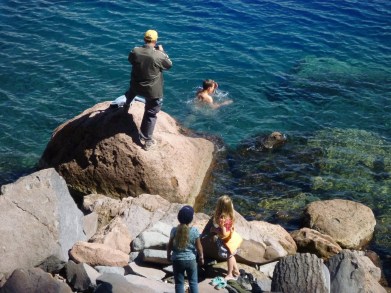
In 2010 we arrived in the parking lot in three cars, cousins pouring out with shy grins after years of missing each other. The tallest boy stood back-to-back with his uncle to compare heights, and the two little girls and a couple of boy cousins followed suit. The 11 yr-old boys linked up and became a  happy world unto themselves, jumping in sync on snow shelves until they broke , and quickly getting separated from the rest of the group so that as we were setting off on a walk we had to take 15 minutes to hunt for them.

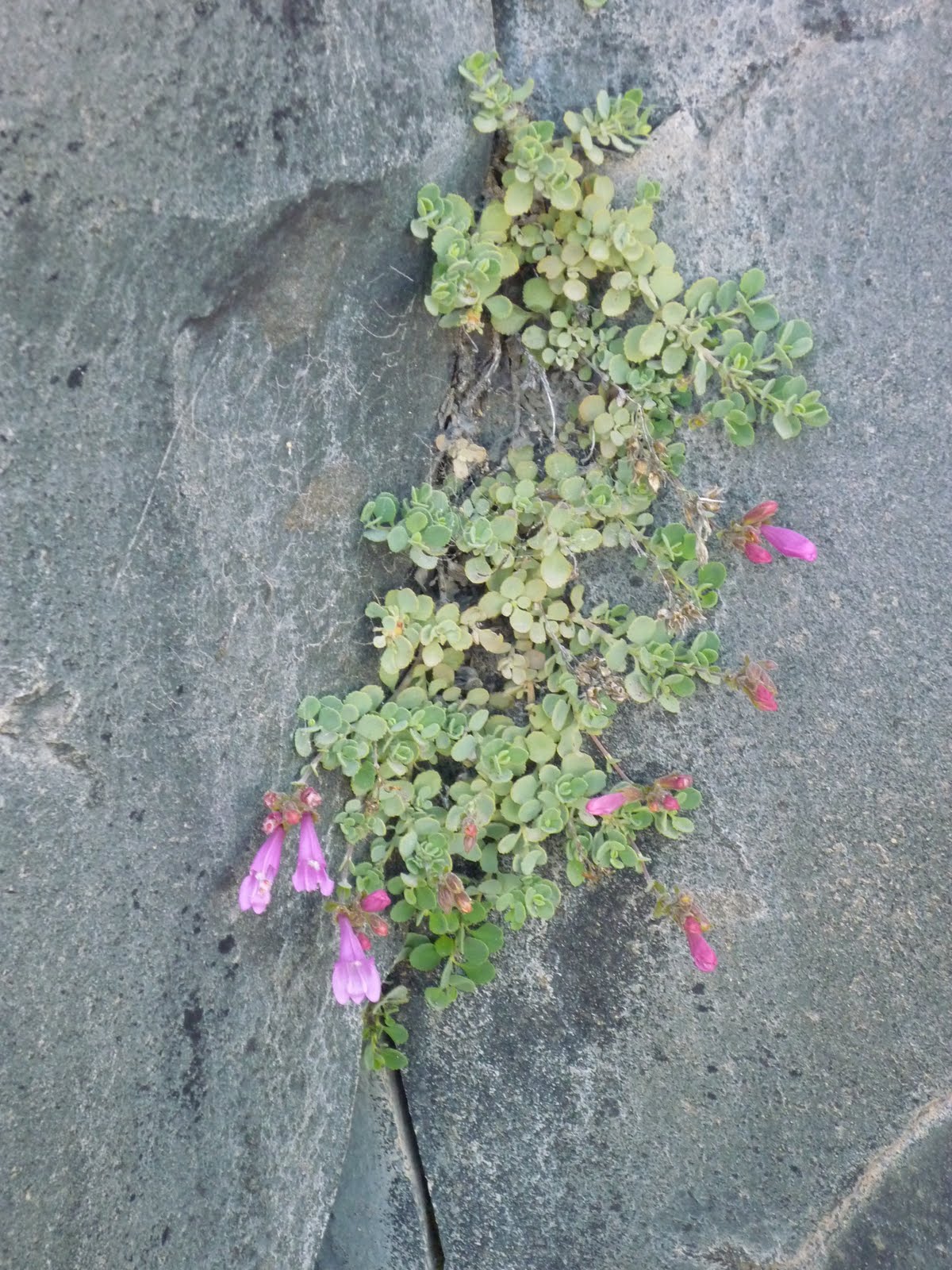
rock penstemon

We were disappointed to find all but one trail still closed for snow; the one open trail was steep to the dock at water’s edge. Everyone from the six year-old little bit of a girl to the stiffening grandma me tripped down the switchbacks along the inside of the old volcano’s top.

By the path and in cracks at eye-level this flower grew. As soon as I saw Pippin again, later that day, she got out her wildflower books and we found out that it is Rock Penstemon.

All along the path to the shore, which was about a mile’s walk, I was thinking about how much longer it would take me later to tromp back up the grade. That’s the problem with hikes that start with a descent.

At the boat launch, one of my Grandsons from the East got permission from his father to swim in the lake, whose sides slope steeply down to the almost 2,000 ft. depth at bottom. He stripped down to his undershorts and plunged in, only to exit within seconds, the water was so icy. But back in he went, and swam a few strokes to make it official. The chance of a lifetime!

As expected, the hike back up was slow and rigorous. I focused on putting one foot in front of the other and tried not to think of whether I was the last in the line, or to care. I was prepared for a long haul–or wishing someone could haul me up!

Then suddenly, perhaps half way ? son Pathfinder was alongside, and somehow we got on the subject of a book he is reading, and were talking about greed and how it differs from covetousness, and in no time, having meaningful and philosophical matters take my attention, I was surprised to find myself back on level ground and at the car.

Within a few minutes our carload was on the road south and out of Oregon, full of comfortably tired people who were mulling over the events of the last week, and the satisfactions of being part of a big and loving family.

Crater Lake, Oregon

Yosemite Familiness

Probably it never happened before this, that we camped in Yosemite two summers in a row. But this year and last, we have been that fortunate. The park is so vast and varied, one could easily stay a month and never get bored; our ancestors often did just that. This old photo from before 1930 shows my mother as a child there.

Farewell-to-Spring


Nowadays there is a one-week limit on camping, and it’s a rare person who can do the phone work and combine it with luck enough to secure a site or a cabin in Yosemite Valley, where whole campgrounds have been eliminated since our little family started camping there in the 70’s. Pippin’s mother-in-law is one of those dedicated and generous people, and this year Mr. Glad and I benefited from her labors and came along as the second set of grandparents, joining Baby Scout and his parents.

Being there in June meant that we got to see a different batch of wildflowers from those in July. All along the Merced Canyon coming in from Mariposa, the hills and roadsides were covered with these flowers that I am pretty sure are Farewell to Spring, otherwise known as Dudley’s Clarkia, a type of clarkia that reportedly only grows in California. Clarkia is named after William Clark of the Lewis and Clark Expedition, and I wasn’t surprised to learn that it is in the evening primrose family. It reminds me of the Mexican Evening Primrose by my driveway at home.

El Capitan
 The massive rock that speaks to me of God took my breath away
as we entered the valley, and this time I took my own photo.

All six adults in our extended family group were veteran campers with hearts thankful to the Creator for lavishing such beauty on us. One grandfather prayed thanks for the “familiness” we were enjoying and when I heard the word I knew it would be in the title of my blog.

The first day some of us went on an expedition to gather firewood in an area that had been severely burned in 1991.  Pippin took pictures of Scout sitting in the middle of acres of purple lupine, and later we went into the woods and found the colorful Harlequin Lupine as well–two sisters in that family group.

That afternoon the same group of us hiked past Mirror Lake to Hidden Falls. The last time I had seen the lake it was just a swamp full of horsetail and other such stuff. But this year every body or stream or fall of water in Yosemite is at its fullest and highest, and many families with children were playing in the sandy boulder-studded water as we tromped past.

Rattlesnakes! We saw two on the trail– One crossed silently, completely ignoring us. But the second one shook his rattle as he slithered into the leaves. I took his picture, too, but he is well camouflaged.

Hidden Falls wasn’t easy to get to, not with my stiff and unreliable joints and sinews. There was much clambering up steep hunks of granite and even some log-walking, but before long we came to the spot on Tenaya Creek where all my senses were bombarded.

There is little dirt in that place; towering all around are trees with thick trunks, growing out of granite slabs and boulders as big as houses. And water, torrents of it this wet year, pouring off the top of more speckled gray rock in falls that remained hidden somewhat behind huge craggy stones. The water’s roar echoed off all the rocks and made talking nearly impossible, and the brightness of the white foamy water glared somewhere out of every photo frame.

Child Pippin some decades ago

Scout had come along in the backpack. His parents sat him down in a flat place next to the falls and me, while they tried to scramble a little higher, and he started singing and squealing. He liked the excitement in the air, I think, all the fine cold spray and the tempest blast of sound. Clean and fresher than anything.

All the waterfalls are exciting this rainy year of 2010.  Mr. Glad and I hiked together part way to Vernal Falls, and I read a book while he completed the ascent to the top of the falls. High steps are cut out of the rock next to the canyon, where spray from the waterfall drenches the hikers on the Mist Trail, some on their way back from the summit of Half Dome.

We have hiked the Mist Trail several times as a family, but this year my knee hurt just thinking about climbing those steps. The photo above right is of Pippin on that trail, aged three, with her papa.
It was a new kind of camping for us, in Housekeeping, where you get three walls surrounding beds with mattresses, canvas roofs over your head, electricity in your cabin and patio area, and hot water in the restrooms nearby. Not like our tent camping at Crane Flat in the past, pictured.

Tent camping in Yosemite in the past

Cooking was fun, shared by the three women. I had a new and hot propane canister stove to replace our old one that was of a kind that we had to pump what seemed to be every few minutes, and even then the burner farthest from the tank never got very hot.

Pippin made a version of Power Pancakes with blueberries. No one had brought a large enough bowl for the batter so we made do with a dishpan.

Scout missed his routine, and seemed to get more overtired and cranky day by day. This is a shot of him sleeping early in the week, after being lulled to sleep on a wheeled walk. He often enjoyed his outings in the baby backpack, with its pauses next to trees and rocks where he was given time to feel the textures.

Our last full day in the park Mr. Glad and I went with our daughter to Taft Point. It’s a short hike after you drive up toward Glacier Point for an hour or so. Still, the trail involved a bit of “boulder-hopping” as I heard it described.

The streams are full and the distances between the rocks that stick up sometimes require a leap. It’s not that the water is deep; I could have taken off my shoes and walked across if I wanted to lessen the risk of wet boots or a sprained ankle. I managed without doing that–but on the homeward crossing, it took me about half a minute to coordinate my eyes, legs and courage and figure out how to spring–or lunge.

From Taft Point you look down into Yosemite Valley where the Merced River is snaking along, and across the canyon to perhaps the most thorough view of  Yosemite Falls possible. The day before, we had stood at the bottom of that waterfall; the experience from Taft Point is much quieter and drier.

You can also see down to El Capitan, that mass of rock one often sees from the bottom on entering the valley. It’s in the upper center of this photo, sloping down to the trees.
 

We ate our trail mix and crackers sitting on the rock slabs, and let Scout out of the pack to wiggle his toes in the granite dust.

So many wildflowers up there remain a mystery to me, even though I have prolonged my vacation (Yes, yes, I know, I should finish putting my kitchen back together or prepare for my soon arriving house guests.) researching them online and writing this blog.

The curious specimen here, for example, has the look of a Longhorn Steershead–the descriptive common name of a flower, Dicentra uniflora–but it doesn’t have the leaves to match that identity, which would be a relation of Bleeding Heart. Is it an imposter steer? How could there be two flowers so similar, that are not at least in the same family? Those blade-like leaves must go to something else…but where are steershead’s leaves? Very odd.

But I can’t let that problem distract me from the main point of this flower: God is amazing!I saw chamomile ready to bloom, and the tiniest alliums: each plant consisted of a single thin stem that I’d have thought was a frail blade of grass sprouting out of the sand up there where there is only wind and rock and sun. But at the tip of a few “blades” were the remains of a half-inch spherical tuft, lying down on the ground at that point because the thin stem couldn’t bear it up.

These leafy plants at left were scattered profusely over the meadows and forests at about 7,000 ft.; when the buds open they will make for a lot of color–we think yellow–and then they will really be attention-getters.


After taking in the views from Taft Point we hiked back to the road and drove on to Glacier Point, the most popular viewing spot in Yosemite National Park. No matter how often I visit the park, I appreciate the broad perspective. You can see where you camped or hiked over the last few days when you were down in the trees.

At Glacier Point the people-watching is unbeatable, because the population is international (Yosemite belongs to the world, or the U.N., or something, after all, which doesn’t please anyone I know), and there are so many people. After driving up the mountain all that way they aren’t in any hurry to leave, so everyone can watch everyone else as well as the scenery. We wondered if this pink-and-black woman might be on her honeymoon…anyone have a guess as to the origin of what looks like a traditional costume?

I didn’t know what a ghillie suit was until I asked Moss Boy if I could take his picture, and why he was dressed like that.

Kate as a child

“I love your dress,” I said to the woman with the long yellow costume. It was also quite pretty from the front, as was she.

Kate was dressed in our family’s traditional outdoor clothing when we took this picture of her at Glacier Point nine years ago.

But Glacier Point was not the last view; we always love to see things from Washburn Point as well; it’s just a bend or two of the road back from Glacier Point. Additional exotic members of the Family of Man could be viewed there, like Hasidim taking pictures.

What first caught our ear was a shiny man standing on a prominence and turning to and fro, singing over the treetops an Asian style of chant, a cell phone in one hand and a camera in the other. Two or three other men–one dressed all in black– and four women were singing nearby at the same time, and the women were tapping their feet.

 I asked one of the women, when she was finally walking back to the parking lot, what she was singing about. She was beaming smiles as she said, “Oh, I sing to myself.” I didn’t want to pry, but she didn’t seem in a hurry to get away, so I pressed, “What were you singing about?” She was happy to tell me, “About mountains, high, lonely.”

There is no last word that seems to fit after that, unless it would be Psalm 104, revealing to us our Lord,

Who walketh upon the wings of the winds….The mountains rise up and the plains sink down, unto the place where Thou hast established them….He sendeth forth springs in the valleys; between the mountains will the waters run….He watereth the mountains from His chambers; the earth shall be satisfied with the fruit of Thy works….How magnified are Thy works, O Lord! In wisdom hast Thou made them all; the earth is filled with Thy creation….