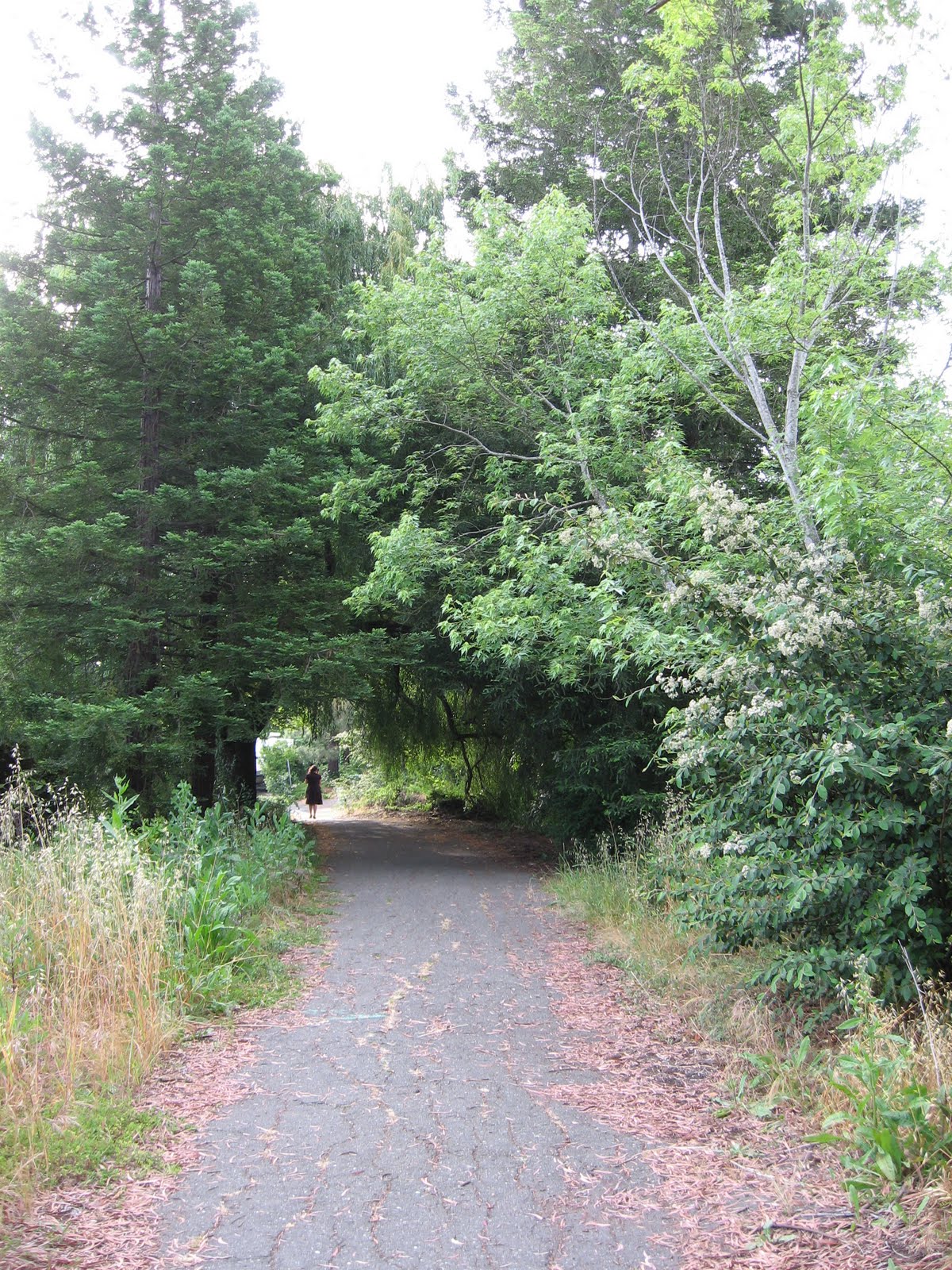
A brisk walk before 7:00 a.m. was just what I needed, I thought as I pulled on my clothes and quietly left the house yesterday morning. There was frost on the rooftops as I headed down the street to the bike/walking path a block away.
No sooner had I reached it but I overtook my neighbor and his dog, whom I’ve seen walking these paths for over a decade. Our relationship demonstrates the way friendship sometimes develops by baby steps, or maybe I could call them old-man-walking-old-dog-steps.
I don’t remember him from the first five years that we lived about six houses down from his, though I spent a lot of time on our wonderful paths that run along all the creeks through town. We were both busier, I suspect, and moving faster.
Ten or fifteen years ago I started noticing him with his dog. The dog was never in a hurry, and the man hunched a bit and shuffled, stopping and starting to avoid stumbling over his companion. He didn’t often look up at me when I drove past or when I met them strolling the other direction, but if he did, we would smile at each other.
A few years later I got a chance to speak to him a couple of times, and I told him that I lived just down the street. I didn’t say anything about how his yard was always neglected and full of tall weeds. Earlier on I had thought of bringing him cookies or offering to do some yard work, but once or twice I did see a woman there who I thought to be his daughter. Maybe it was she who planted some petunias one spring.
On this day, I had my perfect opportunity. Our relationship had progressed through the smile stage, into the speaking stage, and now, it seemed natural to slow my pace to theirs and say, “Good morning!” We started talking about his dog with the beautiful champagne-colored coat, a French sheepdog he’d gotten at the pound 14 years ago. “His name was Ben when we got him, but I changed it to Spunky.”
Somehow the conversation turned to politics–it wasn’t my doing! I walked alongside and followed their route, across this bridge, at which point Spunky stopped, changed direction, and was ready to go back more in the direction of home. That was as far as was his usual, his owner said. The whole hour I was with them I had to watch out for the leash and dog as they kept crisscrossing the path.
My friend told me about his childhood in Pittsburgh, PA, how he realized that if he didn’t leave shortly after high school, he’d be working in the factory forever. So he left, and he joined the Army, and traveled, but didn’t fight in Korea after all. His traveling gave him a different and broader perspective on the world from the average person, he believed. He recommended that I read The Economist, and told me about the three periodicals he reads to help him decide what companies to invest in.
Old men are often fun to talk to, especially if they like to talk about their lives and will carry the conversation. Then I can just show my interest and listen. Often they have a refreshingly old-fashioned outlook that I rarely encounter anymore. My neighbor doesn’t care that his jeans have a hole in the knee, or that his jacket is dirty. He had enough manners to pause in his story and ask a question about me or what I thought, but he wasn’t pushy if I didn’t talk much.
Eventually we got back to his house, and stood in the driveway for another ten minutes chatting about the Middle East and other places he had visited, and about how he has lived in that house for 38 years. I pointed out my house. He looked at Spunky, who had settled down to rest on the pavement, and said, “I have to get him inside,” but just before that I had introduced myself and found out that the man’s name is Ray.
My time was used up, it was nearly 8 o’clock, so I just walked quickly around the block and went home to tell B. about my new friend.
Lying in bed at night as a child, I used to hear trains pass less than a mile away, as the whistle blew at the intersection where I also would catch the school bus in the mornings. We were out in the middle of citrus orchards, on a dead-end road, so there was little else to hear at night. The coyote howling was a different tone from the locomotive’s warning. Now that my daughter lives where trains toot-toot as they go by many times throughout the day and night, I find that the sound still strikes a chord of comfort and regularity.
While we are busy about our work and play and sleep, thousands of people are being diligent to do their jobs driving the trains, loading them, keeping the schedules updated, whatever all is necessary. I know so little about it, it’s like magic.
Books I enjoyed with my children fed this romantic feeling I have: The Little Red Caboose, TheBoxcar Children, The Railway Children, even The Narnia Chronicles with its train trips here and there during holiday. Children and trains.
When I was still a young child I was allowed to ride the Santa Fe with just my two sisters, four hours to my grandmother’s house, which no doubt also makes me love trains, and the train stations just as much. Excitement and heightened emotion pervade these meeting places of people who might be returning from exotic and faraway lands, or perhaps are just now being reconciled face-to-face with kinfolk after years of estrangement….One never knows all the stories, one hardly knows all that churns in one’s own heart at meeting one’s own people.
When I rode the train, it was to visit my most dearly beloved maternal grandparents. I can see in my mind’s eye, just as I saw them from the train window before they could see me, Grandma and Grandpa, standing in the crowd waiting for us. We climbed down the steps and went to them, and got a kiss, and Grandma’s warm hands in ours (those were the days before hugging was expected), and her remarking how cold my own hands were.
There is mention of British trains and stations, even Victoria Station, on this blog recently. I’ve been on some British trains, and the last time I was on that island, my hotel was quite near Victoria Station, which was awfully modernized from the first time, and certainly a different world from what lives in my memory and heart’s imagination. When you can’t even throw your own trash away, but must hand it to someone walking around in a sort of spacesuit, it feels like a new age, and not of flower children.
One recent sight jived with the old world, though. Driving through the mountains of forests last week, I looked down the wooded slope at a railroad track snaking along a river, and thought I caught a glimpse of the little red caboose.
Today marks a year that I have been blogging, and that seems like an opportunity to tell the origin of my blog’s name. I only now looked on Wikipedia for the vesperal hymn “O Gladsome Light,” which when I hear or sing it always imparts something of the reality of the Trinity of which it tells. When I first thought of writing a blog, there was no other name that ever came to mind, even though I feared it might be presumptuous, to put it mildly, to take that title for my own.
But just as we Christians are to be “little Christs,” so I see that all the gifts I write about come from Him, and anything good that comes from me is a lesser light emanating from God. So I post a candle picture in thanks to Him. I like the little dot at the bottom, a lesser, mirrored light. My tiny candle, or reflection of a candle.
As we are reminded in the first chapter of James: “Every good gift and every perfect gift is from above, and cometh down from the Father of lights, with whom is no variableness, neither shadow of turning.”
O Gladsome Light of the holy glory Of the Immortal, heavenly, holy, blessed Father, O Jesus Christ….
“Beauty is the promise of Happiness,” said Stendhal, quoted in The Architecture of Happiness by Alain De Botton.
Written in this 21st century, it is billed as an introduction to architecture. As for decades I have been discovering an appreciation for buildings, and at the same time have been realizing my ignorance of artistic principles generally, I was really ready for De Botton’s helpful study, which doesn’t catalog architectural styles –I seem to have a mental block against learning these—but explains why we humans might like or dislike particular buildings:
“We are drawn to call something beautiful whenever we detect that it contains in concentrated form those qualities in which we personally, or our societies more generally, are deficient.”
John Ruskin said that we want our buildings to shelter us and to speak to us, of what we find important and need reminders of. These values can change somewhat across centuries and cultures, but de Botton lists several “virtues of buildings” that are required if they are to be beautiful.
1) Order. But not over-simplified. We like to see complex elements arranged in a regular pattern.
What the author calls the “perverse dogma” from the Romantic Period, that all edifices must be of original design, led to chaos in the landscape. “Architecture should have the confidence and the kindness to be a little boring.”
2) Balance. Some concepts to be mediated are old and new, natural and man-made, luxurious and modest, masculine and feminine. This chapter gave me the most trouble. The photographs showed supposed balance that looked incongruous to me. I don’t like bare concrete, to start with. My tastes prove the point made by another quote from Stendhal: “There are as many styles of beauty as there are visions of happiness.”
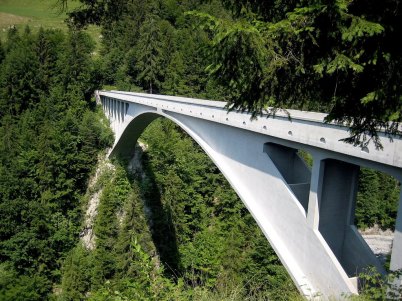
3) Elegance. When the achievement of strength or energy looks effortless and modest as in the Salginatobel Bridge in Switzerland, above.
4) Coherence. The building should not be a hodgepodge of styles. I’ll say it should be a clear declarative sentence. [I must like those a lot; I wrote this months before my last book review.] And that “sentence” should make sense in the context of its “paragraph.” As Louis Sullivan said, for example, tall buildings are all about loftiness, and that statement is made by every line of a skyscraper contributing to its being “a proud and soaring thing, rising in sheer exultation….”
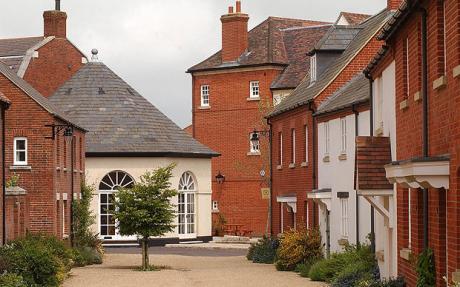
Poundbury
A building should fit into its historical and cultural place as well as its physical setting. De Botton considers one failure in this regard to be the exact replica of an 18th century village style built in the late 20th century in Poundbury, Dorchester, a psychological and practical disconnect. Others have commented on this housing development’s good and bad aspects. It was the brainchild of Prince Charles, by the way, who seems to be always pulling weight against what he considers ugly modern architecture.
The author helped me understand why a building that I have enjoyed is not appreciated in its home town. After reading Death Comes for the Archbishop by Willa Cather many years ago, I was excited to visit the 19th-century cathedral that was actually commissioned by the priest who was somewhat fictionalized in the novel, in Santa Fe, New Mexico. At that time I thought the disregard of the beautiful building was likely because of its Christian history and purpose, in a town that is now in love with its more pagan native roots.
The Cathedral Basilica of Saint Francis of Assisi
Now I understand that while Fr. Lamy conceived of a church he knew to be beautiful, that of his beloved French homeland, if he had been of the modern architect’s sensibility he would have altered the design to reflect his new home and climate. But I don’t believe he was an architect in the first place.
I appreciated the building for its Christian and literary history, even if it is in the Romanesque Revival style. It at least is built of local New Mexican stone; I know of beautiful houses in California that have design elements that required the transport of huge stones from Japan, to keep the whole piece of art Japanese–but what about the context?
The Cathedral Basilica of Saint Francis of Assisi, as it was designated in 2005, looks more odd all the time in the town of Santa Fe, which has, perhaps somewhat in the spirit of Poundsbury, tried to homogenize its architectural style:
“By an ordinance passed in 1958, new and rebuilt buildings, especially those in designated historic districts, must exhibit a Spanish Territorial or Pueblo style of architecture, with flat roofs and other features suggestive of the area’s traditional adobe construction. However, many contemporary houses in the city are built from lumber, concrete blocks, and other common building materials, but with stucco surfaces (sometimes referred to as “faux-dobe”, pronounced as one word: “foe-dough-bee”) reflecting the historic style.” [from Wikipedia]
Of course, these efforts to “pueblofy” the city have meant a loss of the eclectic elements from the past, though it was all done in the interest of promoting tourism and preventing decline of another sort.
De Botton writes of buildings having an aesthetic mission, and if one is on a mission, the last listed quality is crucial:
5) Self-knowledge. When I first saw that heading, I thought, This is carrying the anthropomorphism too far. I was relieved to find that the author was by now speaking not of buildings but of us humans, especially of the architects among us.
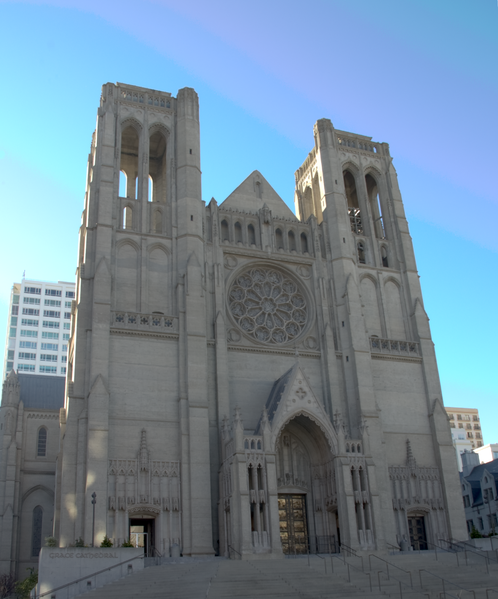
Grace Cathedral, San Francisco
We need to understand our human nature in all its complexity if we want to avoid the utopianism of the famous Swiss-French architect Le Corbusier, who seemed to have many radical plans, at least some of which we can be thankful were not accomplished, such as tearing out the heart of Paris in 1922 to replace it with 16 residential skyscrapers, some of which would house 40,000 people each. He wanted to eliminate suburbs, and abolish city streets, and glancing across the ocean, to raze Manhattan and start over. For one thing, its skyscrapers were too short.
Getting back to that quality of balance, I’m wondering if my own distaste for concrete is perhaps as closed minded as Prince Charles tends to be. My snobbishness made it hard to appreciate Grace Cathedral when I visited it last month, because though it has soaring arches and design beauty, it lacks the natural stone of the cathedrals I enjoyed in England.
I should remember that concrete is only a type of cast stone, which has a long history in antiquity, as I learned from reading The Pyramids: An Enigma Solved by Joseph Davidovits. He argues that at least the outer casing stones of the pyramids themselves were built from a masonry product poured on-site. It’s been more than ten years since I read this book when the children and I were studying ancient history, and I plan to read it again soon.
My own church is built of concrete, though one can’t see any of that base material anymore, covered as it is now in plaster and icons and marble. And on the subject of church architecture, I hope to write more, as my excitement grows into deeper understanding.
Thanks to De Botton, I have a little more foundational knowledge to aid me in my explorations. His style is slow and thoroughgoing in explanations of concepts, so much so that it took some getting used to; but I soon came to appreciate his carefulness. He includes many photographs to flesh out the architectural ideas he presents to the reader.
Alain De Botton is a philosopher as much as an artist, and helped to found a school called The School of Life. He has written several books, and my intention is that The Architecture of Happiness will be just the first of other thought-provoking works of his that I read.
 A brisk walk before 7:00 a.m. was just what I needed, I thought as I pulled on my clothes and quietly left the house yesterday morning. There was frost on the rooftops as I headed down the street to the bike/walking path a block away.
 Somehow the conversation turned to politics–it wasn’t my doing! I walked alongside and followed their route, across this bridge, at which point Spunky stopped, changed direction, and was ready to go back more in the direction of home. That was as far as was his usual, his owner said. The whole hour I was with them I had to watch out for the leash and dog as they kept crisscrossing the path.



 Gladsome Lights