“No frail human morality can ever hope to contain the overflowing fullness of life with which Christ desires to rejuvenate the faithful.
“The world will not be saved by optimistic humanism that believes human progress and morality will eventually save the world. For Dostoevsky and the church fathers, man’s deepest problems are not moral, nor even psychological, but ultimately existential and ontological. It’s not about following the rules or feeling balanced. It is a matter of choice and it is a matter of human nature being touched by the hand of God Himself.
“Only by daring to leap towards God in spite of the good and evil that exist in the heart can the believer hope to get beyond the contradiction of the human condition. In order to avoid descending into nihilism, Dostoevsky offers his readers another path: the acceptance of suffering and affliction in the context of a relationship with God. It is only in this context that man is able to recognize a path out of his fallen condition. It is only this Love that is able to transform suffering into salvific joy.”
-Father Alexis Trader (Now Bishop Alexis of the Diocese of Sitka)
Today in the Orthodox Church we remember The Expulsion of Adam and Eve from Paradise. “The knowledge of Good and Evil, no matter how systematically or thoroughly consumed, will by no means make us gods. Rather, modern ethics, modern psychotherapy, and modern political ideologies all tend to produce not superhumans but pitiable slaves to the rationalizations generated by our distorted human desires. In order to gain control over the world, we have been too willing to renounce essential aspects of our own freedom.”
― Timothy G. Patitsas, The Ethics of Beauty
Will I finish reading The Ethics of Beauty during Lent? Maybe not, but I will at least keep plugging away at it. It’s full of insights about the order of Creation, including the humans, of course — and is infused with much wisdom and hope.
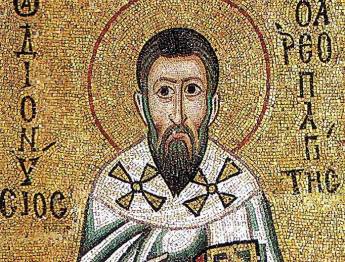
Some years ago Donald Sheehan’s widow Xenia shared on social media an excerpt from his book The Grace of Incorruption, a passage in which he links Robert Frost with St. Dionysius. She published it on the saint’s feast day in October, along with his icon below, but for re-posting Sheehan’s thoughts I have chosen today’s date, on which Robert Frost breathed his last, an appropriately wintry day in 1963. Xenia Sheehan:
This day the Orthodox Church celebrates St. Dionysius the Areopagite, 1st (or possibly 5th)-century poet of “Mystical Theology,” whom Donald Sheehan uniquely compares to American poet Robert Frost in his “deliberate turning out of all the lights of false knowing . . . in order to behold — in Dionysius’ astonishing words — ‘that darkness concealed from all the light among beings.'”
Don writes in The Grace of Incorruption that,
“…in order to know the personhood of another, we must unknow both the persona and the personality: we must let these lights go out. Again and again, in his finest poems, Robert Frost accomplishes precisely this unknowing, the deliberate extinguishing of all the false light, and a welcoming-in of the darkness in which true personhood can shine forth. And true personhood is, always, genuinely beautiful.
“I think what moves us so deeply about the poem ‘An Old Man’s Winter Night’ is Frost’s evocation of genuine personhood in the old man. The old man in Frost’s poem is not a persona nor a personality; he is, genuinely, a person. And as the lights go out in the poem, the more beautifully and movingly his personhood emerges. One vivid detail: when the log in the stove shifts with a jolt, we, too, are jolted into a deeper intimacy with the old man, an intimacy that gains in power because of the darkness.”
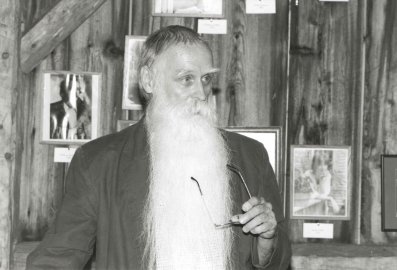
-Donald Sheehan
Text and icon from Donald’s widow Xenia Sheehan in 2018
AN OLD MAN’S WINTER NIGHT
All out-of-doors looked darkly in at him Through the thin frost, almost in separate stars, That gathers on the pane in empty rooms. What kept his eyes from giving back the gaze Was the lamp tilted near them in his hand. What kept him from remembering what it was That brought him to that creaking room was age. He stood with barrels round him—at a loss. And having scared the cellar under him In clomping there, he scared it once again In clomping off;—and scared the outer night, Which has its sounds, familiar, like the roar Of trees and crack of branches, common things, But nothing so like beating on a box. A light he was to no one but himself Where now he sat, concerned with he knew what, A quiet light, and then not even that. He consigned to the moon,—such as she was, So late-arising,—to the broken moon As better than the sun in any case For such a charge, his snow upon the roof, His icicles along the wall to keep; And slept. The log that shifted with a jolt Once in the stove, disturbed him and he shifted, And eased his heavy breathing, but still slept. One aged man—one man—can’t fill a house, A farm, a countryside, or if he can, It’s thus he does it of a winter night.
O our Lord, God and Savior Jesus Christ, Who in the beginning fashioned man out of the dust of the earth and breathed into him the breath of life so that he became a living soul, Who knowest the time of life and name of each even from his mother’s womb, Who numberest even the hairs of our heads, and Who keepest a watchful eye over every living thing in Thy creation, do Thou now look upon Thy creation which Thou hast fashioned according to Thine own image, and grant to those who are in their mother’s wombs and to their mothers the protection that Thou gavest Thine own Virgin Mother when she carried Thee, and fill them with the Holy Spirit even as Thou once filled Elizabeth such that John the Forerunner leaped in her womb at encountering Thee.
As Thou becamest incarnate of the Holy Spirit and the Virgin Mary and became true man, hidden within the veil of Thy mother’s flesh, joining Thy divinity with our humanity, join Thyself now with us and all Thy human creation through Thy grace. As Thou didst enter into the womb of Thy Mother, be present also in the wombs of all mothers, with them and with their children. Protect them from all assaults of the evil one and his foul spirits, that in due time all may come unto Thee, as Thou didst say, “Suffer the little children, and forbid them not to come unto Me, for of such is the kingdom of heaven.”
O Thou Who at Thy birth heard the weeping of Rachel in lamentation, who would not be comforted for her children were no more, crying out at the slaughter of the innocents by the wicked Herod for Thy sake, hear also the weeping of all those who lament the deaths of Thy little children, who cry out for Thy love and peace in the midst of terror and inhumanity.
As Thou once granted true contrition of heart to David and to Manasseh and to Peter, Who sinned against Thee, grant true repentance to all who in malice or greed or desperation or hopelessness or ignorance sin against Thee and Thy creatures in the untimely taking of their lives. Receive their tears as the tears of the Publican, which flow from the depths of their hearts, as Thou didst receive David, who had taken life unjustly, and Manasseh, who had permitted the worship of idols, and Peter, who thrice denied Thee. Receive them as the Prodigal, with eagerness and rejoicing, clothing them with the robe of holiness and glory and celebrating with them the feast of faith.
Speak words of justice into the hearts of our rulers, that they may be guided by divine wisdom in protecting and nurturing life in every good way. Give strength and love to those who minister to all who suffer in desperation and need, granting through them every spiritual and earthly blessing. Protect the widows and orphans and the abandoned, be father to the fatherless and hope to the hopeless, raise the young, protect the bond of marriage in peace and concord. Remember the forgotten and bring them to mind in all of us who pray unto Thee. Grant eternal rest to the fallen, and raise them up at the last day.
O Christ our God, Who knowest all in our depths and receivest the supplications of Thy servants Who call out to Thee in our own transgressions and imperfection, hear this our humble prayer and give us all Thy divine blessing from on high, for Thou art ever glorified with Thy Father Who is from everlasting and Thine all-holy, good and life-creating Spirit, now and ever, and unto ages of ages. Amen.