I’m taking a break for Lent.
This will be my last post until after Pascha,
which is April 12.
Let us understand …that what the Church wants us to do during Lent is to seek the enrichment of our spiritual and intellectual inner world, to read and to meditate upon those things which are most likely to help us recover that inner world and its joy. Of that joy, of the true vocation of man, the one that is fulfilled inside and not outside, the ‘modern world’ gives us no taste today; yet without it, without the understanding of Lent as a journey into the depth of our humanity, Lent loses its meaning.
-Father Alexander Schmemann, Great Lent
Man will not have peace in his heart until he… says, “God and I are alone in the entire world.” -St John of Tobolsk
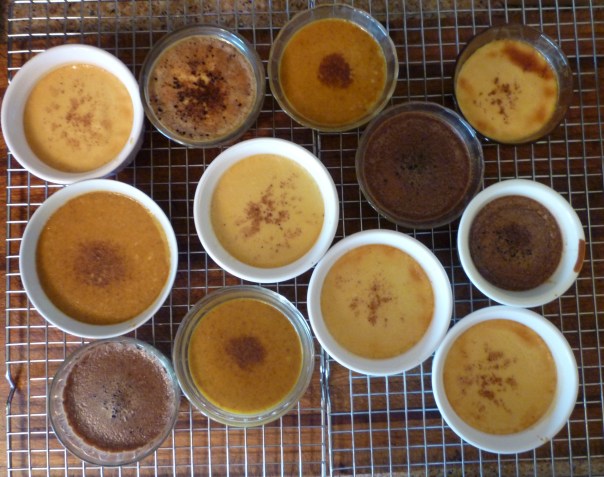
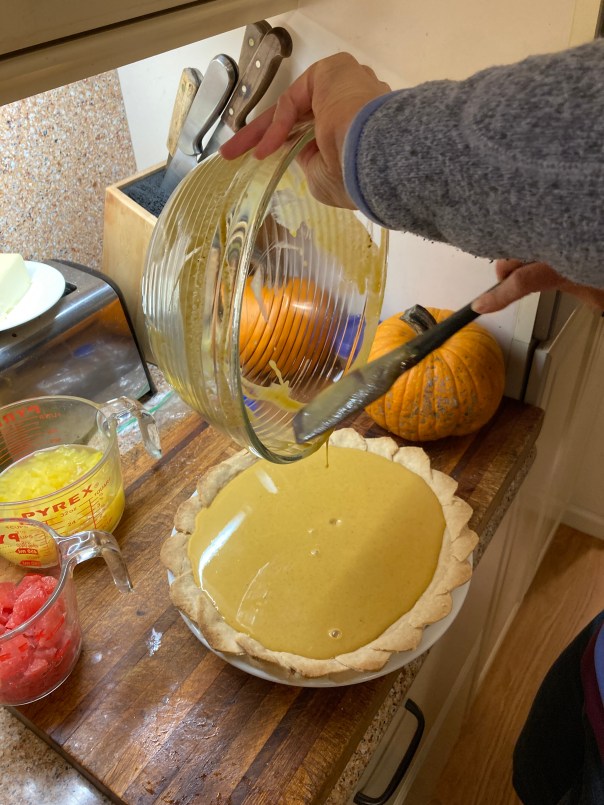
In the Orthodox Church we start fasting from meat a week before full-on Lent. And this week we don’t restrict ourselves otherwise, even on Wednesday and Friday. I thought I might post an appropriate recipe … but I’ve run out of time, so instead I’m just going to put up a few pictures of such foods as I have cooked, and might cook again, during these seven days.
Butter Week QuicheSalty Honey Pie
As I eat more butter than cheese always, I prefer to call it Butter Week,
but Cheesefare Week is also a good name.
Egg Lemon Soup
I can make Egg Lemon Soup with vegetable broth instead of the traditional chicken broth, but I can’t see making it without eggs, though I’ve seen recipes for such a thing. But please, give it a new name if you are going to do that!
Tea Eggs
You know I’ve never even flirted with the idea of being vegan.
Lemon Sour Cream Cake
You can find some of these recipes on my Recipes page tabbed above.
Happy Butter Week!
Palm Sunday is the beginning of Holy Week, and here on the eve of it I’m sharing again, slightly updated, my experience of about ten years ago when I was in the middle of reading The Brothers Karamazov, and I came to the the part “From the Life of the Elder Zosima,” which takes place during this week leading up to Christ’s death and resurrection:
The Elder Zosima first relates about his older brother, who only at the age of seventeen and sick unto death, turned from anger and scoffing toward a path that might lead to repentance, and seemingly only to please his mother. But that is not an entirely bad reason.
… on Tuesday morning my brother started keeping the fast and going to church. “I’m doing it only for your sake, mother, to give you joy and peace,” he said to her….But he did not go to church for long, he took to his bed, so that he had to confess and receive communion at home. The days grew bright, clear, fragrant — Easter was late that year. All night, I remember, he used to cough, slept badly, but in the morning he would always get dressed and try to sit in an armchair. So I remember him: he sits, quiet and meek, he smiles, he is sick but his countenance is glad, joyful. He was utterly changed in spirit — such a wondrous change had suddenly begun in him!
The young man asked forgiveness of everyone and talked about his great sin, but at the same time was so happy and full of thankfulness and exhortations, that people thought he was going mad.
Thus he awoke every day with more and more tenderness, rejoicing and all atremble with love. The doctor would come — the old German Eisenschmidt used to come to us: “Well, what do you think, doctor, shall I live one more day in the world?” he would joke with him. “Not just one day, you will live many days,” the doctor would answer, “you will live months and years, too.” “But what are years, what are months!” he would exclaim. “Why count the days, when even one day is enough for a man to know all happiness. My dears, why do we quarrel, boast before each other, remember each other’s offenses? Let us go into the garden, let us walk and play and love and praise and kiss each other, and bless our life.”
This older brother died a few weeks after Easter, when the teller of the story, the elder Zosima, was only eight years old. Now now near death himself, he talks more about his childhood, and how it was also during Holy Week that he began to see more when he went to church.
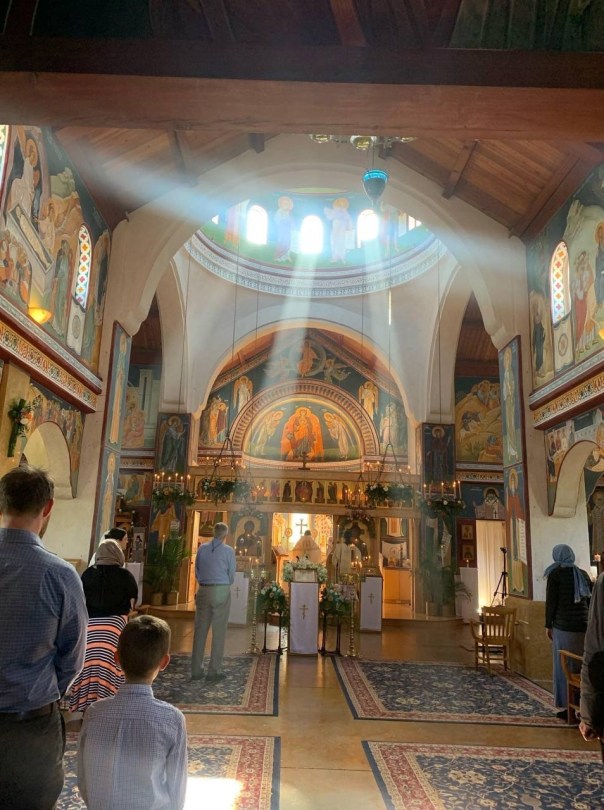
But I remember how, even before I learned to read, a certain spiritual perception visited me for the first time, when I was just eight years old. Mother took me to church by myself (I do not remember where my brother was then), during Holy Week, to the Monday liturgy. It was a clear day, and, remembering it now, I seem to see again the incense rising from the censer and quietly ascending upwards, and from above, through a narrow window in the cupola, God’s rays pouring down upon us in the church, and the incense rising up to them in waves, as if dissolving into them. I looked with deep tenderness, and for the first time in my life I consciously received the first seed of the word of God in my soul. A young man walked out into the middle of the church with a big book, so big that it seemed to me he even had difficulty in carrying it, and he placed it on the analogion [lectern], opened it, and began to read, and suddenly, then, for the first time I understood something, for the first time in my life I understood what was read in God’s church.
The reading was from the book of Job. I myself have attended these same services over the years, and they grow more precious every time I hear the readings and hymns. The gifts of the Church are too rich to ever plumb their depths, but there is no need to fret about our limitations, when, as the sick brother says, “even one day is enough for a man to know all happiness.” How many times have I also watched the beams of light shining down when I stood in church, and even felt their heat on my face, like the warmth of God’s love?
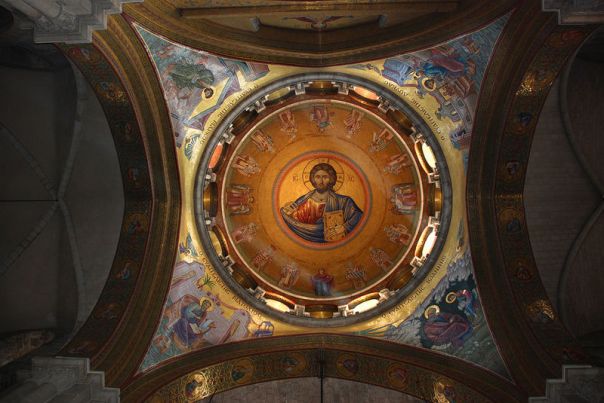
Christ the Bridegroom
The Elder Zosima is a fictional character, but he is believed to be based on a real-life monk in old Russia. In the novel the Elder proceeds from this point in his very moving fashion to tell his life’s story: “– and over all is God’s truth, moving, reconciling, all-forgiving!”
The “accidental” timing of my reading seemed to be a gift from God that morning, helping me in an unusual way to become even more receptive to His being with us at the evening service by means of hymns such as, “Let my prayer arise in Thy sight as incense….,” and the Psalms of Ascent — and the Holy Mysteries.
When our bishop was with us the previous week, he gave a good word about the last days of Lent — well, technically Lent has come to an end, but we are still in the anticipation and preparation that is Holy Week. He said that Lent is not about finding every bit of dirt in our souls, but about the bridal chamber, about discovering the great love that our Lord Jesus has for us. It is truly a “bright sadness” that colors these days as we accompany Him to the Cross.
Perhaps Zosima’s brother went to a Bridegroom Matins service on Tuesday; we have three of them during Holy Week. The Lord Himself has been filling my lamp with the oil of His Holy Spirit.
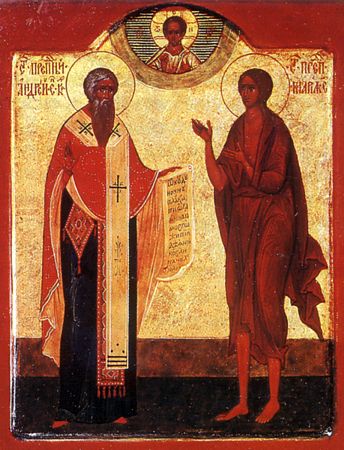
In the fifth week of Lent we Orthodox have “Thursday of the Great Canon,” on which day the entire Great Canon of St. Andrew of Crete is sung. This penitential hymn is very long, and in the first week of Lent the singing of it is divided among four services. But today we hear and pray it all at once.
“A basic distinguishing feature of the Great Canon is its extremely broad use of images and subjects taken both from the Old and New Testaments. As the Canon progresses, the congregation encounters many biblical examples of sin and repentance. The Bible (and therefore, the Canon) speaks of some individuals in a positive light, and about others in a negative one—the penitents are expected to emulate the positive examples of sanctity and repentance, and to learn from and avoid the negative examples of sin, fallen nature and pride.” -Orthodox Wiki
Here is a small portion from Canticle Four:
“Thy Body and Thy Blood, O Word, Thou hast offered at Thy Crucifixion for the sake of all: Thy Body to refashion me, Thy Blood to wash me clean; and Thou hast given up Thy spirit, O Christ, to bring me to the Father.
“O Creator, Thou hast worked salvation in the midst of the earth, that we might be saved. Thou wast crucified of Thine own will upon the Tree; and Eden, closed till then, was opened. Things above and things below, the creation and all peoples have been saved and worship Thee.
“May the Blood from Thy side be to me a cleansing fount, and may the water that flows with it be a drink of forgiveness. May I be purified by both, O Word, anointed and refreshed, having as chrism and drink Thy words of life.”





 … on Tuesday morning my brother started keeping the fast and going to church. “I’m doing it only for your sake, mother, to give you joy and peace,” he said to her….But he did not go to church for long, he took to his bed, so that he had to confess and receive communion at home. The days grew bright, clear, fragrant — Easter was late that year. All night, I remember, he used to cough, slept badly, but in the morning he would always get dressed and try to sit in an armchair. So I remember him: he sits, quiet and meek, he smiles, he is sick but his countenance is glad, joyful. He was utterly changed in spirit — such a wondrous change had suddenly begun in him!


 Gladsome Lights