Category Archives: music

It cheers my heart like spirit’l wine.

I have just discovered the 18th-century hymn “Jesus Christ the Apple Tree,” on this G.K. Chesterton site., where you can read good meditations on its meaning. It is thought to have been written by a New Englander, and has been set to various tunes. The most common seems to be the one by Elizabeth Poston, of which this video records a nice rendition.

The hymn has become associated with Christmas, and I’d like to add it to our own family’s collection of carols, at least by next Christmas. “Under the shadow I will be, Of Jesus Christ the apple tree. ”


The Music of My Life

The third chapter of The Hidden Art of Homemaking is the impetus for this post. It is titled simply “Music,” and continues the theme of how Christians might express their creativity in their varied and unique circumstances. I am participating in the discussion of the book on Cindy’s blog, Ordo Amoris. This is a long post and I apologize — you would be smart to skip it and go do something creative!

It might have been 30 years ago that I first read Hidden Art, and I wrote on the day of the author’s death how important it was in developing a vision for my life. At the time of its publication in 1971 I don’t think there was anything else like it, but feminists were writing plenty about the stifling life of the typical housewife. It was lovely to have laid out before me many concrete examples of interesting people and their home-enriching activities.

Just a couple of years later, Karen Mains wrote Open Heart, Open Home, which also contributed to my Christian vision, on the theme of hospitality. And I was married in the early 70’s, and enjoying keeping house and garden even before the children started arriving. When the house began to fill with kids, I never lacked for creative projects and plans.

But I hadn’t even read Schaeffer’s book yet. My young-married-childbearing years were overflowing with culture and creativity, and I could not relate to the reader Edith seemed to be writing for, someone who is frustrated, locked up, or unfulfilled (her words).

Only recently have I been able to look back over my life and see with more understanding (I hope) why the story reads the way it does. I needed time to think, and I needed to see more of the plot toward the end, before I could notice how the first chapters fit with middle parts of my saga.

Part I contained an excess of family drama, as we call it these days, emotional and psychological stress that I didn’t get any help dealing with. If you have a splitting headache it is hard to tap into your creativity. It’s the same with emotional pain, maybe more so when it isn’t diagnosed or even acknowledged, but stays like an always-freshening wound that makes you want to move as little as possible.

Me in Part II

What brought me into Part II was getting married to a good man and empowered to create my own story, free of distracting pain. The setting was calm and clear and full of the hope of the gospel. It was somewhat the opposite of what Schaeffer talks about, because being home was my obvious opportunity to do just about anything. I had had no lack of examples and ideas; actually, the hippie era for me segued into a homesteading spirit a la The Mother Earth News. And there were all the creative people I’d known growing up (just about everyone), while I was storing up tinder for my creative fires.

I see that I have mixed a few metaphors here trying to tell my story — or am I writing the score for the symphony that has been playing out? Though this chapter is about music, it seems as good a place as any to bring up what seem to me to be realities on which our artistic life is built. They apply to music, too.

I received little musical training as a child, and I had no career that I had to put on the back burner. But growing up in church was good ear-training, and even in the Girl Scouts and in public school we sang a lot. I was lucky to marry a musician, and by means of his guitar and my singing we filled the house and our children’s ears with music.

We sang in the car, using songbooks I wrote out by hand. We sang around the campfire. We parents sat on the bedroom floor and crooned lullabies to our children every night. And in church I helped the young readers to develop fluency while hymn-singing, running my finger along the page under the words while they looked on. But I don’t know how to read music.

At first there wasn’t money for music lessons, and I wept over the injustice of a world in which my firstborn had no opportunity for a more structured musical education. Then grandparents and great-grandparents stepped in and God provided a generous piano teacher two blocks from our house. From that time forth the provisions continued in various ways, so that eventually all of our five children learned to play at least one instrument. The photos are of them and a grandson enjoying their music. Two of our daughters became piano teachers in their teens.

But for many families, music is not something they can really accomplish. My parents could not provide it for me, but it all worked out o.k. Some women find that their distracting drama only starts when they marry, or when a child falls ill. There are women for whom getting through the day is like climbing a steep mountain, and while they might be relieved to stop and smell the flowers, it’s asking a lot to tell them they ought to get out the seed catalog and develop a plan for further landscaping. But I suppose they aren’t the ones reading Hidden Art.

When Schaeffer says things like, “Christian homes should…be places where there is the greatest variety of good music,” I balk at the word should. I don’t know how she might otherwise have presented a picture of what she considers the ideal home, but every time she says we should do this or that to develop our creative side — and in the short Chapter 2 she used the word nine times — I get annoyed that she is telling me what my Christian duty is.

To me that’s backwards, because I can’t recall ever doing one creative homemaking thing out of a sense of duty, though I firmly believe we are all obligated to do our duty. To fear God and keep His commandments is the whole duty of man, according to Ecclesiastes (Not that we can even accomplish those basics on our own). It seems to me that the rest, the art and music and beauty, flow naturally from a human soul that is nurtured by God’s love — just as sap running up a tree trunk results in bright leaves and colorful fruit. The main thing is not to tell the tree to make fruit, but to keep the connection to the life-giving Fountain — Who is also the One who heals all those diseases of the heart that might hinder us.

What do you know — beauty in our life is one of the healing potions God provides. So if we start with small things that brighten our homes, say, singing a few lines from a hymn over the kitchen sink, or teaching a nursery rhyme to a toddler, just in response to the impulse, we are creating culture and feeding our own souls. It keeps the sap running, and the more the tree grows, the more sap and delicious fruit there will be.

Since Edith Schaeffer wrote this book and What is a Family, the only two of hers that I have read, thousands of families have discovered that homeschooling provides the opportunities to build the kind of family life and culture that the author presents a vision for. Just give us enough time with our children and all these good things are more likely to happen. The vision she sets forth was an ingredient in the soil that nourished my own heart and gave me the courage I needed. All the rest is in Part II, Part III, and still writing… Oh, and still singing new songs!


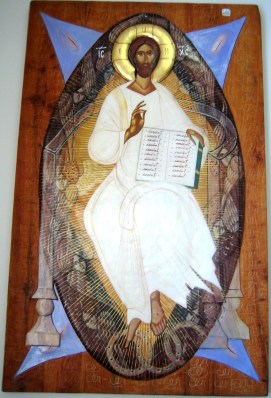
Christ accepted the impossible death.

He died although he cannot die; he dies although he is immortal, in his very human nature inseparably united with his Godhead. His soul, without being separated from God, is torn out of his body, while both his soul and his flesh remain united with the Godhead. He will lie in the tomb incorruptible until the third day, because his body cannot be touched by corruption. It is full of the divine presence. It is pervaded by it as a sword of iron is pervaded by fire in the furnace, and the soul of Christ descends into hell resplendent with the glory of his Godhead.

The death of Christ is a tearing apart of an immortal body from a soul that is alive and remains alive forever. This makes the death of Christ a tragedy beyond our imagining, far beyond any suffering that we can humanly picture or experience.

Christ’s death is an act of supreme love. It was true when he said, “No one takes my life from me; I give it freely myself.” No one could kill him — the Immortal; no one could quench this Light that is the shining of the splendor of God. He gave his life, he accepted the impossible death to share with us all the tragedy of our human condition.

–Metropolitan Anthony Bloom

This hymn of Holy Friday, of which I found a version on YouTube, begins, “Today He Who hung the earth upon the waters is hung upon a tree,” and continues with an exploration of all the impossible details. At Royal Hours this morning I heard a quartet of men sing it, fittingly beautiful and powerful.

I see in the glass darkly.

When I married my husband, I married into his family. If that family were a building made of earthly stones, the large rock that for so long stood at the corner of the foundation, the one that bore the most weight, has been taken out of his place. He passed from this life last week at the age of 96. My husband’s father was a Christian man and there was nothing fancy about him; still, many people said rightly that he was “a prince of a man.”

The house is being restructured. We know that God’s everlasting arms are under us in any case, but I feel the shifting, and the huge change. And I could not think of a thing to say here until today when I read these words from a hymn of the Greek Orthodox Rite for the Burial of Priests. This man who was so significant in my life was not a priest, or even Orthodox, but the hymn helps me to pray and to hold the mysteries in faith.

God intended the soul and body to be a unity, but at death they have to be torn apart. The words wonder about that and about other things regarding our death of which we understand so little. I like the musical setting by John Tavener; you can read the words below the link while you listen to the hymn.

And let us do as exhorted at the end, to enter into Christ, and His Light. Amen.

Why these bitter words of the dying, O brethren,
which they utter as they go hence?
I am parted from my brethren.
All my friends do I abandon, and go hence.
But whither I go, that understand I not,
neither what shall become of me yonder;
only God who hath summoned me knoweth.
But make commemoration of me with the song:
Alleluia.But whither now go the souls?
How dwell they now together there?
This mystery have I desired to learn,
but none can impart aright.
Do they call to mind their own people, as we do them?
Or have they forgotten all those who mourn them
and make the song:
Alleluia.

We go forth on the path eternal,
and as condemned, with downcast faces,
present ourselves before the only God eternal.
Where then is comeliness? Where then is wealth?
Where then is the glory of this world?
There shall none of these things aid us,
but only to say oft the psalm:
Alleluia.

If thou hast shown mercy unto man, O man,
that same mercy shall be shown thee there;
and if on an orphan thou hast shown compassion,
the same shall there deliver thee from want,
If in this life the naked thou hast clothed,
the same shall give thee shelter there,
and sing the psalm:
Alleluia.

Youth and the beauty of the body
fade at the hour of death,
and the tongue then burneth fiercely,
and the parched throat is inflamed.
The beauty of the eyes is quenched then,
the comeliness of the face all altered,
the shapeliness of the neck destroyed;
and the other parts have become numb,
nor often say:
Alleluia.

With ecstasy are we inflamed if we but hear
that there is light eternal yonder;
that there is Paradise,
wherein every soul of Righteous Ones rejoiceth.
Let us all, also, Enter into Christ,
that all we may cry aloud thus unto God:
Alleluia.

He is the Resurrection and the Life.