What can we do
but keep on breathing in and out,
modest and willing, and in our places?
– Mary Oliver, from the poem “Stars”
I’m taking these lines out of context, because they are the ones that jumped out at me when I randomly took a book of Oliver’s poems off a shelf this afternoon. If many of my behaviors of late seem random and fruitless and perplexed, at least I do breathe in and out. That is an excellent case of something I do that I can’t really take credit for; God has programmed me to do it. He gives each of us life and breath, and I’m thankful.
One day last week I was given another gift, when Kristi at Thoughts from Thicket House sent me the link to a hymn, “In the Lord I’ll Be Ever Thankful.” She actually linked me to the German “Meine Hoffnung und Meine Freude,” (My Hope and My Joy) which I like even more. I spent two days singing those hymns from morning till night; there is something about the simplicity and redundancy of the lines and melody that I needed as a prayer to carry me along.
I’m in my place, I know it. And I’m working at the willing part.
Wandering on White Horse Hill in England – 2005 (by Pippin)
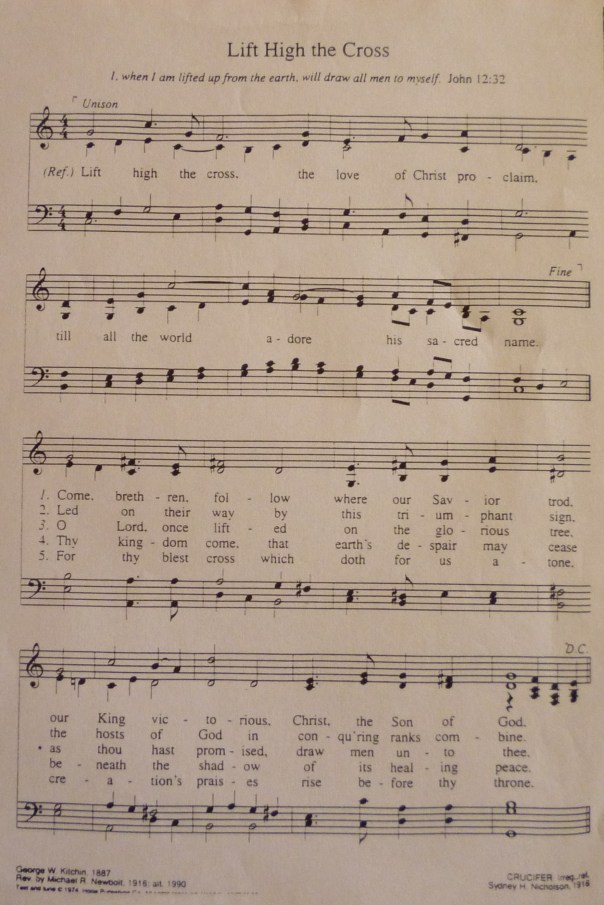
This morning I wasn’t able to attend Liturgy, but as it was the Sunday of the Veneration of the Holy Cross, I was singing the Troparion hymn of the feast to myself as I went about opening the blinds and other movements of greeting the day. (“Oh, God, save Thy people, and bless thine inheritance….”) Gradually, without my fully noticing for a while, the melody of my humming changed to this hymn, which our family learned relatively recently and which has become a favorite of mine. I suppose it’s slightly more appropriate for another Sunday focusing on the Cross, that one in September when we consider The Elevation of the Life-Giving Cross. But it came to me today, so here it is, for your uplifting, too.
My first sweet pea opened on Pascha. At church the roses are abundant, and I’m grateful to be in a temperate area of the Northern Hemisphere where we can be extravagant with our flowers.
Here at home our snowball bush is going all-out for Easter. When he was a boy, Mr. Glad and his sister often had their Easter Sunday photo taken in front of a snowball bush; today I brought some of the blooms in to put on the dining table.
Of course, if we lacked flowers, we would still have eggs to color, and white/bright clothes to wear with our smiles and beaming faces.
I surprised myself with a desire to color eggs this year, but time ran out, and I displayed our small collection of pysanky for the holiday. This red egg is not one of them – I found its picture on the Web.
Another tactile and tasty symbol associated with this week is the loaf of bread called the Artos, about which I wrotelast yearwhen I was for some reason blessed to carry it in the Bright Monday procession.
Today’s Artos
But this morning what most impressed me was the sounds of worship, because our parish had many guests from two other Orthodox parishes in the area, from the Antiochian and Bulgarian patriarchates. Our Orthodox Church in America made the third. Historical events and migrations of peoples have led to the development, over centuries, of these ethnic distinctions between parishes, and we look forward to the day when the situation can be rectified.
In the meantime, we have the opportunity locally to demonstrate our unity and the glorious historicity of our common liturgy by gathering on this brilliant and shining day to pray, and to sing “Christ is risen!” in more languages than I could identify or count, not just in the Arabic, Bulgarian and English of the clergy, but others including Russian, Spanish, German, and of course Greek. Not only the words, but the tones of the hymns and the styles of chant vary quite a bit, and maybe just because it is more exotic, to my ear the Arab-style chant is especially soul-stirring.
This 10-minute YouTube sampler of many styles of Orthodox Easter hymns includes some in English, some with the lyrics displayed on the screen with the icons, and quite a few are of the sort we might typically sing in our parish, but it doesn’t include anything like what I have heard in the Arab churches near here. This one comes the closest to the deep baritone voice and style of the cantor who has often led us in worship as he did this morning. But for today’s congregation of a majority of American-born converts, I was thankful that he sang most of the hymns assigned to him in English.
Truly the Kingdom of Heaven comes to us in the Divine Liturgy, and at Pascha, as is described in the scriptures:
“After this I beheld, and, lo, a great multitude, which no man could number, of all nations, and kindreds, and people, and tongues, stood before the throne, and before the Lamb, clothed with white robes, and palms in their hands; And cried with a loud voice, saying, ‘Salvation to our God which sitteth upon the throne, and unto the Lamb.’”
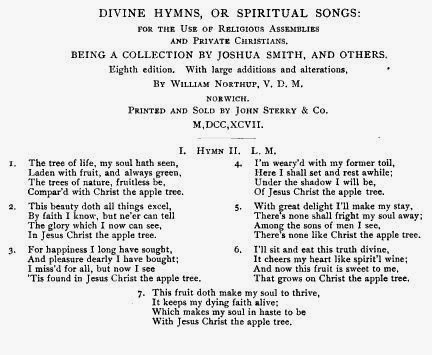
I have just discovered the 18th-century hymn “Jesus Christ the Apple Tree,” on this G.K. Chesterton site., where you can read good meditations on its meaning. It is thought to have been written by a New Englander, and has been set to various tunes. The most common seems to be the one by Elizabeth Poston, of which this video records a nice rendition.
The hymn has become associated with Christmas, and I’d like to add it to our own family’s collection of carols, at least by next Christmas. “Under the shadow I will be, Of Jesus Christ the apple tree. ”


 out, and I displayed our small collection of