Category Archives: music

What Happened at the Symphony

I was moved to tears by the experience of attending the symphony yesterday. As I have little musical training beyond being challenged by the Tonette in third grade, I’m not the one to give a knowledgeable critic’s review. Other than one music appreciation course in college, most of my music listening has been with three-quarters of my brain elsewhere.
Our son’s Japanese violin teacher assured us that even if we dozed during concerts we all would benefit by hearing the music played well, so I have comforted myself with the image of beautiful sounds soaking irresistibly into the consciousness. After my marriage, our house was often full of live music, what with five children and a husband playing guitars, flute, violin and piano. But I was normally in another room stirring the soup or folding laundry.

And concerts were typically not in the budget, though I have to admit that many of the children’s recitals filled me with joy at the expertise of the students, especially toward the end of the lineup when those most advanced at their instruments showed us their stuff. The boys were also able to play in beginning or amateur orchestras. It makes me very happy these days even to hear over the radio one of those pieces from the Suzuki violin repertoire, or a Nocturne that a daughter played. I can’t seem to enjoy classical music the first time I hear a piece, but after it has become familiar I love it dearly.

That’s why I cared so much about going to the symphony last weekend, to hear Brahms; in college when I owned only a few LP’s, a thrift-store album of Brahms symphonies was one of them. We’ve never acquired an updated recording, but I was eager to hear a live rendition of his music.

I also wanted to sit there in the concert hall and listen to whatever was on the program, familiar or not, for the greater chance for participation that it affords. Even when the compositions being performed are not to my liking, the visual component helps to keep me on the edge of my seat. Because I’m not much of an auditory learner, if the sensory input is limited to hearing, as in a recording, it’s really hard for me to assess or even pay close attention to the music, and the fact that I’ve never learned to play an instrument is another hole in my readiness.
But with the orchestra arrayed before me I’m greatly helped to appreciate the amazing work that’s being done. It’s all to the glory of God at the very outset, Who formed each individual in the womb with incredible gifts of intelligence and physical coordination. From there every artist has a unique story about how he struggled to bring his fingers and/or lips into submission to the requirements of the instrument and to the demands of  the musical score.

Speaking of fingers, the conductor had the longest fingers I’ve ever seen. His whole body was long and thin and so flexibly energetic, he threatened to bounce into the floodlights or melt into the sound waves. The timpanist looked like my high school chemistry teacher — well, who knows, perhaps he is a high school teacher. One balding cellist with a bushy ponytail stood out because he jerked his head so emphatically with his bowing, and the flutist who played a solo part exquisitely — thank God for her!

The two Brahms pieces were the 4th Symphony, and the Violin Concerto Opus 77. Though she is famous in the classical music world, Mr. Glad and I hadn’t heard of the violin soloist Elina Vähälä, so we read a little about her online beforehand and even listened to a clip of her playing. Of course, the live performance was thrilling. Certainly I’ve never heard anything more sublime than the sounds from that “Antonio Stradivari violin, built in 1678 and generously loaned by the Finnish Cultural Foundation,” which she played lovingly. She’s a beautiful woman and we were privileged to be there with her in her radiance.

After her performance, Ms. Vähälä came up into the balcony not far from where we sat, to join the audience in enjoyment of the 4th Symphony. I so admire all those regular members of the orchestra and the way they submit their art and skill to the group, and to the composer. They gather in ranks and in humble monochrome to work their magic, making the music emerge and shine in all its brightness, lifting our spirits. Even Brahms and his talent, the story of his life and how God worked in it to bless the world, are in the background.

It all makes me think of lying dreamily in a meadow in springtime. Your mind is filled with contentment and excitement all at once, for the multitude of pleasant sounds and feelings all mixed up and coming in. Gradually and intermittently, you notice individual players, like a particular bird’s song or the scent of the grasses. The sky is blue overhead; clouds with interesting shapes pass by. And yes, you might even sleep. But in the end, you are a richer person for having been there. And you don’t even know how it happened.

Happy over Vegetable Stews

Cooking makes me happy. Having a lot of vegetables to cook up and eat, with extra to freeze, makes me especially content.  B. plays various fun R&B tunes at the computer, and I bounce around the kitchen chopping and singing along with James Taylor or Eva Cassidy, clapping sometimes when I put down the dishtowel or knife on my way to open the fridge or oven.

On the way home through the fertile Central Valley last week I bought some okra, not having a plan for it, and this week I happened to see this recipe for Green Gumbo, which I made with deviations from the letter, but keeping the spirit. How could I go wrong with all those favorite ingredients like kale and okra, sausage and bacon? We ate it on rice as suggested, with corn on the cob alongside.

Summertime gardens always make me want to cook up a pot of Ratatouille, a classic that is not complicated but requires a lot of chopping and mincing. I also had to take time to go out to the garden at the last minute to get the parsley and basil to go with onions, eggplant, peppers, zucchini, garlic and tomatoes. My version mostly stews in the oven.

The picture shows it the first time I stirred the stew, after an hour or so. When I opened the oven and took the lid off the pot, the aroma skipped quickly on the evening breeze across the room to B., who cried out in a swoon. Normally this recipe takes three hours in the oven, but this time it was done in two hours flat; must have been the new convection oven.

Turkish Green Beans come out surprisingly and deliciously intact even though they are cooked in a pressure cooker for 18 minutes. It is probably the generous amount of olive oil that helps them keep their integrity, while tomato, garlic and hot pepper add to the flavor.

I’m sorry to say that the store-bought green beans, young and thin as they always seem to come these days, did not turn out as well as my homegrown pickings. I guess even the additions to the pot can’t overcome the blandness of those wimpy beans. I put half the recipe in the freezer right away, because their flavor and texture are just as nice after being set by frozen for a few months.

Right now I just want to get this post up, so the recipes will have to come later, and also will be included when I create a page on my blog — soon, I hope — where I can link to all of the recipes I’ve ever shared, including these beans and ratatouille. There are a few that I haven’t written down anywhere else, and I need the reference at least for myself, so I can know whether I’ve already written about a particular dish, and also to remember how to make some of them that were sudden inspirations.

Long Doll on the Straw

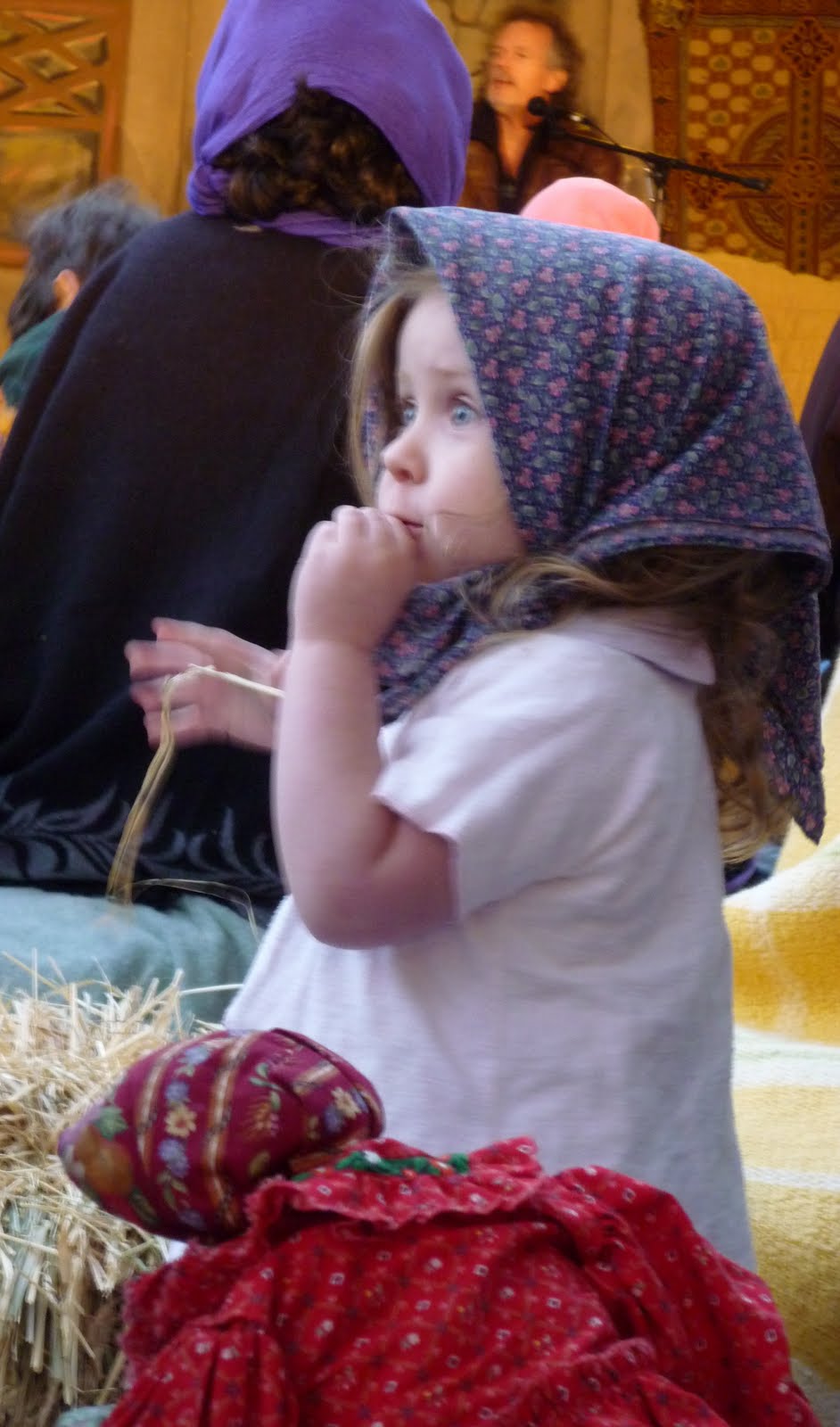
 The latest charming doll lady I saw was at an outdoor event where we sat on straw bales and listened to Patrick Ball play his mesmerizing Celtic harp.

On the row of bales right in front of us was this dolly, alongside her Little Girl and the Girl’s mommy and daddy. I couldn’t decide if she was a gypsy or a babushka, but she made me want to sew a doll and dress her in a flowered skirt and a blouse with full sleeves.

Beyond the Girl in the top picture you can barely see the harpist’s face up on the stage. I never got to see Long Doll’s face.

She was wearing a head covering like many other people that evening, because the wind was blowing through very cold! Yes, even in the Merry Month of May.

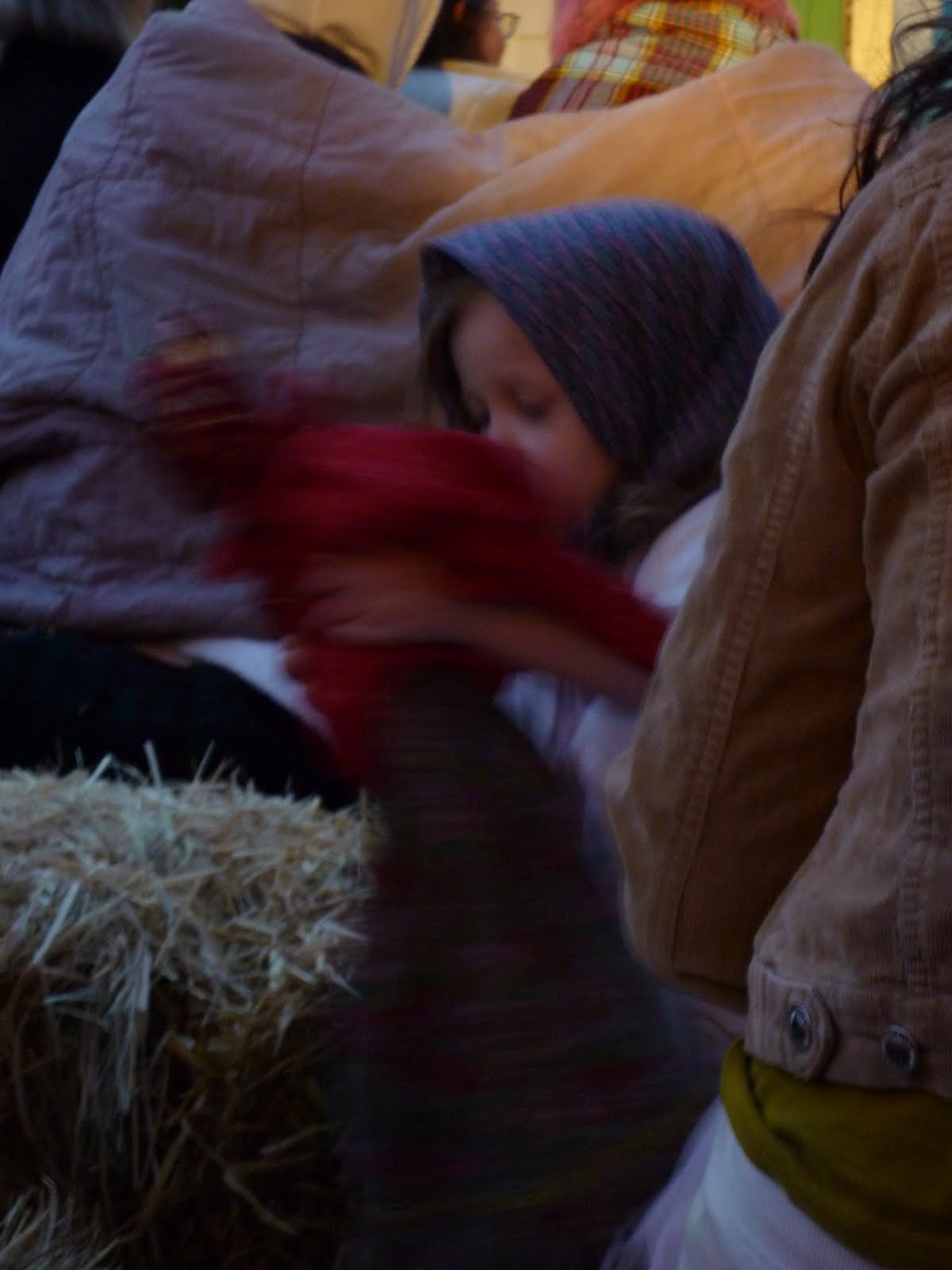
Once the Girl grabbed her doll and I got a blurry shot of her willowiness. But she was right away tossed aside.

Long Doll seems to have fallen right asleep where she landed.

A Lullaby Sound

My definition of lullaby presupposes a woman’s voice, though I will allow for poetic license in lines such as “The rain made a lullaby sound on the roof,” which phrase I’m pretty sure stuck in my mind from reading The Maggie B. a hundred times. But some people must think a lullaby is anything boring enough to make a child flee in desperation to the Land of Nod. That is my conclusion after listening to a recording titled “Lullabies” in the car today.

Before I set off this morning for a long drive, I rummaged through the box of CD’s temporarily in storage during the remodel, and spied two collections of such songs, which made me think, “Why not brush up on your lullaby repertoire?” So I brought them along, and as I was listening to the Lifescapes CD I realized that it was for the first time.

When I had babies in the house, I never thought of playing a recording for them at bedtime. When I borrowed LP’s from the library or bought lullaby songbooks it was so that I might discover a new soothing melody to croon myself. For years Mr. Glad and I would sit on the children’s beds or on the floor at night and sing to them for a long time as they drifted off.

I did know a grandma, long before I was a grandma myself, who played recorded music for her grandchildren in their beds when they came to visit, but at least it was of a woman singing sweetly — though it was admittedly too sweet for my taste. One young mother filled me with dismay, and pity for her children’s impressionable souls, when she complained that she couldn’t get her kids to settle down unless she played the “Christian rock” radio station at nap time.

My own children had their father and me to sing to them, or they had silence, or in the case of one baby, she got to the point where she groused at me when I stood by her crib singing, and when I gave up and left the room, she contentedly babbled herself to sleep.

Some favorite bedtime songs that come to mind, of the family collection, were: the Italian “Nina, Nana, Cocolo Della Mama,” “Swing Low, Sweet Chariot,” “All the Pretty Little Horses,” “Summertime,” “Hush, Little Baby, Don’t Say a Word,” and many Psalms that had been put to folksy tunes by Jesus People. “Trot Along, My Little Pony” was a huge favorite. My most recent acquisition is “A La Na Nita Nana,” which may actually be a Christmas song, but I think babies don’t mind.

I didn’t pick up any new ideas from the Lifescapes anthology. There were many traditional lullabies that I already knew, but bereft of any lyrics, and with minimalist and s-l-o-w string renditions even on “Dance to Your Daddy.” I hit the skip button many times because I couldn’t stand the dragging sensation, kind of like being tranquilized by annoyingly tasteless sweets.

The last fifteen minutes of the CD is pretty much equally divided among non-tunes. Not rain-on-the-roof, but “Running Water,” “Womb,” and “Heartbeat.” Running water I didn’t think was a good idea. It immediately made me think of the bathtub overflowing, and I wondered how was a child eventually to learn to be alarmed at the sound of water trickling in a house? Womb sounds were not so boring, but reminded me of a recording of humpback whales we once had, and whose songs I found more lovely. “Heartbeat” was, of course, tedious to an old woman, whereas it might be comforting to an infant. Perhaps the producers put five minutes of an adult-speed beating heart at the very end, thinking that if nothing else had lulled the baby to sleep after the first tiresome hour, that fundamental lub-dub might do the trick.

It’s likely that these sounds would calm a child, especially if the same recording were played every night. That could be true, though, of many sounds coming from a machine. It seems right to give my children what I myself like and what seems most wholesome. In a real live human voice you can be embraced and loved even after you are in your cradle. If the babies could tell us, I think that is what they would say.