
The second Tuesday after Pascha it is common for Orthodox to visit cemeteries to share the joy of Easter with the departed, just as Christ must have done when he “descended into Hades” first thing after His Resurrection. In our area it is a strong tradition among parishes and monasteries, and I learned to love this trip to the cemeteries early in my life as an Orthodox Christian.
Until this year I had only visited one of the many cemeteries that are included on this day, but now that my own husband lies “newly reposed” in different one, I wanted to go and sing “Christ is risen!” by his grave as well. Priests from two Orthodox churches arrived unintentionally at the same time and led the service right next to the yet unmarked grave of Mr. Glad. You can see the long rectangle where turf was replaced, in the center of this picture.
The cemetery where his body was laid is of the modern “endowed” sort. All of the grounds are kept up by the owners, paid for by the burial fees. This is the same cemetery that I first visited in 2012 and afterward wrote about in A Sleeping Place Is Blessed. Not two years later Mr. Glad realized it would be prudent to buy plots for us there.

Up the road a few miles at the next stop, we were met by Nina who was waiting by the graves of both of her husbands. I saw on the marker that her first husband died when I was still a child. Through the oaks down the hill we could see a third priest praying with two women at one gravesite.
This cemetery is of the old and non-endowed sort, where you are lucky if once a year some community organization chops down the larger weeds. And there is concrete, lots of it, in big broken squares and rectangles of curbs and cracked slabs over and around family groupings. I had forgotten about the hilliness, and about this difficulty of standing and walking on uneven concrete surfaces, an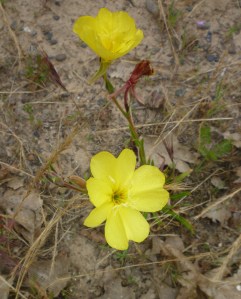 d my ankles began to hurt. Note to self: No Danskos next time.
Besides the concrete, in the unpaved areas there are often foxtails and dust. But flowers grow in the cracks even in drought, and the rockrose that was planted long ago (photo at top) is vigorous. Last year it was really hot on Radonitsa (the Slavic word for this Day of Joy) but today it was cool and drizzly, so our shoes got wet on the lawns.
We didn’t have a big crowd at any of the cemeteries. A different group showed up at each place, with the most people at the third one, including several nuns from a nearby monastery; and women originally from Bulgaria, Ukraine, and Russia, presumably because they are used to doing a similar thing in their countries. Yevhenia, my new friend from Ukraine (that’s a phonetic spelling of how I try to pronounce her name, a form of Eugenia) said that in her country they bring tables and chairs to the cemetery so that they don’t have to rush off, and they picnic on festal foods while they think a while longer about death and God. They like to leave food on the graves, too, for poor people to pick up later on.
When I came home and read again about the Day of Rejoicing, I found that “The Slavs, like many ancient peoples, had a tradition of visiting family members’ graves during the springtime and feasting together with them.” It was an easy custom to continue after their conversion to Christianity, a faith that gave them a truly joyful message to bring along with the food, about Christ’s life-giving death.
 This third cemetery has a smooth endowed section with flat grave markers, down the hill from what is in this picture, and we all trailed over there on the paths between the large square plots, to finish the service near those newer graves. Not far off a group of three people we didn’t know was gathered around a gravesite that was heaped with flowers, one woman obviously weeping.
They watched and listened to us as we faced their direction and sang the Paschal Canon enthusiastically, and when Father walked around censing, and blessing the graves with holy water as he sang, he went as far as their spot and sprinkled water on it, too, just very naturally, but did not interrupt the service. When we finished we went to talk to them; the woman’s mother had died. Maybe the two men were her husband and son. She kept telling us, “Thank you!” through her tears, and we exchanged hugs and repeated greetings of “Christ is risen!”
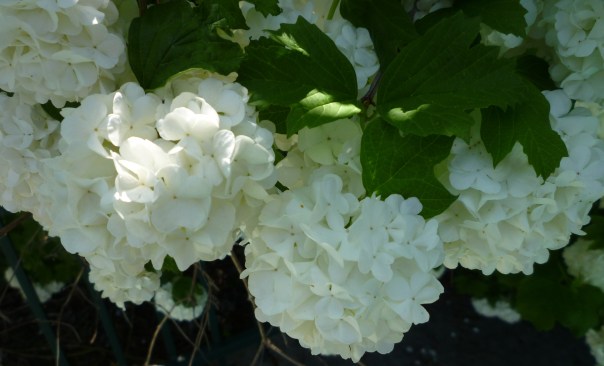
Some of us had colored eggshells left over from Pascha, to sprinkle on the graves. I didn’t have anything like that for Mr. Glad’s grave but a friend shared his with me. I hope to be ready next year, as I’ve conceived a plan, to make use of the blooms of our big snowball bush (viburnum) which are usually at their peak about this time. On the graves of those awaiting the Resurrection, they would be a lovely adornment.
 “We call wild flowers common because of their quantity. But this is just where we strike the great difference between the productions of Nature and the productions of Man. When we produce many samples of the same thing they are of poor quality and we speak of them as mass-produced. The mass productions of Nature do not fail at all in terms of quality. Take the bluebell. There indeed is quantity. Yet every single year we are freshly struck by their quality. Only a flower-snob could fail to see that any one of these bells on the uplifted belfry is as delicate a construction as any tulip or any rose. I will not say more beautiful, or less, for in this realm of flowers we actually are in the presence of abundant examples of — perfection. I think that perfection is the key to the emotion that flowers cause in us. When a thing is perfect the problem of its existence is solved. Gazing at flowers in a wood an unexpected signal seems to go up; we feel a movement of happiness and hope about everything, there is a suggestion that all is really well, all is right with the world….”
 I took a long walk around the neighborhood this morning. If I had brought my camera, I’d have more pictures to post, but then the prayer and exercise benefits of my outing would have been greatly reduced, so I don’t regret not thinking of it.
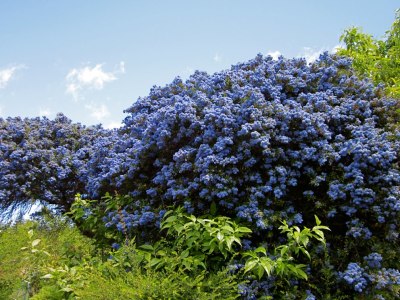
 March is the month of our wedding anniversary, which makes it the month that we have many times made day or weekend trips within northern California to celebrate. Usually some blue bushes are flowering in the places we are visiting, and we are outdoors a lot walking or looking from highway overlooks. Maybe this is one reason that blue flowers have long been my favorite.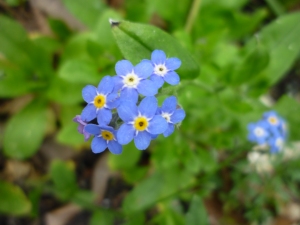
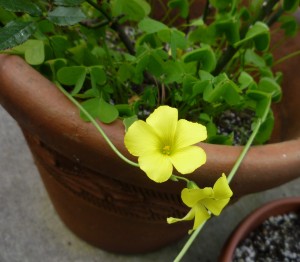
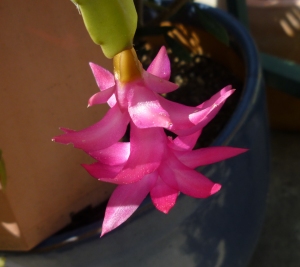 Not a week later I walked past the corner of the utility yard where my poor peaked plant would have gone unseen as usual if its flower buds hadn’t glowingly called up to me, “Look at us!” I was shocked and blessed no end, and quickly moved “her” to a sunny place. Now that my cactus has shown a desire to perform, I am endeared to her in a new way and have named her “Tylda,” after Jerry’s late wife.
 We got a little rain today, but it was pretty much over by early afternoon, and while driving home from an errand I was feasting on the fantastic cloud formations spread all over the sky.
 Several times I did this and out of the batch I kept a few that are sort of interesting, but really, what is a cloud if you can only experience it out of time, flat and tepid and in the still air of another place not its own?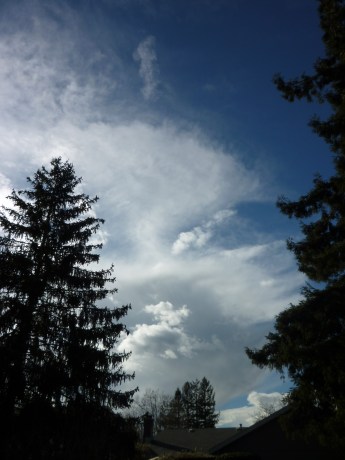

 Resurrection of the Dead I will be transported splendidly to my permanent and eternal and most substantial home.
