Category Archives: nature

blackberry wine and a white fence

At various spots in our town and country I’m sure I smell the blackberries turning to wine on their bushes – even as I am driving down the street or road that particular scent of summer-into-fall invades my car. I’ve never noticed it before…it’s probably all kinds of fruits breaking down into soil and earth and giving out their last sweetness on the way.

The sweet olive is blooming at the same time, and I must say, this is almost too much deliciousness to absorb in one day. I roasted pimientos from the garden last night, to loosen their skins, and that filled the house with…what shall I call it…Old Mexico? If Autumn has its special atmosphere, it must include all these ingredients in the recipe. We haven’t initiated the wood fires, and I’m wondering if I put off generating smoke, maybe I can prolong these other more subtle experiences. But pretty soon — maybe tomorrow?! — I will be shivering too much to care about that aspect of the season’s loveliness.

And there is plenty of visual feasting to do, with various plants making their seeds now, or putting out the last blooms, the flowers seeming even brighter in the slanted light. They are brave to emerge into the cold mornings when any day now they might get cut down by Jack Frost.

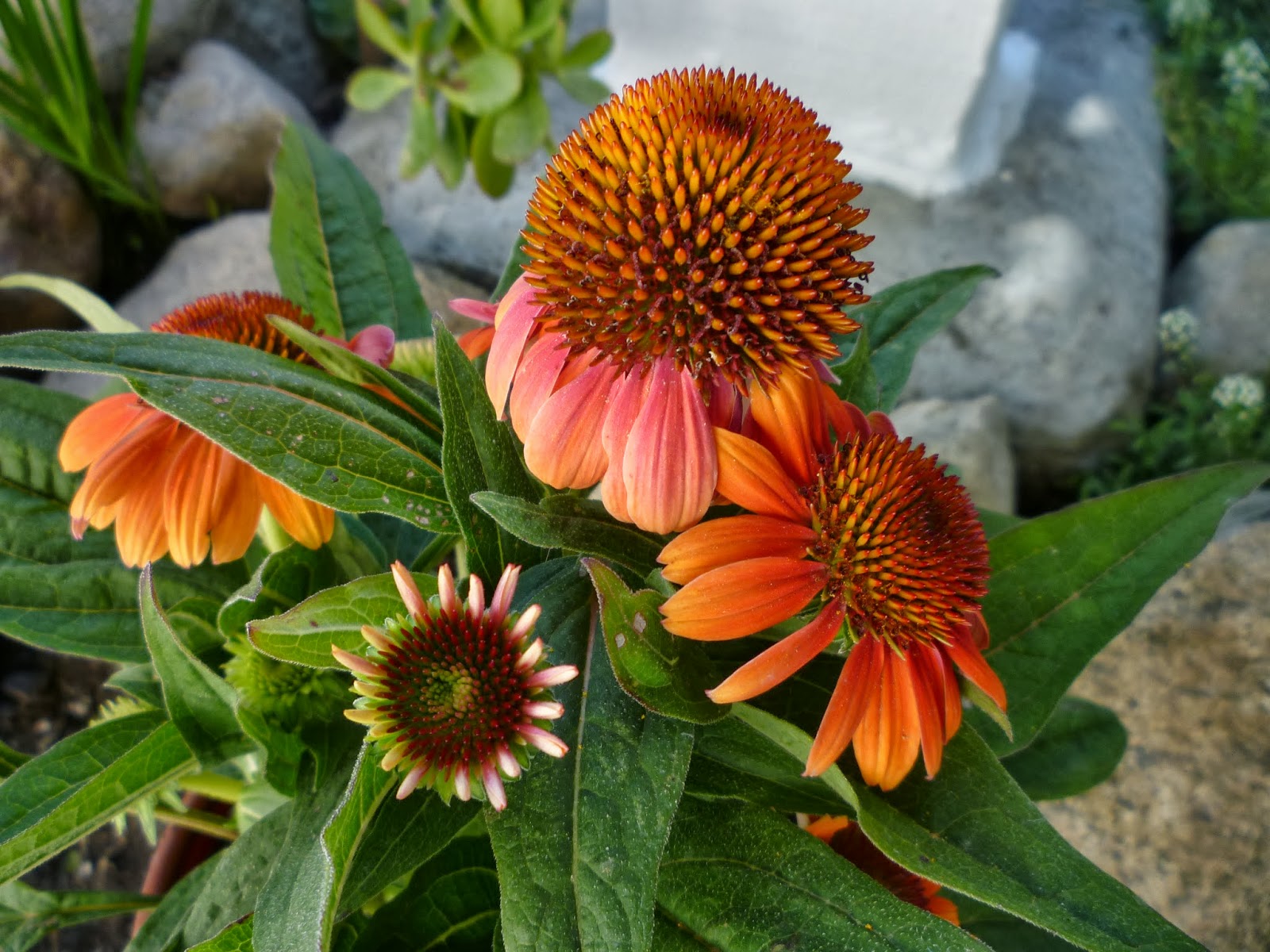
Echinacea Sombrero Hot Coral


October is the best month to plant any kind of peas in our area, and I haven’t had sweet peas in the garden in too long. The excitement of the fall garden is making me feel up to helping the little pea seedlings through the winter, so I went to the nursery to buy some seeds. Look what I found – an Echinacea Sombrero Hot Coral. When Kim at My Field of Dreams found something like this last month I ran to the store to get my own, but found nothing. Is this the name of yours, Kim?

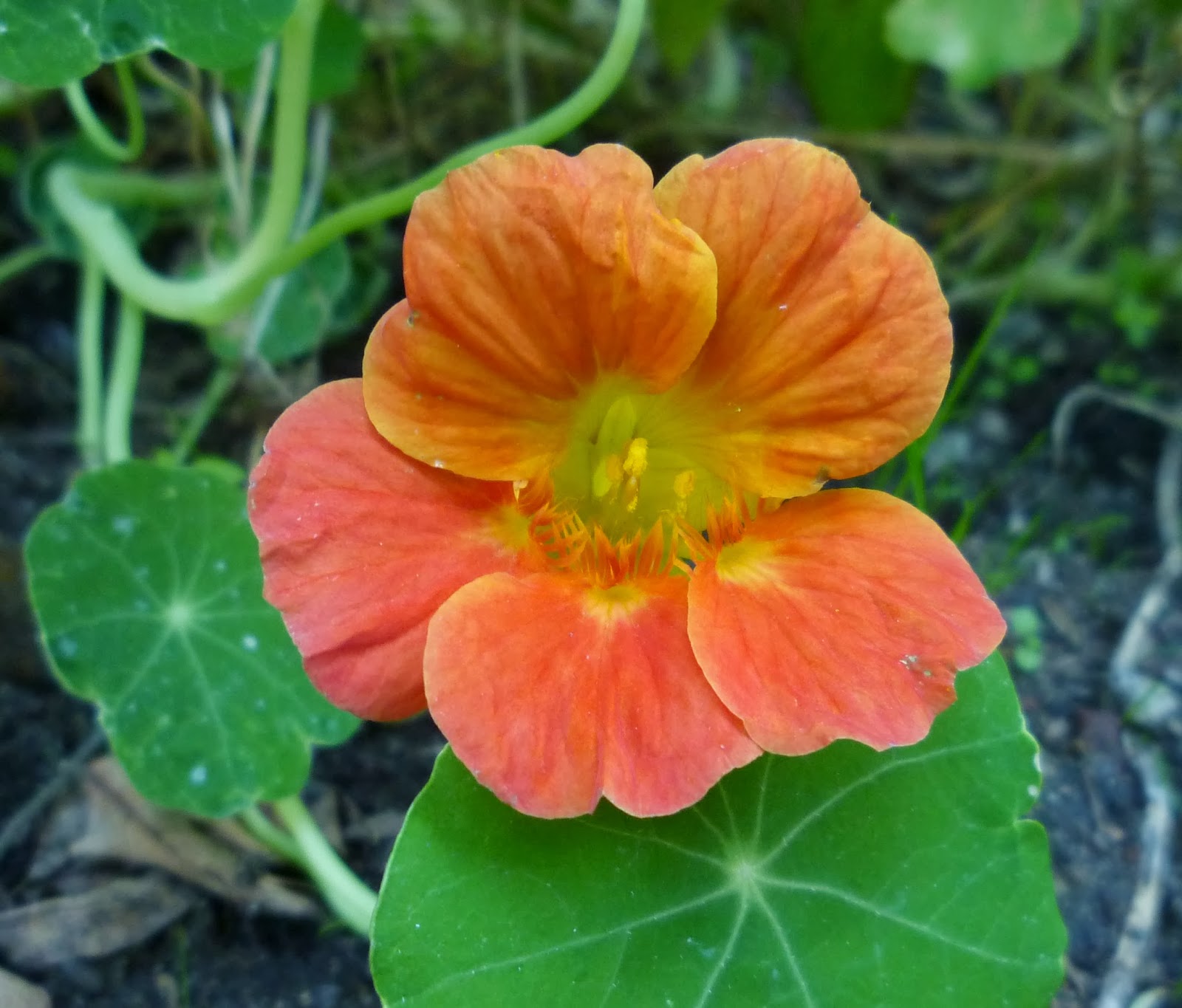
Not all the fall colors are orange. Ground Morning Glory

A few weeks ago we had automatic irrigation installed, in the form of a system of plastic tubes running just under the surface of the ground all over the yard. Little black plastic emitters stick up at various places and cover the soil with a spray of water at whatever time intervals we program into the control panel.

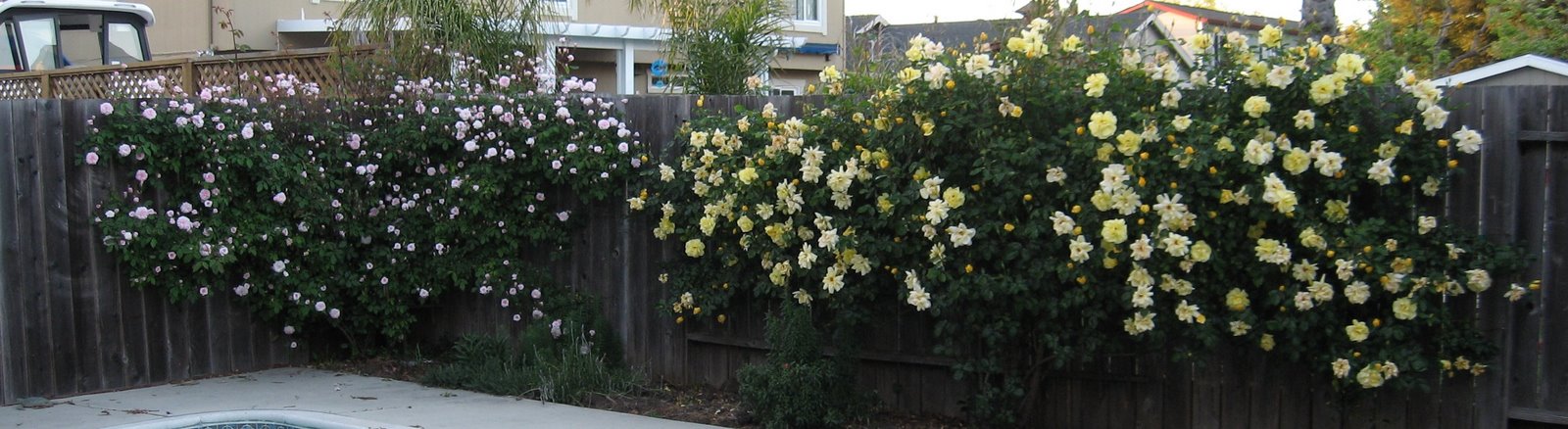
Little fence is in the background near the street.

Not a week had gone by before one emitter very close to the front sidewalk was broken off, so we had the guys return and move that line back a few inches, and Mr. Glad installed pieces of wooden fence with stakes that poke into the ground. The paint was a little thin, so he put another coat over it first. I think it’s cute, and when the plants nearby have grown up bigger the white picket look will complement the foliage and flowers nicely.

This afternoon I’m headed back out to plant that echinacea, and also some stock and snapdragons. I’ll clear the pine needles off the cyclamen and trim the rosemary, and sniff and breathe in all these goodies of my garden.

Bees vs. horrid insects

We have helped our neighbor over the years by pruning her overgrown Asian pear tree, and by picking up the fruit that drops throughout the summer months. Recently she did some of this work herself, and put fifty or so pears into a plastic bag and left it under the tree for a week or two. After a while Mr. Glad couldn’t stand it, and he tried to put the whole lot into the trash, but he found it also contained scads of bees, one of which stung him.

[Correction years later: Those probably were not bees, but syrphid flies; I can’t see any of the images clearly enough to know, this much removed from the event. I didn’t know about syrphids at the time, and even after learning how flies differ from bees, I get them mixed up. But this article has some good information still, so I will leave it up. And maybe it is not a yellow jacket, either, but it is a wasp.]

I saw one of those fruits on the sidewalk with 60% of the inside gone, in the process of being excavated by six honeybees. I was so surprised — I didn’t know they would eat fruit. Another day I took pictures of some of the pears lying on the grass, full of bees, and wasps too.

yellow-jacket wasp on left

The few wasps were spending as much time acting aggressively toward the bees as they were drinking pear juice, trying to be king of the mountain. I thought of what I’d read from The Bee Lady, who recently instructed us about the difference in species. She also let us in on the fact that yellow jackets are carnivores, and they will eat bees. I think that is horrid – as if bees didn’t have enough problems already.

Wasps aren’t bees. Pest removal companies perpetuate the confusion by saying they do “bee removal” when they are talking about both insects. Why can’t they say “Bee and Wasp Removal”? This one has a good chart showing many wasps and bees, even though the company name is not entomologically precise.

To be fair, even wasps do serve a purpose on the earth, as this page points out. I read that one kind of wasp eats black widows, for which I’m sure I must thank the Lord.

wasp and bee getting along in Australia by C. Frank Starmer via Creative Commons

I liked this page, too, that delineates some differences between bumblebees and honeybees. Ants, wasps and bees are related species, but they are different species. I am with The Bee Lady on this one — bees should not have to bear the reproach of their cousins.

Ever since I reviewed all those pictures of the blessing of bees and honey, while telling about the Feast of Transfiguration, my love for bees has grown as has my wonderment at honey and the miracle of it all. I’m even eating more honey, such a beautiful food. Wasps haven’t a clue how to make it.

Mountain Air – Berries

Wikipedia Commons – sambucus mexicana

Last July when we were descending from the lake to the valley, along the road between about 7,000 to 4,000 feet elevation I glimpsed many tall plants with big flower heads resembling the umbrella-shaped blooms of cow-parsnip.

Our driver was of the usual sort who is totally uninterested in suddenly pulling over just because I cry, “Look! Another one of those plants – what do you suppose they are?”

So I just kept straining my eyes and craning my neck as we sped past one after another. And I really wasn’t too disturbed, because I was confident that since I had recently studied various similar plants in the parsley family after our trip to Oregon, I would be able to look in a book or online and find out which species had yellowish blooms of that sort. At home I researched for an hour or more but there was no such plant.

blue elderberry

When I drove up this month I guess I was in too big of a hurry to find what I was looking for, but once again, on the way down the hill some tall bushes got my attention, with their big clusters of berries. I realized after a while that those were the same plants I had seen in July, and I stopped twice at turnouts and walked back to take some pictures.

Once I saw the leaves up close, it was obvious they weren’t in the parsley family. Mr. Glad suggested they might be elderberries, and when I plugged that name into Google I found that indeed they are. In the Sierras three species of elderberries grow. The black elderberry is at higher elevations, and the red elderberry is red, so that leaves this one, the blue elderberry, which grows up to 25′ tall and wide.

It’s always satisfying to come back from a trip with at least one new plant in my mental directory. True, sometimes I only keep them in my blog postings, because they disappear from my recallable memory. In any case, knowing some names makes me feel more friendly with the natural world.

That’s the last I’ll see of that part of the country for a good while. Very soon the cabin will be shut up against the snows of winter in the Sierra Nevada. We pray that this year they will be very heavy!

sambucus mexicana

Mountain Air – Stars and Storms

top of a little fir tree

I’ve mentioned the smoke from the Rim Fire, and the stinging of eyes and throat. It all was a bit distracting. The discomfort made any mental focusing difficult, and one thought kept coming back to me: Will I have to cut my time short and go home? By the second morning, I knew I would be able to stay.

Naturally the stars were still there where I’d left them in July, and I did spend some time with my friends, but not the first night – I was a little altitude sick, and spent. Just give me a good bed, and I’ll leave the window open so the cool mountain air will brush my cheek in the night, gently. The second night I also did not feel great, because of the smoke and the headache it gave me. I could only imagine that the stars were somewhat blocked out anyway.

But – surprise! – I woke at 2:30 in the morning, quite wide awake. It’s not very cold, and I feel good. So I dragged a sleeping pad out onto the deck, shook my sleeping bag (brought just for this purpose) out of its stuff bag, and crawled inside. Hmmm….I am not in the best location; the eaves of the roof are blocking part of the show… so I hauled myself out, moved my bed and scooted back down inside.

I lay there looking up at the Milky Way and noticing again how the tall Lodgepole pines make a kind of ruffled edge to the pool of stars. They also hide some constellations I’d like to have seen, like the Little Dipper. Next I found that the umbrella was cutting into my view, so I rearranged myself and my pallet once more, and then stayed put for an hour and a half. During that time I stared a lot, and saw many shooting stars. Stars appear to be so alive, making the sky coldly electric and exciting with their sparkling. And I felt alive, too.

I tried to go back to sleep out on the deck, which is why I stayed so long. But that didn’t work, so I went back to the bed by the window, from which I could actually see the stars a little.

One reason to make one’s mountain vacation at least four nights long (or should we make that ten?) is so that you can have more possible nights for star-gazing. In the mountains you never know when a thunderstorm will come through for a couple of days, and that’s what happened next. My remaining nights at the cabin were rainy, so I was really thankful that God had awakened me in the wee hours to have my Star Time.

I was sitting on the deck that afternoon, reading or sewing, when I noticed the sky clouding up. I could see that rain was falling in the northeast, and I heard the thunder very loud. Then lightning…but I resisted being driven indoors until an hour or two later when the sky was completely clouded over, and the temperature was dropping.

The kind of fire I’ll build next time.

I had moved inside to the dining table by the picture window when I heard the patter of rain, and looked up to see dark spots appearing on the deck boards…what a blessing to have this Mountain Storm experience! It made me very contented. I thought of building a fire in the massive rock fireplace, but the weather didn’t really call for it; I still had the doors and windows open as the temperature hadn’t dropped that much.

Me sitting by that window in yesteryear

When the rain had stopped, and it was still not dark yet, I went out and stood looking out beyond the deck to the lake. I smelled the earth and the trees — for the first time! I hadn’t even noticed as I was entering the forest on my drive up, or anytime in the first two days, that the mountain air hadn’t pressed its heady aromas on my senses. All I could think was that the smoke had been filling those olfactory spaces until the rain washed things up.

As I looked out and soaked up the quiet, and the moist and piney smell, a small doe picked her way through the rocks and little trees right below the cabin, not aware of me. It’s the first time I’ve seen a deer that close to the house, and I counted it one more gift of the mountains.