Category Archives: nature

Lakes, Waterfalls, and Sky

Eagle Creek

Before I finish the Maui Diary, I have to tell about our outing to Lake Tahoe last week. We were with Mr. and Mrs. C at their cabin, which is a true and rustic cabin with thin walls, so we wore our wool socks and flannel pajamas during the chilly mornings and nights.

Emerald Bay

But midday, on the trail to Eagle Lake, the temperature climbed to about 70° and the sun was hot. The warm air brought out the nutty scent of the cedars and other trees of the forest.

At our destination we ladies stepped into the melted snow of the little lake that is about a mile’s hike above Emerald Bay. Patches of snow were still hugging the shore of the lake all around, and the willows were barely in bud.

Eagle Creek streams out of the lake and flows over falls on its way into the bay. From a lower vantage point we looked out at the little island, the only island in the whole lake. The squarish thing at the very top is the shell of a tea house that was built there in the 1920’s. I’ve never been out to that island or on the lake in a boat.

Fannette Island

When our husbands went to the Nevada side of the lake one day for guy activities, we wives shopped for food and other supplies. Mrs. C found some blue champagne glasses at a thrift store, from which we drank wine the next evening out in the back yard. I sat in a comfy camp chair that laid my head back such that this was my view, of a pine-rimmed sky.

The mini-vacation was soon at an end, and Mr. Glad and I had to say good-bye to our friends and drive back down to the flatlands. But not so fast — we stopped to take another short hike to a place where we might get a good view of Horsetail Falls off Highway 50.

Picture of pussypaws (and lupine) by Pippin, I think

There hadn’t been wildflowers on our walk to Eagle Lake, so I didn’t feel so bad that day about not bringing my camera along. This day I left it in the car again ! and here, where we lost the trail that wandered over vast granite slabs, blooming pussypaws and purplish succulents were growing out of crevices, and red-orange pillows of moss made a splash in the shade of a downed tree. This picture is from another place and time, but I didn’t want to leave anyone wondering what the flower looks like.

We did get a good view of the falls, but my favorite part of this walk was the fields of rock, which I had missed since last summer. It was a satisfying finish to a springtime getaway.

web photo

Maui Diary 6 – Christmas and Fishes

Ornate Butterflyfishes
No, we didn’t go to Maui at Christmastime, but one of the fishes I saw was named the Christmas Wrasse. That got me thinking about how children love Christmas with all its treats and presents and surprises, and how swimming in the ocean in that warm climate and discovering new wonders every moment made me feel like a child.
Orangeband Surgeonfish
Lots of people who are old or achy like to swim because there is no pressure of gravity on the joints, and we can get some exercise without much pain. It seems the salty ocean is even more buoyant; several times I tried hard to dive underwater to get closer to the fish, but I could not. And this water was blissfully mild in temperature…I thought I could swim forever, it was so friendly.
Saddle Wrasse

We didn’t take pictures of the fish, but I was able to find some photos online and am posting the ones that most resemble the particular fish as they were when we met them. I personally saw at least 16 different species on our four expeditions, of which I think my favorite to look at was the Ornate Butterflyfish (photo at top). Three times we rented snorkel equipment, and the last time we just used swim masks.

How free and happy I was, exploring a whole new natural environment. This was nothing like my usual gym pool where I doggedly plow up and back, up and back, watching the clock. It felt like a dream, maybe I was a fish myself, gliding almost effortlessly through the liquid world, gazing down into underwater pools and coral gardens. Sea urchins made splashes of black, blue, and hot pink behind the fish. But no, I wasn’t a fish, because there was the rough sound of my breath going in and out of the snorkel tube. At least the fish didn’t seem to be bothered.

Honolua Bay
It’s a mark of how special the snorkeling experience was generally that I can even remember the less pleasant parts without sadness. Like our visit to Honolua Bay, which on a good day is reported to have the best snorkeling — but it was not a good day. In this photo you can probably see that the water was brown under the surface, but we didn’t want to see that. So on we went!
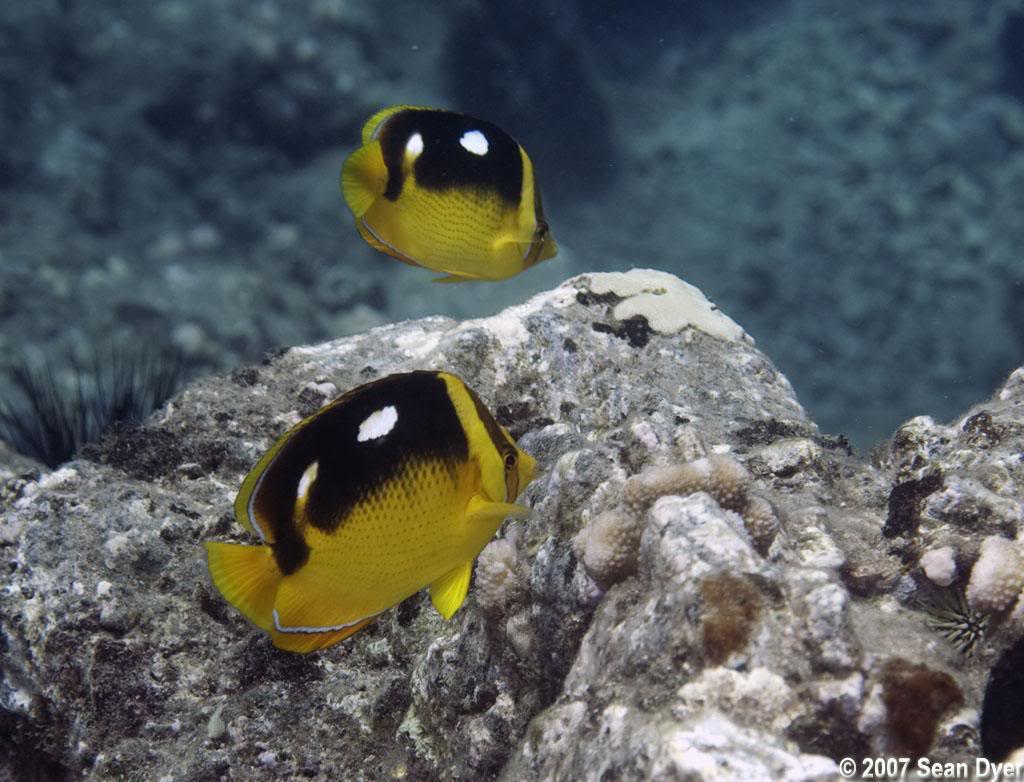
Fourspot Butterflyfishes
The wind was blowing too hard, the water was cloudy, and a lot of gunk in the form of wood chips, twigs and other dirty organic material floated on the surface above the fish hangouts, getting into my hair and under my swimsuit. It was my birthday, so I didn’t feel guilty about asking that we cut that excursion short. Besides, we had already taken up a lot of time picking our way along the rugged shore, looking for a safe place to enter into the bay without getting sloshed against big rocks. Mr. Glad was pretty content to swim back to land, because he had seen a trumpet fish.
Ahihi Cove
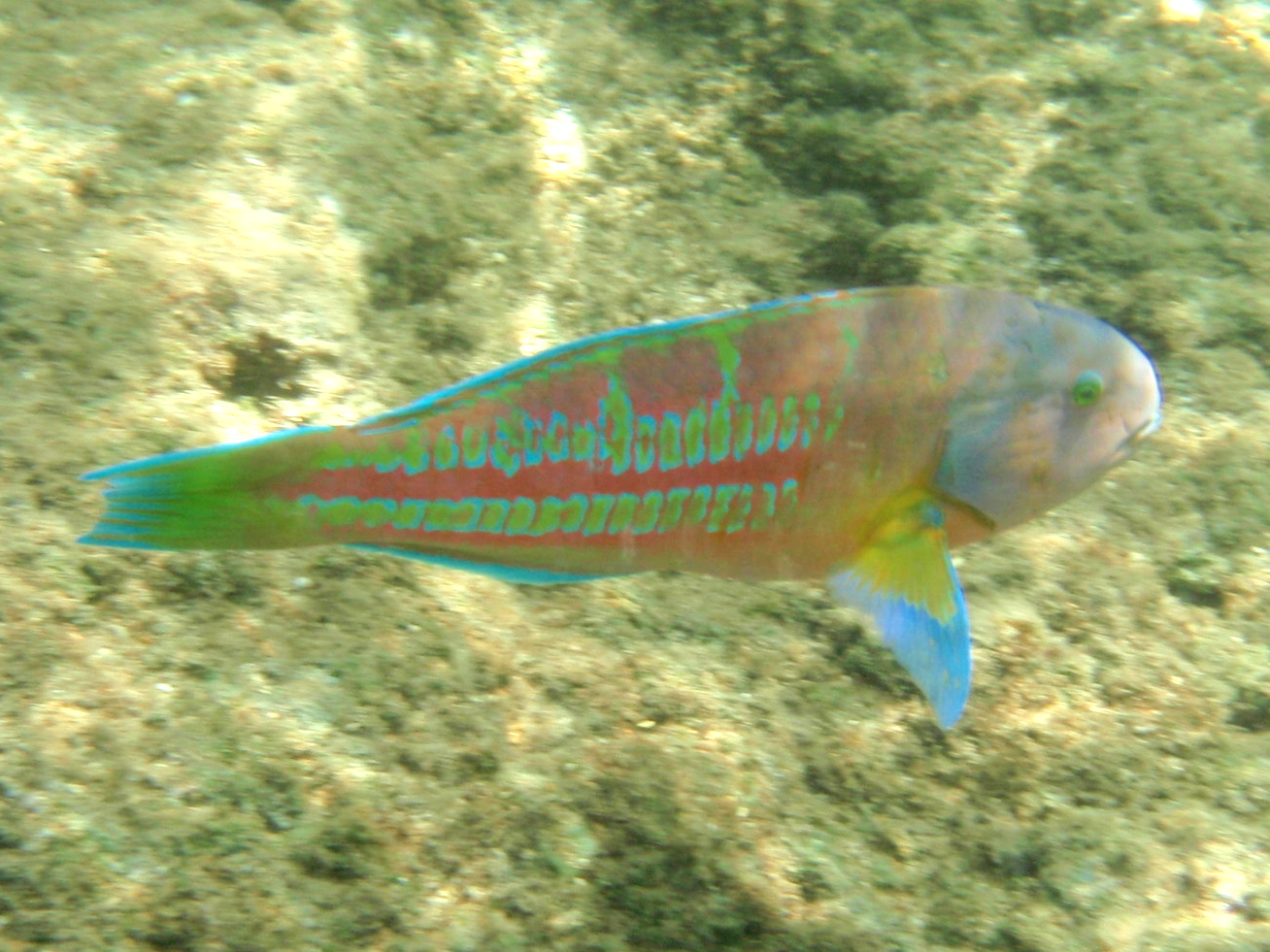
Christmas Wrasse
Our best fish-viewing experiences happened a few days earlier at spots along the South Shore, like the little cove in the picture above.

On our first outing, my first snorkeling ever, we lost track of time at Ulua Beach as we swam marveling back and forth. We managed to stay close together and point, waving our arms at one another when we saw a new fish for the first time — still, when we went back to the condo and looked at pictures we learned that each of us had seen at least one type of fish that the other hadn’t seen.

Several times I found myself in a predicament of tall coral and had to pay more attention to my paddling in order to get out of there without damaging me or the coral. Twice it seemed we were headed back to shore to rest, without discussing it…and then we changed direction and went away from the beach again and back to the coral beds. We didn’t really want to leave yet, I guess.

On one of these sojourns closer to shore I found myself next to a shimmery school of small silver fish that were swimming pretty close to the surface, a thousand of them at least, and I swam toward them, reaching out my hands hoping to touch one. They were like an underwater version of starlings, swiftly breaking into legions, swirling into new groupings and always away so that I could never get into their ranks, but I spent quite a while trying, and they didn’t seem to make much effort to get out of range.

They were some kind of scad, probably Big-eye Scad, and definitely the most fun to swim with. We were like distant cousins getting acquainted on Christmas Day, in a game of water-tag, playing chase for the pure joy of it.

(I’m taking a break from the computer for a few days, so it might be a week before I get the next Maui Diary episode published.)

Maui Diary 4 – Bright Trees and Critters

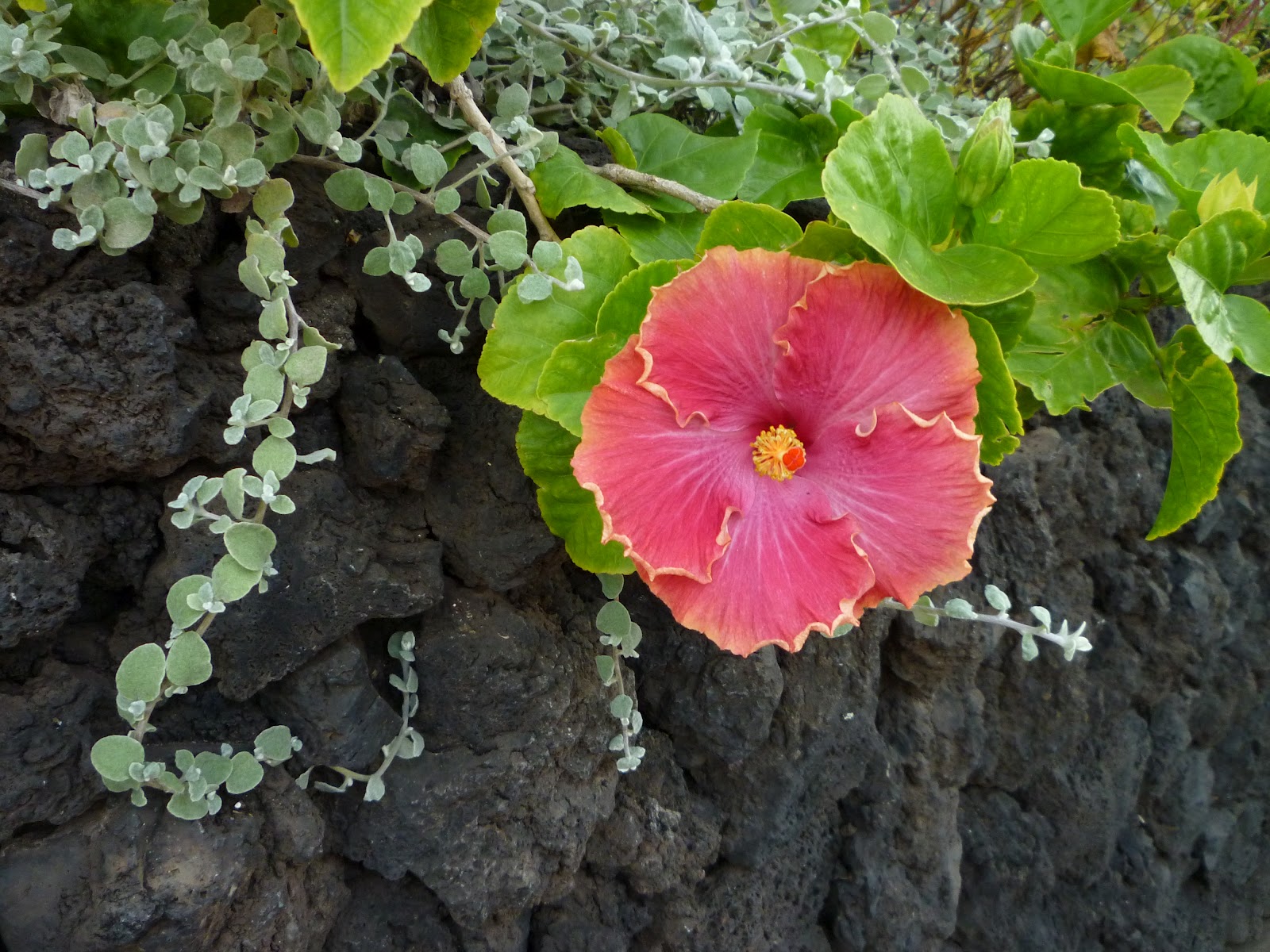
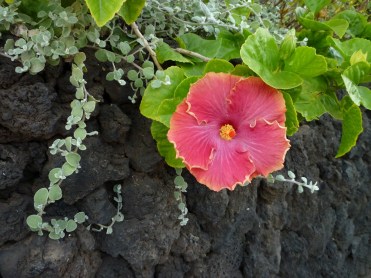
Hibiscus looks nice against volcanic rock.

For most of my life, the image that came to my mind when someone mentioned Hawaii was of beaches, and volcanoes spewing lava into the ocean. Ten years ago or so a friend visited the islands and told me about the beautiful flowers, and at that point I began to be interested.

Reading The Folding Cliffs, about the history of Kauai in a setting that highlighted the lush landscape, took my imagination further along, to the point where I was willing and interested to visit.
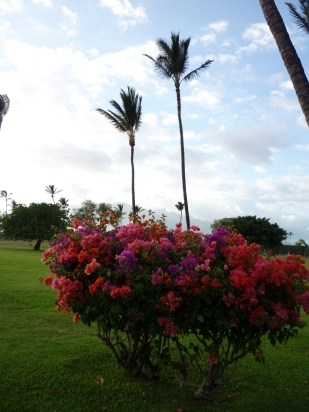
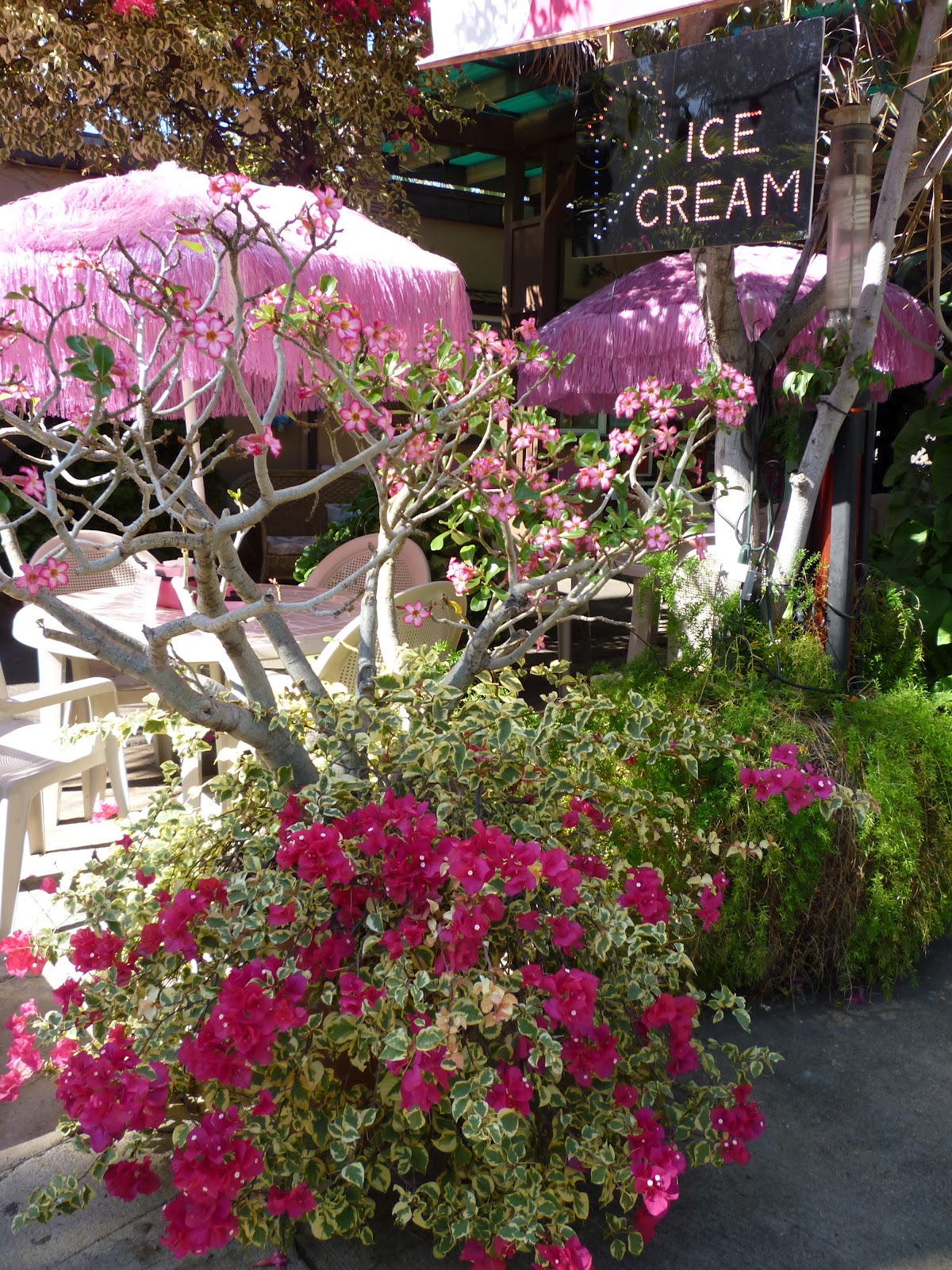
bougainvillea bush

If our stay on Maui had a focus, I would say it was the ocean, based on the amount of time spent, but with the flowers blooming everywhere I turned my head, I came away with my visual sense more than satisfied in that department — it was more than I could take in.

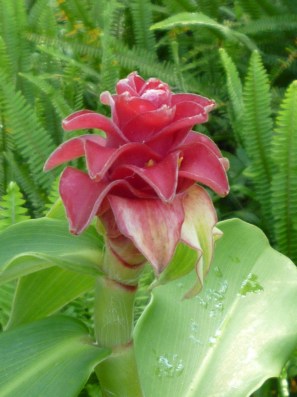
Right out our back door there were spider lilies and red ginger, and multi-colored bougainvillea trained into shrubs. Along the roads hedges of hibiscus or bougainvillea or even more extravagant flowers let us know we were in the tropics.

African Tulip Tree

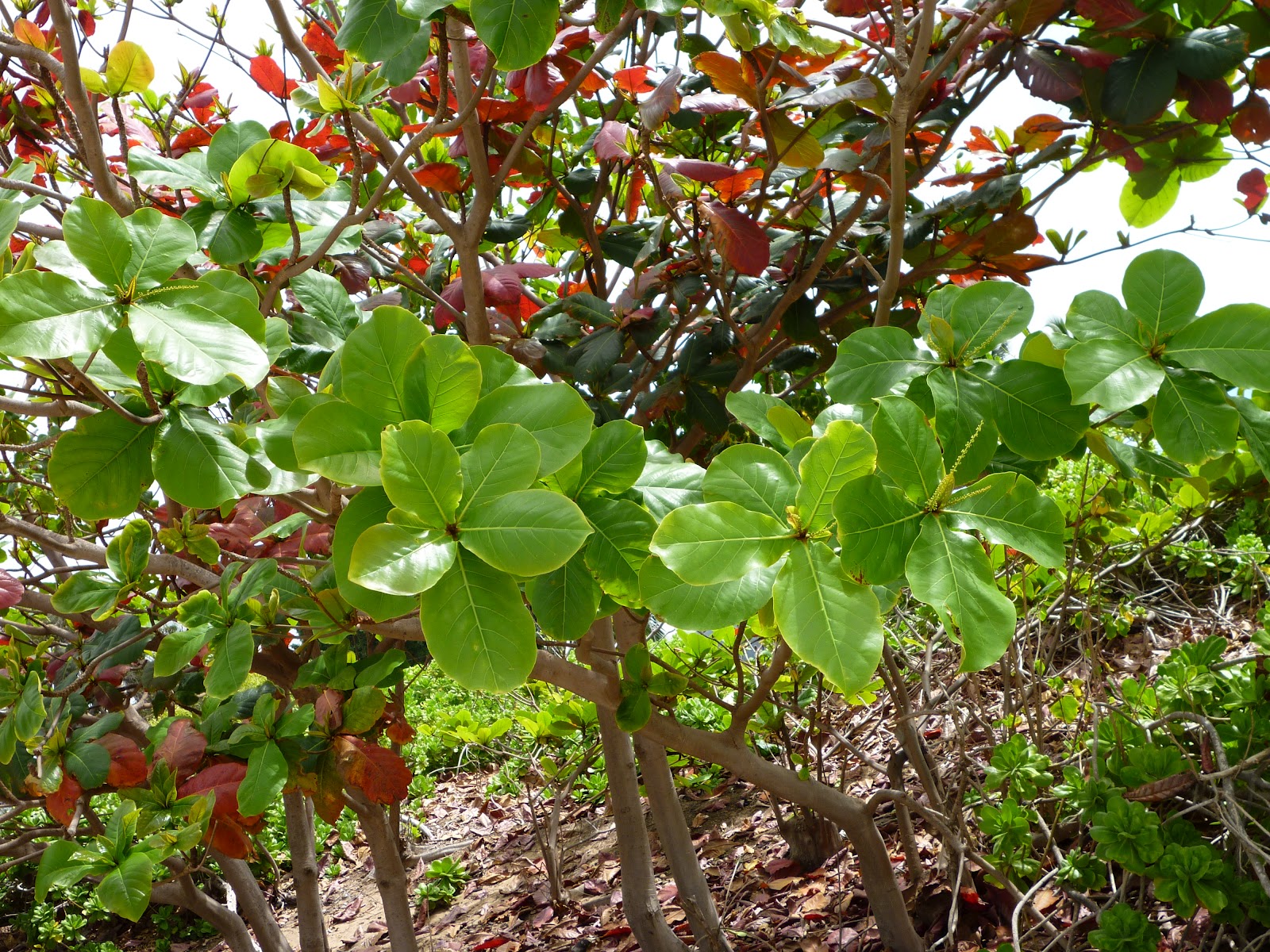
The writer of the plant guide we took to Maui was clearly biased against species that were not native, or that at least had been brought from other Polynesian islands long ago, but I admit to liking many of those plants very much. The African Tulip Tree makes lovely splashes of orange against the green landscape, and it at least doesn’t seem to have spread into the weed category yet.
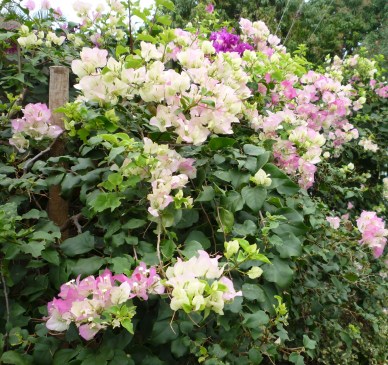
Bougainvillea along roadway

We’d heard reports of wild chickens being found all over Maui, and we were happy to see a lot of them on beaches, along streets, most anywhere. And other beasts who had no doubt escaped from households and barnyards generations ago.

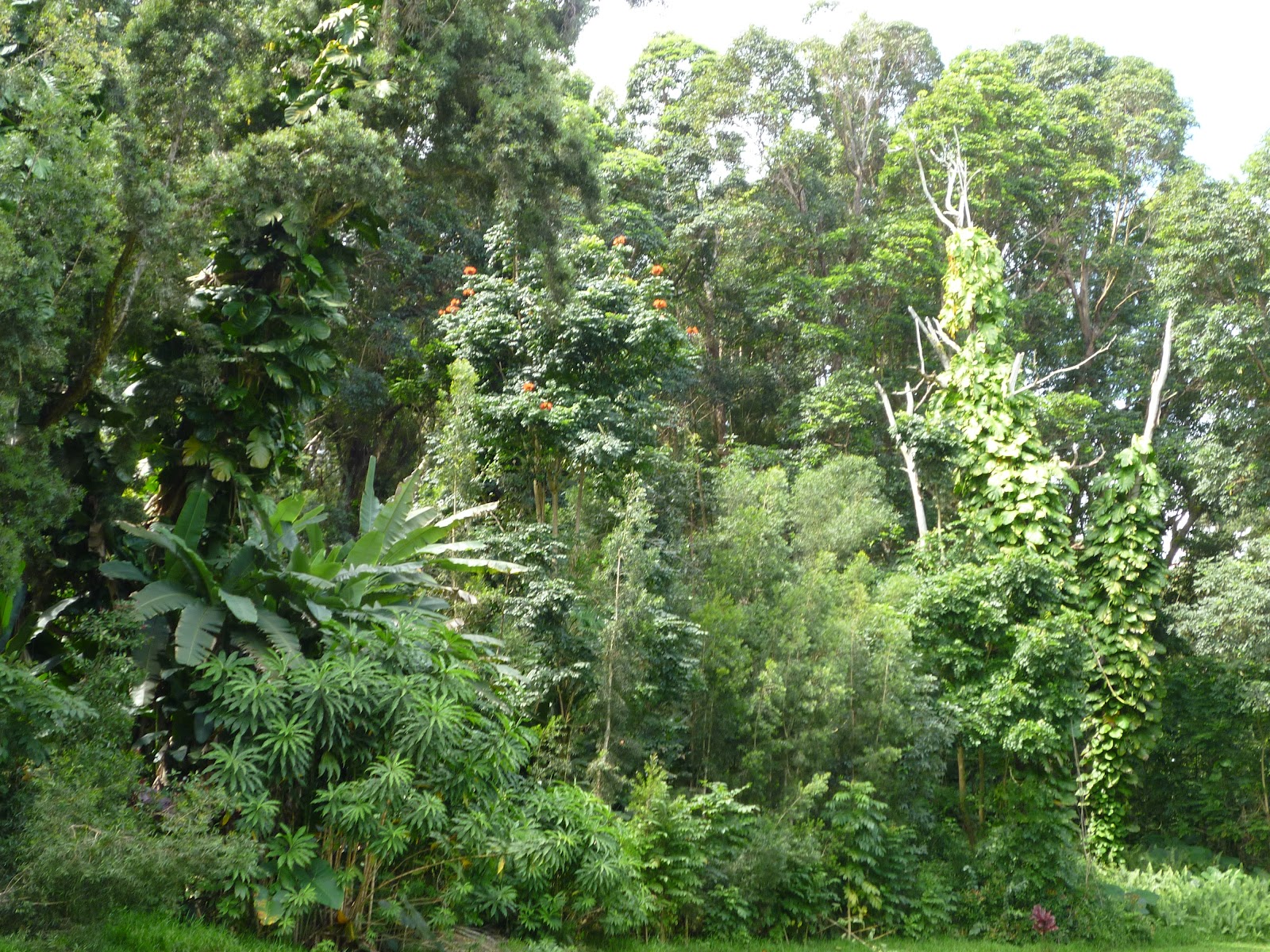
On the drive to Hana we ate our lunch at a wayside park where a green lawn ran up the hill to a tall and thick forest — or perhaps on that rainy stretch it would be called a jungle. I spotted chickens with shiny feathers up there, and walked up to try getting a picture. It was not to be: the closest bird disappeared behind some vines, I followed as quietly as I could and peeked under the trees, to see a couple of cats lounging there with the chickens. It was just a glimpse, and then the whole inter-species family was gone from sight.
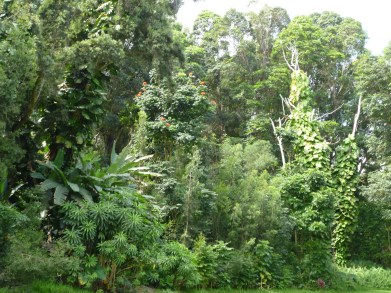
Where I saw cats and chickens

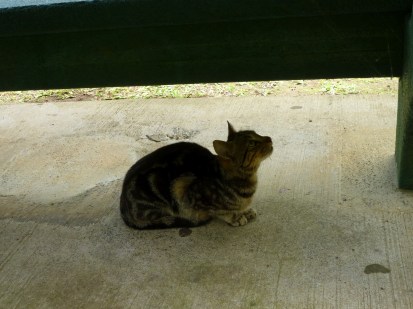
This cat sat patiently under our table while we were picnicking, and waited for us to drop a bite of sandwich. And at Honolua Bay a bright rooster in the middle of the jungle path was engrossed in pecking the meat out of a broken coconut. Many times we saw road signs warning of the approach of a pig or nene crossing. Nenes are the type of goose that is the state bird of Hawaii.

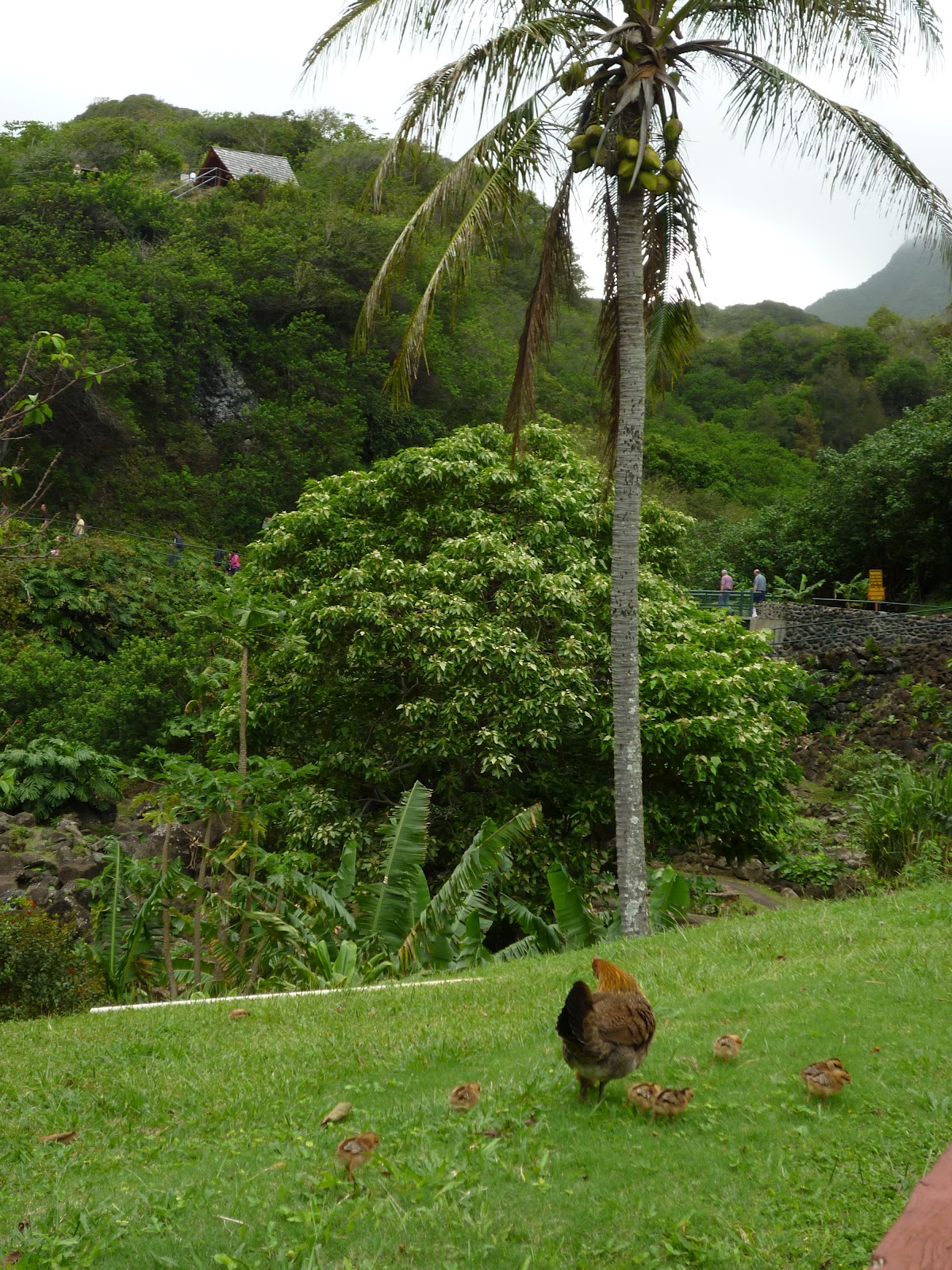
Feral chickens in Iao Valley
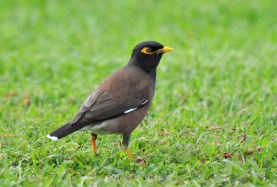
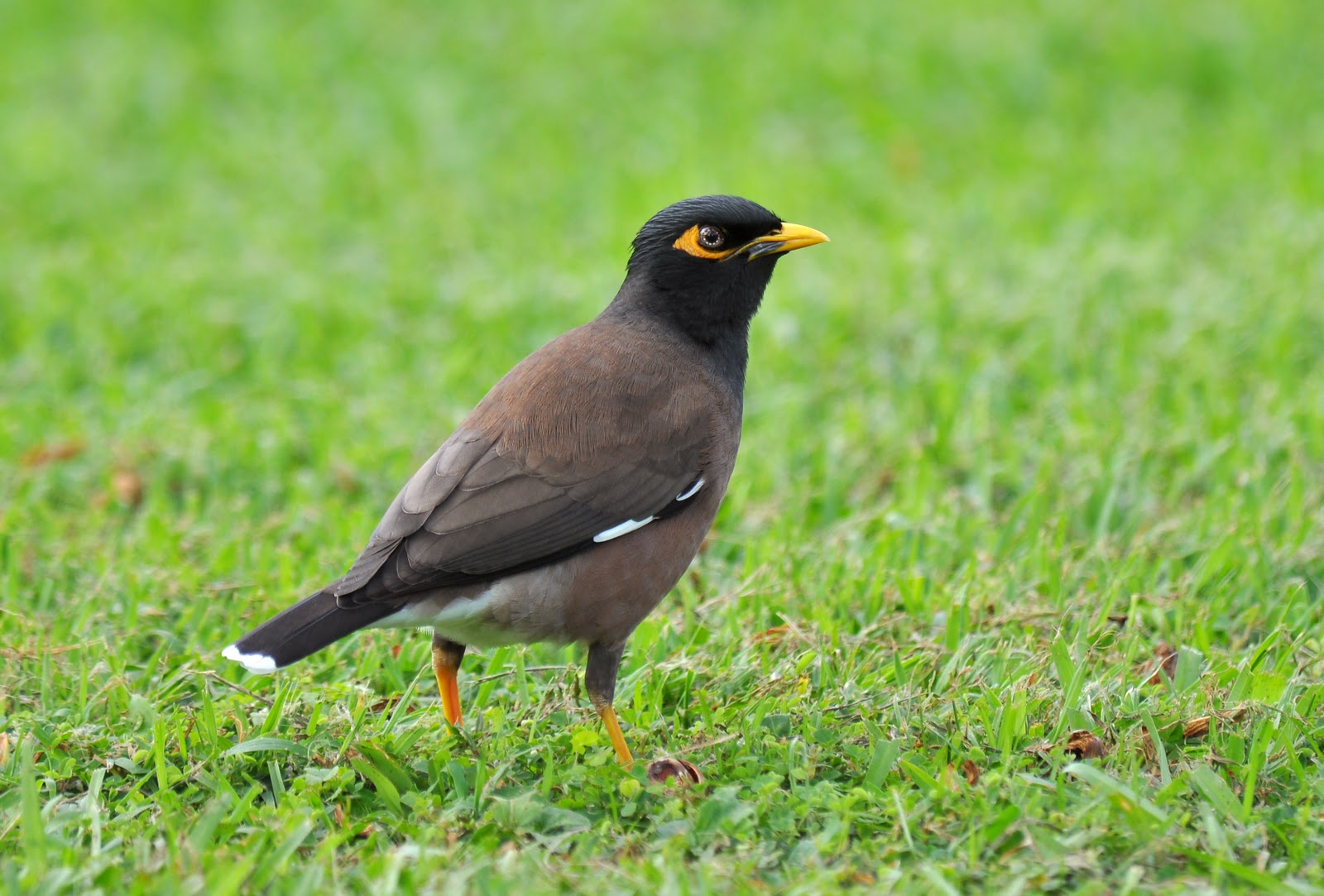
Common Myna

We were on the island for several days before we discovered that the perky bird we saw everywhere is the Common Myna, native to Asia but living all over the world. On a list of the 100 Most Invasive Species, there are only three birds, and the Myna is one of them. Found this picture on the Internet.

My favorite animal sighting was in the Upcountry where there are farms and ranches with jacaranda trees catching your eye with their purple flowers. We drove past a large pasture with a herd of dark cattle grazing on the green, and as many white birds as steers walking around chummily in their midst. I assume that they are what has been sensibly named the Cattle Egret.
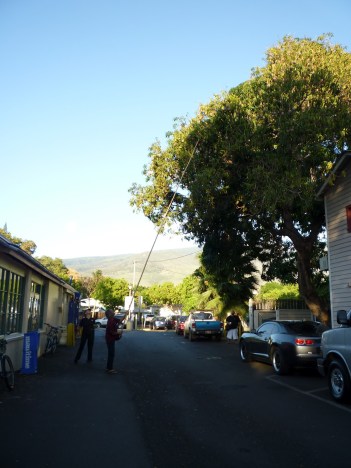
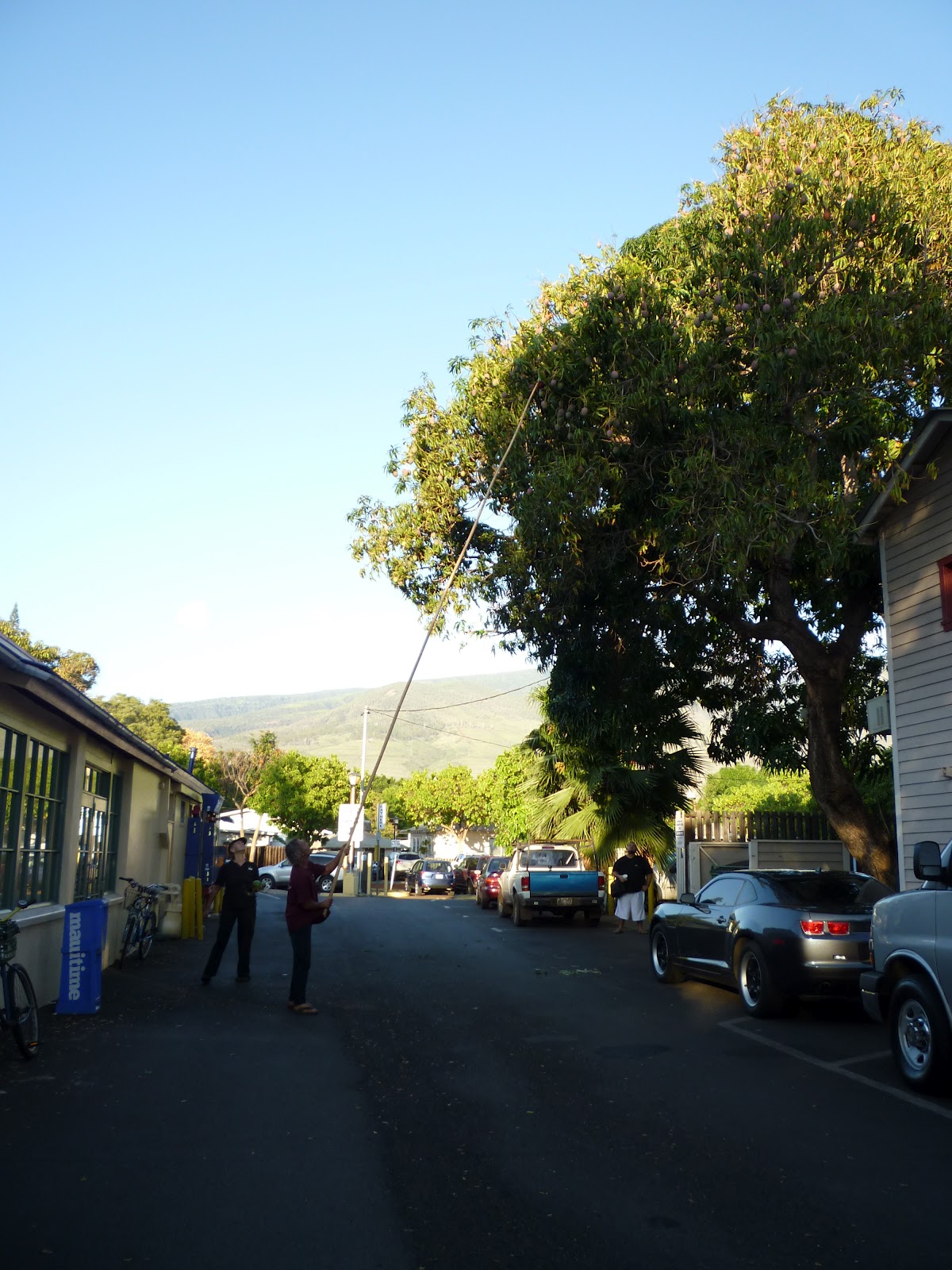
picking mangoes

It seems that a lot of trees bearing flowers or fruits are so tall that it takes some trouble to harvest the crop. I asked the rosette-pinning woman (whom I tell about further down) if pickers use ladders to get the flowers from those tall plumeria trees, and she replied that they “mostly climb” to fetch them. Walking around Lahaina, we saw a man picking mangoes with a long pole contraption, and it’s certain one would need a ladder or good tree-climbing skills to get papayas.
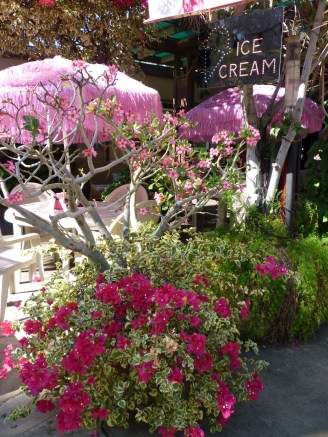
tiny plumeria tree at center


Plumeria! I’m in love with plumeria. I knew of leis, of course, and I’d heard that flower mentioned, but I had to go to Hawaii to see what a plumeria blossom looks like or get intoxicated by its scent. It was a surprise to find that these sweet flowers grow on trees.

I wish I had taken a dozen more pictures of plumeria trees. Many of the taller ones look at first glance as though they are some kind of dead thing, but then you notice the flowers at the tip of every smooth and bare branch.
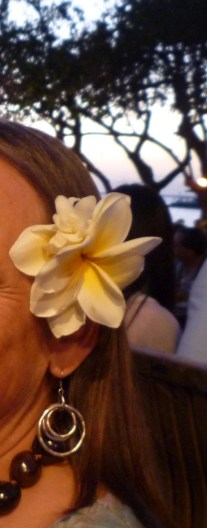
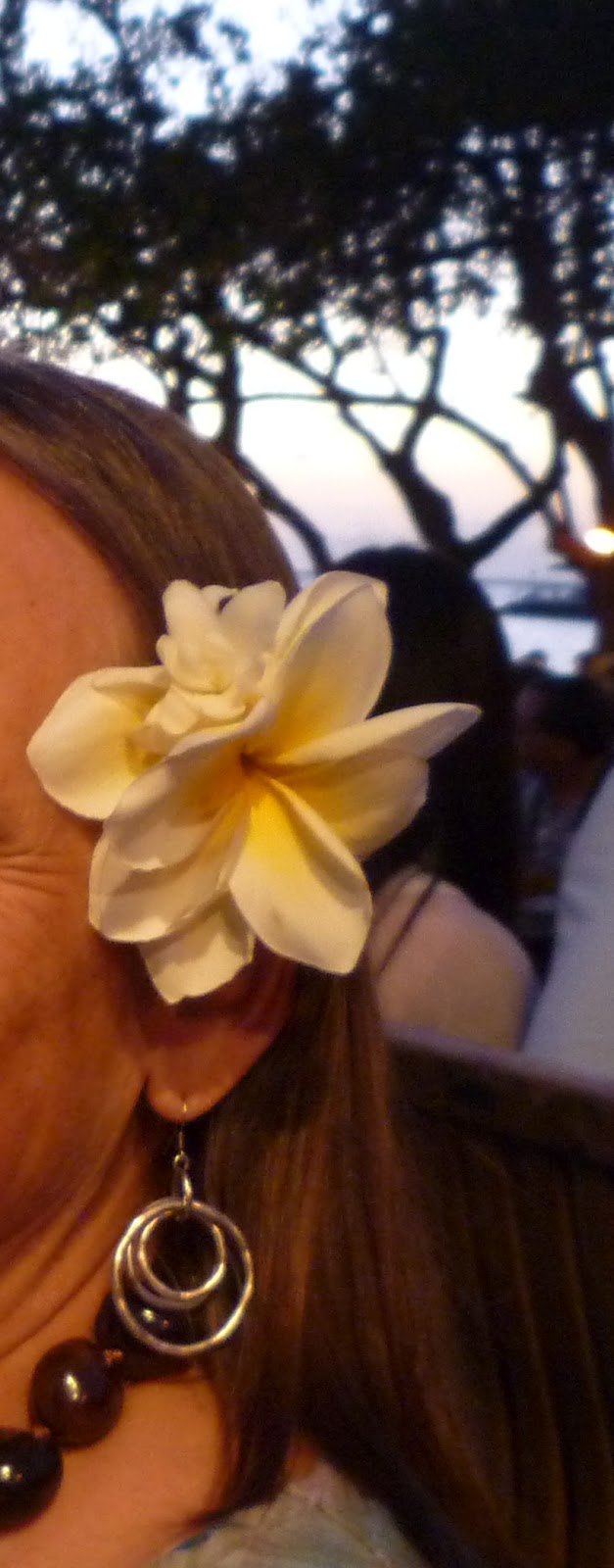
We went to a luau where a girl in Hawaiian dress taught female guests how to stick plumeria flowers on to a toothpick to make a rosette, which she then fastened into our hair with a bobby pin.

When we had first arrived at the luau, I was given a tuberose, which I had been carrying around for a while, so I stuck that on to my toothpick as well, and while our taste buds enjoyed the traditional foods, my nose feasted on the rose and plumeria delicacies. I already have forgotten most of the food I ate, but the memory of my fragrant rosette lives on.

Maui Diary 3 – An Upcountry Garden

King Protea buds

The Kula Botanical Garden is in the part of Maui called Upcountry. It is conveniently located just far enough down the hill from the top of Haleakala Volcano to be warm and out of the wind.

While Mr. Glad dozed on a bench I wandered the paths with my tiny notebook and scribbled the names from whatever markers I could find, of strange plants from all over the world. Gradually I thawed out from the high-elevation freezer experience, and breathed the oxygen-rich air of the thick plantings.


This west side of the volcano is relatively dry, as the rain that blows in from the east stops at the volcano and falls on the other side. This makes the Upcountry an agreeable climate for species from South Africa and Australia, such as the proteas and their relatives the banksias.

This Orange Banksia (above), banksia prionotes, was white and not orange when I took its picture, because the florets on its spike had not fully opened, but I found a close-up on Wikipedia showing the collection of little flowers, called an inflorescence, with not quite all of them opened:

The full opening up of the florets is called anthesis and occurs over several days, spreading from bottom to top.

Some of the plants in the garden were unmarked, and will have to remain anonymous for now, like this red one. [update 2023: it’s Red Ginger Lily] It would have taken me many more hours or days than we had allotted to thoroughly investigate the wealth of God’s creation represented here.

The Paperbark Tree, Melaleuca quinquenervia, is also a native of the Southern Hemisphere, but it has naturalized and can be found all over Hawaii. (In Florida, I read, it is now considered a serious weed.) I found out that there are several types of paperbarks, but they are also called simply melaleucas. Also of this species are the tea trees, from which the tea tree oil that some of us use medicinally is extracted.

Madagascar palm
another banksia


leucospermum catherinae

The proteas were many and varied, and what wild and dramatic plants these are! The one above is Catherine’s Pinwheel.

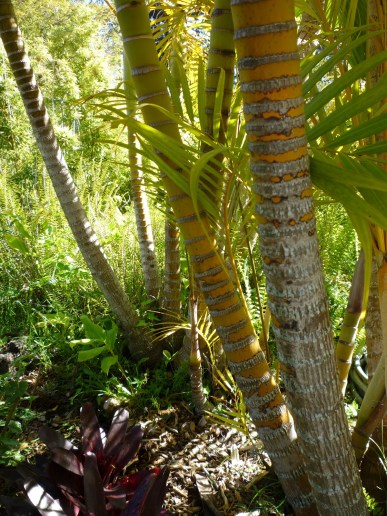
And the trees — my goodness, I was surprised at all the trees on Maui. Did I think that they only grew coconut palms here? This closeup of an Australian tree trunk in the botanical garden was one of the few more intimate looks I got of a tree, because other than at this place we didn’t spend too much time looking at plants.Still, I will have more to say about trees and flowers in another post about this fascinating Mauian world.(Kula Dwellable – for more info)

banksia aemula