“The public interest has shifted from the nature of man to the nature of nature and to the prospects of domination its exploration opened; and the loss of interest even turned to hatred when the nature of man proved to be resistant to the changes dreamed up by intellectuals who want to add the lordship of society and history to the mastery of nature.”
The spacious firmament on high, with all the blue ethereal sky, and spangled heavens, a shining frame, Their great Original proclaim. The unwearied sun from day to day does his Creator’s power display; And publishes to every land the work of an almighty hand.
Soon as the evening shades prevail, the moon takes up the wondrous tale, and nightly to the listening earth repeats the story of her birth; whilst all the stars that round her burn, and all the planets in their turn, confirm the tidings, as they roll and spread the truth from pole to pole.
What though in solemn silence all move round the dark terrestrial ball? What though no real voice nor sound amid their radiant orbs be found? In reason’s ear they all rejoice, and utter forth a glorious voice; for ever singing, as they shine, “The hand that made us is divine.”
-Joseph Addison, 1712 (after Psalm 19)
This psalm, and its poetic rendering by Addison, was C.S. Lewis’s favorite. Why did he love it so much? Because it speaks of the wondrous, shining, singing, rejoicing cosmos, the firmament, the heavens, in the voice of the medieval mind, of which Lewis was an expert — and he thought that vision most beautiful.
In the last few years I’ve reread and re-reread the trilogy of novels by C.S. Lewis originally titled the Space Trilogy. Lewis was never happy with that name for the three books, because of the bleak connotations of the word space. He preferred the medieval vision of the cosmos and the heavens. Lately, lovers of the world that Lewis created in these novels have been calling them the Ransom Trilogy, after the protagonist of all three.
One can read about medieval cosmology in Lewis’s own work, The Discarded Image, which I plan to do. This year my introduction to the mind of Lewis on this topic was through the works of Michael Ward, who is probably the preeminent C.S. Lewis scholar alive today. His beautifully written book, Planet Narnia: The Seven Heavens in the Imagination of C.S. Lewis, has been on my shelf for years, long enough for me to forget about it; to my chagrin I didn’t remember until a few days before our church book group’s discussion of the Ransom Trilogy, but I was able to listen to a shorter presentation of his treatise on Audible, read by the author himself: C.S. Lewis: Christology and Cosmology. You can also read an even briefer summary of it in this article in Touchstone Magazine: “Narnia’s Secret.”
I am just a beginner in all of this, as far as it being an academic subject, and I don’t have the time or understanding to say any more about it. For now, I just wanted to share this psalm-poem, which Michael Ward puts on the very first page of his book. Because I also love the heavens and their divine message.
Today my friend Cindy and I drove out to the beach, a birthday outing for her. It was about 60 degrees, which was truly fine when the sun came out; there wasn’t much wind. While Cindy lay under a driftwood teepee, I took a brisk walk down the beach a ways, trying to exercise my feet in the squishy sand right where the wave has just receded.
Washed up by the surf I saw several by-the-wind Sailors, Velella velella. It’s hard not to notice their brilliant blue. I had heard a couple of months ago that people were seeing thousands of them on California beaches this year, which is unusual. This one was about two inches long.
The only stop we made for wildflower appreciation was on the way home, and it wasn’t for flowers at all, but for grass. Stands of pink grass waved in the breeze a the edge of the road; I discovered it is common velvetgrass, holcus lanatus. I think this is the first time my Seek app has been able to tell me anything about grasses; maybe it has truly been adding to its knowledge base. After all, one often does get the message that “Seek doesn’t know what this is. We are still learning!”
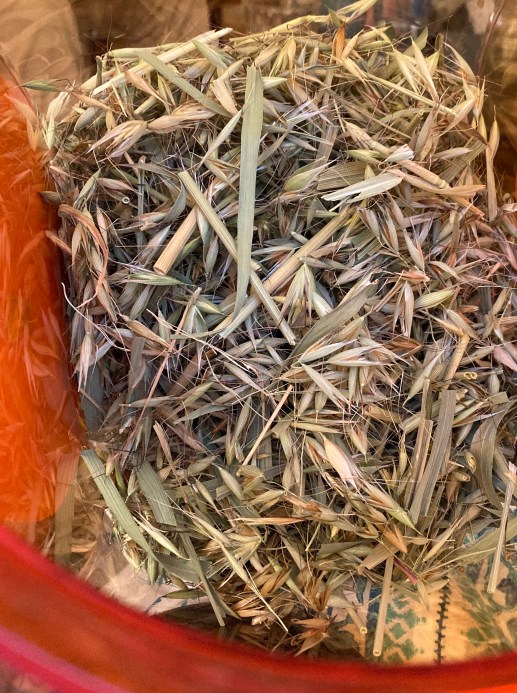
Recently I was offered a cup of tea at a friend’s house, and it was the most delicious drink, toasty and sweet, like nothing I’d ever tasted before. When my host came back into the room I asked her, and she said it was an infusion of wild oats — she had gathered them from nearby fields, and dried them. She showed me her stash, which she keeps in a big pretzel jar:
Just now I read more about this plant, a native perennial called California Wild Oat Grass, Danthonia californica. I was surprised to learn that it is recommended for growing domestically: “In home yard use, this grass gives a lowland meadow look or grows well in a rock garden.”
I don’t think my garden has the meadow look that would provide context for this native grass, but it is nice to think that other people might take advantage of its good features, and maybe drink its flowers, as I did. For now, my own interest lies almost entirely in trying to learn about more of the many grasses that live in northern California. I’ll be sure to let you know if I do.
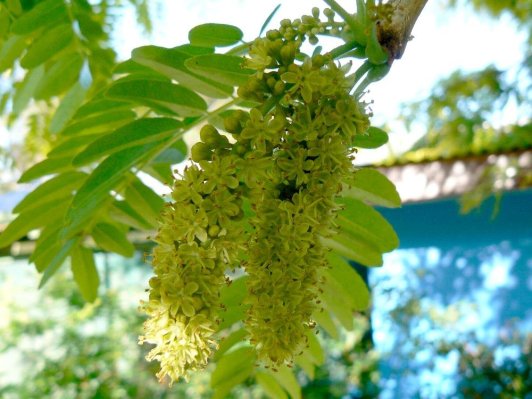
So far I myself have only encountered the black locust tree, and I understand that its pods are toxic. I think the flowers smell pretty nice, but I read today that they are blah, compared to the honey locust. I hope I will one day meet those honey flowers, too (the picture below I found online), but this poem is about more than just one delicious species.
HONEY LOCUST
Who can tell how lovely in June is the ….honey locust tree, or why a tree should be so sweet and live ….in this world? Each white blossom on a dangle of white flowers holds one green seed– ….a new life. Also each blossom on a dangle of flower holds a flask of fragrance called Heaven, which is never sealed. ….The bees circle the tree and dive into it. They are crazy with gratitude. They are working like farmers. They are as ….happy as saints. After awhile the flowers begin to wilt and drop down into the grass. Welcome ….shines in the grass.
…………………………………….Every year I gather handfuls of blossoms and eat of their mealiness; the honey ….melts in my mouth, the seeds make me strong, both when they are crisp and ripe, and even at the end ….when their petals have turned dully yellow.
…………………………………………………………………..So it is if the heart has devoted itself to love, there is ….not a single inch of emptiness. Gladness gleams all the way to the grave.
 This psalm, and its poetic rendering by Addison, was C.S. Lewis’s favorite. Why did he love it so much? Because it speaks of the wondrous, shining, singing, rejoicing cosmos, the firmament, the heavens, in the voice of the medieval mind, of which Lewis was an expert — and he thought that vision most beautiful.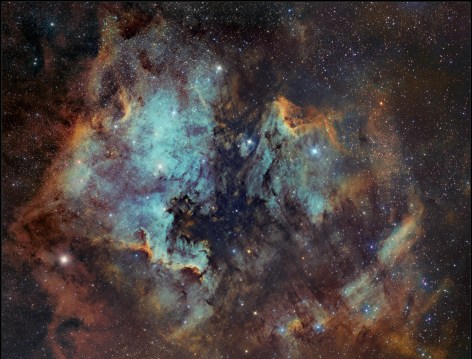
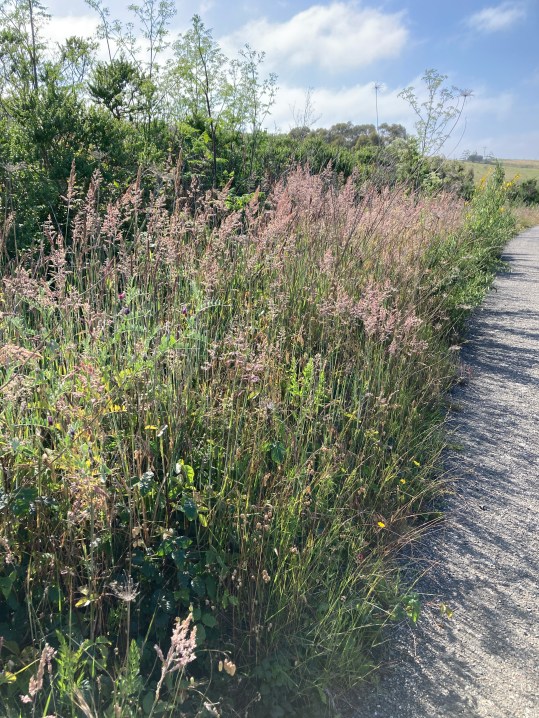

 The only stop we made for wildflower appreciation was on the way home, and it wasn’t for flowers at all, but for grass. Stands of pink grass waved in the breeze a the edge of the road; I discovered it is common velvetgrass, holcus lanatus. I think this is the first time my Seek app has been able to tell me anything about grasses; maybe it has truly been adding to its knowledge base. After all, one often does get the message that “Seek doesn’t know what this is. We are still learning!”