I wondered why I hadn’t seen any goldfinches on the feeder lately. It hasn’t been pouring rain all the time, and a couple of weeks ago they liked feeding even during showers. The weather has been mostly a big cloud, and then added to that, I have personally been Under the Weather. When I came out from under, and the sun also came out, I explored my estate this morning and discovered that the nyger seed has become sprout soup.
tarragon
The Christmas cactus missed Christmas, being shut up in the dark greenhouse. Now it is blooming, and frosty weather isn’t imminent, so I took it out where I can see it from my kitchen window. The tarragon is growing well in that greenhouse, though.
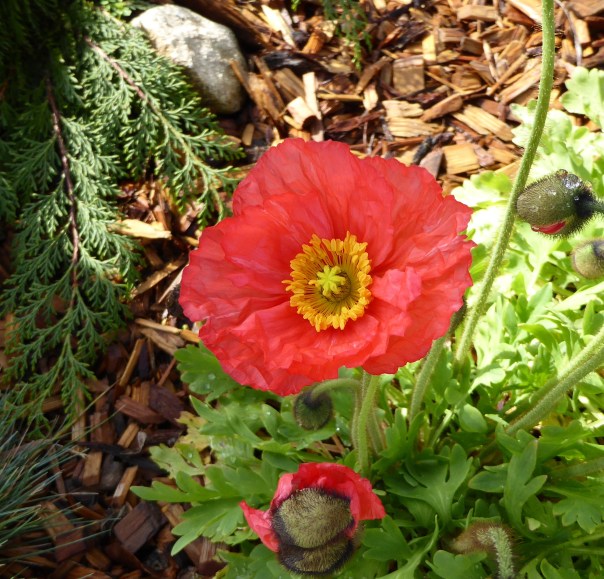
How many pictures of poppies can I post here before my readers start to rebel? How would you show your ennui? Probably you all are too kind to say anything. It’s really not that easy to get a good picture of an Iceland poppy; there is just a moment when the delicate petals are fresh and new, and the sun is not too bright. Yellow flowers are almost always too bright even without the sun. They blooms can’t be too wet, or they hang their heads soggily. This one was the morning’s gift.
It seems to be a modern rite of spring for those of us lucky enough to have snowdrops in our gardens, to take pictures of the lovely things to share online. My snowdrops are not as showy as some, but they are sweet. [Update: I learned from a commenter that these are not true snowdrops!]
I don’t enjoy them enough. They start blooming in January — I see them from afar out the kitchen window, just little white spots on the landscape, inconveniently located under the manzanita. Sometimes I delay venturing out into the weather to stoop down close, until the first blooms are starting to fade.
I read that it has been a tradition in Ireland not to bring them into the house until St. Brigid’s Day, and maybe I thought that I could also wait that long.
But most of mine are fading by the first of February. This morning when I saw pictures of two different snowdrop variations on blogs, I wondered if I could find just a couple of newish flowers on mine, and I did find more than that. Now they are on my windowsill in a place of honor, blessing the kitchen.
Update: It has come to my attention that these dear flowers are not called snowdrops, but snowflakes. They are in the same tribe as the snowdrops – or maybe not! It depends on which Wikipedia page I look at. Anyway, they are called Leucojum and snowdrops are Galanthus. And now I’m even more determined to get some Galanthus to plant next fall!
More than one of my readers has asked if I live near the potential flooding from the Oroville Dam spillway failure here in Northern California. [Update: Here is a place you can see videos of the scary action http://kron4.com/] I do not. But when I was a babe-in-arms my family lived in the county just south, and I started this post thinking I would paste in a photo — which I can’t find after all — of my mother cradling her swaddled first child as she stands in front of our house in water up to her hips.
It wasn’t the last time my poor parents had to deal with floodwaters and babies at the same time, living as they did in farmland fed by various rivers that had not yet been dammed or hedged out with levees. I’m thankful to say that as an adult, the floods I have known have not caused any personal property damage or even much inconvenience.
The abundant rain made January of 2017 less depressing than average for that dark and cold month of the year. It looks likely that my town will have received 40 inches for the season-to-date before the end of the week. Usually we get 20+ inches. When it rains the air is cleared of pollutants and the burn restrictions are lifted – so we had lots of wood fires which are always cheering!
Christmas joy and lightness always carry me through Theophany on January 6th, but then I have the reality of a Christmas tree that needs taking down eventually. I strained my shoulder slightly a few weeks ago, which slowed me down, but it gave me time to read five books in just the first month of the year, often sitting in front of that woodstove. I started drinking coffee, which is a mood-elevator for sure… and now suddenly, it’s February, and the weather has been 20 degrees milder.
manzanita
Flocks of goldfinches and juncos have returned to the garden, swooping down from the bare branches of the snowball bush. The juncos peck around on the ground, and the finches hang all over the nyger seed feeder, even in the rain.
And flowers are coming on dear Margarita Manzanita, buds on the currant bushes and calla lilies. I went out and took pictures just now under the umbrella, so everything is too wet to be optimal, revealing how one of my asparagus beds is less than optimal – we didn’t dig down deep enough into the adobe clay, and now there is standing water. That may not portend good for the future of that planting.
I made several gallons total of various soups in January, including Barley Buttermilk Soup, which I decided to try incorporating into bread yesterday. Here you have it, Barley Buttermilk Bread. It was enough dough that I ought to have made three loaves of it, but what I did was bake one oval loaf on my pizza stone, with butter brushed on top toward the end, and a round one in the Dutch oven. I added some oat flour which made it soft, but by this morning its crumb is very nice, and I like it very much… even too much.
It’s been a long time since I had eggs from hens who ate lots of greens. My fellow communion bread-baker James brought some pale blue-green eggs from his Americaunas to our last baking session, and I was the lucky one to take them home, just as he had brought them, in the bottom of a paper shopping bag. They are so wonderfully orange-yolked, I had to take their picture, too. They go well with Barley-Buttermilk Bread. 🙂
Every week the peas and the poppies have been beaten down by the rain…
But they keep growing and blooming. Overall, they appear to thrive in it. I am reminded of this verse from the hymn “O Worship the King,” which likens God’s provision for us generally to the moisture that falls.
Thy bountiful care, what tongue can recite? It breathes in the air, it shines in the light; It streams from the hills, it descends to the plain, And sweetly distills in the dew and the rain.

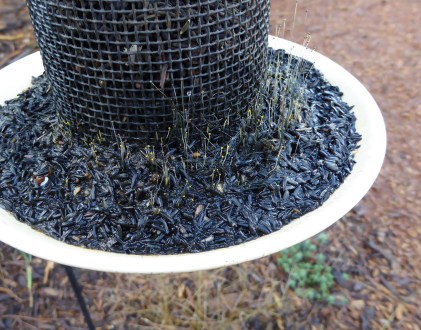 hy I hadn’t seen any goldfinches on the feeder lately. It hasn’t been pouring rain all the time, and a couple of weeks ago they liked feeding even during showers. The weather has been mostly a big cloud, and then added to that, I have personally been Under the Weather. When I came out from under, and the sun also came out, I explored my estate this morning and discovered that the nyger seed has become sprout soup.



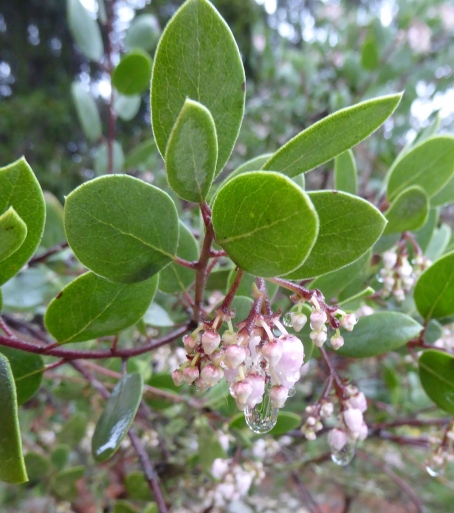
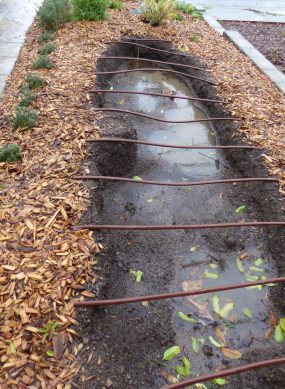 are coming on dear Margarita Manzanita, buds on the currant bushes and calla lilies. I went out and took pictures just now under the umbrella, so everything is too wet to be optimal, revealing how one of my asparagus beds is less than optimal – we didn’t dig down deep enough into the adobe clay, and now there is standing water. That may not portend good for the future of that planting.

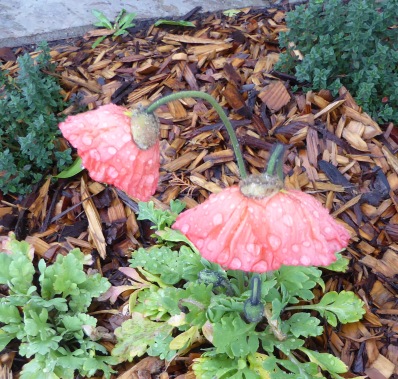 But they keep growing and blooming. Overall, they appear to thrive in it. I am reminded of this verse from the hymn “O Worship the King,” which likens God’s provision for us generally to the moisture that falls.
 Gladsome Lights