Category Archives: philosophy

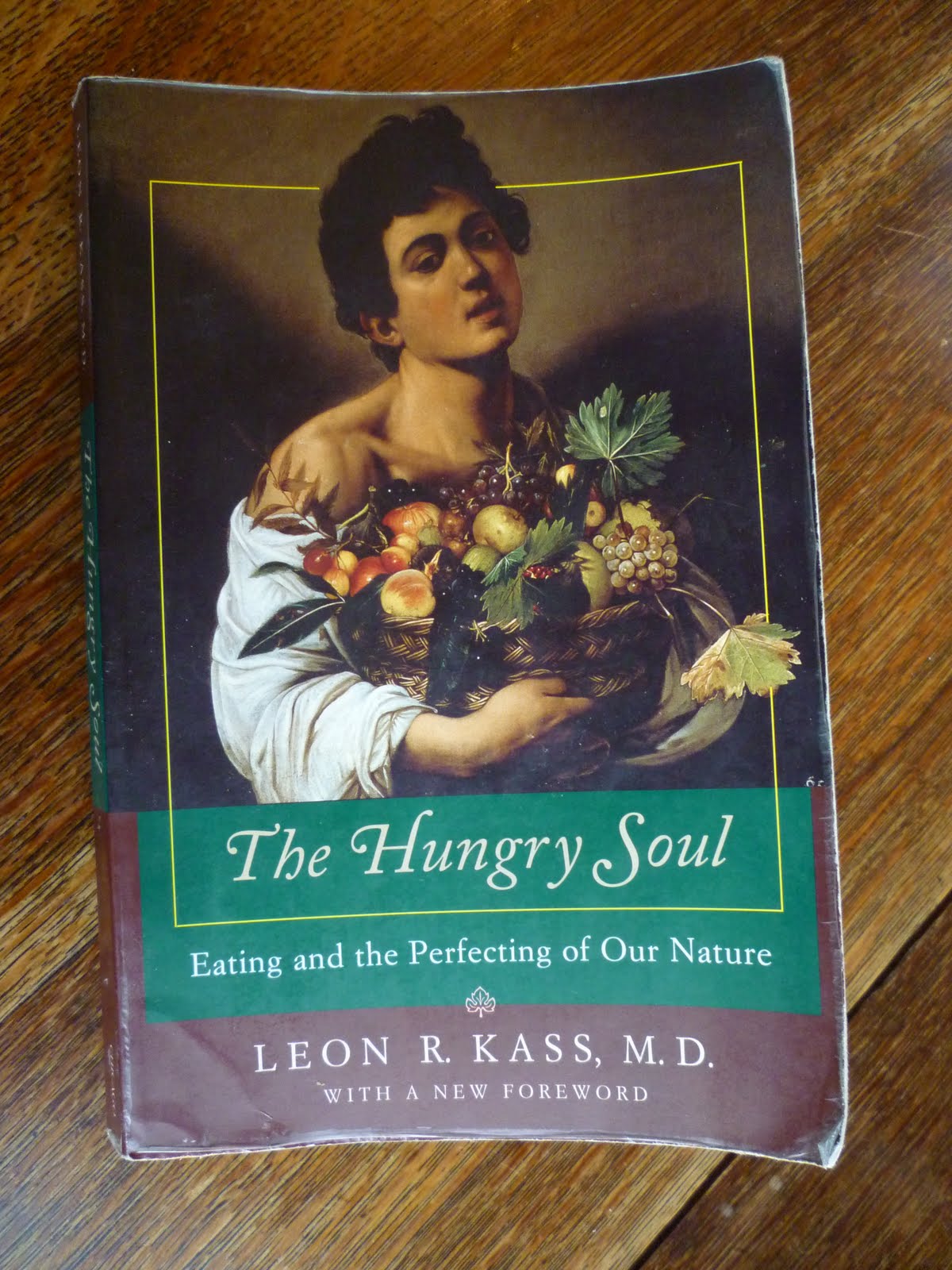
The Hungry Soul – Why I Love This Book

Any self-conscious emotional eater might take notice of a title like The Hungry Soul: Eating and the Perfecting of our Nature. I had the added attraction to the book that came from having heard the author’s warm and thoughtful voice on the Mars Hill Audio Journal as he was being interviewed on an altogether different topic.

Leon R. Kass, currently a professor at the University of Chicago, was appointed to chair the controversial President’s Council on Bioethics at its creation in 2001 and remained on the council until 2007, during which time he wrote Life, Liberty, and the Defense of Dignity: The Challenge for Bioethics. Though he is naturally called a bioethicist, he prefers the term humanist, because it better conveys the breadth of his concerns. Kass is also a medical doctor, but this is not a book about eating disorders any more than it is a cookbook — rather, it is a pondering of “the truth about our human situation.”

At the outset I must submit that there is no way Kass can tell us the whole truth, because he ignores Jesus Christ who is The Truth. Christ reveals the Father to us, being His “express image,” and He was the only fully human person who ever lived on earth, showing us as He did what man can be when he lives in constant communion with His Father as humans were meant to do.

Given this severe omission, one might wonder how I could find such treasures in Kass; I have to admit that this book has to be one of my ten favorites, at least of non-fiction, and the numerous notes and underlinings I’ve made in pencil and in red and blue ball point show how much I am still interacting with the material. Each time I read a section (with a different writing implement at hand) I find morsels of bread on the path leading in the direction the author wants me to go, and also see other lanes he probably isn’t even aware of. As I walk along I eat the tasty bits that have been laid out with care, wanting to race ahead to whatever is at the end of the trail, but resisting that urge for a while so I can savor the food and enjoy the stroll, all the while making note of the forks in the road and the byways I need to explore later on a return trip.

I really think I could come back to The Hungry Soul again and again and find more philosophical paths to explore, but if I wait to share my discoveries I’m afraid the tale will never be told. So I will begin the telling, even though I’m pretty sure I haven’t chewed on these ideas enough to do justice to what the most eminent reviewers hail as “an intellectual feast” and “a profound and brilliant exploration.”

Kass is Jewish and does reveal his belief in a Creator. He wrote this book to demonstrate through the human activity of eating that man has a soul, refuting the claims of corporealists that we are only material beings and that all our thoughts are nothing but electro-chemical events. 

This introductory post is a good place to list the chapter titles or topics that I may draw from in future posts, though just the foreword, preface and introduction are the kind of appetizers from which one could make a full meal.

1. The Primacy of Form
2. The Human Form
3. Host and Cannibal
4. Civilized Eating
5. From Eating to Dining
6. Sanctified Eating

I can’t help but notice how the sights along this philosophical journey are related to other trails and books I’ve encountered, and of course I’ll have to mention those, too, in postings to follow.

As an example of humankind who are the crown of God’s creation, Kass himself is proof of his thesis. The fine mind and heart that are expressed in his writing testify to the fact that men were made in God’s image. And the reasoned and well-written arguments he makes, or even the questions he gently asks, are clear and flowing. It’s a pleasure to follow him when all the paths seem to lead me to God.

Part 2 – Struggle to Stand
Part 3 – How Science Disappoints
Part 4 – From Eating to Dining
Around the Net

When Joanne at  Seasonal Hearth  was in the Netherlands she and her family rode bicycles a lot, and they took so many pictures of bicycles of all sorts everywhere, it adds up to give a feeling for the country where the population of bikes is greater than that of people.

On this blog about Words, I learned that I possess philoprogenitiveness, and it has been one of the greatest stories of my life! I don’t always read these posts, but they come daily…Now that I’ve been so encouraged by this one, I might check in more often. If I had known the word amphibology it would have come in handy when I was grousing about grammar recently.

Some people can drink milk their whole lives seemingly without  any problem (though my husband’s chiropractor thinks it’s the worst thing for anyone) while others can’t digest it. Via Touchstone I ran into this article about population migrations and where the gene for lactose tolerance came from. I’d like to read more about it.

My favorite prize from recent web wandering is a daily posting of poems from the George Hail Library in Rhode Island, each one accompanied by a picture and brief introductory notes. It’s more reliable than the online poem-a-day I used to read, and the blog host has some pleasing parameters for the sort of poetry she likes to share. Here is a recent one that I love. If you click on the title you can see the photo and comments as well:


THE PATIENCE OF ORDINARY THINGS

It is a kind of love, is it not?
How the cup holds the tea,
How the chair stands sturdy and foursquare,
How the floor receives the bottoms of shoes
Or toes. How soles of feet know
Where they’re supposed to be.
I’ve been thinking about the patience
Of ordinary things, how clothes
Wait respectfully in closets
And soap dries quietly in the dish,
And towels drink the wet
From the skin of the back.
And the lovely repetition of stairs.
And what is more generous than a window?

~ Pat Schneider, American poet and writer

A Chesterton Blog

I’ve recently been browsing on this helpful blog, The Hebdomadal Chesterton, the purpose of which is to provide us with longer portions of G.K. Chesterton’s writings than the thousands of one-line quotes one can find online. The host takes passages from many different books by Chesterton.  I just read “Too Liberal to Be Likely,” which is still quite current, though written in 1925. It consists of a paragraph from The Everlasting Man, a book that got my head spinning delightfully God-ward many years ago when I read it the first time.

Hebdomadal, I learned, means “appearing weekly,” which the posts seemingly fail to do, as I look at the dates on the archives. But that’s not much of a problem, when G.K.C.’s ideas are so richly provoking, and keep the mind busy for much longer than a week at a time. And if one is hungry for more, there are several links to other places where similar nourishment can be found.

Essential Aromas


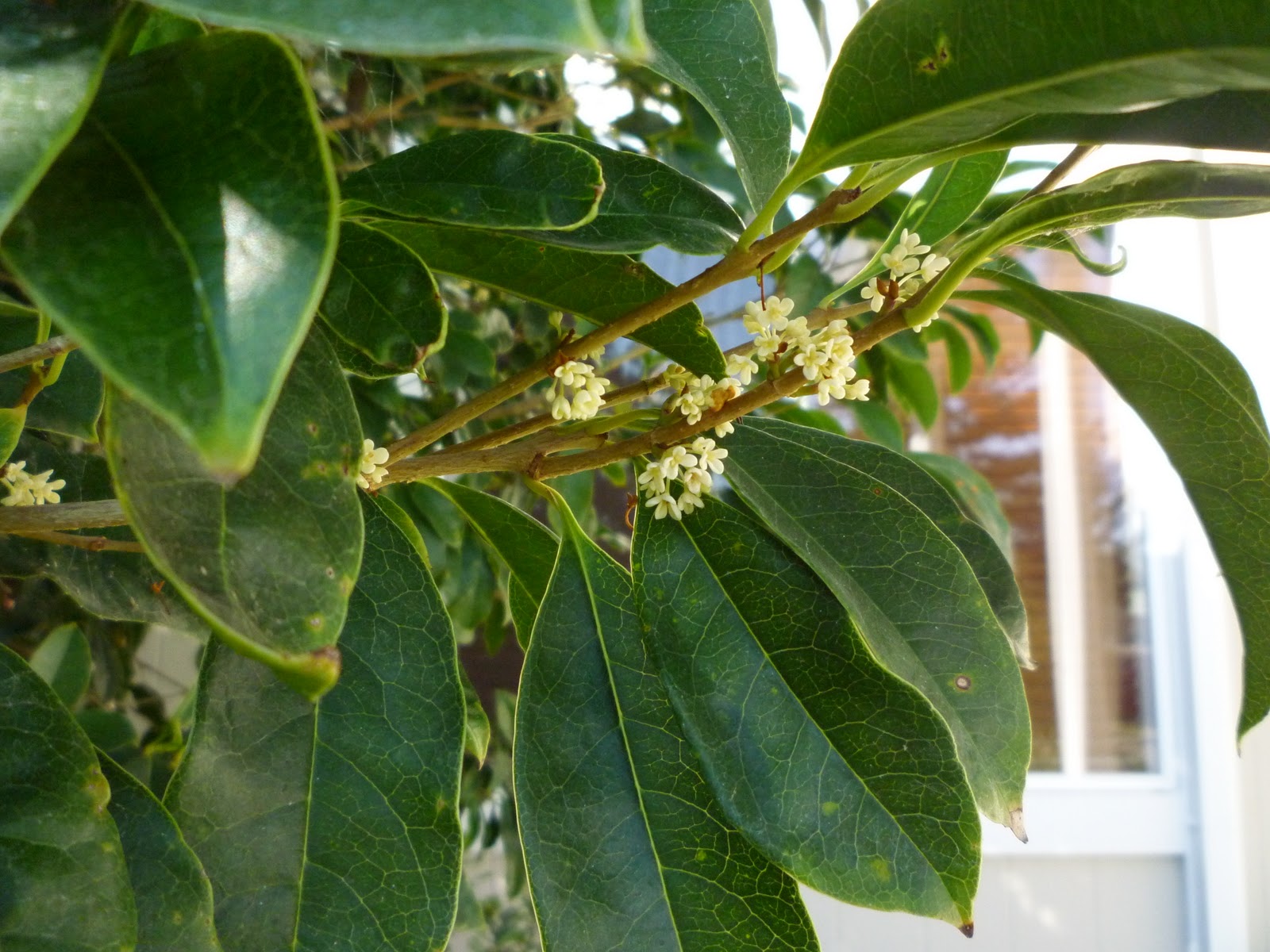
When Debbie at Artful Aspirations posted about her sweet-smelling bush, I suspected a near relation, perhaps even a twin, to my Osmanthus fragrans. She said she bought her plant because of its common name Tea Olive; I had only known mine as Sweet Olive.

Not many days later M.K. at Through a Glass, Darkly, who was not a follower of Debbie’s blog, posted photos of her “holly bush,” with descriptions of its “heady and rich” scent reminiscent of gardenia.

The challenge of describing various scents is always of interest to me. I wonder if an individual flower is easier to pin down than a whole rain forest. We usually have to say that any given smell is something like another. Having grown up in an orange grove, I didn’t confuse osmanthus with orange blossoms, but upon my first encounter I did envision some woman along the route of our neighborhood stroll setting an apricot pie to cool by the window.

Surely osmanthus is its own heady aroma that nothing else is quite like. Last year, at the end of a post about how various other scents link to my grandmother, I tried to describe its effect on me.

One website that sells many essential oils for their aromatherapy benefits describes Osmanthus fragrans as “Friendly, lively, intriguing, what’s new, what’s next, early morning excitement, setting out on a whole new journey.”

Peet’s has blended a black tea with osmanthus blossoms, which might add some extra excitement to those mornings when I choose it over plain black or green.They say “its pleasant aroma could be described as a combination of apricot, chamomile, and orange flower.” They don’t make it all year long; stocking up would be necessary if you want to be assured of having it when you want.

After she heard about osmanthus, M.K. began to wonder if her hollies might actually be Tea Olives. In the meantime I had been reading about fragrant holly bushes and found that there are hundreds of types of holly, and some of them do look a bit like osmanthus. One osmanthus looks so much like holly that its common name is False Holly. Wikipedia mentions that osmanthus flowers can be various colors, even dark orange, and that in China it is traditional to mix some osmanthus jam into millet gruel.

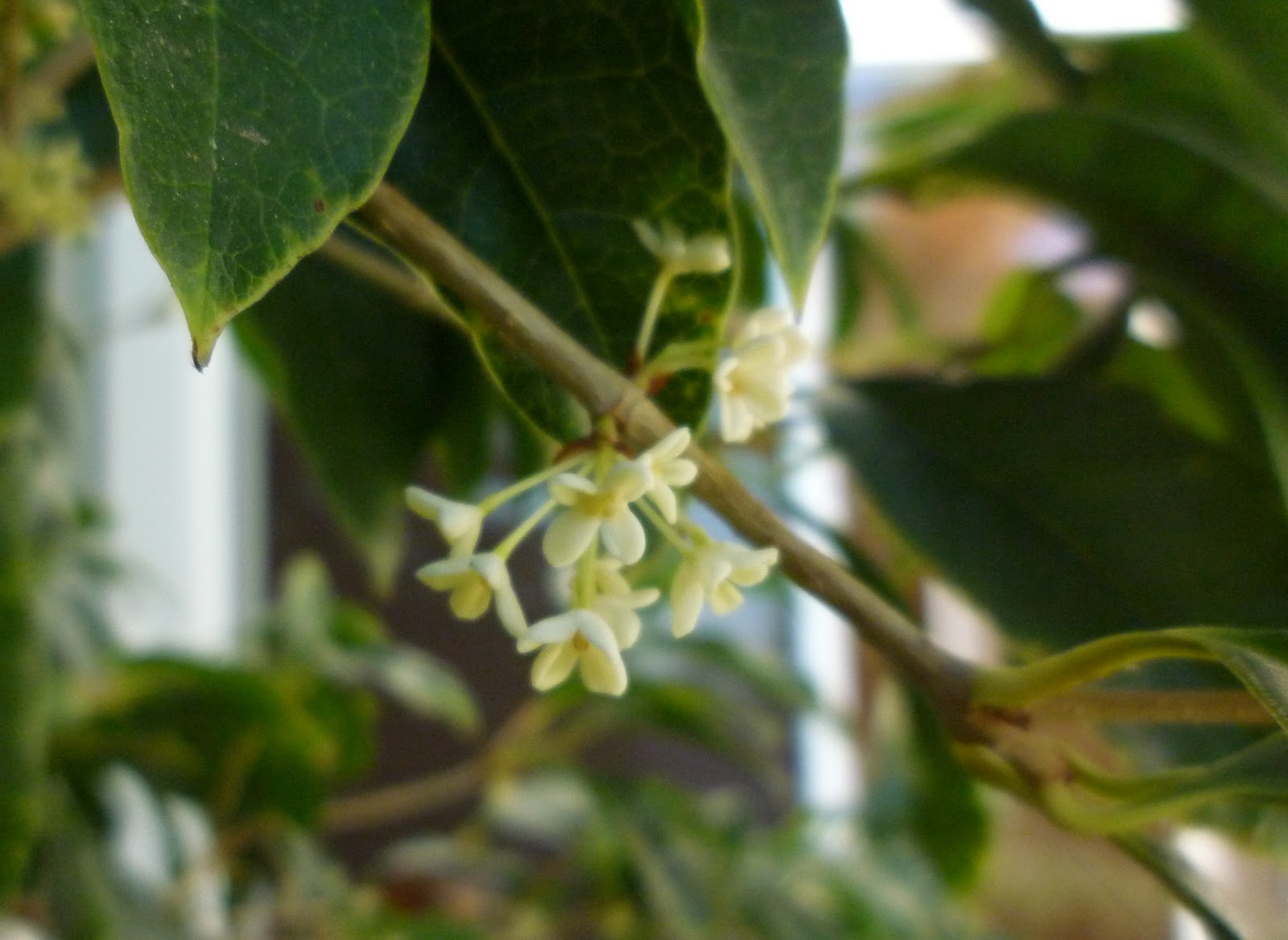
You can see on that page a photo of an orange-flowered osmanthus taken in Japan. All of the photos here on my blog were taken just this week in my yard.  B. and I planted the bush about 20 years ago on the advice of  horticulturist friend. If we had known how big they get, we’d have started it out farther from the house.

Wikimedia also has this whole page of related photos.

Some of my other favorite botanical scents are lemongrass and rose geranium. I have a big bush of the geranium in a pot on the patio, and in my cupboard some essential oil of lemongrass to add by drops to hand soap. So far I’ve only enjoyed my osmanthus when it happens to fill the air with its essence, and that occasion always takes me by surprise and humbles me by the extravagant gift. “The osmanthus is blooming!”  I will announce, if someone is around. This happens at least twice a year; do I really need the oil extraction at other times?

The people on the planet of Perelandra in C.S. Lewis’s novel by that name had an admirable way of making the most of every experience. They considered an actual event in time to be only the smallest part of anything that they did or that happened to them. The anticipation was also to be enjoyed for all it was worth, and the memory of the incident or act would be savored into the future. In this way even the most lovely and desirable events were completely satisfying whether or not they took place more than once in a lifetime.

When one comes upon a strong aroma, say, walking into a house where bread is baking, or walking out one’s front door to the scent of osmanthus, if the stimulus continues for a time the olfactory receptors get desensitized or something; in any case, you stop noticing, until you go out and come back again. So I don’t know, if I had only smelled osmanthus once, if I could have made much of the experience. I’m not too good at paying attention, if that’s what’s necessary.

But I’ve had decades of being enveloped by the sweetness and the love that the Sweet Olive aroma signifies to me. I think I’ll just try to bask in it for a few seconds longer next time I pass by, or sit on the step and drink it in as long as my nose will keep sending the message to my brain. And if we move to a colder climate I’m sure I’ll be busy enough sniffing the air in that place without trying to import gifts that belong to the memorable past.