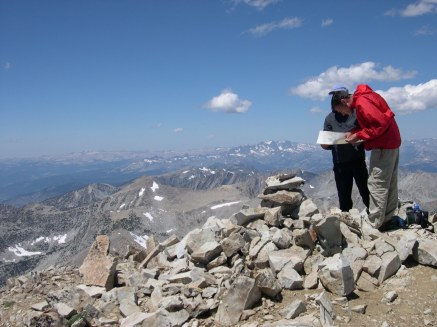
Most people in our family love maps. The previous generations loved them, too, and I treasure the memories and pictures of various father-son or sibling groupings around a map, planning a road trip or a backpacking adventure, or just getting a better idea of the world we live in.
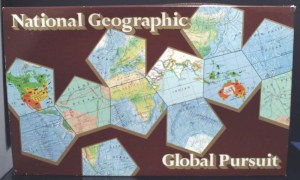
Geography games including maps can also be fun, such as Global Pursuit that was put out by National Geographic in 1987. It was a little challenging for someone like me who isn’t sharp in spatial orientation skills, because the map of the world was all chopped up into pentagons which never fit together all the way.
It’s easy to lose all track of time when poring over maps. One of my favorite parts of an unusual aviation ground school that was offered at my high school was studying the aviation maps pilots use to plot their course. In those days it was all done on paper, and I was fascinated by the concentric rings around airports, and all the copious information including odd names of towns in Texas, which was the area our school sample was showing. (The one below, I realize, is of Anchorage, Alaska.)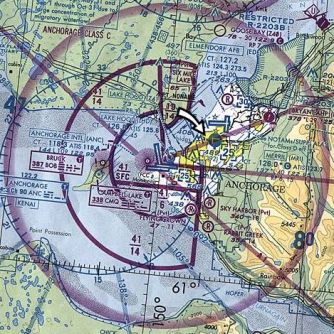
The whole concept of a map, a simplified form by which we can get a mental handle on a vastly greater reality, became useful for me in a different manner when I was introduced to the way M. Scott Peck uses it in his book, The Road Less Traveled. I have never actually read the book, but the the image of a mental/emotional map has served me well through the years. Some excerpts:
CHOOSING A MAP FOR LIFE – Truth is reality. That which is false is unreal. The more clearly we see the reality of the world, the better equipped we are to deal with the world. The less clearly we see the reality of the world–the more our minds are befuddled by falsehood, misperceptions and illusions–the less able we will be to determine correct courses of action and make wise decisions.
Map of Life – Our view of reality is like a map with which to negotiate the terrain of life. If the map is true and accurate, we will generally know where we are, and if we have decided where we want to go, we will generally know how to get there. If the map is false and inaccurate, we generally will be lost.
I brought all of my real and metaphorical map history to this poem I read today. The poet is another woman who also likes maps, but her poem shows clearly the ways that they fail to reflect reality. That doesn’t bother her; even in their failure she praises them for the vision they give us, “not of this world.”
Perhaps we also don’t need to worry about whether our heart-maps are all matched to our surroundings. Might they also serve a great-hearted and good-natured purpose, so that instead of giving up on our inner maps we strive to bring the full reality closer to the vision? I’m thinking of our daily prayer, “Thy Kingdom come…” and of “Love hopes all things, love believes all things….” May the Lord write the map of His Kingdom large in our hearts.
MAP
Flat as the table
it’s placed on.
Nothing moves beneath it
and it seeks no outlet.
Above – my human breath
creates no stirring air
and leaves its total surface
undisturbed.
Its plains, valleys are always green,
uplands, mountains are yellow and brown,
while seas, oceans remain a kindly blue
beside the tattered shores.
Everything here is small, near, accessible,
I can press volcanoes with my fingertip,
stroke the poles without thick mittens,
I can with a single glance
encompass every desert
with the river lying just beside it.
A few trees stand for ancient forests,
you couldn’t lose your way among them.
In the east and west,
above and below the equator –
quiet like pins dropping,
and in every black pinprick
people keep on living.
Mass graves and sudden ruins
are out of the picture.
Nations’ borders are barely visible
as if they wavered – to be or not.
I like maps, because they lie.
Because they give no access to the vicious truth.
Because great-heartedly, good-naturedly
they spread before me a world
not of this world.
–Wislawa Szymborska
Translated from the Polish by Clare Cavanagh
The New Yorker, April 14, 2014
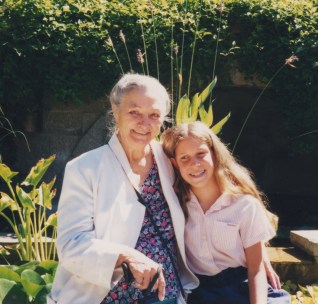 into her heart and gave me of her self: her motherhood of thirteen children, her married womanliness shaped by devotion to a passionate and visionary man, her thankfulness to a loving Father.
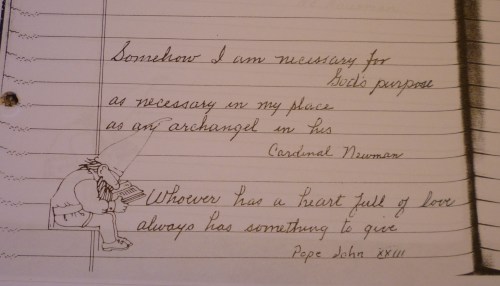
 at she liked to write in, her Gnome Gnotebook, repository of decades of treasures she had collected in the form of poems, quotes and proverbs. I had enjoyed exploring the original book whose pages had long ago been filled up; when she ran out of room Bird simply wrote any new notes and poems on scraps of paper and kept them tucked between the pages, the whole bundle getting fatter and fatter, held together with a rubber band and always kept within arm’s reach.