Category Archives: poetry

Monkeys in the Forest

Rudyard Kipling turned me against monkeys long ago, when I was reading The Jungle Book to the children. As I recall, all the other animals of the jungle despised the monkeys for being foolish and emptyheaded chatterboxes. Add to that the rumors (as I’ve never known a monkey firsthand) that they are in real life dirty and infested with vermin, and the result was my assignment of them somewhere around the level of cockroaches.

Perhaps 15 years ago I took one of the first of the quizzes that have since become ubiquitous on the Internet. This one had you rate animals according to how much you liked them, and at the end you were told in turn something about your character or personality. I think it was based on some Oriental tradition and valuation. My results came back with the assessment that I disliked children. Oh, I’m sure there were some other points to my identity, probably equally misread, but all I remember is my horror at being so unfairly pegged in regard to that one aspect, I who was joyfully homeschooling my several children and praying for more. I figured out eventually that it was the dismissive attitude toward monkeys that did me in.

You know how children behave like little monkeys much of the time? I guess I never thought of mine as resembling monkeys, but if I had, I’d still think that educating them, training them to be grown-ups with good manners and character, would transform them from monkeys into human beings.
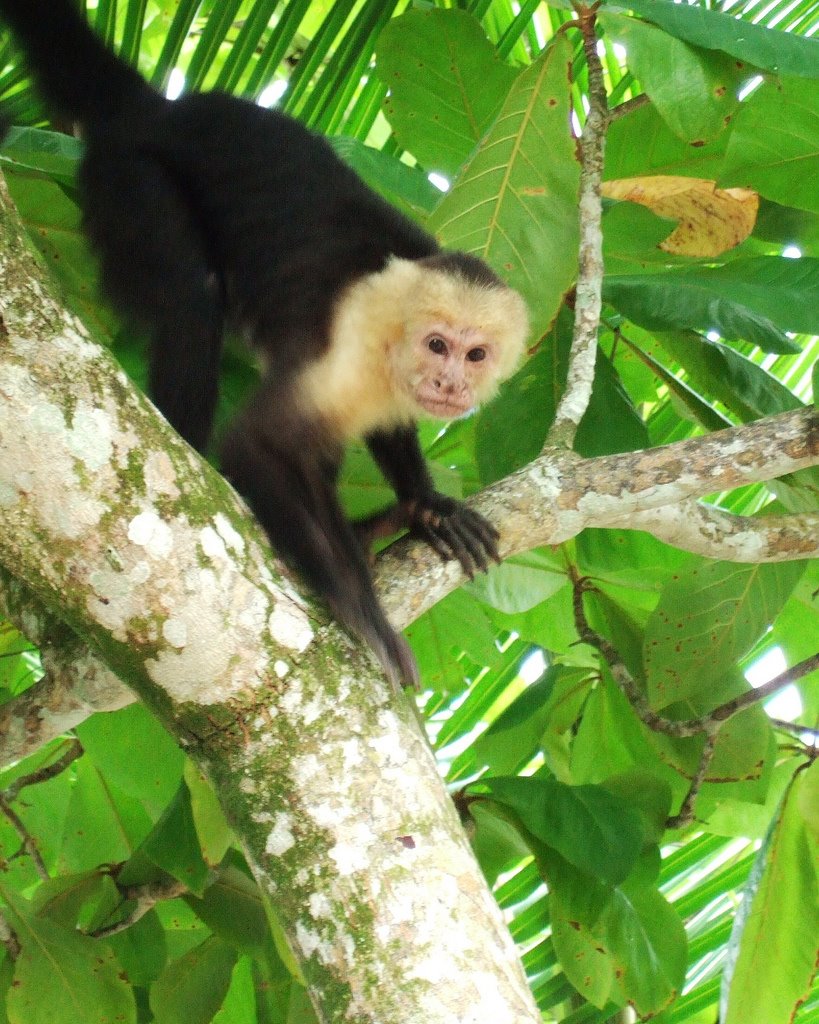
In my last post I shared “A Psalm of the Forest” with you, with its descriptions of trees and monkeys honoring and delighting in the Lord with whatever gifts and personality they have. In the scene described, the monkeys can’t be considered foolish, as they are giving glory to their Lord. The fool says in his heart that there is no God, and lives as though he were the center of everything. But the monkeys of this forest are all consumed with excitement over God. They are more like innocent and lively children who have no fear of offending Him.

My heart is softened nowadays toward monkeys, not that I think of them very much. I think the change was happening even before I discovered these lines from Paton, but he in his forest psalm has helped by reminding me how much every creature plays a part in bringing praise to the Creator.

We have the redwoods that amazed Alan Paton growing in our backyard, and have often camped near where he wrote these lines. The same feeling of awe and reverence has come over us in these forests, but nothing so playful and raucous as in the scene he describes. I love the fig tree, the waterfalls, the leaves showering down on their Maker, and the monkeys standing in for all of us children of our Father.

A Psalm of the Forest


Alan Paton wrote Cry, The Beloved Country in about 1947. He hadn’t been planning to write a book when he went on a world tour visiting reformatories, but in Norway his heart was full and he started what became a whole novel before he returned to South Africa after his sabbatical.

A few years later he found himself again in California, where the last words of Cry had been set down, and this time he was supposed to be working on a second novel, staying in a cabin alone under and among the towering redwoods, when he wrote this modern psalm. I hope I can write more about it later, but I can’t wait to share the poem itself with you and tell you that it is one more thing that endears me to this man. I will let him introduce it as he does in Journey Continued, which is the second volume of his autobiography:

“…It is called ‘A Psalm of the Forest,’ the forest being that of Lane’s Flat, but the actual trees of the poem, and the monkeys that played in them, being imported from Africa.”

A Psalm of the Forest

By Alan Paton

I have seen my Lord in the forest, He goes from tree to tree laying His hands upon them.

The yellowwoods stand upright and proud that He comes amongst them, the chestnut throws down blooms at His feet.

The thorns withdraw their branches before Him, they will not again be used shamefully against Him.

The wild fig makes a shade for Him, and no more denies Him.

The monkeys chatter and skip about in the branches, they peer at Him from behind their fingers,

They shower Him with berries and fruits, they shade the owls from their hiding places,

They stir the whole forest, they screw up their faces,

They say to each other unceasingly, It is the Lord.

The mothers cuff their children, and elder brothers the younger,

But they jump from tree to tree before Him, they bring down the leaves like rain,

Nothing can bring them to order, they are excited to see the Lord.

And the winds move in the upper branches, they dash them like cymbals together,

They gather from all the four corners, and the waterfalls shout and thunder,

The whole forest is filled with roaring, with an acknowledgement, an exaltation.

Low-Lying Days

The last few days have found one or both of us down with the flu. I resisted until yesterday, after I returned from an early-morning gardening session at church, where I had accidentally broken off a rosebud. This morning it greeted me thus. I’m very thankful for it, a little present to cheer me up as I am missing a wedding and the chance to visit with friends and family from out of town.

Last evening was my worst sickly period, and the thought of cooking dinner made me cry. So I sat on the patio and read The Folding Cliffs. What strange interaction followed, and gave me creative energy to go into the kitchen and make dinner, I can’t really understand, and I won’t try to go into it here–but I managed to make another meal with what was on hand, and this time it was burritos with scrambled egg filling, spiced with chili and cumin, onions and garlic and sweet red pepper and cilantro. Cheese, too. And love and thankfulness and peace. That was the miracle that came from On High, via a fellow human using the written word with care.

And some fresh roundish fruits we called tomatoes, one each left in produce bags from two shopping expeditions. I had bought one, Mr. Glad the other. One from Mexico–not surprising–and the other from….Canada! What? The information on the sticker was so alarming to me, my mind ran away and I forgot to take a picture for proof that the world had turned upside-down, not least geographically.

I didn’t add chile-type “heat” to the filling I made, so we added it at the table in the form of sauce from a bottle. And this is the perfect time to display photos I took some time ago and have been waiting for a chance to use.

Whether or not something requiring spicing-up is going to be on the table that night, when my husband and I are in a certain local market, we like to peruse this library of hot sauces, right next to bags of hot chiles, in case you want to make your own, perhaps.

But we rarely have any of these playfully fiery brews around to use on our own Tex-Mex food, as we long ago developed a taste for Crystal Louisiana Hot Sauce, when as head cook I didn’t always distinguish one culinary region from another. And Crystal is cheap.

At the end of our meal, there were a few chunks of the reddish fruit left in their blue bowl. My man asked what to do with them, and I said, “Throw them out. I don’t ever want to buy a tomato out of season again.” You see, I had also been reading about M.F.K. Fisher and realizing that these sorry, pale things with nary a drop of flavor or juice do not express me. Ha ha.

I’d like to return my kitchen to the days memorialized in this photo, when we had our fill of dead ripe tomatoes in the summer and fall, and the rest of the year made do with canned or dried or frozen.

In the coming months I’ll write more about tomatoes– growing, picking, buying, cooking. As to eating them fresh, I think it’s best, for now, merely to anticipate.

Book Notes

This stack represents the top of the current pile I’ve been working on. Any guesses as to which one I’ve already abandoned? I’ll start from the top. At Large and Small by Anne Fadiman was a gift from Pippin. We had both enjoyed her earlier book for readers, Ex Libris. She specializes in the personal essay and does a fine job of it, but I like the first book better; this one ranges over topics not so interesting to me. At least it is a small and lightweight book, which makes it possible to read while lying down just before the eyelids get heavy.

Creators is the first book by Paul Johnson that I have actually completed, though I’ve started in on two others by him. It is a collection of essays on famous creative individuals “from Chaucer and Dürer to Picasso and Disney.” Um…to be exact, I didn’t complete the book; there were a few in whose stories I couldn’t drum up enough interest at bedtime. The chapter comparing Picasso and Disney was certainly thought-provoking. Johnson thinks that the ideas of Picasso will fade and be outmoded, while those of Disney will endure–not because Picasso was so selfish and violent and Disney a maker of “family movies,” but for an entirely different and more fundamental artistic reason, which I don’t want to give away here.

I learned a lot more about many people in this book: T.S. Eliot, Jane Austen, Mark Twain, J.S. Bach, fashion designers and landscape painters. How does Johnson know so much, and how can he be so opinionated? He is easy to read, and refreshing in his willingness to tell you just what he thinks, and to not be politically correct, either. This book is one of a series with two others: Intellectuals, published many years ago, and Heroes, which has come out since. Some critics thought Intellectuals somewhat of a downer, but these last books should make up for that.

My friend K. lent me The Folding Cliffs. It’s not a book I’d have ever picked up otherwise, written as it is without any punctuation and me a member of the Apostrophe Protection Society. Is this even English? I guess it is, as I am able to read it, though it is definitely a variant form. In this case it is worth the trouble, though I’m not ready to tackle Merwin’s other poems. Here’s a sample from Cliffs:

The story is as captivating as the imagery, and I certainly won’t abandon this one, even if it takes me a year of little snatches. I like the way the words flow as soothingly over my consciousness as the stream over the narrator’s body.

Steinbeck’s novel East of Eden was recommended to me by two friends, so I was happy to find it in the used book store. I’ve read almost half of it, and enjoyed several of those hundred pages. But this is the one I’m quitting. Mr. Glad says I could write a dissertation on “What Can Be Learned of Steinbeck by Reading Half a Book”; I gave him my whole dissertation while cooking dinner after my decision to quit, but I will spare you readers. It boils down to the reality that life is short, and there didn’t seem to be anything to be gained by continuing with Steinbeck. There has always been something missing between him and me. Perhaps this time would be different, and I’d be surprised and gratified if I’d finished it, but one can’t have everything in life.

The Hacienda by de Teran is a re-run for me, but now my husband and I are reading it aloud together. It’s a fascinating story of Venezuela in the 1970’s and of the author’s experience–how she got herself into a mess and lived in a primitive society for quite a while before escaping for her life. I’ve read a couple of other books by this author and she tells a good tale–the ones I’ve read were the autobiographical accounts.

I love to read on a airplane. There is not much else to do, usually, so hours can go by without the attention being distracted. The Everlasting Man by G.K. Chesterton I took on my last flight as a treat I’d been long waiting to enjoy again. I knew the first time I read it that it was the kind you have to read at least two or three times if you hope to get near the bottom of it.

Before our plane taxied down the runway I was well into the first chapter. My seatmate, who had initially seemed reserved, interrupted my reading to tell me that he much admired Chesterton and that particular book. Over the next ten or fifteen minutes we chatted on the subject of good writers, Christianity, how books had changed us, etc. And we still hadn’t taxied anywhere, because as it turned out, the plane had a mechanical problem which ended up delaying our flight for three hours, by which time we’d all disembarked and my new friend had got a different flight. I was quite pleased that the Lord had given me a short and sweet discussion time and a long and sweet reading time, all on the same leg of the journey.

Richard Wilbur may be my favorite poet. K.’s having introduced me to hers jogged me into digging out Wilbur’s poems again, which are so varied and beloved, I will have to write one or more posts just on him.

Now that there aren’t any travels in my near future, there might not be many new books begun, either. But as you can see, I’ve still plenty to keep me busy.