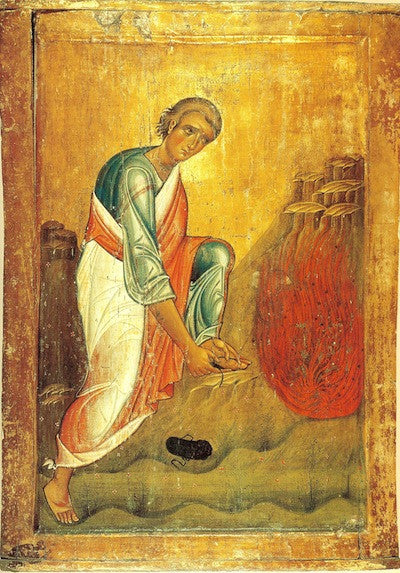
At Vespers last night, the lighting was unusual, in that electric lights had been turned on in the dome; typically we do without those, and in the winter it means that we see the icon of the Pantocrator only dimly. Because the amount of light, and the angle at which it enters through the cathedral windows, is always in flux, every service at every time of day is differently illumined — but the effect is always sublime.
Over the last two days, at church and on my neighborhood path, I was warmed by the beauty of physical lights, not separate from their symbolic role: They represent and mysteriously convey the presence of Christ Who is, as the Evangelist said, “The true Light, which lighteth every man that cometh into the world.”
Today was the Leavetaking of Theophany, and I was the chanter of the Third and Sixth Hour prayers before the service. On Sundays we always have hymns of the Resurrection, and usually hymns of that Sunday’s feast or saints as well. It was the Kontakion of Theophany that got my attention this morning:
On this day Thou hast appeared unto the whole world, And Thy light, O Sovereign Lord, is signed on us who sing Thy praise, and chant with knowledge: Thou hast now come, Thou hast appeared, O Light Unapproachable.
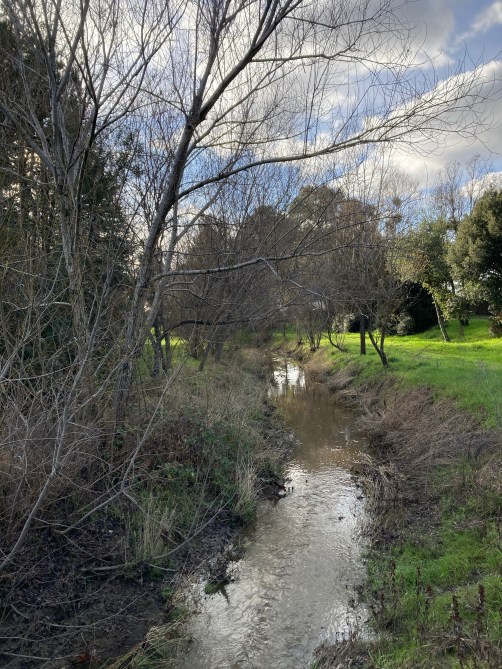
As soon as I returned after church, I (shock!!!) changed my clothes and went for a walk. We had been surprised by the sun coming out in the afternoon, so it was delightful out there. Even though the creek was muddy from rain, the light shining on it made it lovely.
And I practiced Psalm 89 some more. Reading the same lines and stanzas over and over, thinking of links to help me transition from one thought to another, has been the most rewarding kind of meditation; the theology and the poetry fill my heart, certainly in much the same way as one line states:
We were filled in the morning with Thy mercy, O Lord, And we rejoiced and were glad.
But this line is in the latter half of the psalm, when the mood has turned upward. A few stanzas before, the psalmist is considering how in the evening man “shall fall and grow withered and dry.” “We have fainted away,”“our days are faded away… our years like a spider have spun out their tale,” and “Return, O Lord, how long?”
Withered and dry, but still handsome.
I have looked at two other translations of the Psalm, one of them a different version of the Septuagint, and compared with the one I am using (see sidebar note), to me they both are clunky and harder to read, though they do have many of the same vivid images that help me to learn this poem.
I stopped a couple of times on my walk to sit on a bench and think about these things. And when I got home again I looked at the notes in the Orthodox Study Bible, which points out that this is “a morning prayer designed to keep one focused on the Lord rather than on this temporal life and its hopelessness. For He exists outside time, and is therefore our only refuge…. It is read daily at the First Hour.”
There are many references to morning and evening, days and years, and our lifespan being “in the light of Thy countenance.” But one reason I have wanted to learn the whole prayer poem is the last verse, whose first line brings me back to “Thy light is signed on us” in the hymn we read and sang this morning:
And let the brightness of the Lord our God be upon us, and the works of our hands do Thou guide aright upon us, Yea, the work of our hands do Thou guide aright.
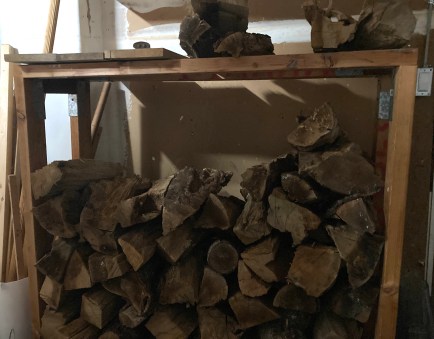
This morning was frosty enough to make ice in my garden fountain. I wore a thick wool sweater to church, and kept it on until I got home again five hours later and changed into my firewood clothes. Both the supply of logs near the wood stove and the nice rack I have in the garage needed replenishing from the stacks outside. I bring in a dozen or so logs at a time to dry out, and to have handy when it’s raining or just dark and I don’t want to go out.
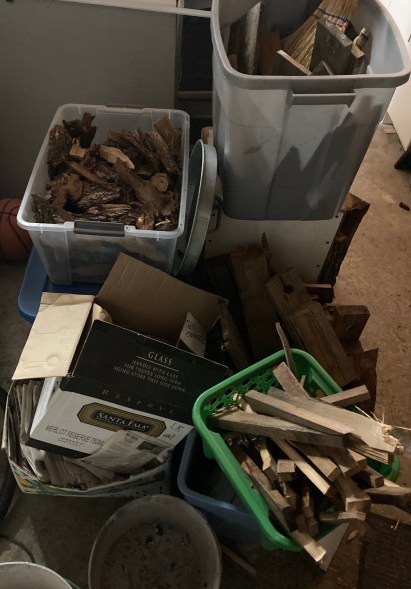
Opposite that rack I have tubs and boxes and bags of kindling and newspapers, a place to split the kindling, and a bucket for collecting ashes. I don’t see how I’m ever going to make room for my car in the garage, which has been a minor goal for a couple of years now. That space serves as my pantry and laundry room and tool shed, and holds all the sorts of things that my daughter Pearl says you have to keep in the garage if you don’t have a basement.
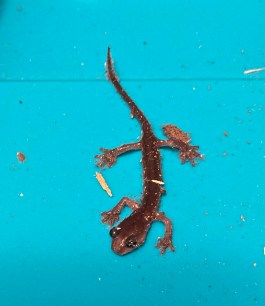
The little guy below came in with a load of logs; the young house guests squealed and their mother scooped him out of the fireplace corner into a dustpan. He was trying to fall out of it, so I picked him up and tried to hold him in such a way that the children could look at him for a bit. But they would have none of it, and just wanted him out of the house, so I let him out the back door into the rain. I hope it washed him of all the woody litter.
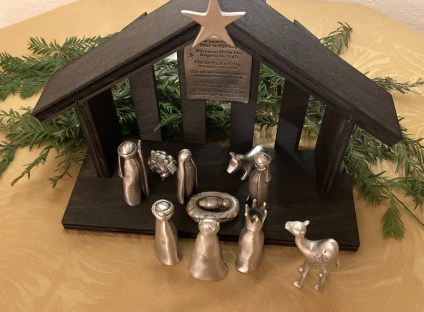
The pewter wise men have arrived, after journeying across the table in my entry, to take up their worshipful positions in front of the Christ Child. I’ve removed a small amount of Christmas decor, mostly the fresh cotoneaster berries that weren’t fresh anymore. The redwood branches and candles remain, because they have life left in them, at least for today. And the faux tree will last as long as I want it to, which is, until I have some mental space to give to it.
For now, I have too many other projects going on. Writing thank-you letters to a few grandchildren, cooking soup for our women’s book group this week, and maybe a two hour trip to see my niece — just in this week.
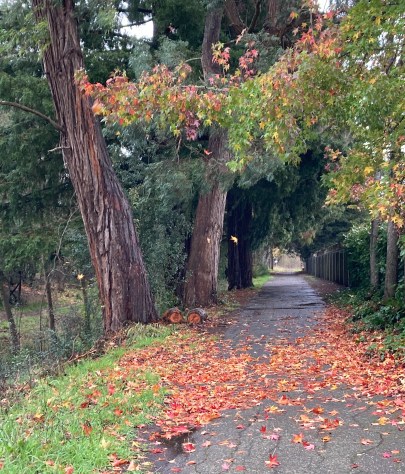
At the same time, I am working on new habits. For more than a week now, I have taken a walk every day, outdoors, not on the treadmill. This was the scene on the bike path less than a week ago; can you see the leaves falling?
Since then we got a big dumping of rain, and the leaves aren’t so pretty anymore. One day I walked my old two-mile loop and it was quite delicious, because everything — the trees and earth and grass, and especially the air — was wet and refreshing and not cold. I wore my rain jacket and was prepared for a sprinkle, but when I was still ten minutes from home I got fairly drenched. Excitement like this has been adding to my general winter happiness.
Even before I read an encouraging article about the value of memorizing things, I had been planning to renew my effort in the coming year to learn some Psalms and possibly other poems by heart. “The Great Forgetting,” by Ruth Gaskovski, about “How ‘critical thinking’ and outsourcing of memory are withering culture, and how to turn the tide,” is giving me a boost.
Last year — or even before? — I had started to memorize Psalm 90 and 91 (89 and 90 in the Septuagint), and then lost my focus. This year, so far, I have noticed how my memorizing project coordinates nicely with my improved walking habits. I have the psalms written on 3×5 cards and can practice them as I stroll along — unless it’s one of those rainy days.
Here are the first few verses I am working on:
Psalm 89 — A Prayer of Moses, the man of God
Lord, Thou hast been our refuge in generation and generation.
Before the mountains came to be and the earth was formed and the world, even from everlasting to everlasting Thou art.
Turn not man away unto lowliness; yea, Thou hast said: Turn back, ye sons of men.
For a thousand years in Thine eyes, O Lord, are but as yesterday that is past, and as a watch in the night.
Things of no account shall their years be; in the morning like grass shall man pass away.
In the morning shall he bloom and pass away; in the evening shall he fall and grow withered and dry.
The poetry of these verses, the rhythm of their music and the depth of meaning, as I tell them to myself phrase by phrase, is so beautiful to my mind and heart. Glory to God!
I was first introduced to this poem by Dr. Oliver Tearle, on his expansive website Interesting Literature; he says it is little-known as a New Year’s poem. Twice before I posted a few lines of it, but this time I am sharing the whole thing. Usually I only like short poems, but this one is like a song that wants to be sung through all the verses, until the repetitions of “passing away, passing away” are completed, and finally, “Lo, it is day.”
OLD AND NEW YEAR DITTIES
New Year met me somewhat sad: Old Year leaves me tired, Stripped of favourite things I had Baulked of much desired: Yet farther on my road to-day God willing, farther on my way.
New Year coming on apace What have you to give me? Bring you scathe, or bring you grace, Face me with an honest face; You shall not deceive me: Be it good or ill, be it what you will, It needs shall help me on my road, My rugged way to heaven, please God.
Watch with me, men, women, and children dear, You whom I love, for whom I hope and fear, Watch with me this last vigil of the year. Some hug their business, some their pleasure-scheme; Some seize the vacant hour to sleep or dream; Heart locked in heart some kneel and watch apart.
Watch with me blessed spirits, who delight All through the holy night to walk in white, Or take your ease after the long-drawn fight. I know not if they watch with me: I know They count this eve of resurrection slow, And cry, ‘How long?’ with urgent utterance strong.
Watch with me Jesus, in my loneliness: Though others say me nay, yet say Thou yes; Though others pass me by, stop Thou to bless. Yea, Thou dost stop with me this vigil night; To-night of pain, to-morrow of delight: I, Love, am Thine; Thou, Lord my God, art mine.
Passing away, saith the World, passing away: Chances, beauty and youth sapped day by day: Thy life never continueth in one stay. Is the eye waxen dim, is the dark hair changing to grey That hath won neither laurel nor bay? I shall clothe myself in Spring and bud in May: Thou, root-stricken, shalt not rebuild thy decay On my bosom for aye. Then I answered: Yea.
Passing away, saith my Soul, passing away: With its burden of fear and hope, of labour and play; Hearken what the past doth witness and say: Rust in thy gold, a moth is in thine array, A canker is in thy bud, thy leaf must decay. At midnight, at cockcrow, at morning, one certain day Lo, the Bridegroom shall come and shall not delay: Watch thou and pray. Then I answered: Yea.
Passing away, saith my God, passing away: Winter passeth after the long delay: New grapes on the vine, new figs on the tender spray, Turtle calleth turtle in Heaven’s May. Though I tarry wait for Me, trust Me, watch and pray: Arise, come away, night is past and lo it is day, My love, My sister, My spouse, thou shalt hear Me say. Then I answered: Yea.
-Christina Rossetti, 1830-94
Christina Rossetti, by her brother Dante Gabriel Rossetti




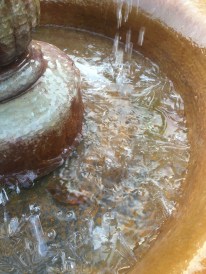 This morning was frosty enough to make ice in my garden fountain. I wore a thick wool sweater to church, and kept it on until I got home again five hours later and changed into my firewood clothes. Both the supply of logs near the wood stove and the nice rack I have in the garage needed replenishing from the stacks outside. I bring in a dozen or so logs at a time to dry out, and to have handy when it’s raining or just dark and I don’t want to go out.