“Devils take great delight in fullness, and drunkenness and bodily comfort. Fasting possesses great power and it works glorious things. To fast is to banquet with angels.”
+ St. Athanasius the Great

“Devils take great delight in fullness, and drunkenness and bodily comfort. Fasting possesses great power and it works glorious things. To fast is to banquet with angels.”
+ St. Athanasius the Great
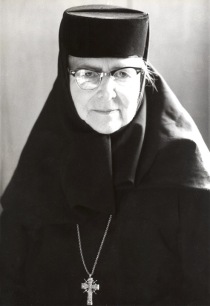 But what does humility really mean? The derivation of the word “humble” is the Latin “humus,” meaning “soil,” and herein lies a most apt metaphor for understanding what is most basic to humility. The humble feel themselves equal to the soil upon which they walk and from which they are made. They cannot be lowered, for they are already low. But this lowliness in no way means servility; it means purity and godliness. Satan’s great fall came from his inordinate pride, which rendered him impure. For us, each time that we let pride get the better of us; we have similarly soiled ourselves. This is the nature of our lowliness: not servility, but a purity shared with the soil, by which we paradoxically remain unsoiled (by pride).
-Mother Alexandra (formerly Her Royal Highness lleana, Princess of Romania and Archduchess of Austria)
“Correctly understood, repentance is not negative but positive. It means not self-pity or remorse but conversion, the re-centering of our whole life upon the Trinity. It is to look not backward with regret but forward with hope – not downwards at our own shortcomings but upwards at God’s love. It is to see, not what we have failed to be, but what by divine grace we can now become; and it is to act upon what we see. To repent is to open our eyes to the light.
“In this sense, repentance is not just a single act, at initial step, but a continuing state, an attitude of heart and will that needs to be ceaselessly renewed up to the end of life.”
-Metropolitan Kallistos Ware, in The Orthodox Way
Mother Gavrilia was one of those people I have heard about who know what it is to die to oneself, to “cease to exist,” as she put it. St. Paul wrote about this in his letters, saying, “I have been crucified with Christ. It is no longer I who live, but Christ who lives in me.” You might think that someone for whom this is a reality would lack personality or presence, because if your self is truly swallowed up in Christ, who would you be?
I know this question has come up through the years, talking with various people. It’s been theoretical to those of us who talk, knowing as we have that we ourselves have not advanced very far on that road to “non-existence.” But of course, to be fully in Christ is to be most fully alive, and about the opposite condition Mother Gavrilia also said, “When we lack love, we become corpses, entirely dead.”
 She was born in 1897, and was the second woman ever to enter a Greek university, but she said, “One thing is education: that we learn how to love God.” Later she trained in physiotherapy in England and returned to Athens to open her own practice when she was over 50 years old. Several years after (and older still) she traveled to India by herself. She treated lepers and helped the poor everywhere. Then Palestine, East Africa, France, America. She was friendly with Muslims and Hindus and Protestant Christians, but often withdrew from society altogether. As John Brady tells in one account of her life, “Mother Gavrilia’s life obliterated the inane distinctions that we so often make between prayer and service, contemplation and action….The difference was immaterial because the Source was the same.”
Lately I have encountered many thought-provoking sayings from Mother Gavrilia. Reading them, and about her very active and miraculous life, I get the impression of a bright intellect, a radiantly energetic person, so full of life and light as to make the concept of mere “personality” seem tiresome.
Here is one story in her words that makes a good introduction:
Once… some foreign missionary came and said to me, “You may be a good woman, but you’re not a good Christian.”
I said, “Why?”
“Because you have been here so long and you only go about speaking English. What local languages have you learned?”
I said to him, “I haven’t managed to learn any of the local languages, because I travel a great deal from place to place. As soon as I learn one dialect, they start speaking another. I’ve only learned ‘Good morning’ and ‘Good evening.’ Nothing else.”
“Bah, you’re no Christian. How can you evangelize? All the Catholics and Protestants learn all the local dialects in order to . . .”
Then I said, “Lord, give me an answer for him.” I asked it with all my heart, and then I said, “Ah. I forgot to tell you. I know five languages.”
“Really? What are these five?”
“The first is the smile; the second is tears. The third is to touch. The fourth is prayer, and the fifth is love. With these five languages I go all around the world.”
Then he stopped and said, “Just a minute. Say that again so I can write it down.”
With these five languages you can travel the whole earth, and all the world is yours. Love everyone as your own — without concern for religion or race, without concern for anything.
Mother Gavrilia reposed in 1992. Her monastic daughter, with the contributions of others of her spiritual children, wrote the story of her life in the book Ascetic of Love.
 Gladsome Lights