Category Archives: quotes

The Library of Congress

p1050884
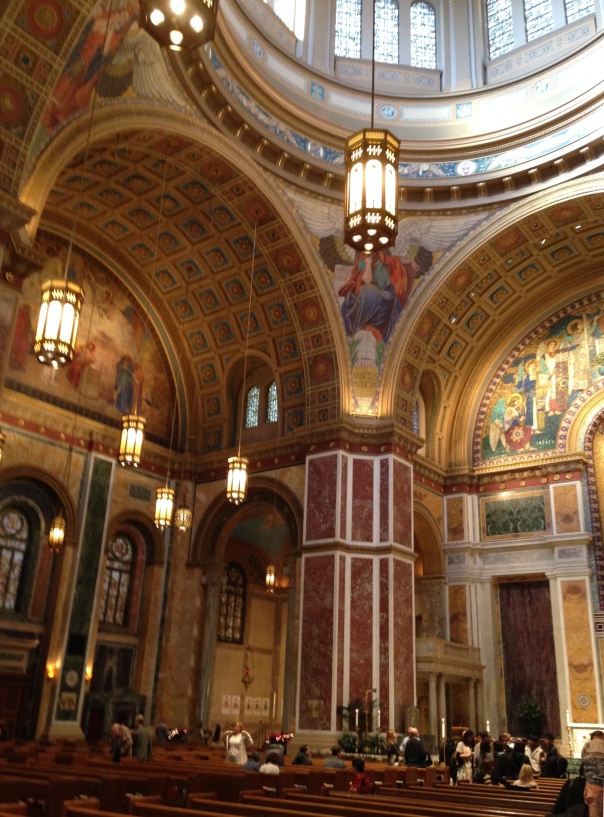
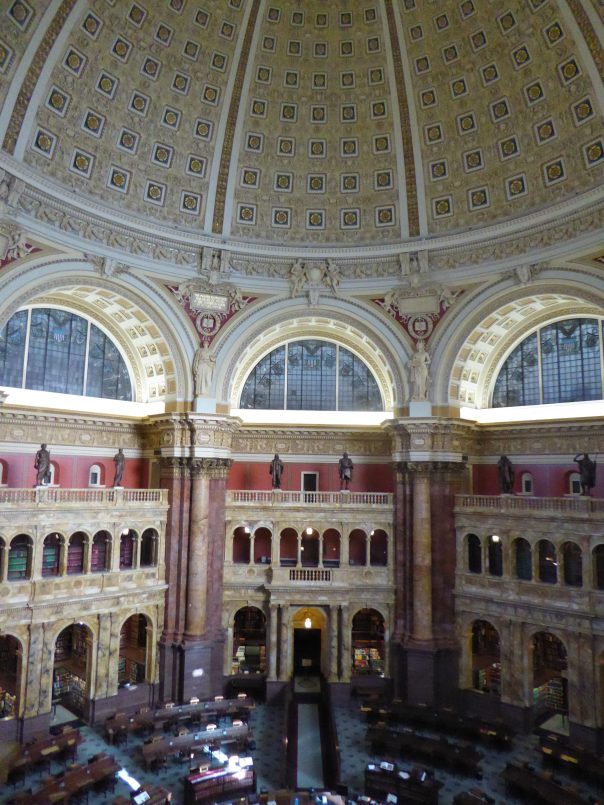
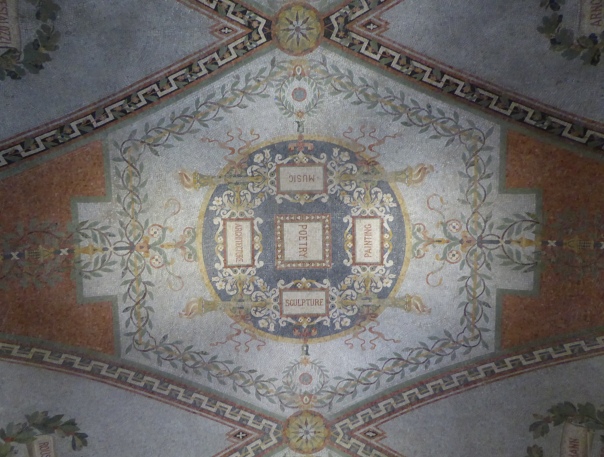
Ceiling of the Great Hall

The Library of Congress, the Thomas Jefferson Building, was a joy to visit, primarily for its architecture and design – which is not what I had anticipated. Before I had left home, when Kate suggested that we go there, I had naturally thought first of books, and exhibits about books.

We heard a story about how it ended up so beautiful: The first two construction attempts failed at the level of the foundation, and a third person was called in to complete the project. His son, who had recently graduated from the University of Beaux-Arts in Paris, took over the design and completion of the interior ornamentation. Or so our tour guide told us 🙂

When I was trying to review these facts online for this post, I discovered another version of the story in a book about “German Achievements in America.” That story does not mention any failure on the part of the original (German) architects, but rather emphasizes that they spent twenty years perfecting the design and were never given adequate credit for it.
p1050894
Main Reading Room

This page on the LOC site gives broader detail about the drama of these events — involving “the selection of the proper cement for the foundation” — and eventual completion in 1897 of the main building of the library, which was not named for Jefferson until 1980.
p1050904

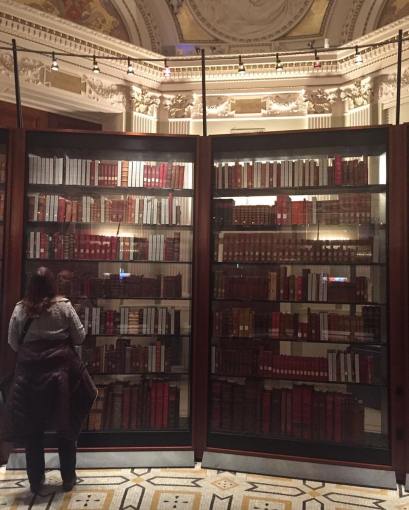
Thomas Jefferson deserved to be honored this way, because he offered to sell his whole personal library to Congress after their collection of books was destroyed by fire in the War of 1812; at that time the library was stored in the Capitol. He said he would accept whatever price they decided upon. Previously they had owned only law books, but Jefferson persuaded them that “…there is, in fact, no subject to which a Member of Congress may not have occasion to refer,” and they bought his 6,487 books for $23,950. That amount was based on the number and sizes of the books.

Jefferson’s generosity was not because he no longer needed what he named “unquestionably the choicest collection of books in the U.S.” He used the money gained to pay some of his debts, and began right away in a “frenzy” to assemble a replacement library for himself, saying, “I cannot live without books….”
gle-g-at-thomas-jefferson-library-exhibit-loc
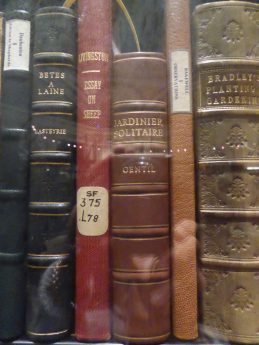
(A little part of) Thomas Jefferson’s Library exhibit

Two-thirds of the new Jefferson library was destroyed by another fire in the Capitol, in 1851. In the last decades efforts have been made to restore all the books that were in the original collection bought from Jefferson, and by 2008 replacements had been found for all but 300 of the original books; together with the volumes not destroyed by fire, these all comprise the exhibit of Thomas Jefferson’s Library which has been on display since then. Though we wandered through a couple of other exhibits in the building, this one is where Kate and I spent the most time. I had been to Jefferson’s home at Monticello ten years ago, but through this unhurried perusal of his books I felt more connection to him than ever before.
p1050890

Librarian of Congress Ainsworth Rand Spofford, an appointee of Abraham Lincoln, had wanted the Library of Congress to be not just a resource for legislators but a library for the whole nation, and he was responsible for the copyright law of 1870,  which required every author of any copyrighted map, book, piece of music, etc., to deposit two copies in the Library. This method of acquiring materials worked very well, and soon Spofford was pressuring Congress to approve a separate building dedicated to housing the collection, and to do it quickly, because books “were being piled on the floor” and he could see that his job would soon devolve into “presiding over the greatest chaos in America.” Though it took 25 more years before the new building was ready to store the books in a more orderly fashion, Librarian Spofford stayed on all that time, presumably presiding over chaos with hope.

In order to fully appreciate all of the art and architecture of the Library, someone who knows as little as I of fine arts and literature would need days of viewing and background studies. Many short quotes decorate the walls, without reference to the work quoted, and I was curious about these. I did look up this one that I liked (below), and found that it is from a Shakespeare play. Though it is a statement about what we can learn not from books but from nature, I will close with it, as I myself must leave the Library and go now to explore some other good things.

gle-quote-crop
Tongues in trees, books in the running brooks, sermons in stones,
and good in everything.

-William Shakespeare, “As You Like It”
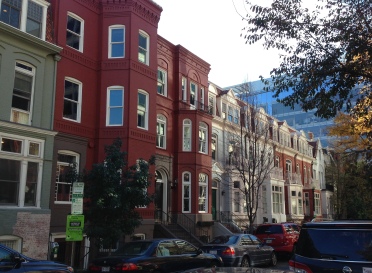
Strolling Kate’s neighborhood.

gle-row-housesThough Kate has lived in Washington, DC for almost eleven years, I’d never spent a night in any of her dwellings before. This time, I stayed five nights with Tom and Kate in their apartment that I was seeing for the first time.
I am a country girl who lives in the suburbs – I’ve never in my life been a city-dweller. When I get the chance to take any kind of walking tour of a city with this much history, I find myself stopping and staring a lot. Just the brick row houses could keep me occupied for hours, if I had hours to spare.

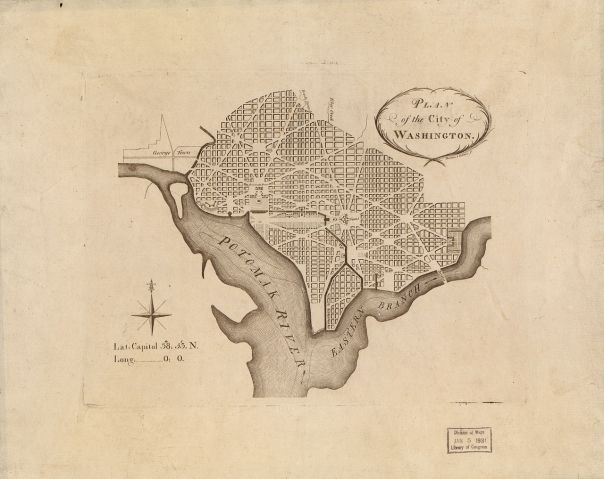
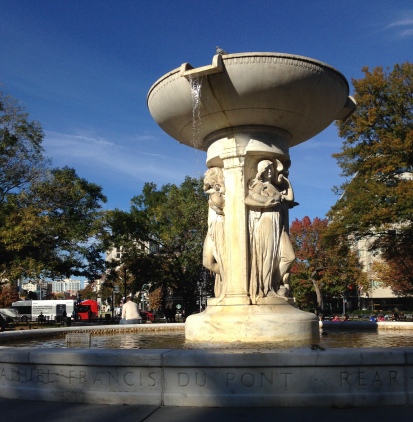
131 neighborhoods are unofficially recognized in our nation’s capital. One of them in the “Old City” is Dupont Circle, arranged around streets that extend like spokes from the traffic circle that was part of the original plan for the city, designed for President George Washington in the 1790’s. This is Tom and Kate’s neighborhood for a few more months; you can see it just west of the center of this map:

dc_neighborhoods_map-lg

Pierre Charles L’Enfant was the architect who laid out the streets of what is now called the “Old City.” Much of the area was not developed until after the Civil War; in 1871 the Army Corps of Engineers began construction of the traffic circle that was then called Pacific Circle. About ten years later Congress renamed it Dupont Circle after Samuel Francis Du Pont, to honor his service in the Civil War. He was the grandson of another Du Pont I heard about a few days later. Here is one of his original drawings:

dc-1280px-lenfant_plan_original-lg-ca-1794

I arrived in D.C. the day after the presidential election. The next morning Kate and I walked through her neighborhood….

gle-dupont-circle

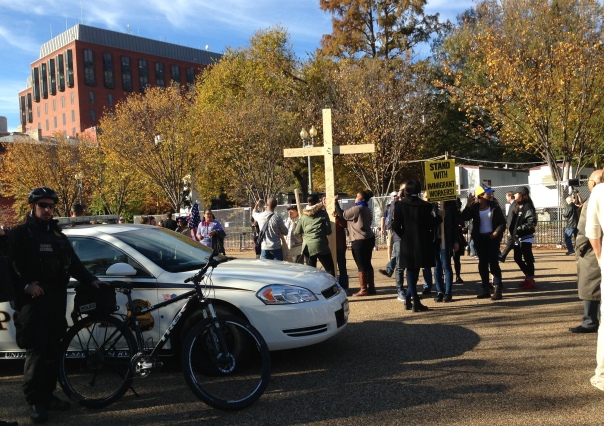
…and on to the White House, where the President-Elect Donald Trump was meeting with President Obama. Some quiet demonstrators were there, too. Lots of construction was going on and we couldn’t get as close as usual.gle-demonstrators

gle-talking-at-the-white-house

This young woman was talking for as long as I would watch, to the boy in the Trump t-shirt. He was listening meekly. I wondered if he ever got a chance to talk, or had anything to say. There at the White House, I didn’t see anything hateful, and I don’t believe in speculating about the thoughts of other people’s hearts.

We spent quite a while touring the Renwick Gallery – so much beautiful artwork, which my pictures don’t do justice to, so I’ll just share one bit of Jennifer Trask’s art; she creates her designs with the antlers, teeth, and bones of many different animals including snakes, water buffalo and camels.

gle-bone-art

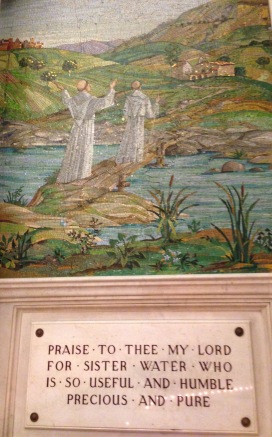
My daughter and her husband have been living the best kind of city life, the kind where you sleep, work and worship all in the same neighborhood. On Sunday we walked a couple of blocks to their church, the Cathedral of St. Mathew the Apostle, where I also had not been before. I was sorry to leave after the service, there were so many beautiful mosaics to gaze upon, and quotes from St. Francis in the side chapel dedicated to him.

img_3728

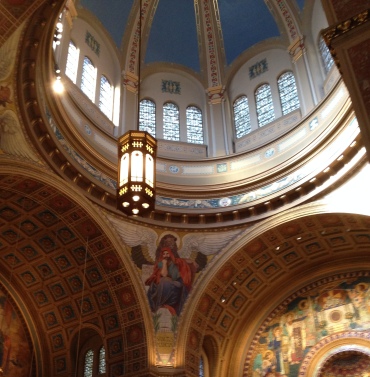
gle-st-mark-and-dome


Because that first photo blocks the face of St. Mark, I will share another, which shows a part of the beautiful dome, and all of St. Mark.


gle-st-francis-water

This quote from the prayers of St. Francis took my thoughts back home, where we really appreciate every drop of moisture that falls on our farms and gardens. Speaking of farms, Kate’s neighborhood boasts a farmer’s market, which we walked through after church, to sample fruit and salsa and pickled jalapeño okra. We bought apples and a jar of the okra.

gle-kate-apples

gle-columbian-embassy

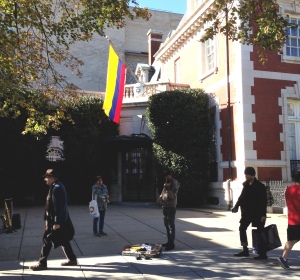
Right next to that market is the Colombian Embassy, and in front of it a fiddler was busking.

A bookstore-café, Kramerbooks & Afterwords, is a popular spot in the Dupont Circle neighborhood. It was the first of this kind of duo to open in the capital. We browsed in there, too, and I even took pictures of books 🙂

gle-voting-dangerously

gle-speaking-american

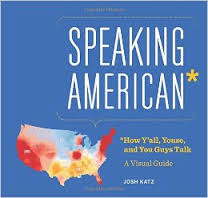
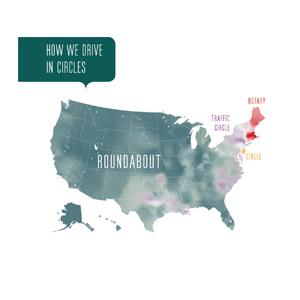
Tom bought a different book that afternoon, Speaking American by Josh Katz, which kept us busy for hours afterward — and afterwords in this case — because it is full of statistics on regional differences in word usage: Do you say sneakers or tennis shoes, sub or hoagie? Maps show where you likely live, if you prefer one word or the other. Tom seemed to be “from” all over the place.

This example from the book shows something I already knew from living in that neighborhood for a few days, that in D.C. they say “traffic circle,” not “roundabout.” But all in all, it’s a pretty inexact science.gle-speaking-american-exampleBeing in the nation’s capital during this particular week meant that I engaged in more political thinking and talk than is usual for me, but as a group we weren’t entirely consumed by the kind of emotions that the media stories seem determined to rouse. We were too busy exploring all the rich cultural, natural and even culinary riches to be had close at hand. Oh, yes, if you don’t mind I will indulge in just one food photo, of some coconut milk panna cotta I had for dessert at a restaurant that actually wasn’t in their neighborhood. We got there via Uber!

gle-panna-cotta

Another reason for our relative calm may be that we have been influenced throughout our lives by the truths and reality exemplified in another quote that I found in the neighborhood, right in Tom and Kate’s living room. The words from the Bible were part of a gift that Kate’s brother made for them the first year they were married, and they do help keep things in perspective.

gle-trip7

In my next post there will be more books, buildings and quotes.
Come back again if you also like this sort of thing!

A good traveler has no fixed plans.

gl11-img_3532crpThe cold mornings hit this week, but the fog always lifts in time for a walk under blue skies. On one of  those days, I was only warm for the hour when I was walking down the path with the sun on my back.
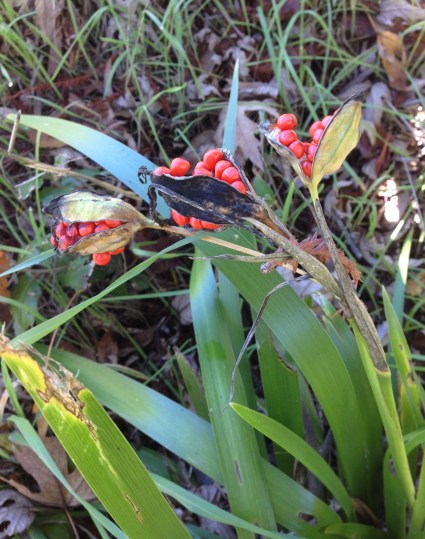
Always something different to see, and why should I be surprised? But I always am! I saw two plants I didn’t know yesterday; maybe one of my readers can help me identify them.img_3566

What seems to be a lily in the seed-forming stage.gl11-img_3567

And a bush with fuzzy seeds.

gl11-img_3557-fuzzy-bush

gl11-img_3559

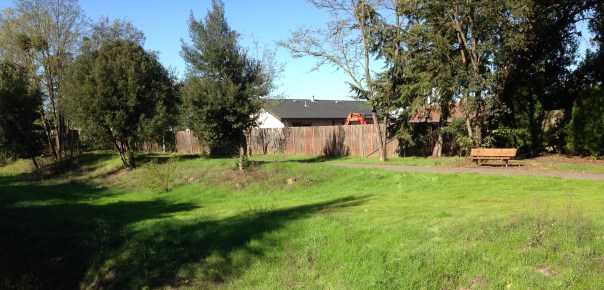
I was so relaxed, I dinked around and took forever to get home (to the house with not enough windows). I even sat on this bench for a while and noticed things. The last time I enjoyed the view from that spot I was with my late husband, almost two years ago. Normally on my walks now, I just walk.

gl11-img_3576

Back in my own yard, blooms hang on to the newly-planted echinacea. This week I set out Iceland poppies, and will soon put up more trellising for the various peas. I’m trying to get things in order here before I leave next week on a trip across the country. There is so much to do I shouldn’t really take the time to compose blog posts, but that strategy seems to work about as well as if I would stop eating for lack of time.

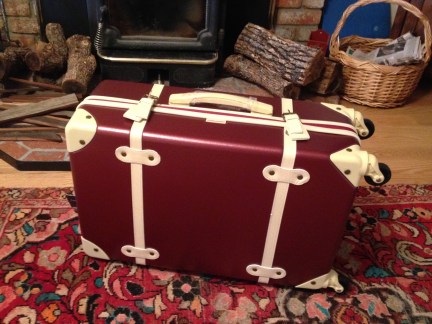
So far I don’t feel anxious about the deadline by which all my preparations must be made, before my departure. Maybe that’s because I still have a few days, and they aren’t packed with other activities to work around. I bought new luggage for this trip, not only practical, but fun. That’s a first-time experience already.  🙂

“Money spent on good-quality gear is always money well spent.”
-Tahir Shah, In Search of King Solomon’s Mines

Before I get on the plane I’ll try to share specifics about this upcoming journey. I read some of my old blog posts yesterday to find out to what degree I’ve already repeated myself in my past travelogues. Often I have a hard time relating to the author of the articles, and I think to myself, “That girl has eaten way too much dark chocolate!” When I am on an expedition farther than my own neighborhood with its familiar insects and flowers, my brain starts playing Beethoven symphonies instead of Chopin nocturnes.

gl11-better-img_3547

Much of the inspiring travel writing out there appeals to the me that once was, in the most energetic and healthy time of life — but when I actually lived in that era and body I was involved in much more thrilling and satisfying work than wandering to and fro among strangers. I was a young wife and mother, and that experience was adventurous to the max, requiring all of my resources and spunk.

People write as though you haven’t really traveled unless you go with no itinerary and no destination, to be surrounded by strangers – whom you would, of course, find to be kind. I do have experience traveling alone among strangers whose language I didn’t know, and they weren’t all careful of my welfare. In the decades since, in the interest of preserving the health and enjoyment of my family, I have focused on thoroughly preparing for journeys. It won’t prevent unexpected events, things “going wrong,” we hope in ultimately harmless ways, and ideally making for good stories to tell. Adventure is a relative concept, I suppose.

I am not averse to meeting new people on my travels, but mostly I hit the road or climb on the plane with the goal of seeing a familiar face at the end of my trip. I have the goal, but don’t hold on to it too tightly. Anything can happen, and long before I take my seat on the airplane I give myself into the care of many people who are capable of goofing up. When I get to my destination I will let my hosts take care of me and determine my schedule.

I can’t travel anywhere that God isn’t.  Maybe that is the main reason why every morning my brain will be excited and my heart will be at peace, and I will feel like an adventurer.

“A good traveler has no fixed plans and is not intent on arriving.”  -Lao Tzu

gl11-fullsizerender

A pheasant disappearing in the brush.

poem-wynken-etcI was a child when poetry was still “taught badly,” according to some people. In fifth grade we had to memorize a poem, choosing from a collection that our teacher had compiled. Before that I remember reading some poems at home, like “Wynken, Blynken, and Nod,” which I came to love. It was in a children’s literature anthology my grandmother had given us.

From the options my teacher presented I chose “The Children’s Hour” by Longfellow. It seems that we had some weeks to learn our poems, and the practicing and reciting of the poet’s metered verse are a very pleasant memory for me. I did enter vicariously into the scene the poem describes, of a father surrounded by his affectionate and beloved daughters. I can still hear the music and feel the happiness even if I can’t remember many of the words past the first line.

Now, when I read about that particular poem on Wikipedia, I find that it serves as an illustration of one aspect of poetry that educators debate about: “More recently, the poem has been called overly-sentimental, as have many of Longfellow’s works. Scholar Richard Ruland, for example, warns that modern readers might find it ‘not only simple and straightforward, but perhaps saccharine and overly emotional,’ though he concludes it is a successful poem. Scholar Matthew Gartner, however, uses the poem as an example of how Longfellow invited his readers into his private home life in New England to refine them and teach them lessons in virtue.”

I have been lightly musing over these questions since reading a recent article by California’s Poet Laureate Dana Gioia, who has for as long as I’ve known him been intensely interested in education, and how to restore among the populace the love for poetry that used to be commonplace.

dana-gioia-with-cat-photo-by-web-824x549In the article “Poetry as Enchantment” the poet discusses the huge changes that have taken place in the world of poetry over the last few generations. I can see how my own experience reflects some of the losses that occurred. After the one poem that I memorized (not counting lyrics of hymns and folk songs) there was to be no more reading aloud in school, or memorization. In high school I know we analyzed some poems, but nothing grabbed me. Despite this, our small rural high school retained vestiges of the past in the form of a literary magazine in which students might publish poems or stories that the student editors selected.

I tried writing some poems, of which I was of course ashamed soon after they were published in the magazine. Maybe the magazine was not actually a leftover from a previous era but a “progressive” thing, packed with material from untaught writers, screened by writers just as unqualified. And likely it was an attempt to hold on to a fuller experience of poetry than we were getting in the classroom. Gioia says that textual criticism and analysis is all well and good and can be very helpful — he does quite a bit of it himself — but that we require an encounter with poetry that engages more than our intellect. We amateurs should not be underestimated as readers of poetry:

Amateurs have not learned to shut off parts of their consciousness to focus on only the appropriate elements of a literary text. They respond to poems in the sloppy fullness of their humanity. Their emotions and memories emerge entangled with half-formed thoughts and physical sensations. As any thinking person can see, such subjectivity is an intellectual mess of the highest order. But aren’t average readers simply approaching poetry more or less the way human beings experience the world itself?

Life is experienced holistically with sensations pouring in through every physical and mental organ of perception. Art exists embodied in physical elements—especially meticulously calibrated aspects of sight and sound—which scholarly explication can illuminate but never fully replace. However conceptually incoherent and subjectively emotional, the amateur response to poetry comes closer to the larger human purposes of the art—which is to awaken, amplify, and refine the sense of being alive—than does critical commentary. The scholarly response may be accurate and insightful. The culture is enriched by specialized discourse about literary texts and traditions. But critical analysis remains deliberately outside the full experience of the poem, which is physical, emotional, subjective, and intuitive as well as intellectual.

poem-fisher-mizzly

Less than ten years out of high school, I was teaching poetry to my children. That was when I fully fell in love with many a good poem. Maybe all the analytical skills my high school and college teachers had tried to teach me came back and helped me appreciate the art, but I think much of the good effect came from starting from the ground up:

-Teaching toddlers the fun of a sing-song nursery rhyme;

-reading A Child’s Garden of Verses to older children so many times that we couldn’t help but learn several by heart (skipping a few that didn’t seem to be teaching “a lesson in virtue,” to use the words of Matthew Gartner above);

-working the copying and memorization and reciting of poems into our homeschool curriculum; reciting/memorizing Frost’s “The Figure in the Doorway” as a family in the car while on a camping trip.

We didn’t try to analyze or figure out hidden meanings, but I think we often intuited deep things. Probably many times we missed the primary intent of the poem, but we still were enriched in our humanity and our connection to the poet, and the world.

“Genuine poetry can communicate before it is understood.”
-T.S. Eliot, as quoted by Dana Gioia

More from the article:

Poetry offers a way of understanding and expressing existence that is fundamentally different from conceptual thought. As Jacques Maritain observed, ‘poetry is not philosophy for the feeble-minded.’ It is a different mode of knowing and communicating the world. There are many truths about existence that we can only express authentically as a song or a story.

Conceptual language, which is the necessary medium of the critic and scholar, primarily addresses the intellect. It is analytical, which is to say, it takes things apart, as the Greek root of the word ana-lyein, to unloosen, suggests. Conceptual discourse abstracts language from the particular to the general.

Poetic language, however, is holistic and experiential. Poetry simultaneously addresses our intellect and our physical senses, our emotions, imagination, intuition, and memory without asking us to divide them. The text may be frozen on the page for easy visual inspection and analysis, but the poetic experience itself is temporal, individual, and mostly invisible. As Wallace Stevens wrote, ‘Poetry is a pheasant disappearing in the brush.’

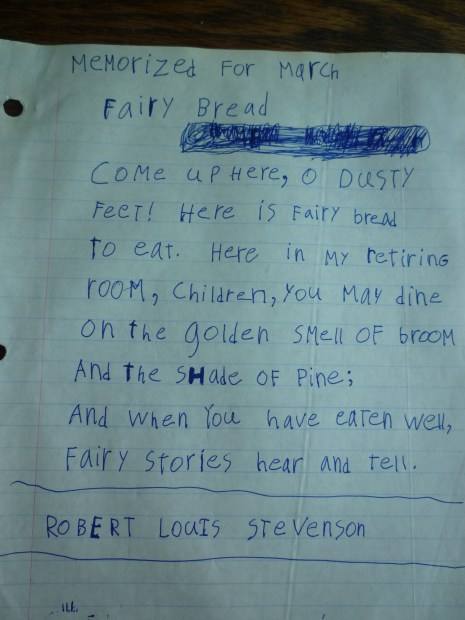
poemstevenson-fairy-bread

In the passion of 20-yr-old pride I tossed out my copies of the high school magazine, but I can remember the first line of one verse I wrote: “Must we tear apart the thing, and analyze and criticize?” Even then I had no leanings toward being a literary scholar. But I am still in the process of getting a literary education.

“The purpose of literary education is not to produce more professors;
its goal is to develop capable and complete human beings.”
-Dana Gioia

Against much resistance, when he was chairman of the National Endowment for the Arts, Gioia managed to implement a program he designed to restore some of the practices that encouraged a love of poetry in bygone years. Many of you are probably familiar with Poetry Out Loud, but I only learned about it in this article. High school students are having fun learning poems and reciting them in competitions, and this has been going on for ten years now! I’m hoping to attend the recitations in my area this coming January. It will do my heart good.

Get the fuller story of Gioia’s thesis and suggestions, and of the Poetry Out Loud events, by reading the entire article here.