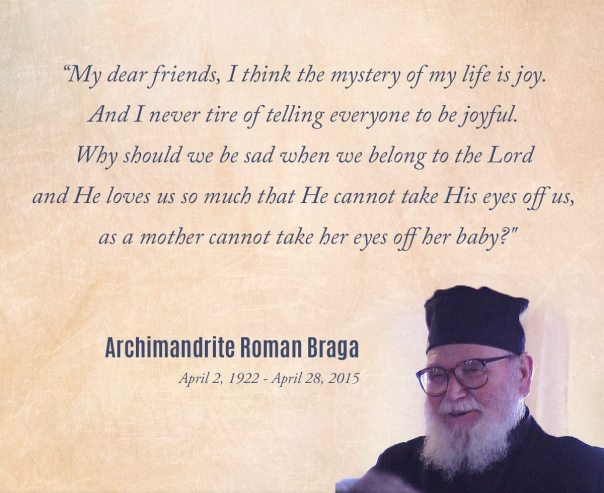
from the Orthodox Christian Network
And this about Fr. Roman from the Touchstone newsletter:
Prisoner of the Redeemer
Early this morning, about a four-hour drive east of Chicago’s Holy Name Cathedral, a new and much smaller church in the Michigan countryside sheltered the body of a recently departed priest-monk of the Orthodox Church, Fr. Roman Braga. His funeral was scheduled to begin at 9:30 AM.
While Fr. Roman held no office as elevated as the Archbishop of Chicago, it would not surprise me if in some ways he influenced nearly as many people over the years through his counsel, prayers, and service to the church–to all who spoke with him.
Fr. Roman moved to Michigan from Brazil the same year I moved from Michigan to Chicago (1972). Twenty-five years later, on October 7, 1997, I met him for the first time at Holy Dormition Orthodox Monastery in Michigan. I was privileged to have a several conversations with him over the years, including an interview published in Salvo Magazine (Solitary Refinement: How One Man Found Freedom Inside a Communist Prison. A former high school teacher, he *loved* Salvo and young people.) His counsel helped me in many ways.
Fr. Roman was expelled from his native Romania in 1968, where he had served as a priest of the Romanian Orthodox Church. He had spent 5 years in a labor camp digging the Black Sea Canal, and later served 6 years of a new 18-year sentence, including time in solitary confinement, before being released under a general amnesty in 1964. He began his priestly ministry, watched carefully by the secret police, who came one night in 1968 with a Brazilian passport in hand and expelled him.
Fr. Roman said he discovered Jesus Christ more deeply in the depths of his being in prison, especially in solitary confinement, where he came to experience true spiritual freedom. He spoke of prison with nostalgia.
The New Testament has many scenes in prison: John and Peter, then Peter, Paul and Silas, then Paul. How many of Paul’s epistles were written from prison?
Didn’t the new church of God began in a prison (phulake), with the first sermon preached (ekeruxen) to its prisoners by Pilate’s former Prisoner (1 Peter 3:19)? Here the “gates of hell” did not prevail against Christ and his new church as he burst those gates and led the captives free.
I could sense from the way Fr. Roman prayed and chanted the “Akathist Hymn to Jesus Christ” on Sundays before Divine Liturgy that I was witnessing a loving communion between the Lord and his servant. One stanza is an icon of his faith:
Jesus, true God.
Jesus, Son of David.
Jesus, glorious King.
Jesus, innocent Lamb.
Jesus, Shepherd most marvellous.
Jesus, Protector of mine infancy.
Jesus, Guide of my youth.
Jesus, Boast of mine old age.
Jesus, my Hope at death.
Jesus, my Life after death.
Jesus, my Comfort at Your judgment.
Jesus, my Desire, let me not then be ashamed.
He also praised Jesus Christ, “Redeemer of those below” and “Vanquisher of the nethermost powers.” Fr. Roman was singing a song to his Paschal Liberator. I will always think of him with a captivating twinkle in his eye, revealing an inner joy forged in the crucible of prison. He was, with St. Paul, a “prisoner of the Lord” and true servant.
Father Roman, I trust, beholds the face of his Beloved Savior in the mansions of the righteous. Christ is risen! Memory eternal!
Yours for Christ, Creed & Culture,
James M. Kushiner
Executive Director, The Fellowship of St. James
 Father Alexis Trader in another article on grief, excerpted and linked below, discusses not just the memories we hold of those who are departed, but the love that binds us to them even after our former connection is gone forever. Notice that it is not the loved one who is gone forever, but the nature of the relationship.
 “We call wild flowers common because of their quantity. But this is just where we strike the great difference between the productions of Nature and the productions of Man. When we produce many samples of the same thing they are of poor quality and we speak of them as mass-produced. The mass productions of Nature do not fail at all in terms of quality. Take the bluebell. There indeed is quantity. Yet every single year we are freshly struck by their quality. Only a flower-snob could fail to see that any one of these bells on the uplifted belfry is as delicate a construction as any tulip or any rose. I will not say more beautiful, or less, for in this realm of flowers we actually are in the presence of abundant examples of — perfection. I think that perfection is the key to the emotion that flowers cause in us. When a thing is perfect the problem of its existence is solved. Gazing at flowers in a wood an unexpected signal seems to go up; we feel a movement of happiness and hope about everything, there is a suggestion that all is really well, all is right with the world….”
