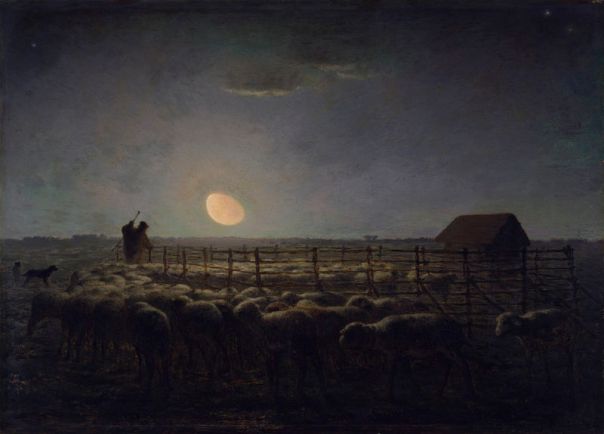
Anthony Esolen reflects on the significance of Catholics dropping the word “man” from the Ash Wednesday service:
A little consideration shows that there is no substitute in English for man. None of the alternatives do the necessary work. Human being is singular and somewhat personal, but it is not a universal term; we do not conceive of the fall of human being. Humanity is abstract and impersonal, and names a quality rather than a being. People is plural, and not necessarily universal; I am not people, and the sin of people might mean the sin of John and Mary and Agnes and Bill, but not the sin of all people considered as one. Mankind is a universal, but not personal. The priest could never say, “Remember, mankind, that thou art dust,” because he would then seem to be speaking not to the penitent, but to a vast generality. Men and women is not universal—it excludes children!—and introduces an irrelevant distinction of sex. Person is singular but not universal, and is in any case not limited to man; angels, too, have personal being, as do the Persons of the Holy Trinity.
…why should we not have a word that corresponds to our mysterious sense that each one of us carries the burden of all, and that the good of all is oriented towards the good of each?
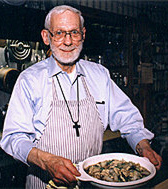
Since my first reading of Leon Kass on the subject of dinner parties, I’ve wanted to share my excitement via my blog, and also to use this enthusiasm to try to host the sort of event he writes about toward the end of The Hungry Soul: Eating and the Perfecting of our Nature. That was many years ago, and since then I’ve read a similarly inspiring chapter in Supper of the Lamb by Robert Farrar Capon.
Robert F. Capon
But actually giving the kind of convivial feast these men describe is a project requiring scores of preparatory steps, none of which is simple to insert into my schedule, crowded as it already is with many entrenched patterns and habits of socializing, or resting after socializing. Until such time as I had participated at some level in a formal dinner party, all I would be able to do on my blog would be to copy passages from books.
That longstanding situation changed last month when I was surprised and delighted to be part of a dinner for eight, given by my goddaughter Sophia. Her labor of love fulfilled the vision I had been given in the books, such as this from Kass’s introduction to his chapter “From Eating to Dining,” on what can happen when the plans have been laid with care and the guests chosen and seated wisely:
“One could speak about freedom — the ever-increasing emancipation from the bonds of instinct and appetite and the progressive cultivation of self-command. One could speak about beautification — the adornment of self and surroundings, the grace of gesture and movement, the delight in taste and tastefulness. One could speak of friendship and love, beginning with the companionable sharing of bread and moving, through the appreciative sharing of speech, to the meeting and cherishing of souls. One could speak about the cultivation of the mind, beginning in speech liberated by the satisfaction of necessity and moving through playful conversation and wit in the direction of the pursuit of wisdom.”
Both authors emphasize that in praising the glories of formal dinners done right, they are not denigrating all the other more casual arrangements that can be blessed and sanctified by thankfulness and love. When I started to expound on this elevated form to one of my daughters she was quick to defend the value of the more humble sort of hospitality that our family has extended to hundreds of people over the decades, or the meals I have served to my husband and children. I said not to worry, this is something else.
In some ways the simple soup and bread served to one’s own family, or a feast given for those one goes into the highways and byways to find, expresses a more Christlike spirit. The many generous and delicious meals friends have bestowed on me over my life, especially when accompanied by true fellowship, lacked nothing in graciousness and satisfaction. But the formal dinner party brings together at once many elements that add up to a supreme joy in our common humanity, and a taste of that Supper of the Lamb that we will enjoy in the coming Kingdom. The party I attended, given by Sophia, definitely imparted that flavor.
The evening began with the House Blessing itself. In the days and weeks following Theophany it’s the custom in Orthodox churches for the priest to visit the parishioners’ homes with some of the water that has been blessed on the feast day, and to sprinkle it around in every room, as everyone present prays along with him and sings the hymns of Theophany from room to room.
So we had all started out by singing and praying together through the house, and then we came to the table and found our assigned places. I love to go to a party where someone has chosen my place for me, and this, along with the relatively small number of diners, was the first sign to me that it would be a good evening. Capon tells us that “assignment to place by name is the host’s announcement that he cares.”
Capon spends the first pages of his chapter telling us why cocktail parties are so unsatisfying. It may be that many of my readers are like me in rarely having been to a cocktail party, but I well know the feeling of being at other events that follow a model seemingly designed “to frustrate any real meeting of all concerned.” No host has taken you personally into consideration and thought about whom you might like to sit next to. This informal system fails “to provide each person with an assigned and proper place,” which prevents them from forming a company. Not enough care is taken with the guest list, and the guests are left to themselves, making for an impersonal atmosphere.
I know that I often go to parties with a sort of rescuer or missionary mentality, thinking that the best thing I can do is to find someone who looks even more alone or forlorn than I myself feel, and try to be friendly. Capon thinks the whole cocktail party effort is doomed to failure:
“Besides being inhuman, however, the exercise is unmerciful. Too much liquor too fast is only the half of it. What is just as bad is having to wander around like a lost soul while people spill drinks down your back and wipe dips on your front. We are homeless enough, without having to come in out of the cold to nothing better than a warm exile, followed by a cleaner’s bill.”
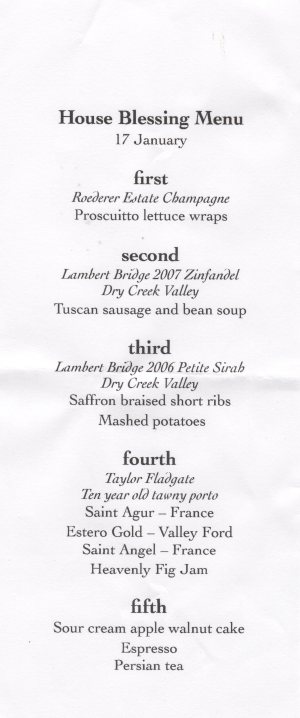
Obviously our own group, assembled by my friend, had the advantage of being a company from the outset. We sat down to find a short printed menu on our plates – short, but promising more than ample feasting – and soon we were drinking champagne and eating the lovely salad, and having lively though sober table conversation.
The bill of fare I have posted above for your enjoyment; our hostess had cooked everything except the bread herself. That mysterious fourth course was cheese, with jam she had made. And she did not have anyone helping her in the kitchen except one of our party who must have given most of his help early on. She made the whole operation look very doable, without appearing at all put out by her labors. On the contrary, she was purely happy to have us.
Capon calls the formal dinner party “a sovereign remedy for the narrowness of our minds and the stinginess of our souls…It is precisely because no one needs soup, fish, meat, salad, cheese, and dessert at one meal that we so badly need to sit down to them from time to time. It was largesse that made us all; we were not created to fast forever. The unnecessary is the taproot of our being and the last key to the door of delight.”
Many of us have experienced a formal dinner party indirectly by reading Jane Austen or watching period movies or “Downton Abbey.” That doesn’t work for me, because we can’t enjoy the best parts of the experience, actually eating the food and having ourselves been cared for by the host. In these storybook events we can’t talk with our own real friends, but must instead participate vicariously in all the dramatic undercurrents of the fiction of which the dinner is a part.
So I’m for the revival of formal dinner parties given in our own homes, and not as a sort of historical reenactment. Each of us will practice this art in his unique way, customizing plans and expectations to accommodate his circumstances and particular ideals, perhaps opting for five courses as Sophia did, instead of the fourteen courses that Miss Manners says used to be common in some mythical time. If you are like me you will be required either to study up for a few years on the subject of wine or to settle for a much simpler offering in that department than what the dinner party pros can accomplish. But I agree with both Kass and Capon that wine is important.
You must choose your guests carefully. Capon reminds us that “To ask a man to break bread with you is to extend friendship, to proclaim in love that you want not his, but him….To invite guests is a courtesy, a courtly act: It confers greatness on all concerned, and therefore must never be done for mean reasons.” I think it is o.k. to have some quieter people in the group (Sophia had invited two little girls who were reserved), but you must have a good number who know how to be convivial without talking too much. And you must think about how you seat them. I read one time that if you have two people who tend to dominate conversation, they may be restrained a bit by being seated side-by-side. That’s just an example of things that a good hostess thinks about. And if a group is larger than eight or ten, it is more likely that multiple conversations will spring up, which might divide the company and dilute the camaraderie.
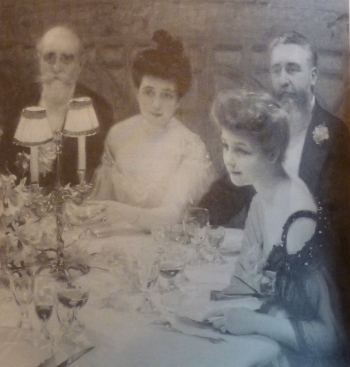
Paul Emile Chabas – “The End of the Table”
Kass writes about the ideal dinner conversation, which “imitates the artfully prepared dinner. There is frequent change of course and topic. Each course in the meal is carefully prepared to look beautiful and to taste good, yet to be different from the rest. Conversation, too, will reflect that variety, yet each ‘course’ will please the palate of the mind. Because our interest is in both the speakers and the speeches, conversation enables us to taste, indeed to savor, the souls of our fellow diners — not their intimate private depths or their polished public personae, but that wonderful side of the soul at play, when it is unselfconsciously and immediately being its open, companionable, and responsive self.”
Along about the dessert course our host Sophia guided our dessert conversation by bringing out some books of poetry and prayers and asking us each to either read something from a book or to offer a story or song of our own, etc. Even the little girls could read, and did surprisingly well with 19th-century poetry. A humorous story was told about a grandpa, one read a Psalm, two of us sang scripture songs — we discovered that my goddaughter and I knew the same one that no one else had ever heard — and Pablo Neruda’s love poems were shared meaningfully. All of those offerings stimulated more conversation that truly did express the “tasty” souls of the guests.
Photos can’t very well express the rich texture of a small dinner party. Most of what you find online are of large wedding receptions or cluttered table decorations, or illustrations mocking these gatherings. I’m glad Leon Kass was able to find a work of art that I think does capture something of the sweetness of sharing such a meal, which is the one by Chabas above; I had to photograph the page in his book to share it here.
It looks as though the diners in that painting may be not only at the end of the table but at the end of their meal as well, and you will be relieved to know that I am at the end of my essay. My readers may wish that they had been spending this long while getting real nourishment for their souls instead of words about it. So I will quickly let Kass finish his paragraph and thought which I introduced at the beginning, because he sums up the highest ideal of the formal dinner party, and also describes the gift we guests received from Sophia that night:
“And one can speak also about piety and reverence, and the human impulse toward transcendence, beginning in awe and fear, and sometimes encouraged by wine, moving through feelings of gratitude and songs of praise in the direction of encountering the divine.”
Bon appétit!
Other posts I’ve written about The Hungry Soul are:
Light, joy, glory… If you don’t know the story of what happened when Jesus was presented in the temple at 40 days old, skip to the bottom of this post and read the account from Luke before going on.
It’s been a few days now since we celebrated the feast of The Meeting of the Lord. It’s interesting that the Orthodox usually know it from the perspective of Simeon and Anna, but it is also called The Presentation of Christ, from the point of view of Jesus’s parents.
As I’ve mentioned more than once, it is one of my favorite feasts (I’ve written about it before), so I was expectant and so glad that I was able to be at Divine Liturgy on what can be an inconvenient day — this year February 2nd was a Monday. But I had missed church the day before and was feeling very needy.
We began with Matins, and every element of the service beginning with the refrain, “Let every breath praise the Lord!” seemed to be calculated to straighten up my bent soul. By means of the most aromatic incense, the chandeliers swinging, the Six Psalms, and many more gifts known and unknown, many kinks in the conduit were at least temporarily untwisted so I could receive the light and the joy.
I got the usual goosebumps when the gospel for this feast was read. Oh, dear Simeon! What must it have been like for you to hold The Christ in your old arms?… knowing not just as information but in your very heart and flesh that this infant was your own God and Redeemer? To help us meditate on this, the words of a hymn ascribe to Christ the words, “I am not held by the Elder; it is I Who hold him, for he asks Me for forgiveness.”
That hymn was part of yesterday’s remembrance of Saint Simeon the God-Receiver and also St. Anna the Prophetess. We remember them especially the day following the event in which they figured. But it’s still not time to leave the nourishment of this feast behind: The Leavetaking of The Meeting of Our Lord is not until next Monday, and by then we won’t be too sad to say good-bye because we will be well into the pre-Lent period, the Sunday of the Prodigal Son being the day before.
In the Church calendar we have these layers of history and sacrament and celebration constantly orienting us to the deepest realities of life. The light and truth that we draw from the lives of the saints and from the events of our salvation history are not random ideas in our individual heads, but are shared experience with the whole Church family as we worship together by means of all the graces and sacraments pertaining to each season.
St. Nikolai on this day encourages us to contemplate joy, and his homily elaborates: “Just as the bleak forest clothes itself in greenery and flowers through the breath of spring, so every man – regardless of how arid and darkened he is by sin – becomes fresh and youthful from the nearness of Christ. For the nearness of Christ is like the closeness of some life-giving and fragrant balsam that restores health, increases life, and gives fragrance to the soul, to the thoughts and to the words of man.”
I came home from church with a candle from among the stack that had been blessed, as this feast is also Candlemas. Candlelight is reminding me to hold on to the joy that has been given to me, and to be renewed in it every morning. Let every breath praise the Lord!
21 And when eight days were accomplished for the circumcising of the child, his name was called Jesus, which was so named of the angel before he was conceived in the womb.
22 And when the days of her purification according to the law of Moses were accomplished, they brought him to Jerusalem, to present him to the Lord;
23 (As it is written in the law of the Lord, Every male that openeth the womb shall be called holy to the Lord;)
24 And to offer a sacrifice according to that which is said in the law of the Lord, A pair of turtledoves, or two young pigeons.
25 And, behold, there was a man in Jerusalem, whose name was Simeon; and the same man was just and devout, waiting for the consolation of Israel: and the Holy Ghost was upon him.
26 And it was revealed unto him by the Holy Ghost, that he should not see death, before he had seen the Lord’s Christ.
27 And he came by the Spirit into the temple: and when the parents brought in the child Jesus, to do for him after the custom of the law,
28 Then took he him up in his arms, and blessed God, and said,
29 Lord, now lettest thou thy servant depart in peace, according to thy word:
30 For mine eyes have seen thy salvation,
31 Which thou hast prepared before the face of all people;
32 A light to lighten the Gentiles, and the glory of thy people Israel.
I am becoming friendlier with the moon. Our growing relationship is the result of my being prodded by things I read on three different blogs in the last year. Hanging Out the Wash by Adair Lara (recommended by Kim) was the final push that brought it all together, with one simple line in a book full of simple, obvious but needed suggestions as to how to “find more in less” and to “come home to ourselves.” The tip: “Start reading the weather page.” People debate about whether the phases of the moon affect weather patterns, but that is not really why that advice motivated me. It’s just that the moon and its changes are part of my everyday physical environment just as the weather is.
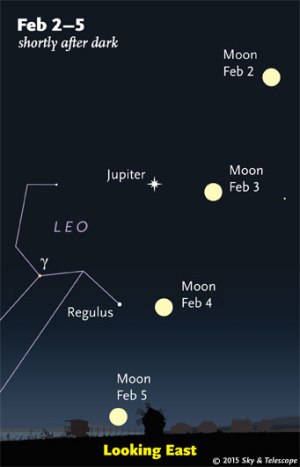
Jody told us about the astronomy site Sky & Telescope on which you can learn what is going on in the sky week by week. I found the lovely painting at the bottom of this page on that expansive website. At left is an example of one of this week’s graphics.
Jody has all around her on the prairie some wide-open spaces without the intrusion of street or city lights, and I can tell from reading her blog that she has made good use of her opportunities.
I don’t think that my urban dwelling is an excuse for ignoring the sky, though. I can at least see the moon, when weather permits, and after I found out when the next full moon would occur it changed my whole week; I have been looking forward to this night (Feb. 3rd in the Western Hemisphere) when the full moon will occur. It so often happens that Mr. Glad and I will say to one another, “Doesn’t the moon look lovely! Do you think it is full tonight?” And we study and try to know if its shape is perfectly round or not, and we never can decide. But this week is different! As I drove home from Vespers on Saturday there was my friend the Man in the Moon smiling down on me, looking just a little lopsided as was to be expected three days ahead of his fullness.
Sun, Moon and Earth by Robin Heath I read about on a blog and ordered by mail. It is just a beautiful little book that tells us how “Every organism on Earth responds to four major cycles: the solar and the lunar day, the synodic month, and the year. We all dance to these primary rhythms. This book reveals the poetic cosmology….”
But it is a little book with correspondingly small diagrams of the movements of our huge sky. I discovered long ago that when I am forced to write in a small space it pinches my creative mind, and I am now thinking that my poor brain was similarly unable to process the meanings of these pictures — perhaps if the images and diagrams had been about 10x larger … It’s a nice size to take on a camping trip, however!
I will digress here from talking mainly about the moon, to a philosophical consideration of celestial bodies from G.K. Chesterton, who in his book Orthodoxy compares the sun and the moon.
“The one created thing which we cannot look at is the one thing in the light of which we look at everything. Like the sun at noonday, mysticism explains everything else by the blaze of its own victorious invisibility. Detached intellectualism is … all moonshine; for it is light without heat … that transcendentalism by which all men live has primarily much the position of the sun in the sky. We are conscious of it as of a kind of splendid confusion … a blaze and a blur. But the circle of the moon is as clear and unmistakable, as recurrent and inevitable, as the circle of Euclid on a blackboard. For the moon is utterly reasonable; and the moon is the mother of lunatics and has given to them all her name.”
If we want to consider the lack of heat of the moon, here is an image as cold as it might ever appear, above a sunset at the North Pole. It’s one of many downloadable astronomy pictures on this site.
As to Chesterton’s assertions: I could not stop myself from posting that paragraph because of my fondness for thinking about symbols and metaphors, and he is using the physical realities of the sky to show the richness of our life and faith. As a symbol, the moon may be set against the sun, but as physical things they are both welcome parts of our everyday lives. Right now I am considering — and loving — the moon merely as itself, and a better quote for that is:
I see the moon, And the moon sees me. God bless the moon, And God bless me.
There is nothing cold and intellectual about that. It’s a sort of poetic cosmology I can appreciate, in which every bit of the Creation speaks of our common Creator and Father, and is part of our earthly home — even the moon that is above the earth, looking down on us, as it seems.
This picture from the Book House volume Nursery Friends from France that impressed me as a child also evokes the familiarity and even homeyness of the moon for the song, “Au Clair de la Lune.”
Two more places I found to help me learn more about my friend:
Moon Giant tells us the exact time of day when the moon is full for each time zone. On this page I had to learn what Coordinated Universal Time (UTC) is; Wikipedia let me know that it is “one of several closely related successors to Greenwich Mean Time (GMT).”
And the almanac shows the calendar for every day of the month, which I like best of all. The sliver of crescent moon, such as Jody caught in her photo, always enchants me, and on this calendar I can see when it will be in that form.
This possibly older version of the rhyme above expands on the meaning of the moon for us humans:
I see the moon and the moon sees me Down through the leaves of the old oak tree. Please let the light that shines on me Shine on the one I love.
This is the moon we have in common with everyone who’s ever lived on the earth, the way we drink the same water that’s been ever recycled. One time when I commented on having seen the moon my husband teased me, “It’s the same moon that’s always been there.” I began to think about how I share the moon with my great-great-grandparents, with John Muir as he saw it from the mountain peaks, with Galileo and with our Lord as He walked the earth.
 Light, joy, glory… If you don’t know the story of what happened when Jesus was presented in the temple at 40 days old, skip to the bottom of this post and read the account from Luke before going on.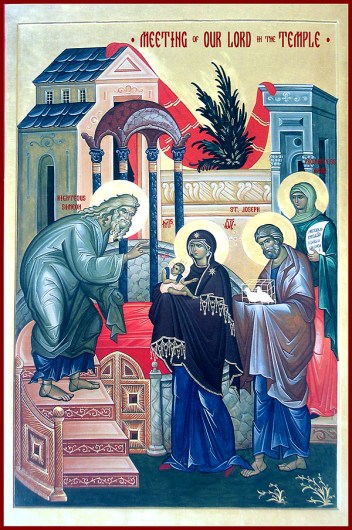
 That hymn was part of yesterday’s remembrance of Saint Simeon the God-Receiver and also St. Anna the Prophetess. We remember them especially the day following the event in which they figured. But it’s still not time to leave the nourishment of this feast behind: The Leavetaking of The Meeting of Our Lord is not until next Monday, and by then we won’t be too sad to say good-bye because we will be well into the pre-Lent period, the Sunday of the Prodigal Son being the day before.
 rn what is going on in the sky week by week. I found the lovely painting at the bottom of this page on that expansive website. At left is an example of one of this week’s graphics.