Category Archives: quotes

My gleanings include rubbish and pies.

I guess I’ve had enough time and thinking power this week to read and ponder, but my activities didn’t result in anything of my own to posit or report, so I’ll just pass on some recent gleanings.

Women Priests?  I love it when a reviewer is bold enough to say “This book is rubbish.” Honesty and confidence! Although, if that’s all she can say, she won’t get a hearing; I want to hear reasons for her belief. I just read this blog post titled “Merlin Stone’s book is rubbish”, and though I had never heard the author’s name before I immediately wanted to read that article.

It’s a brief review of  When God Was a Woman, which the blogger first had to read in seminary years ago. She writes, “There is neither historical nor anthropological support for her thesis that the Hebrews suppressed goddess worship. She tries to prove that the Canaanites had a matriarchial and matrilineal structure. She is wrong on both counts.” Go to the blog Just Genesis to read the supporting details. The writer always has lots of fascinating historical and archeological knowledge to pass on.

Pies, pies, pies... Three women collaborated on a book, which as soon as I read about it I had to have sent as a birthday gift for my granddaughter. It may be a bit early for her, but I like to encourage little girls to start taking a creative role in the kitchen and to look to real grownups for inspiration.

The book is Pieography, written by Jo Packham, Food Styling by Anne Marie Klaske, Photography by Traci Thorson. All of these women have blogs; Jo and Traci feature photos of some pies, but I think you have to get the book if you want the recipes and stories.

I haven’t seen the book yet, but I’ve enjoyed Anne Marie’s blog in particular. The clean and elegant style is nice to surf around in and see snippets of the Klaske Family’s farm life. On Thursdays you can get inspired to bake pies!

Death of the Old Man:  Father Stephen Freeman shared a link to his daughter’s blog, on St. John of the Cross and the loss of identity, or the Dark Night of the Soul, or the “death of the old man.” Actually the subtitle of the post is “The Loss and Discovery of our Identity in God” (italics mine), so it ends on a very positive note, to be sure.

She writes, “If we had always thought of the death of our old man as purely symbolic, it may come as something of a shock to think of real pain being involved. But when our turn inevitably comes to go through pain or tragedy, then we may take comfort in knowing that many have travelled down this path before us.”

Icons and Images:  A book on the history of the use and theology of images in Jewish culture and in the church is the subject of this blog post on Orthodox-Reformed Bridge. Early Christian Attitudes Toward Images is written by Stephen Bigham, and a series of four blog posts is planned to review the book. This structure follows the organization of the book:

The book is divided into four chapters. Chapter 1 deals with the “hostility theory” which holds that the early Christians were hostile toward images. Chapter 2 deals with early Jewish attitudes toward images. Chapter 3 deals with the early Christian attitudes towards images, that is, the pre-Constantinian period. Chapter 4 deals with Eusebius of Caesarea who witnessed the beginning of Constantinian era.

The author is an Orthodox priest, and the blogger Robert Arakaki was Reformed in his theology before converting to Orthodoxy. I’m looking forward to reading all the reviews of what looks to be a thorough treatment of the subject.

Beethoven in Space:  Lastly, here’s a music video featuring Hubble images and beautiful music. A blessed weekend to you all!
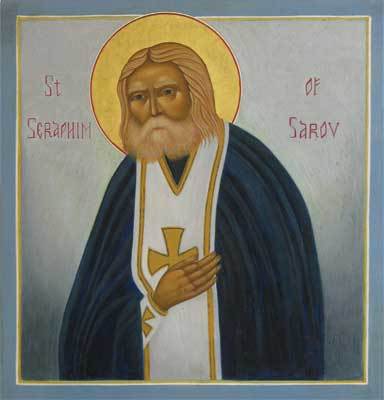

 

St. Seraphim Day

I was sad to have to leave the mountains yesterday and come home so soon. But God knew I needed the major infusion of the Holy Spirit I would get today when we commemorated St. Seraphim of Sarov, patron saint of my church. The example of his life encourages me, and also his words, such as

God is a fire that warms and kindles the heart and inward parts. Hence, if we feel in our hearts the cold which comes from the devil—for the devil is cold—let us call on the Lord. He will come to warm our hearts with perfect love, not only for Him but also for our neighbor, and the cold of him who hates the good will flee before the heat of His countenance.

Rejoice, St. Seraphim, Wonderworker of Sarov!

What the World Needs Now

A recent confluence of thoughts began with hate and destruction, in a blog post from Fr. George:

When we dream about changing the world, we are expressing our own dissatisfaction with it, and thus our rejection and disdain for it. Can you really change something you hate? Not really. What you really want to do is kill it. We want to destroy the world to build one of our own liking.

To love is to accept things as they are, calling the good as good and the bad as bad, and not needing to change them in order to accept them. The truth is you can only change yourself, and even there we have limits because we were all made in certain ways and some things were not made to change.

Fr. George’s exhortation to love and accept “things as they are” brought to mind this poem by Mary Oliver that I have posted in the past:

MESSENGER

My work is loving the world.
Here the sunflowers, there the hummingbird —
equal seekers of sweetness.
Here the quickening yeast; there the blue plums.
Here the clam deep in the speckled sand.

Are my boots old? Is my coat torn?
Am I no longer young, and still not half-perfect? Let me
keep my mind on what matters,
which is my work,

which is mostly standing still and learning to be astonished.
The phoebe, the delphinium.
The sheep in the pasture, and the pasture.
Which is mostly rejoicing, since all ingredients are here,

which is gratitude, to be given a mind and a heart
and these body-clothes,
a mouth with which to give shouts of joy
to the moth and the wren, to the sleepy dug-up clam,
telling them all, over and over, how it is
that we live forever.

When I pay attention, I can hear that a message is always being sent my way, a choice is set before me every day, and on some days it seems to come every few minutes: Will I receive life, and my life, as a gift, or will I fight against what is handed to me, and try to create my own life and self the way I see fit?

I’m familiar with the teaching from wise church fathers that acceptance is a large part of humility. And when I read this passage from Metropolitan Anthony (from “Meditations on a Theme”) it seemed to go right along with these other expressions I’ve gathered here, on what should be my attitude in this life I’ve been made steward over. Met. Anthony credits St. Theophan as the source of his comments about how the earth can teach us:

Just think about what earth is. It lies there in silence, open, defenseless, vulnerable before the face of the sky. From the sky it receives scorching heat, the sun’s rays, rain, and dew. It also receives what we call fertilizer, that is, manure—everything that we throw into it. And what happens? It brings forth fruit. And the more it bears what we emotionally call humiliation and insult, the more fruit it yields.

Thus, humility means opening up to God perfectly, without any defenses against Him, the action of the Holy Spirit, or the positive image of Christ and His teachings. It means being vulnerable to grace, just as in our sinfulness we are sometimes vulnerable to harm from human hands, from a sharp word, a cruel deed, or mockery. It means giving ourselves over, that it be our own desire that God do with us as He wills. It means accepting everything, opening up; and then giving the Holy Spirit room to win us over.

This week I’m getting ready for a trip to the mountains, to My Lake (see posts with the label cabin). I’ll be getting the garden watered, and in the mountains I’ll be seeing lots of earth and its fruiting forests and wildflowers. I will try to take it all as a reminder to open up and give the Holy Spirit room.

Aunt Ida warns against haste in the blood.

Over a year ago I shared here a few excerpts from old letters written from Central and South America by Aunt Ida. I still plan to transcribe them all and share some more stories, but I’m afraid have fallen right down on that job.

This week we’ve been struck by an unusual heat wave. No one has AC here, because it’s so rarely warranted, and my recent experiences of wilting and sweating made me remember this passage from one letter in which she writes home to her sisters about how to cope in the Panamanian climate. I managed to dig it up and offer it here for anyone who may have need of it.

Tues. a.m. Aug. 5, 1919 …I like this country. Talk about the lure of the tropics. It’s got me. You couldn’t pull me away from here. It’s warm but everything is built for it. And it’s always the same so you can get ready for it and stay ready. I sleep with a sheet partly over me every night, and it’s the same at 4 a.m. as at 9 p.m. Everything is built open like a porch and tightly screened and it’s comfortable. All you have to remember is to take it easy and not hurry. “Never hurry” …. A negro sewing woman said one reason why I was so warm was because I had “haste in my blood.” And that is right. If you even “feel” in a hurry, the heat just surges through you. But if you keep calm, you stay cool. This place would never do for Ma. She’d just naturally die. Because she has so much “haste in her blood” and she simply cannot learn to take it easy. You have to learn it or you perish. You know how easy I take things – well if I keep that pace I’m OK but just let me take a spell where I want to straighten up or do the least thing and I’m all “het up.”

May you all keep as cool as possible this summer, in every sense of the word.