Category Archives: quotes

Accustomed to Tepidity

In the West, Lent begins this week with Ash Wednesday. In the Orthodox Church, we don’t begin until March 17 this year! Pascha is May 5th, more than a month after Western Easter. It seems to me this would make it convenient for you who celebrate The Resurrection of Christ the last day of March to visit an Orthodox church near you on May 5th to experience the Feast of Feasts in its glory, in a way you won’t find elsewhere. But I’ll remind you when we get closer to that date.

For now, I want to re-post from almost three years ago a long quote that seems appropriate for Lent, or for any day or hour when needed.

From Father Moses of the Holy Mount of Athos:

An offspring of [the sin of] pride is censure, which is unfortunately also a habit of many Christians, who tend to concern themselves more with others than themselves. This is a phenomenon of our time and of a society that pushes people into a continuous observation of others, and not of the self.

Modern man’s myriad occupations and activities do not want him to ever remain alone to study, to contemplate, to pray, to attain self-awareness, self critique, self-control and to be reminded of death. The so-called Mass Media are incessantly preoccupied with scandal-seeking, persistently and at length, with human passions, with sins, with others’ misdemeanors. These kinds of things provoke, impress, and, even if they do not scandalize, they nevertheless burden the soul and the mind with filth and ugliness and they actually reassure us, by making us believe that “we are better” than those advertised.

Thus, a person becomes accustomed to the mediocrity, the tepidity and the transience of superficial day-to-day life, never comparing himself to saints and heroes. This is how censure prevails in our time – by giving man the impression that he is justly imposing a kind of cleansing, by mud-slinging at others, albeit contaminating himself by generating malice, hatred, hostility, resentfulness, envy and frigidity. Saint Maximos the Confessor in fact states that the one who constantly scrutinizes others’ sins, or judges his brothers based on suspicion only, has not even begun to repent, nor has he begun any research into discovering his own sins.

Thanks to the rector of our parish for posting this passage in the church bulletin.

I’m jumping in with joy.

blessing-creek1

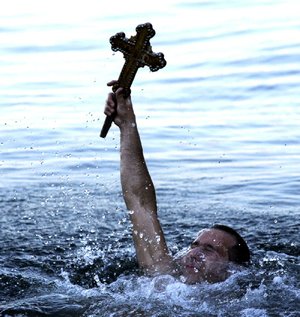
It’s the Feast of Theophany! How can I not post something on this day when there is blessing abounding to the degree that people want to jump into icy waters over it? I am caught between the impulse to spread the riches around, and the awareness of the extreme limitations of my mind when the meaning of Christ’s baptism is set before me. There is a lot to take in and try to absorb at Theophany, regarding the Baptism of Our Lord.

Orthodox Christians celebrate Theophany in various ways around the world. Some release doves as a symbol of the Holy Spirit while others toss crosses into water in remembrance of Christ’s baptism. Young boys or men often dive into the water to retrieve the cross. I know what I’ll do — I’ll post a link to Father Stephen Freeman’s recent blog on the subject. An excerpt:

St. John himself does not seem to understand the purpose of Christ’s Baptism. He is told that “whomever you see the Holy Spirit rest upon and remain” is the Messiah – but he is given little information beyond that. Witnessing Christ’s Baptism and the Spirit resting upon Him, he hears the voice, “This is my beloved Son in whom I am well pleased” (Matthew, Mark and Luke all bear witness to the voice).  The Church later celebrates this manifestation of the Trinity (Christ in the water, the Spirit descending, the Voice of the Father – hence the title “Theophany”).

But with the text alone, on its literal level, we are left with a mystery, without context or meaning. The Tradition of the Church, however, sees the Baptism of Christ in the context of Pascha (Easter) as it sees everything in the context of Christ’s Pascha. Christ’s Baptism is a foreshadowing (and on more than a literary level) of His crucifixion and descent into Hades (just as our own Baptism is seen by St. Paul as a Baptism into Christ’s “death and resurrection”).

When he goes on to explain that in the workings of God in the world, the literal is not all there is, he quotes Fr. Andrew Louth:

Allegory is a way of entering the ‘margin of silence’ that surrounds the articulate message of the Scriptures, it is a way of glimpsing the living depths of tradition from the perspective of the letter of the Scriptures.

There is so much to think about, even if you aren’t part of the Orthodox Tradition in which we will be participating on the praxis level by blessing urns of water, creeks and lakes and oceans of water. In parishes everywhere priests will be blessing houses as my rector described in our newsletter, so as to bring “the joy of the feast of the manifestation of the Holy Trinity to each and every dwelling. Think of the house blessing as a renewal of God’s grace in your home.”

How could we not be welcoming of that? I won’t be jumping into any frozen streams, I hope ever, but I will certainly have the joy of the feast.

O Christ our God,
 Who hast revealed Thyself,
And enlightened the world,
Glory to Thee.

The earth is full of the Lord’s mercy.

This passage I just happened to read today seems to be just right for contemplating at the beginning of a new year. Its focus is the Lord’s nature and works, but it includes instruction to us humans, too. The second line makes me think how all of our art and culture ought to be to His glory, and done to the best of our ability, demonstrating the best of our humanity made in His image.

Sing to Him a new song;
Sing praises beautifully with a shout.
For the word of the Lord is right,
And all His works are done in faithfulness.
He loves mercy and judgment;
The earth is full of the Lord’s mercy.

Psalm 32: 3-5 (Septuagint)

Lord, fill us with Your Holy Spirit this year so that we would be in unity with that mercy that your earth is full of, and may our lives be a beautiful praise song to You.

Athanasius – All the disciples despise death.

On this Sunday in the Orthodox Church we remember the Holy Forefathers, the faithful ancestors of Christ, many of whom are named in a long list in the services yesterday and today, men and women like David, Jael, Daniel, Rachel, Moses and Ruth….

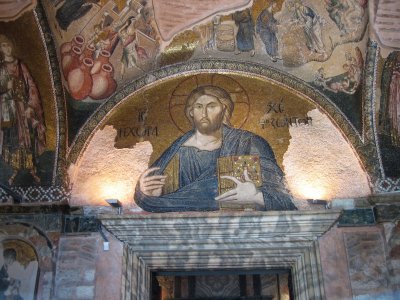
“The Land of the Living” – Chora

And the hymns sing of how they all, long since passed from this earthly existence, are even now “in the Land of the Living.” Thomas Hopko in The Winter Pascha mentions a church near Constantinople where a huge mosaic of Christ is named: “The Land of the Living.” I found a photo of it (above).

I learned in the short account of the life of Athanasius at the beginning of his On the Incarnation that the last and worst persecution of Christians ended in Egypt in 311 A.D., when Athanasius was about fourteen. From the age of five he had lived with the constant threat of death, and with the ever-present reality of persecution of his friends and family. The behavior of the ungodly is irrational and inhuman, and tends to cause great pain and suffering, often unto death, not only of the innocent but also of the most Christ-like. As an adult the scenes and events of his childhood seem to be fresh in his mind when he writes:

“A very strong proof of this destruction of death and its conquest by the cross is supplied by the present fact, namely this. All the disciples of Christ despise death; they take the offensive against it and instead of fearing it, by the sign of the cross and by faith in Christ trample on it as on something dead. Before the divine sojourn of the Saviour, even the holiest of men were afraid of death, and mourned the dead as those who perish. But now that the Saviour has raised his body, death is no longer terrible, but all those who believe in Christ tread it underfoot as nothing, knowing full well that when they die they do not perish, but live indeed, and become incorruptible through the resurrection. But that devil who of old wickedly exulted in death, now that the pains of death are loosed, he alone it is who remains truly dead.”

I started composing this post about death and the saint’s childhood before the horrific murders at a Connecticut school last week. I found the description Athanasius gives, of people bravely and even joyfully facing death daily, foreign to my 21st-century suburban self. But the topic turns out to be pertinent, and the recent stories of gutsy teachers in our own country inspiring — especially when taken with the letter from our Archbishop Tikhon after that event:

“Concerning those who have fallen asleep, Saint Paul exhorts us not to “grieve even as others who have no hope” [1 Thessalonians 4:13]. And yet, herein he does not forbid us from grieving. Now is the time for us to weep, but we must weep with the firm hope that comes from our faith in our Lord Jesus Christ. “Shed tears, but remain calm; weep modestly, and with fear of God,” writes Saint John Chrysostom. And following this example, each of us must strive to transform our sorrow into prayer.

Just this week I was asked to tell one of my favorite Bible verses, one that readily comes to mind without effort. It is always this one, that speaks of our complete dependence on the Lord as our LIFE, whether living or dying. Our leaves will not wither, because Christ Himself is The Land of the Living.

But I am like a green olive tree
in the house of God:
I trust in the mercy of God
for ever and ever.
Psalm 52:8